Harness tax benefits: strategic ETF investing with TFSA and RRSP
Tax efficiency is a cornerstone of savvy investing in Canada. In this comprehensive guide, we'll learn how to strategically position your investments with Tax-Free Savings Accounts (TFSA) and Registered Retirement Savings Plans (RRSP) for tax benefits and navigate the optimal ETF choices for these advantageous accounts.
How taxes impact ETF returns
Although most investors prioritize expenses when selecting an ETF, tax efficiency is often an afterthought. In fact, it's worth noting that taxes can have a much greater impact on investment performance than transaction fees.
According to Morningstar reports, tax drag can significantly diminish investment returns, as shown in the chart below.
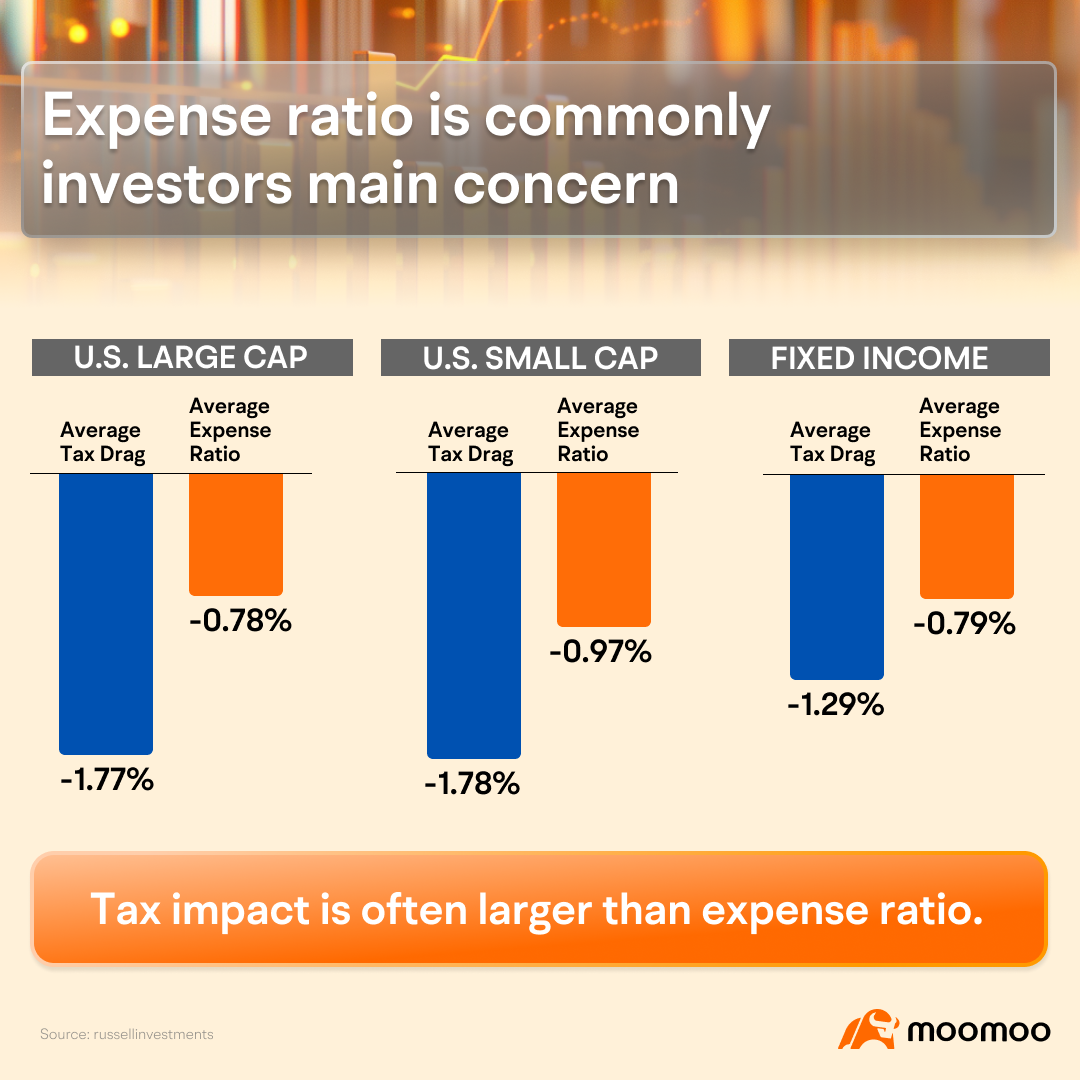
While the analysis targets U.S. investors, the message for Canadians is unequivocal: taxes matter. Tax drag can exceed ETF fees, often significantly. Grasping the tax aspects of ETFs is vital for a solid investment strategy.
How ETF investments are taxed?
ETFs can earn dividends and interest income from the securities they own, and may realize capital gains or losses when investments are sold. After reducing the ETF's expenses, the remaining income or capital gains are distributed to unitholders as distributions, which are taxed at the investor's applicable tax rate.
Tax considerations can generally be divided into two categories:
Distributions paid by the ETF
Realized gains and losses when an ETF is sold
The income from ETFs is typically distributed to unitholders in the same form as it is earned by the ETF. Typically, there are five types of ETF distributions:
Eligible Canadian dividends: This occurs when ETFs invest in shares of Canadian publicly traded companies that pay dividends.
Interest income: This is earned on Treasury bills, commercial paper, bonds, debentures, and mortgages.
Capital gains: This is realized when an investment within the ETF is sold for more than the adjusted cost base.
Foreign income: This is earned when the ETF receives dividends from, or interest on, non-Canadian investments.
Return on Capital (ROC): This describes distributions in excess of an ETF's earnings (income, dividends, and capital gains). For tax purposes, ROC represents a return of an investor's own invested capital.
In Canada, the tax treatment of ETFs varies depending on whether they're held in a tax-advantaged registered account (like a TFSA, LIRA, or FHSA) or a non-registered account. ETFs in registered accounts grow tax-free, with no tax on withdrawals.
For instance, ETFs in a TFSA are funded with after-tax dollars, and all earnings, including withdrawals, are tax-free, which enhances savings for future goals.
In contrast, for ETFs in non-registered accounts, taxes apply to income earned and capital gains realized. Fixed income and dividend ETF earnings are taxed upon withdrawal, while equity ETF gains are treated as income at withdrawal.
Holding U.S.-listed ETFs: which account is better?
Canadian dividend ETFs typically avoid taxes in registered accounts, but foreign ETFs or Canadian ETFs with foreign holdings can face withholding taxes on dividends. If you're investing in U.S.-listed ETFs, choosing the right account is key.
Keep in mind that many countries tax dividends paid to non-residents, impacting both individuals and funds. It's important to factor in the ETF's composition, its structure, and the type of account you're using, as withholding taxes apply differently across various account types.
Hold U.S.-listed ETFs in an RRSP account
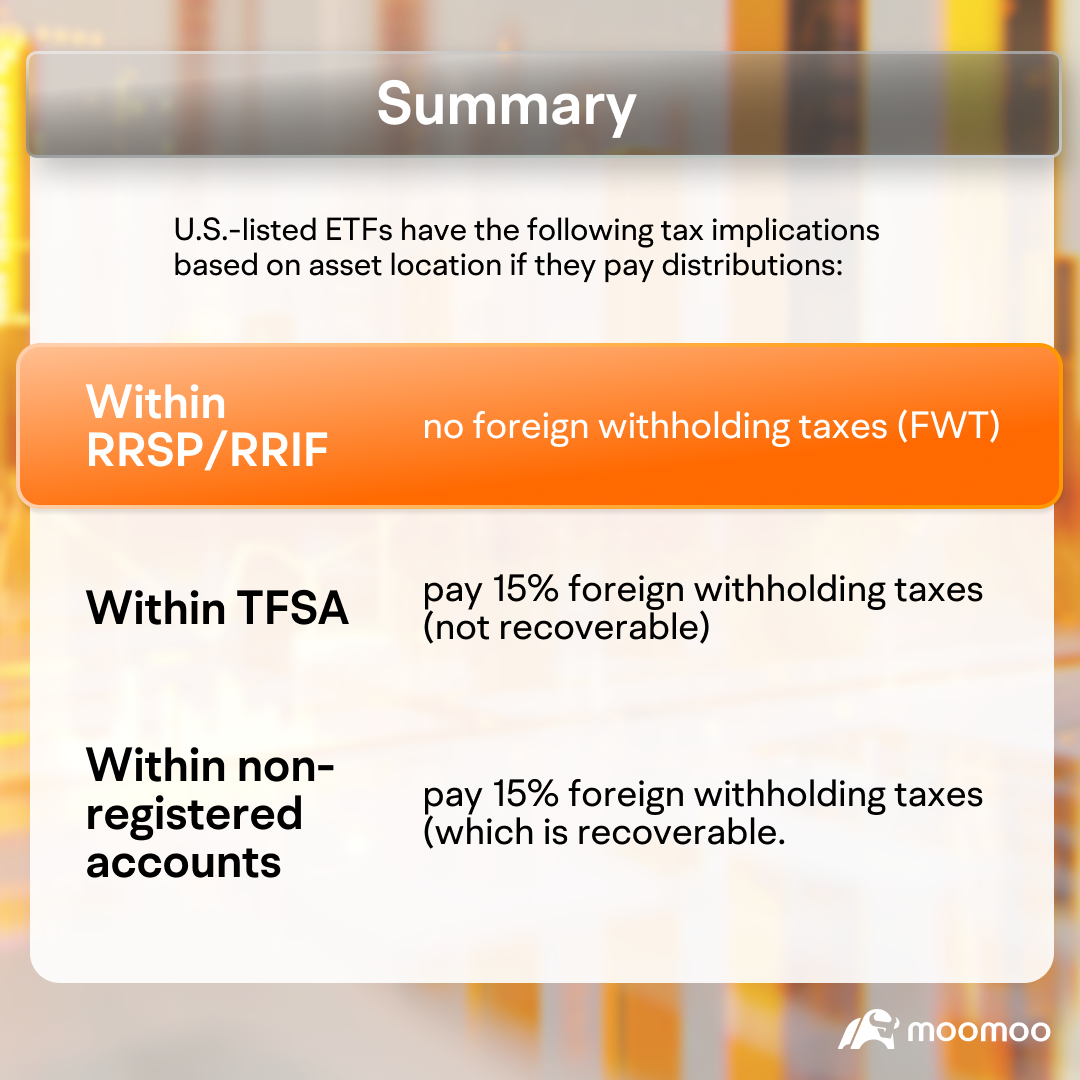
When you invest in U.S. stocks or U.S.-listed ETFs within an RRSP or RRIF, the Canada-U.S. Tax Treaty works in your favor. These types of accounts are exempt from the typical 15% U.S. withholding tax on dividends due to this treaty. As a result, all distributions from U.S. securities in these accounts are not subject to U.S. withholding tax, allowing you to retain the full amount of any dividends paid. This makes an RRSP an advantageous place to hold U.S. stocks or U.S.-listed ETFs.
However, this exemption doesn't extend to Canadian-listed ETFs that hold U.S. stocks or international assets. For these, the foreign withholding tax is deducted before the distributions reach your RRSP/RRIF or TFSA.
Beyond the tax savings, U.S.-listed ETFs often have lower Management Expense Ratios (MERs) compared to their Canadian equivalents.
This cost advantage becomes even more significant for investors with larger portfolios, such as those exceeding $100,000, making U.S.-listed ETFs a potentially superior choice for inclusion in your RRSP or RRIF.
See the table below for detailed examples illustrating these points.:
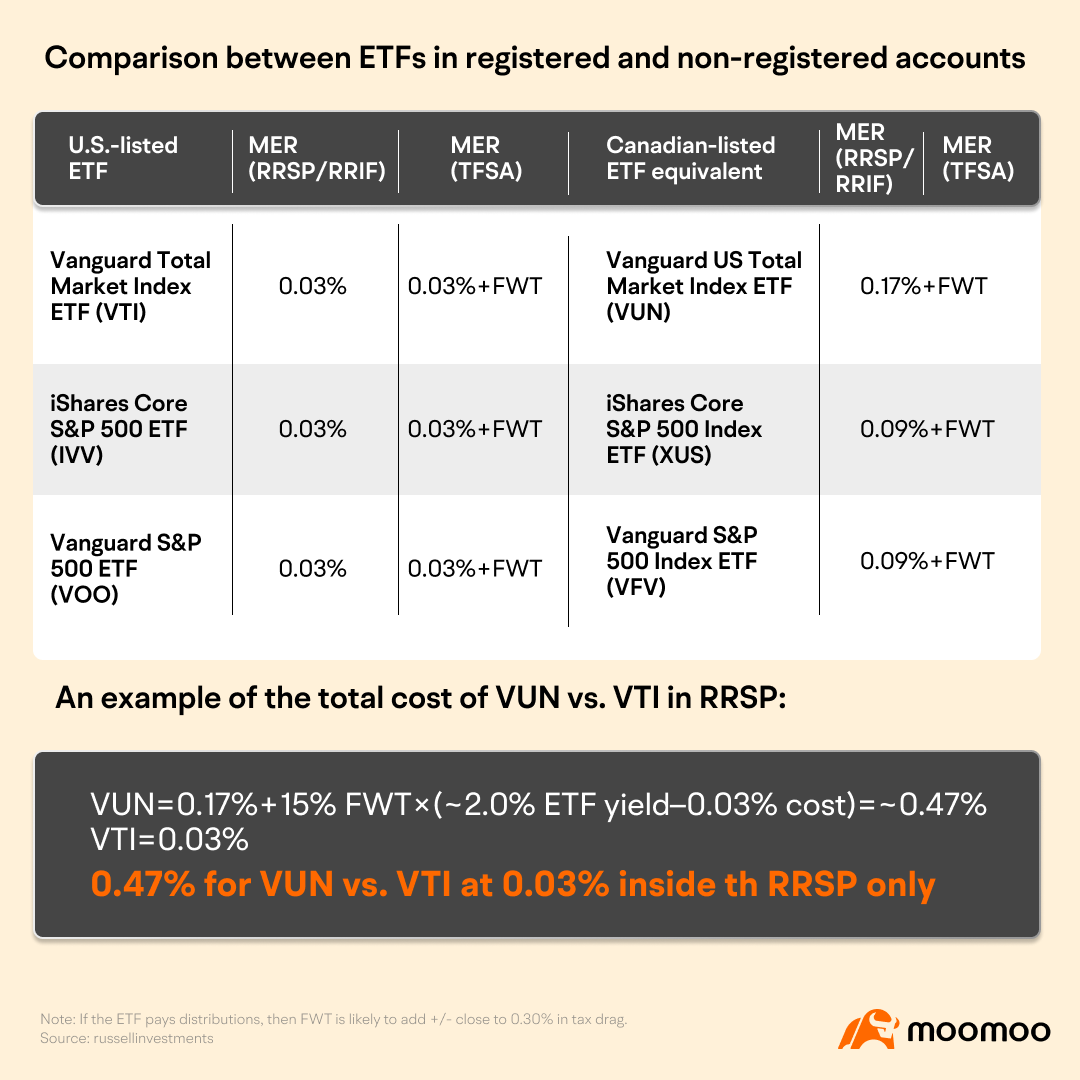
From this example, it can be seen that the cost of purchasing U.S.-listed ETFs in an RRSP account is only 0.03%, lower than the cost of investing in a TFSA account and far lower than the cost of investing in the Canadian-listed ETF equivalent in a registered account.
Not recommended to keep U.S. stocks or ETFs in a TFSA
In a TFSA, you're subject to a 15% FWT on dividends from U.S. securities, and you can't recover this through the foreign income tax credit. This lack of recoverability stems from the fact that the foreign tax credit is only applicable against taxable income, and TFSAs are designed to shield your investments from any tax. Therefore, holding U.S.-listed investments in a TFSA doesn't offer the same tax benefits as Canadian-listed investments.
It is worth noting that owning U.S. stocks or ETFs within a taxable account also incurs a 15% FWT on distributions, but this can be claimed back at year-end using the foreign tax credit when filing taxes.
Recap: Tax efficiency in RRSP vs. TFSA account
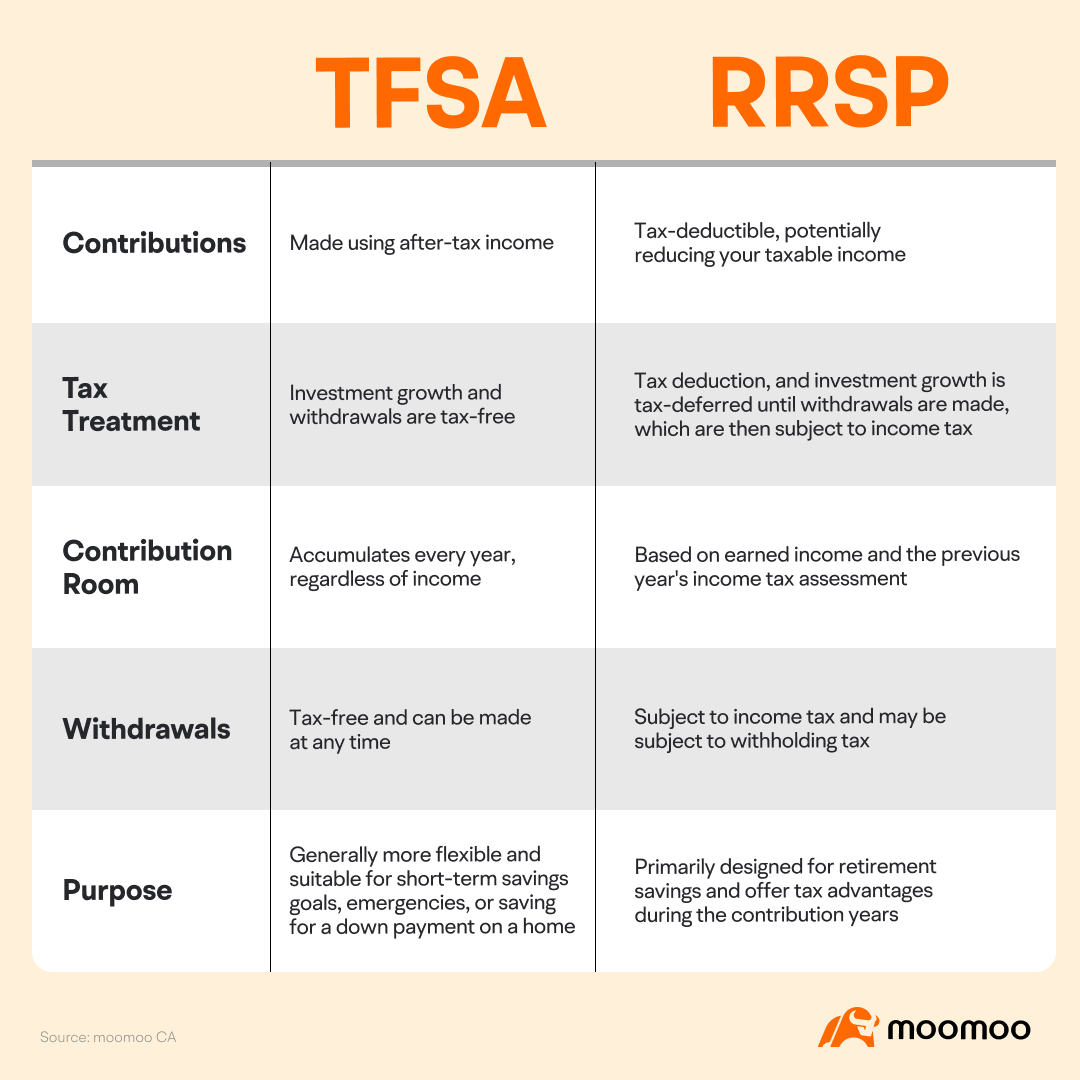
In summary, the IRS recognizes the RRSP as a tax-free account and does not impose taxes on earned dividends. Investors seeking exposure to foreign equities with potential dividend payouts should consider holding them in an RRSP instead of a TFSA or taxable account, as they can avoid the 15% withholding tax on foreign dividends. In contrast, consider holding Canadian-listed ETFs in your TFSA.
How are ETFs taxed in non-registered accounts?
Non-registered accounts come in two types:
A cash account – users invest in securities using their cash.
A margin account – users borrow money to buy securities
In both types of non-registered accounts, investment gains are subject to taxation at your marginal tax rate in the year the gains are realized. This tax applies to all forms of investment income, including interest, dividends, distributions from funds, and capital gains from the sale of assets.
It's important to note that the tax treatment does not vary based on the ETF's origin (Canadian or U.S.-listed) or the method the ETF uses to achieve its investment exposure.
The nature of the income generated within these accounts is an important consideration:
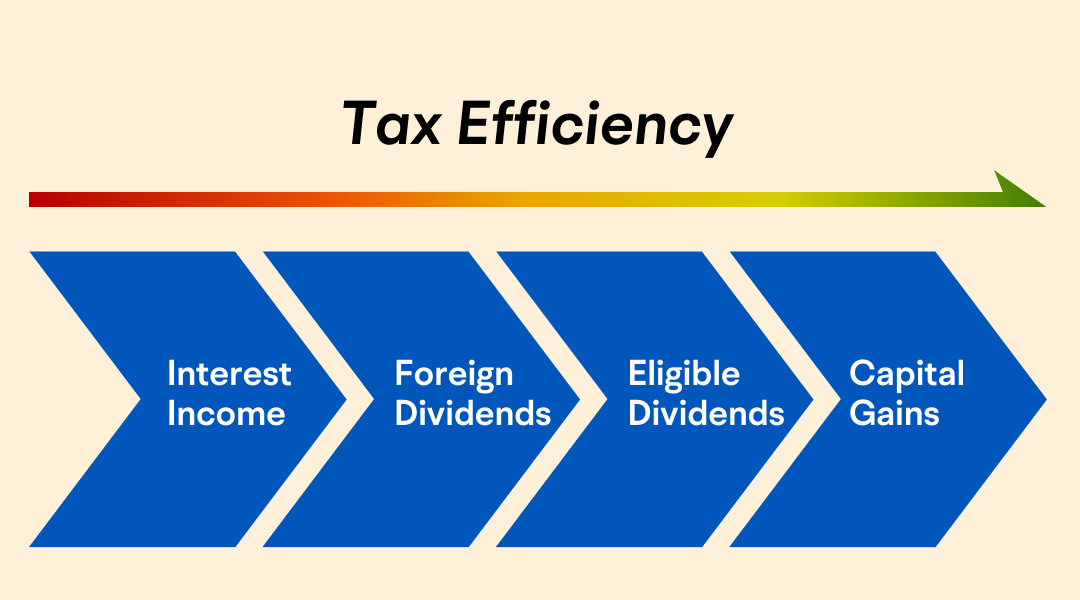
Based on the classification above, bond ETF distributions typically fall into the category of interest income and are taxed at the investor's marginal tax rate, which is often the least favorable. Conversely, a Canadian Dividend Index ETF typically distributes eligible dividends, which benefit from the dividend tax credit and are taxed at lower rates, making them more favorable from a tax perspective.
In general, investors should hold their most tax-efficient investments in non-registered accounts. This would include stocks that are likely to generate the greatest capital gains over time and eligible dividend-paying stocks. On the other hand, the least tax-efficient investments, such as interest-bearing investments, foreign stocks, or non-eligible dividend-paying stocks, should generally be held in registered accounts to defer and potentially reduce the eventual tax bill.
To optimize after-tax returns, it's wise for investors to place their most tax-efficient assets in non-registered accounts. Such assets may include stocks poised for significant capital appreciation and stocks that pay eligible dividends. In contrast, less tax-efficient investments are better suited for registered accounts, including interest-bearing investments, foreign stocks, and assets that produce non-eligible dividends.
Summary: ETF structure and account type matter
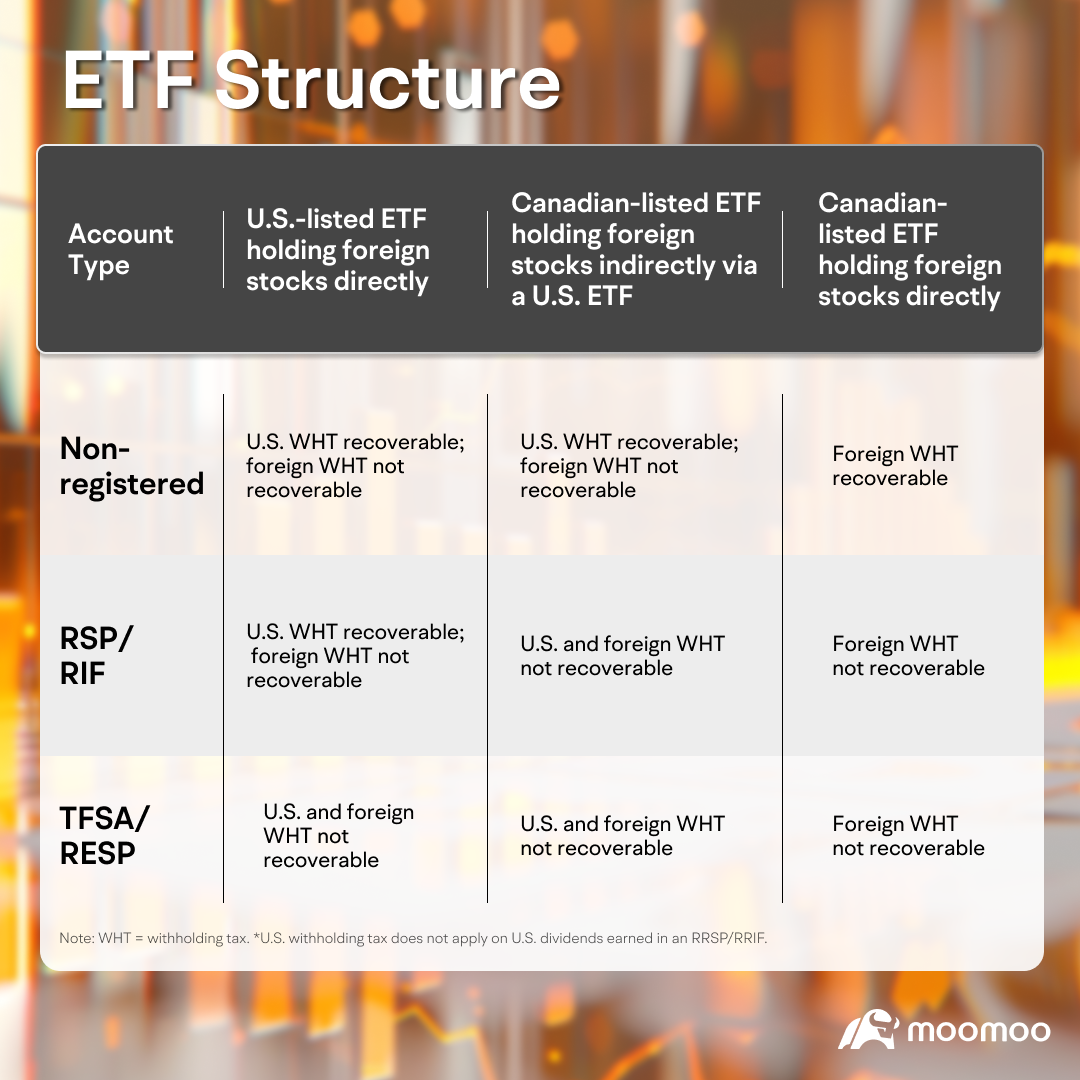
The interplay between the structure of an Exchange-Traded Fund (ETF) and the type of investment account it's held in is a key consideration for investors aiming to minimize the impact of withholding taxes on their returns.
Below is a chart that encapsulates how ETF structures align with different account types to influence the amount of withholding tax applied:
This presentation is for informational and educational use only and is not a recommendation or endorsement of any particular investment or investment strategy. Investment information provided in this content is general in nature, strictly for illustrative purposes, and may not be appropriate for all investors. Read more