Maximizing Your Wealth with ETFs: A Guide for Canadian Investors
Are you considering investing in the stock market but are afraid to choose the wrong stock? ETFs could be the perfect start for your investment portfolio. You can avoid the risk of picking the wrong stock, or the right stock at the wrong time by simply investing in a broader market fund. The best part is you can get started with as little as $100 to invest. In this article, we're going to focus on the definition, advantages, and strategies of ETFs, and answer some of the most common questions of beginner Canadian investors.
What is an Exchange Traded Fund (ETF)?
What types of ETFs are available in Canada?
Why Canadians choose ETFs
How to choose the right ETF?
Top 10 largest Canadian ETFs
Check out the quiz at the end of the article to test your knowledge about ETFs in Canada.
What is an Exchange Traded Fund (ETF)?
An Exchange-Traded Fund (ETF) is a type of investment product that owns and manages an underlying basket of assets (equities, bonds, commodities, derivatives, etc.) and divides the ownership of those assets into individual shares. You can buy one share of an ETF and own many stocks, bonds and other investments.
Typically, ETFs passively track a major market index such as the TSX Composite Index. A passive investment mirrors the performance of its benchmark index and delivers those returns, minus a small fee.
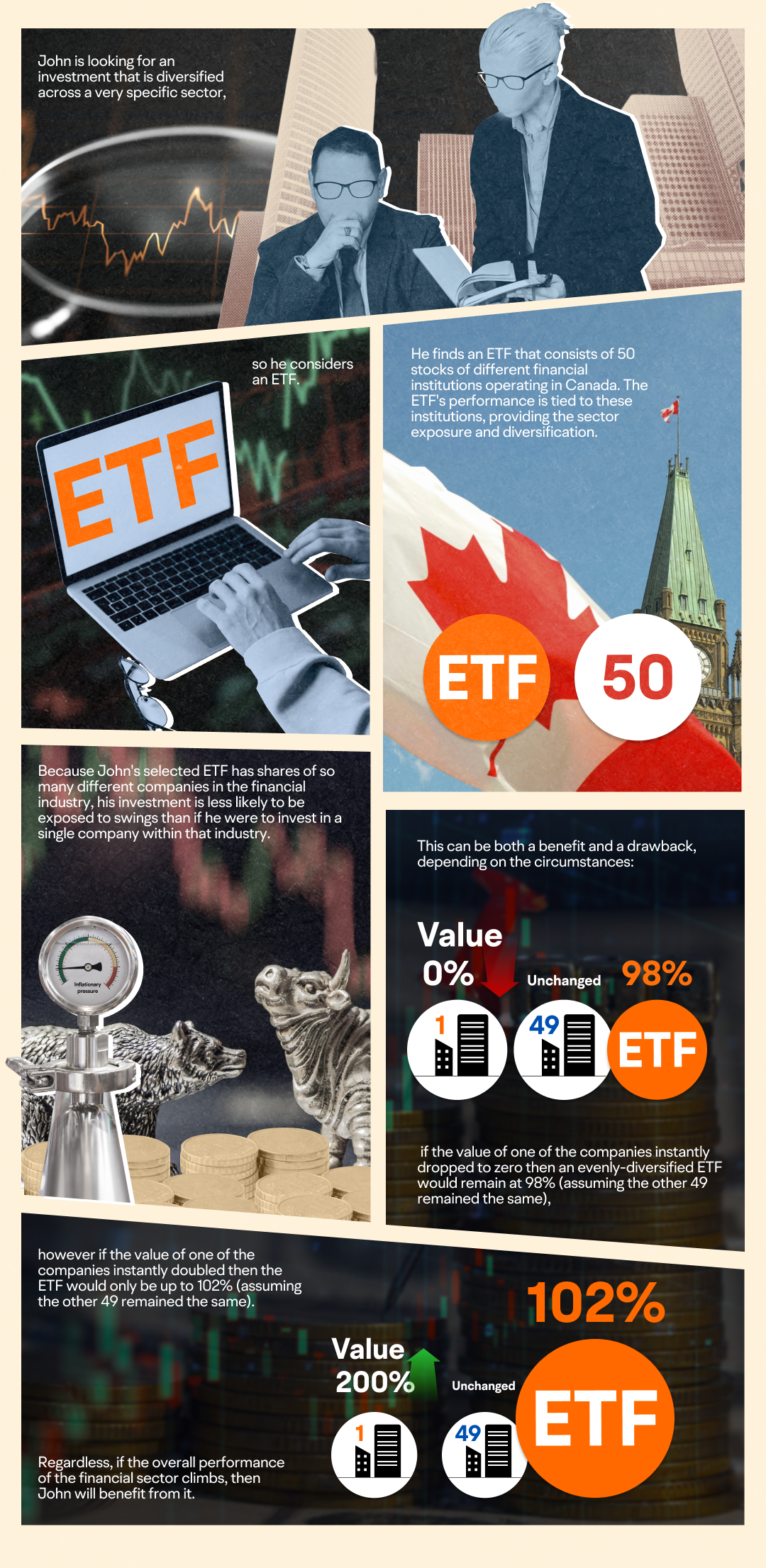
Take a look at this example:
What types of ETFs are available in Canada?
Since ETFs are essentially a basket of financial products, the question remains – What type of ETFs baskets can we choose to invest in?
Here are the major asset classes and investment products included in the biggest ETFs:
Stock Market Tracking ETFs
ETFs tracking stock market indices have garnered the most investment from individual investors. These ETFs are designed to track the performance of a specific index, such as the S&P 500, TSX 60, or more specialized indices. They hold all or a representative sample of the securities in the index, matching the performance as closely as possible.
ETFs are further classified as follows:
Sector-Based: Invest in a particular sector of the economy instead of the entire market. If you believe the healthcare sector will likely benefit from an aging population, consider a healthcare focused ETF.
Theme-Based: Invest in specialized funds that focus on niche trends, industries, meme stocks, new technology such as AI or clean energy. They enable investors to focus capital on a particular idea projected to grow or dominate in the future.
Major financial institutions that offer such ETFs include BlackRock (iShares ETFs), Vanguard, and BMO Global Asset Management, among others.

2. Bond and Fixed Income ETFs
Bond ETFs are among the most popular types of ETFs. Bonds are loans issued by the government or corporations as a way of raising funds without offering up their shares for sale. When you buy a bond, you’re giving the issuer a loan. The issuer repays the loan with interest on the maturity date. Bond ETFs focus on government, municipal, international, or corporate debt.
Many investors prefer holding bond ETFs over directly holding bonds due to their liquidity and ease of buying and selling in small amounts.
3. Commodity ETFs
Commodity ETFs track the prices of a commodity or a related commodity index. Commodity ETFs usually use derivatives like futures contracts to follow the market prices of goods like gold, silver, and wheat instead of directly holding the assets. Derivatives track the underlying price of the commodity, but can be less transparent and carry more risk, such as counterparty risk, than an ETF which owns the underlying asset directly.
4. Currency ETFs
Currency ETFs monitor the value of individual currencies like the Canadian dollar, cryptocurrencies, or groups of currencies in the foreign exchange market. Bitcoin ETFs are publicly traded investment funds that enable investors to gain exposure to bitcoin without actually owning the cryptocurrency. These ETFs are listed on traditional stock exchanges, allowing investors to buy shares in the ETF through conventional brokerage accounts. This eliminates the security risks of dealing directly with cryptocurrency exchanges or creating a digital wallet.
For Canadian investors looking to gain exposure to the US dollar, consider an S&P 500 index ETF, or any other ETF with significant holdings in the U.S. Stock market.
5. Real Estate ETFs
Real estate ETFs invest in the real estate market, in commercial, industrial, or residential properties. They invest in real estate investment trusts (REITs) and other real estate focused companies. REITs directly own and manage real estate, such as apartments, residential houses, hotels, offices, and warehouses. As a trust, REITs are required to distribute out a large portion, usually 90%, of taxable income to shareholders through dividends and may not be subject to corporate taxes.
REITs are a popular investment choice in Canada due to the unique real estate market. A real estate ETF is a great way to broadly invest in the industry without having to worry about the performance of an individual company, or regional property market.
6. Complex ETFs
Complex ETFs are advanced financial instruments with sophisticated strategies, such as the use of derivatives, leverage, or inverse positions, to achieve their investment objectives. These ETFs are tailored for experienced investors seeking non-traditional exposure or speculative opportunities in the market.
These ETF options cater to a wide array of investor preferences, allowing for the construction of diversified portfolios based on investment objectives, risk tolerance, and market outlooks.
Why Canadians choose ETFs
ETFs offer several key advantages for investors, from better cost-efficiency to flexible trading. Here is what you can expect from investing in ETFs in the Canadian market:
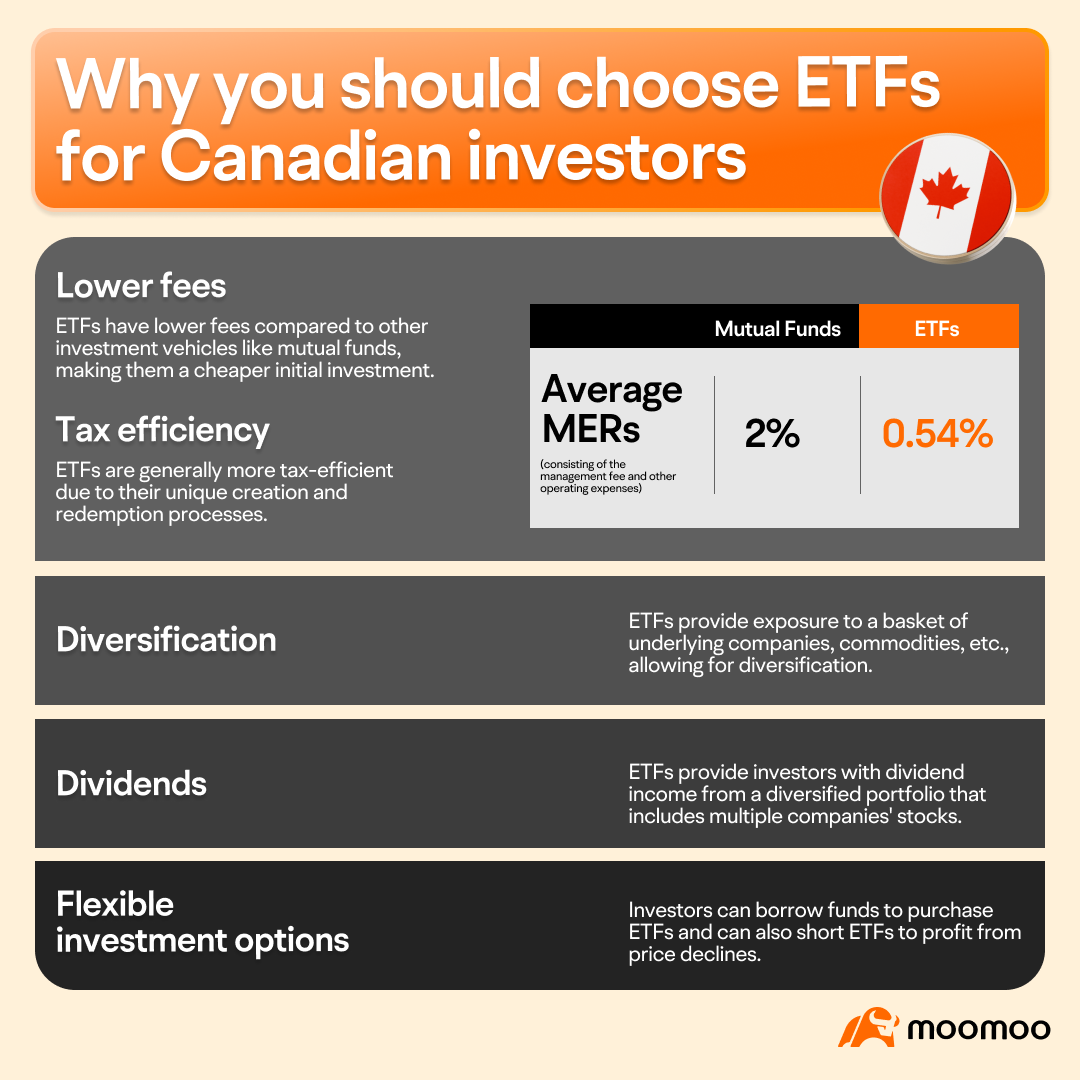
Lower fees & taxes
ETFs strip away the excessive fee layers commonly associated with other investments, like mutual funds. They can be purchased on a stock exchange, by the share, just like a stock. This typically makes them a cheaper initial investment.
ETFs are also praised for tax efficiency. ETFs generally have lower expense ratios compared to index funds and tend to be more tax-efficient due to their unique creation and redemption processes.
2. Diversification
ETFs typically invest in a basket of underlying companies, commodities, etc. So, purchasing an ETF lets you gain exposure to many different companies at once. Start building a diversified portfolio from as little as one share.
3. Dividends
When you choose to invest directly in individual stocks, your dividend income will depend on the performance of those stocks. If an individual stock decides not to issue a dividend this year to conserve cash, you won't receive that passive income. A dividend ETF is a great way to ensure your portfolio always generates a stable passive income you can use for retirement, or reinvestment.
4. Flexible investment options
Investors can borrow funds, also known as buying on margin, to purchase ETFs. This is convenient for people looking to use leverage to their advantage. Investors can also short ETFs, profiting when the ETF declines in price. Buying on margin involves additional risk with the possibility of higher returns.
Younger Canadians choose ETFs as a great way to get started investing with small amounts and benefit from the built-in diversification and ease of purchase. Older Canadians choose ETFs for their stability, steady passive dividend income and tax advantages. ETFs are also a compelling choice for both novice and seasoned investors alike.
Canadian ETFs outperform actively managed funds
You may have heard — Passive funds outperform actively managed funds. While it is often difficult to distinguish stock market chatter and rumors from facts, the reality is that passive funds such as ETFs outperform professional investment managers with actively managed funds.
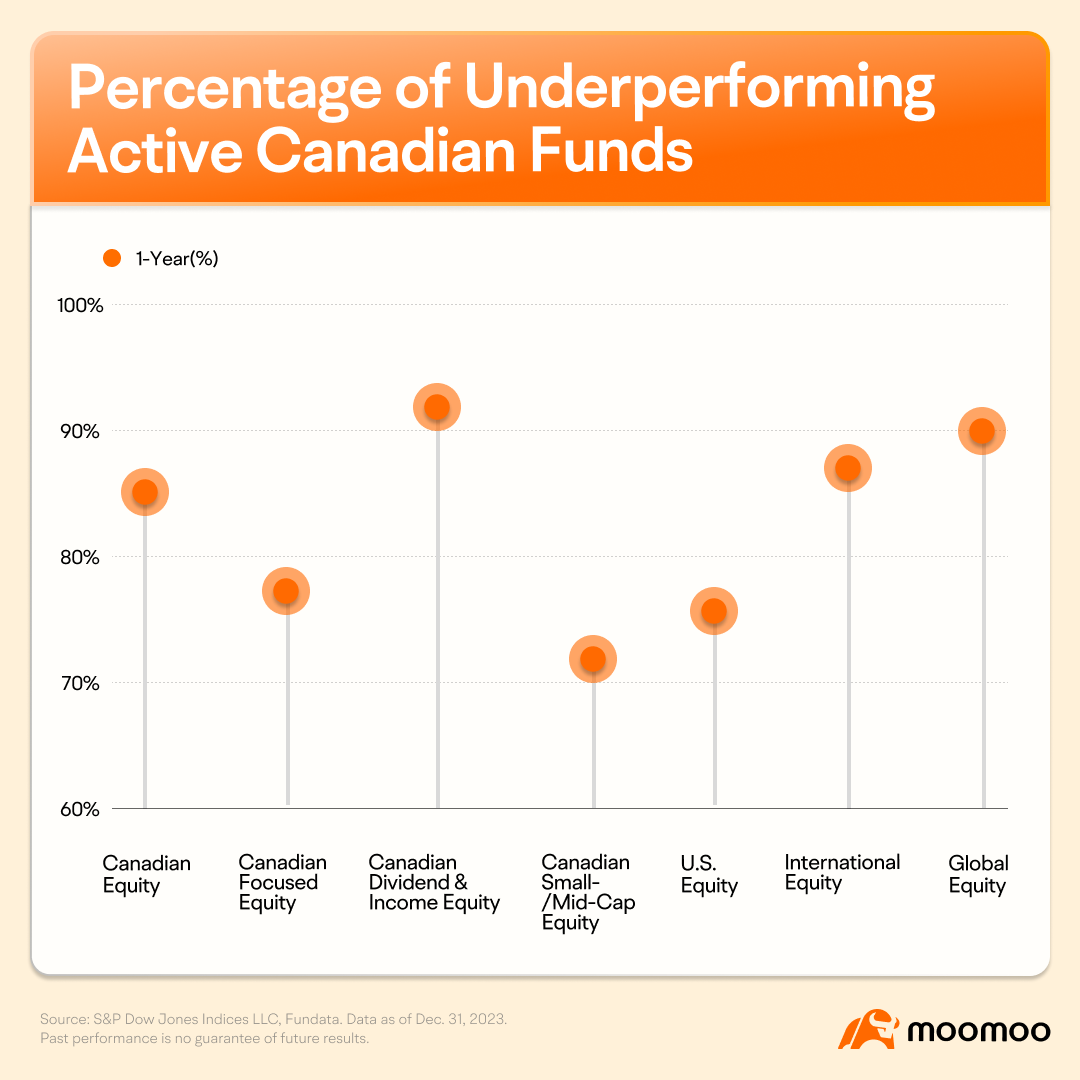
By the end of 2023, we analyzed the performance of various actively managed funds against their benchmarks and discovered that over three-quarters of these funds failed to outperform the indices they track.
For instance, 85% of Canadian equity funds, 77% of Canadian focused equity funds, and 94% of dividend & income equity funds did not beat their benchmarks in the past year. Passive ETFs track the performance more closely by not trying to beat the benchmark market or sector. Instead, they focus on mirroring it while minimizing fees and taxes.
What is a benchmark index?
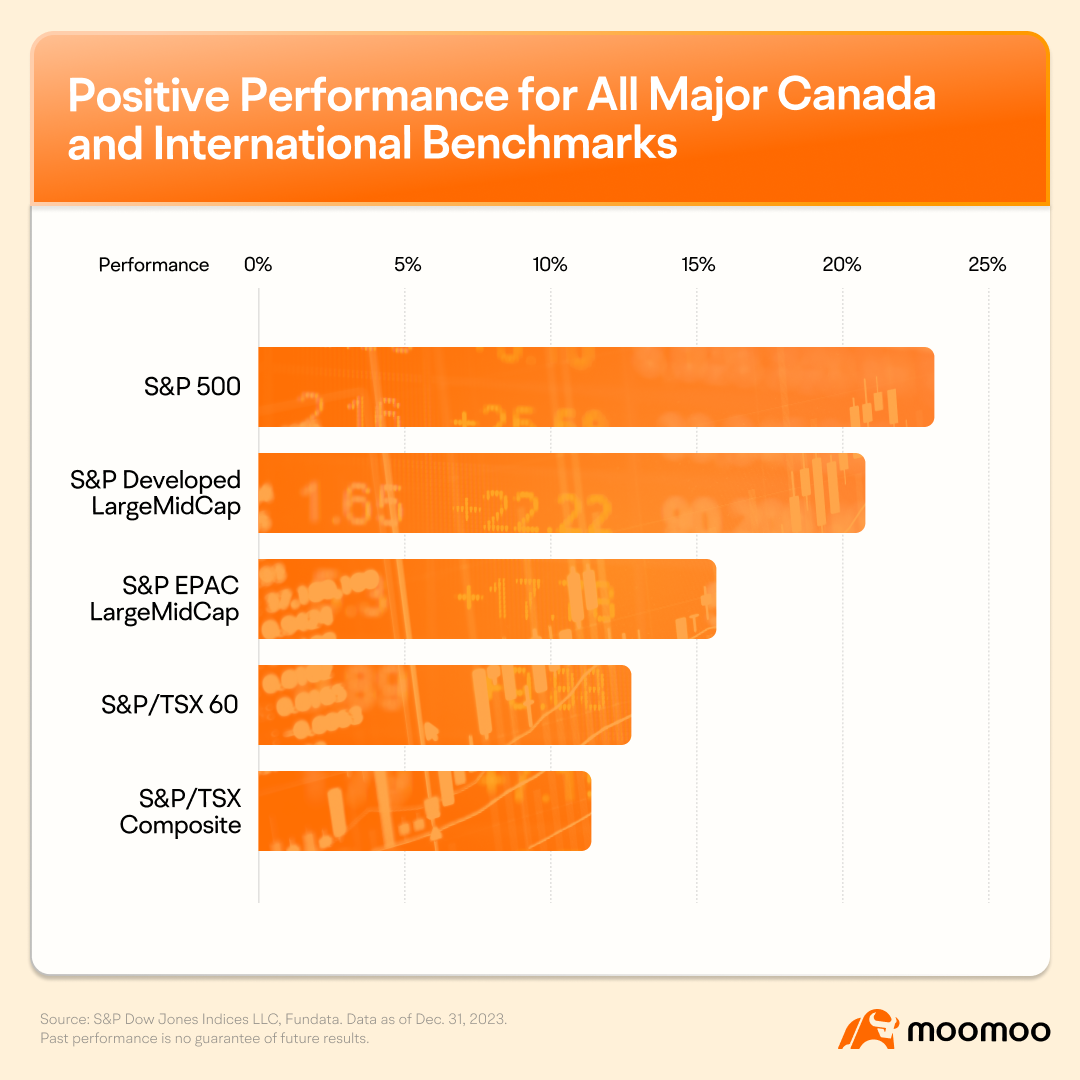
The goal of a passive investment ETF isn't to achieve a specific annual return, say 10% per year. The goal is to simply follow a specified benchmark index, such as the S&P 500 as it moves up and down over time.
If the benchmark returns 5%, and the ETF returns 4.9%, that's a great return! That means next year if the benchmark returns 20%, you can expect a 19.9% return. Choosing the right benchmark index will determine your expected return. You can choose a broad market index, a small cap or large cap index, a technology sector index etc.
In Canada, several ETFs have demonstrated strong performance in line with their indices. For instance, the iShares S&P/TSX 60 Index ETF, which tracks the performance of the largest 60 stocks in the Toronto Stock Exchange, has been a solid performer.
How to choose the right ETF?
Choosing the right ETFs involves knowing your individual investment goals and risk tolerance. ETFs tend to already be a well-diversified investment compared to individual stocks, so finding the right ETF for your portfolio can be done in three steps.
Step 1: A criteria that fits your investment goals
Look for ETFs in a market, industry, sector, theme or with a specific market cap based on your investment objectives and risk tolerance. Technology focused ETFs are likely to be more growth oriented than financial services such as banks with a long history of dividends. Large cap ETFs are usually more stable and offer less growth potential than small cap ETFs.
Step 2: The ETFs performance over time
Review the historical performance of the ETF over different time horizons, such as 1-year, 3-year, and 5-year periods, considering both short-term and long-term returns.
Assess the fund size, as larger ETFs may offer increased liquidity and stability, potentially reducing transaction costs. However, smaller ETFs may offer unique opportunities but could come with higher risk.
Step 3: The expense ratio and fees
Evaluate the expense ratio and any additional fees associated with the ETF, ensuring they are competitive compared to similar funds in the market.
Consider low-cost ETF options to minimize expenses and enhance long-term returns. Additionally, investors should consider the tax implications of ETFs, including dividends and capital gains taxes.
How to find an ETF in moomoo
Moomoo makes it easy to find ETFs for a wide range of benchmark indices for both the U.S. and Canada. You can research specific industries or narrow your scope to certain themes or market capitalization.
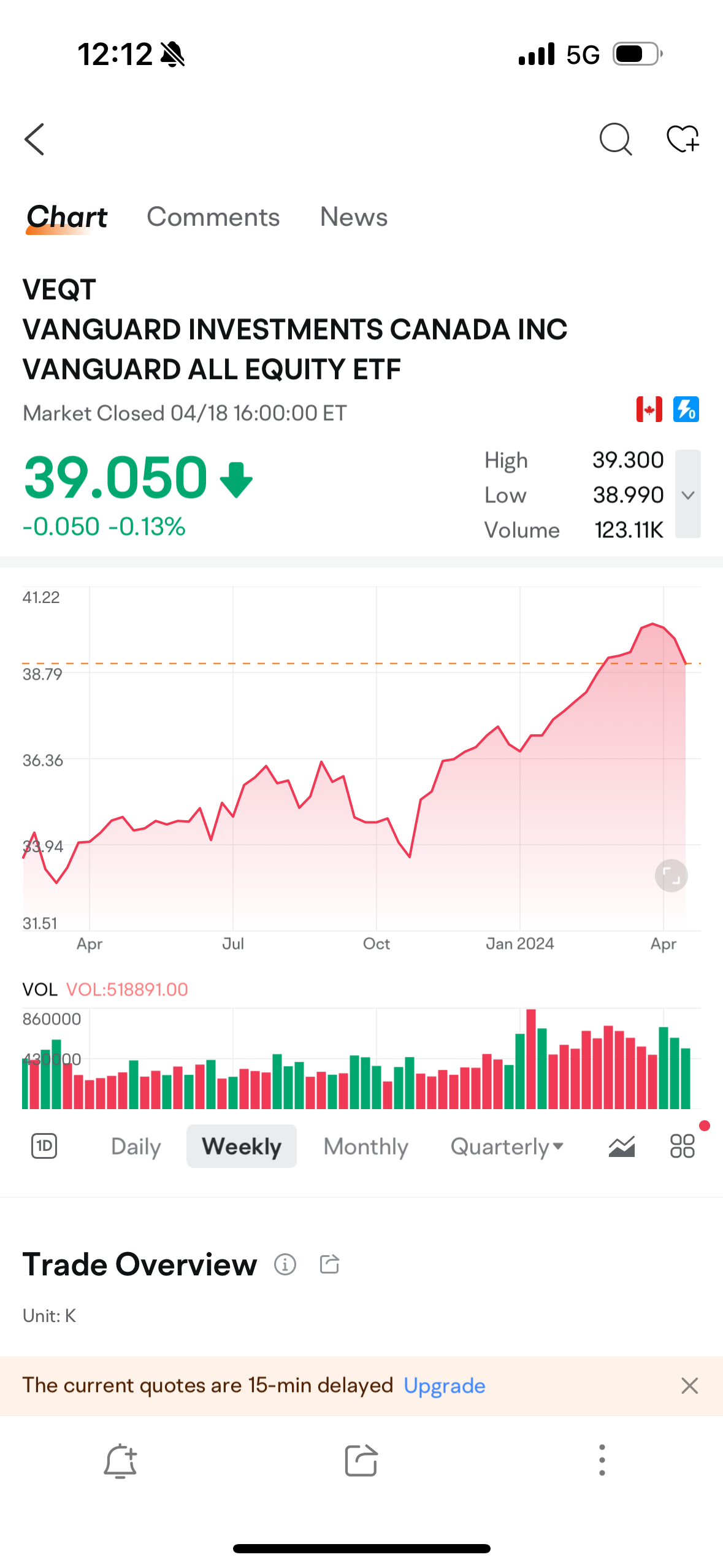
When you find an ETF that meets your criteria, you can use the chart to look at past performance.
For example: The Vanguard All-Equity ETF Portfolio (VEQT) is an ETF that tracks the performance of equities in Canada.
It has demonstrated robust performance recently, showing notable growth. As of April 16, 2024, the VEQT reported a year-to-date daily total return of 7.26% and an impressive one-year daily total return of 22.87%.
Over the past three years, the ETF has also maintained a consistent performance with a 8.78% total return, underscoring its reliability as a long-term investment option.
How to view ETFs on moomoo:
Open moomoo > Enter the ETF name or symbol
Or Open moomoo > Tap the Market tab > Select 'CA' or 'US' > Select the ETF you are interested in.
You can save ETFs to your Watchlist just like regular stocks by tapping the heart in the top right corner.
Top 10 Largest Canadian ETFs
Here are the Top 10 largest Canadian ETFs. You can save this image for later.
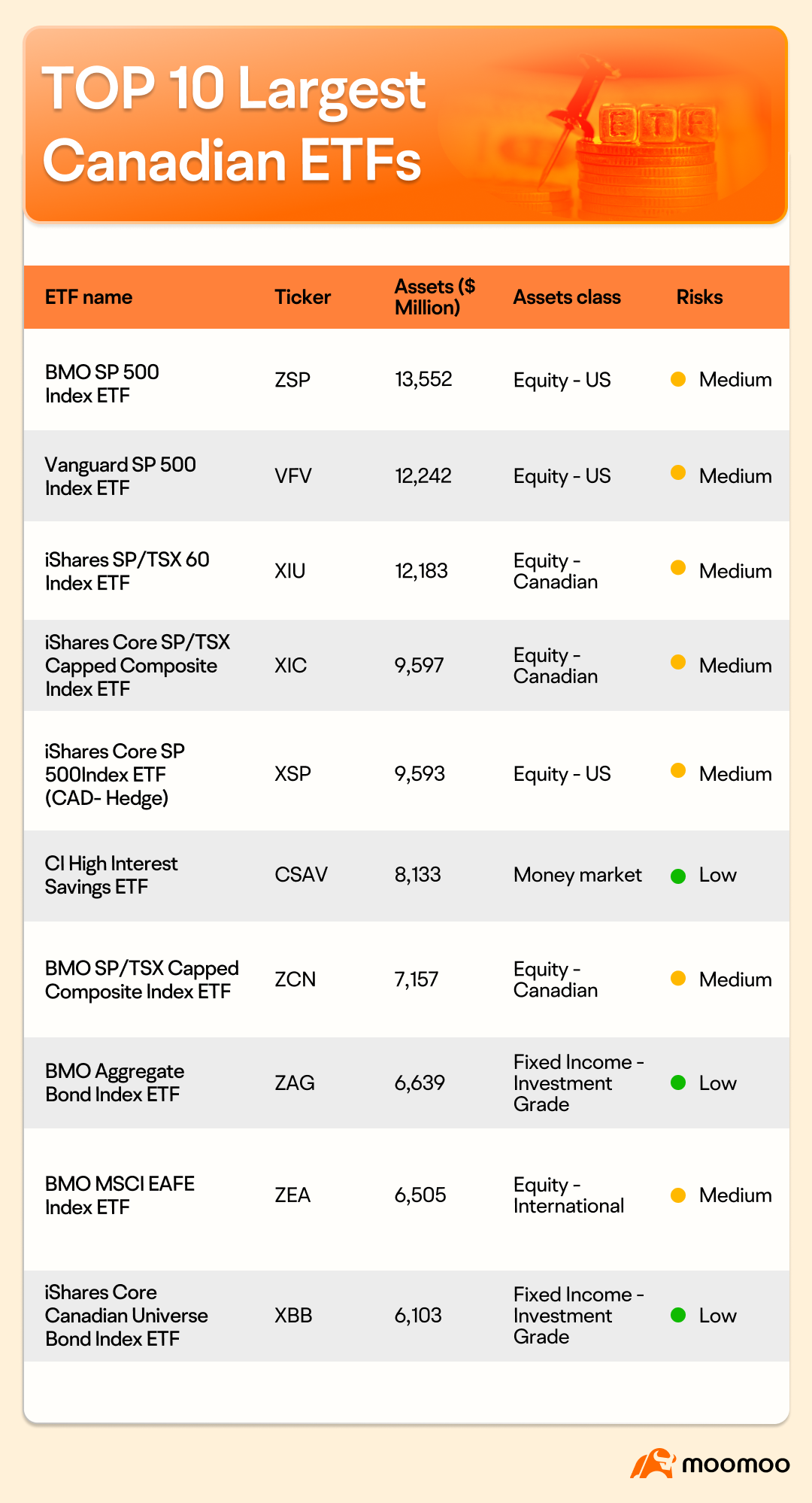
Canada offers investors a broad range of ETFs that include stocks, bonds, real estate and other financial products. You can even find ETFs that track U.S. indices but are traded in Canadian dollars directly on the Toronto Stock Exchange (TSX).
Once you have found the right ETF for your portfolio, don't forget to regularly review and rebalance your portfolio to ensure it remains aligned with your evolving financial needs and market conditions.
To learn more about ETF investing, head over to moomoo to view more articles and find the answers!
Now, check out the quiz below to test your knowledge of ETF.
This presentation is for informational and educational use only and is not a recommendation or endorsement of any particular investment or investment strategy. Investment information provided in this content is general in nature, strictly for illustrative purposes, and may not be appropriate for all investors. Read more