Two Bond ETFs to consider in case of a market correction
The global stock market has been experiencing a correction in recent weeks since mid-July, 2024.
Some Canadian investors may be leaning towards riskless assets for their portfolios. If you are looking for more downside protection, bond ETFs are a good choice.
This article will introduce bond ETFs and compare some of the top ones available to Canadian investors.
What is bond ETF?
Bond ETFs are funds that invest in different bonds and can be bought or sold like stocks. They offer the benefits of both bonds and ETFs, such as fixed income, diversification, and easy trading.
They are especially useful for Canadian investors who want to maintain a stable and balanced investment portfolio.
Key factors to consider when choosing a bond ETF
Size (AUM): Size is often measured by assets under management (AUM). Larger funds generally have better liquidity, lower trading costs, and less risk of being delisted.
Fee: This is the annual cost of owning the ETF, shown as a percentage. The fee charged by an ETF is expressed as the management expense ratio (MER), which is calculated annually. For example, an MER of 0.30% means that for every $10,000 invested, the ETF charges a fee of $30 annually.
Holdings: This is what the ETF invests in. Look for high-quality bonds (rated AAA, AA, or BBB) and a good mix of government and corporate bonds. Also, check the "duration," which shows how sensitive the bond prices are to interest rate changes. Bond prices move inversely to interest rates. Shorter durations mean less risk if rates go up.
Cash distribution: This is how often and how much the ETF pays out interest. Regular income payments can be important if you’re looking for steady cash flow.
Popular bond ETFs For Canadian investors
In Canada, there are many bond ETFs available.
Two of the largest are the $BMO AGGREGATE BOND INDEX ETF UNIT (ZAG.CA)$ and the $ISHARES CORE CDN UNIVERSE BD ID ETF TRUST UNIT (XBB.CA)$. Both are listed on the Toronto Stock Exchange and traded in Canadian dollars (CAD).
To help you decide which one might be better for you, we'll compare these two ETFs based on their size, what they hold, fees, and past performance.
1. BMO Aggregate Bond Index ETF (ZAG)
ZAG could be an attractive choice for Canadian investors seeking diversified bond exposure and stable returns.
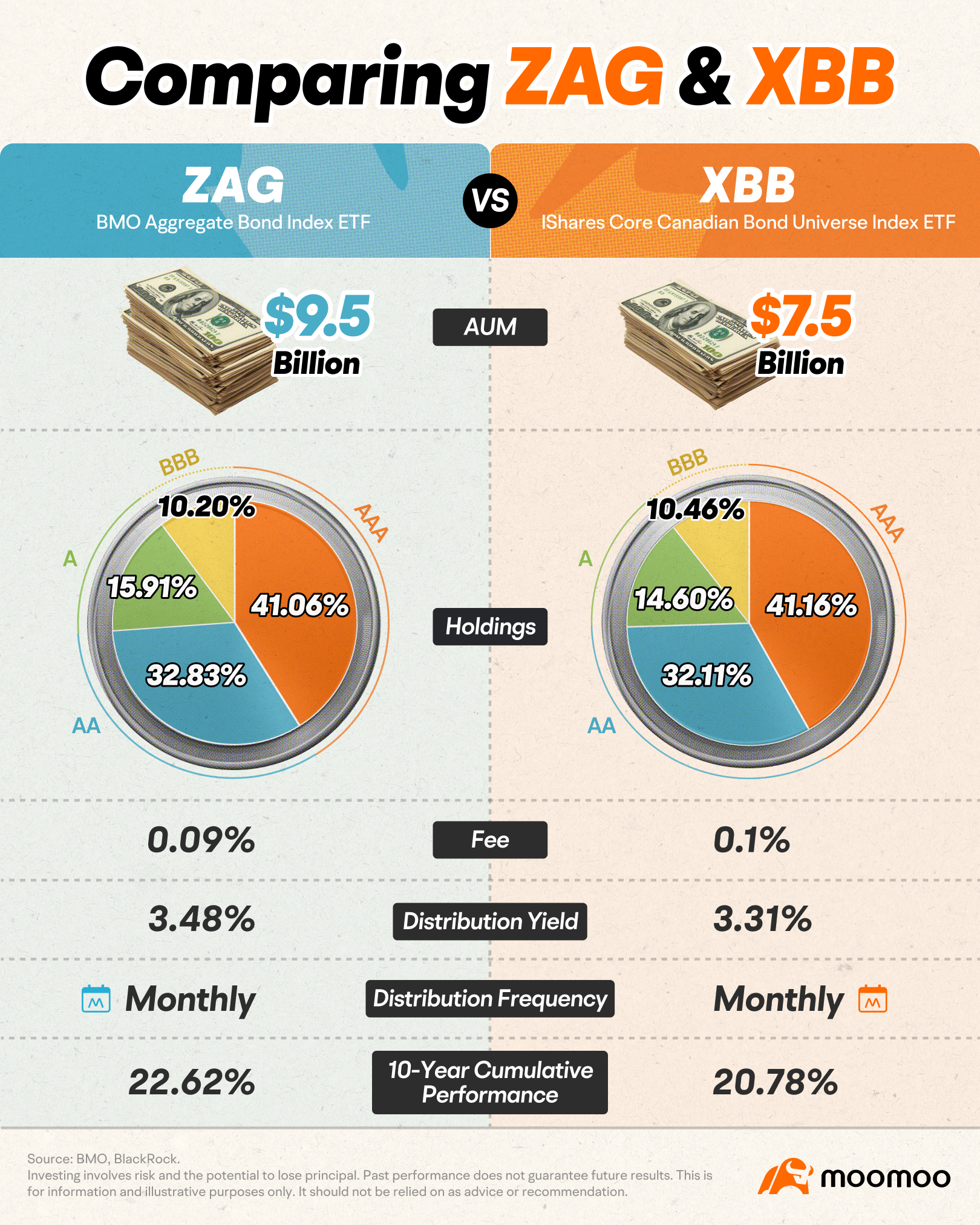
With assets under management (AUM) of $9.5 billion, ZAG offers a well-diversified portfolio, including AAA (41.06%), AA (32.83%), A (15.91%), and BBB (10.20%) rated bonds.
The ETF charges a low management expense ratio (MER) of 0.09% and provides a distribution yield of 3.48%, with monthly income distributions.
For example, an investor with $10,000 invested in ZAG can expect to receive approximately $29 monthly in cash distributions, while paying an annual fee of $9.
In terms of performance, ZAG has delivered a 10-year cumulative return of 22.62%, making it a solid choice for long-term investors.
Key facts:
AUM: 9.5 billion
Holdings: AAA (41.06%), AA (32.83%), A (15.91%), BBB (10.20%)
Fee: 0.09%
Yield: 3.48%
Frequency: Monthly
10-Year Cumulative Performance: 22.62%
Source: BMO. AUM as of August 07, 2024. Distribution Yield as of July 31, 2024.
2. iShares Core Canadian Bond Universe Index ETF (XBB)
XBB is ideal for investors seeking exposure to the Canadian bond market.
Managing assets worth $7.5 billion, XBB holds a diversified mix of bonds, including AAA (41.16%), AA (32.11%), A (14.60%), and BBB (10.46%) rated bonds.
It has a management expense ratio (MER) of 0.1% and offers a distribution yield of 3.31%, with monthly income distributions.
For instance, an investor with $10,000 invested in XBB can expect to receive approximately $27.58 per month in cash distributions, while paying an annual fee of $10.
In terms of performance, XBB has delivered a 10-year cumulative return of 20.78%.
Key Facts:
AUM: 7.5 billion
Bond Holdings: AAA (41.16%), AA (32.11%), A (14.60%), BBB (10.46%)
Fee: 0.10%
Yield: 3.31%
Frequency: Monthly
10-Year Cumulative Performance: 20.78%
Source: BlackRock. AUM as of August 07, 2024. Distribution Yield as of July 31, 2024.
Takeaways
Both ZAG and XBB offer broad exposure to the Canadian bond market, making them solid choices for investors seeking safety during market downturns.
The slight differences in fees, distribution yield, and cumulative performance may influence your decision based on individual preferences.
ZAG has a slightly lower fee and higher distribution yield, while XBB provides a similarly diversified portfolio with a slightly higher fee.
Risk of investing in Bond ETFs
Investing in bond ETFs can provide stability and regular income, but it is not without risks. One of the main risks is interest rate changes.
When interest rates rise, the prices of existing bonds generally fall because new bonds are issued with higher interest rates, making the older, lower-yielding bonds less attractive.
This causes the value of the bond ETF to decrease. Conversely, when interest rates fall, the value of existing bonds with higher rates increases, boosting the ETF’s value.
Another risk is default risk. This occurs when bond issuers fail to make interest or principal payments, potentially leading to losses for bondholders and decreasing the value of the ETF. Default risk is higher for bonds issued by entities with lower credit ratings.
This presentation is for informational and educational use only and is not a recommendation or endorsement of any particular investment or investment strategy. Investment information provided in this content is general in nature, strictly for illustrative purposes, and may not be appropriate for all investors. Read more