Investing in an S&P 500 ETF in Canada
The S&P 500 is a well-known stock market index that attracts investors interested in the U.S. market. Both retail and professional investors value this index as a way to measure U.S. stock performance and as a benchmark for comparison.
For Canadians who want to invest passively in the S&P 500, several exchange-traded funds (ETFs) that track the index are available. These ETFs are appealing because they are low-cost, offer great diversification, and are easy to use.
If you're interested in learning more about the S&P 500 and how to invest in it through ETFs, let's explore it further.
What is an S&P 500 ETF?
An S&P 500 ETF is an investment fund that tracks the performance of the S&P 500 Index. This index includes 500 of the largest publicly traded companies in the United States, covering a wide range of industries. Some well-known companies in the index are $Apple (AAPL.US)$, $NVIDIA (NVDA.US)$, $Microsoft (MSFT.US)$, $Alphabet-C (GOOG.US)$, $Amazon (AMZN.US)$, $Meta Platforms (META.US)$, and$Tesla (TSLA.US)$ .
By investing in an S&P 500 ETF, Canadian investors can participate in the growth of these leading companies without needing to buy individual stocks.
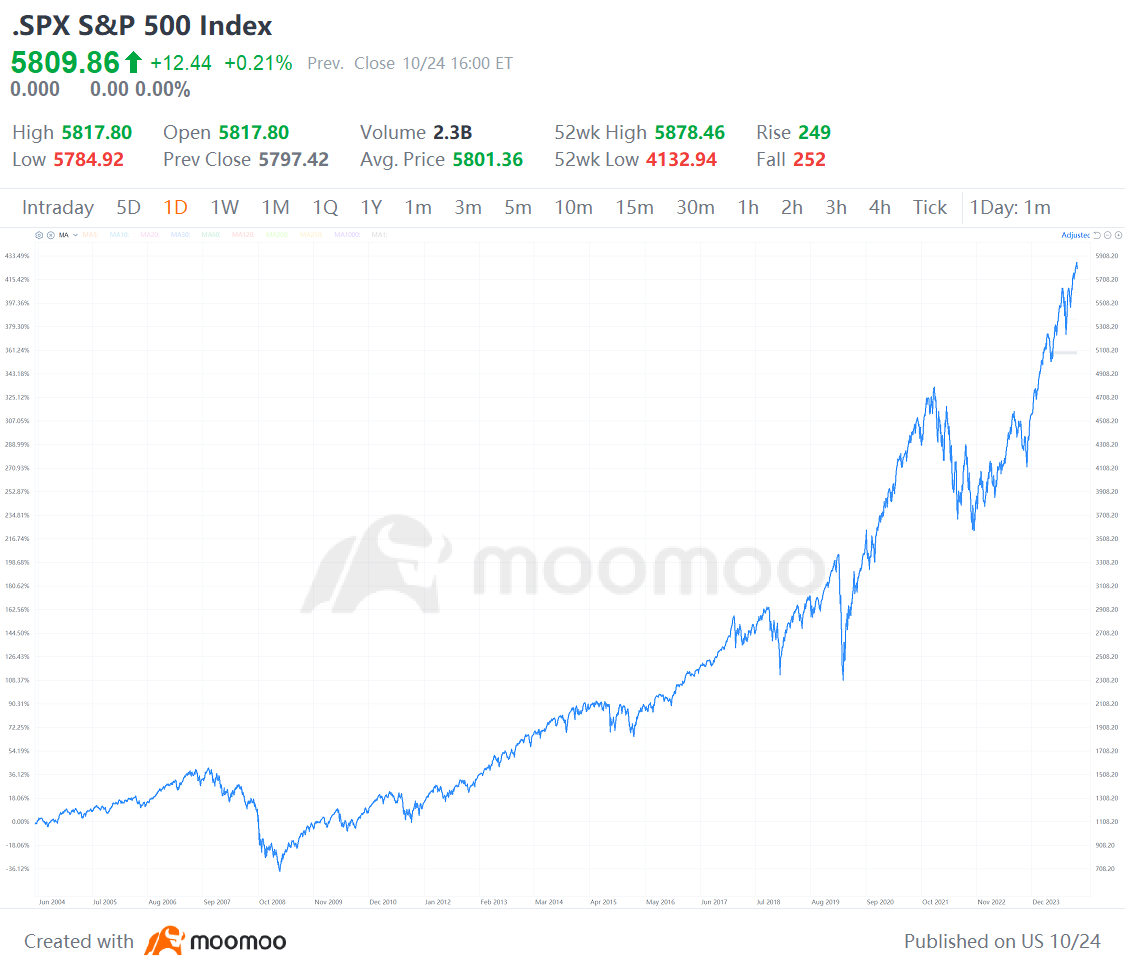
Historical data shows that investing in the S&P 500 over the long run will pay off for investors. According to S&P 500 data, from 2003 to October 2023, the S&P 500 delivered a compound annual return of 10.41% (assuming all dividends were reinvested). For example, if you invested $100 in the S&P 500 at the start of 2003, it would have grown to about $800.60 by the end of 2023.
Types of S&P 500 ETFs in Canada
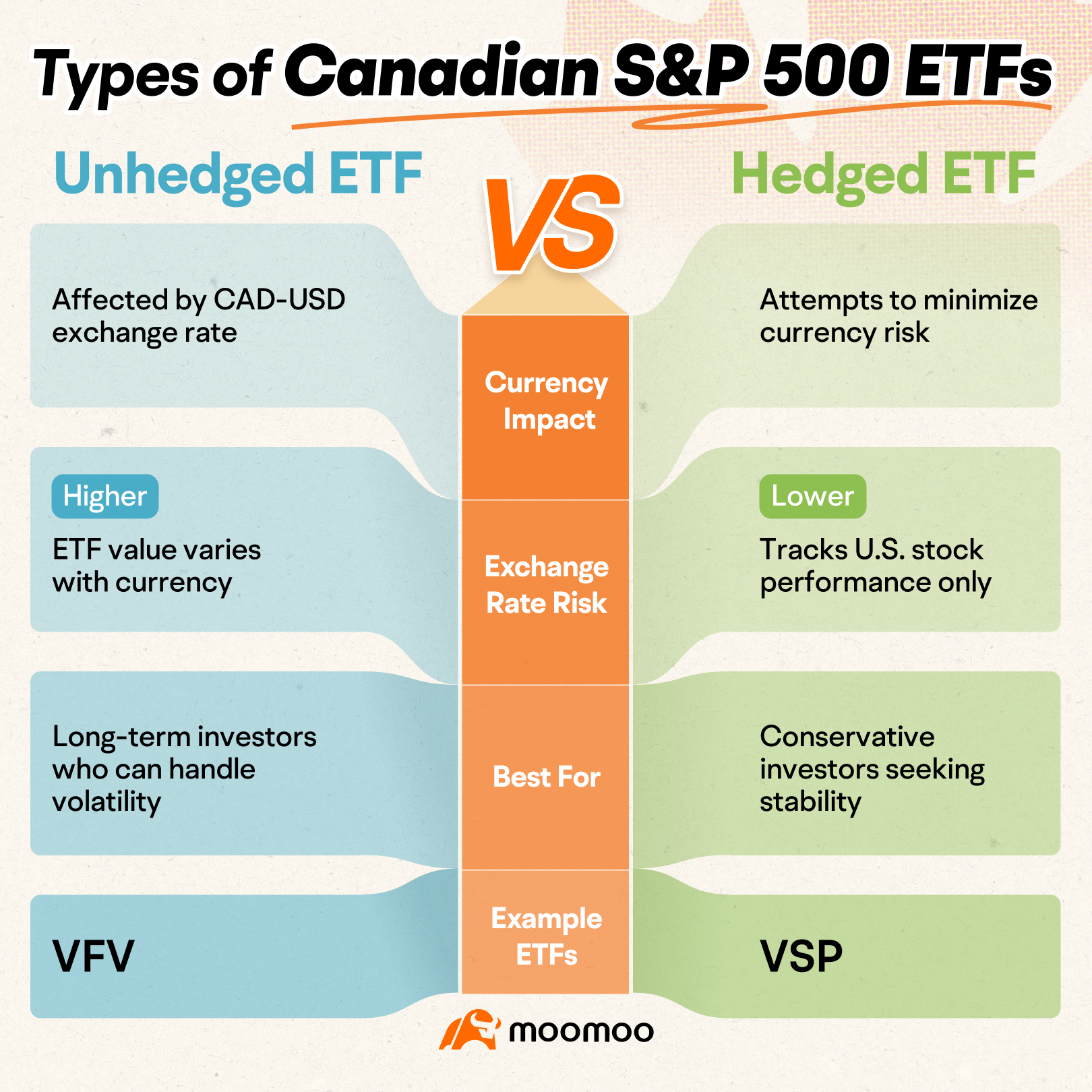
Some Canadian-listed S&P 500 ETFs come in two versions: unhedged and currency-hedged. Here's a simple breakdown of the differences and which option might be right for average investors.
Unhedged ETFs
Unhedged ETFs are traded in local currency but are influenced by fluctuations in the exchange rate of their underlying assets. Canadian-listed S&P 500 ETFs are traded in CAD, while the underlying stocks are traded in USD. As a result, the value of these ETFs can be affected by changes in the CAD-USD exchange rate.
If the U.S. dollar appreciates, the Canadian-listed S&P 500 ETF gains extra value.
If the Canadian dollar appreciates, the Canadian-listed S&P 500 ETF loses additional value.
Due to this currency fluctuation, the ETF's performance can differ from the actual performance of the underlying stocks.
Hedged ETFs
Hedged ETFs aim to mitigate this currency risk by locking in a specific CAD-USD exchange rate each month using financial contracts called derivatives. This means the ETF's value is based solely on the performance of the underlying U.S. stocks, minus management fees. While this makes hedged ETFs less volatile, it also means you might miss out on extra gains if the U.S. dollar appreciates.
Which one is better: Unhedged or hedged ETF?
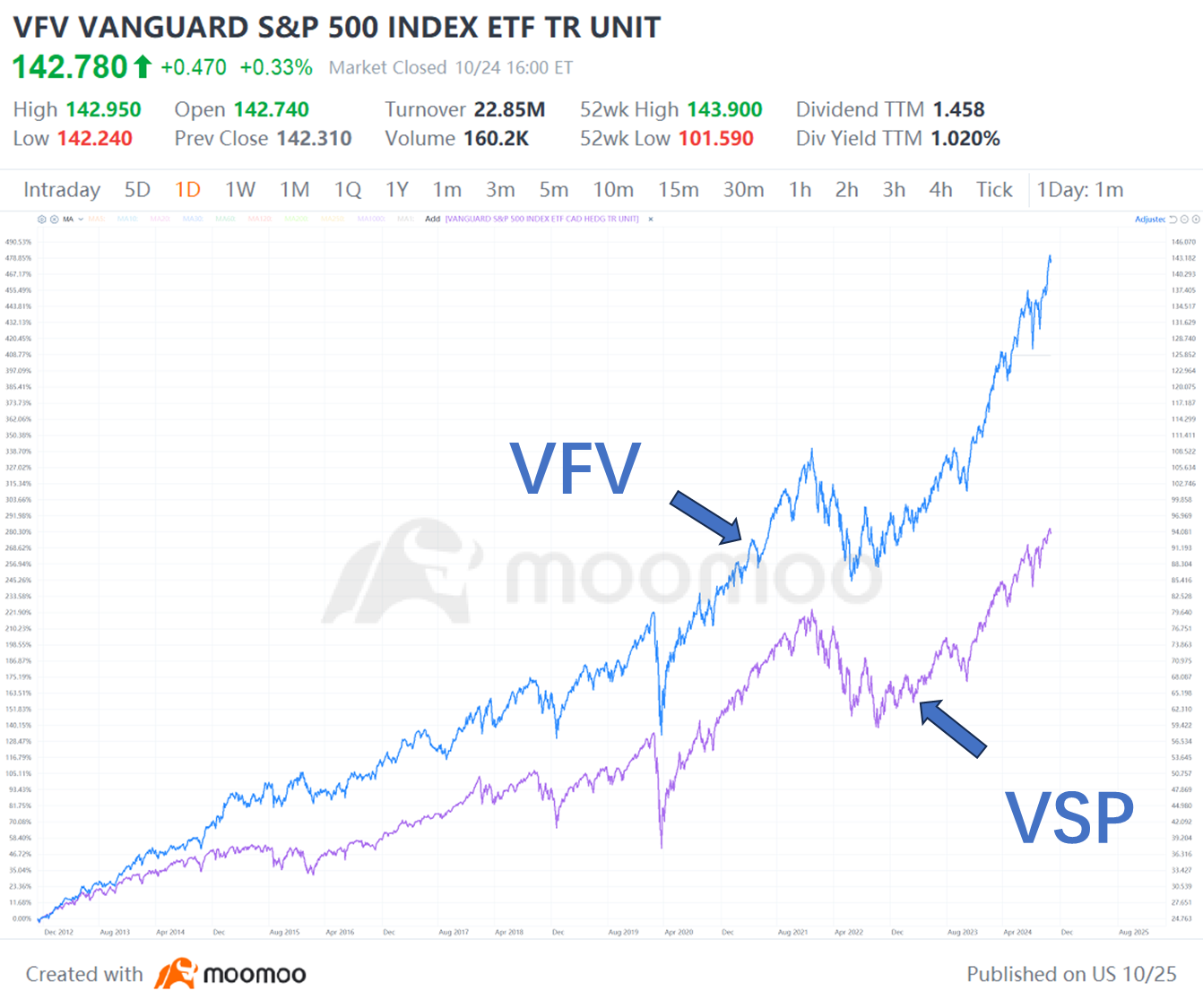
Let's compare their performance using Vanguard's Canadian-listed S&P 500 ETFs: $VANGUARD S&P 500 INDEX ETF TR UNIT (VFV.CA)$ , an unhedged ETF, and $VANGUARD S&P 500 INDEX ETF CAD HEDG TR UNIT (VSP.CA)$ , a CAD-hedged ETF.
Over the past decade, the U.S. dollar has appreciated against the Canadian dollar, giving VFV a significant performance advantage over VSP, as seen in the chart below.
Therefore, the choice between unhedged and hedged ETFs depends on an investor's risk tolerance and investment timeline. Unhedged ETFs are often a better option for younger investors who can tolerate more volatility.
How to pick a S&P 500 ETF
Choosing the right S&P 500 ETF is important for your investment success. Here are some key factors to consider to help you find the right option for your needs:
Assets Under Management (AUM)
AUM is the total market value of the assets that an ETF manages. A higher AUM often indicates popularity and liquidity, which can make it easier to buy and sell the ETF without significantly affecting its price.
Tracking Difference
Tracking difference indicates how closely an ETF matches the performance of the S&P 500 Index. A lower tracking difference suggests that the ETF effectively mirrors the index's performance. On the other hand, a high tracking difference may signal management inefficiencies or elevated costs.
Management Expense Ratio (MER)
MER is the annual fee expressed as a percentage of the fund's assets, covering operating expenses and management fees. Lower MERs are generally better, as high fees can erode your investment returns over time. Look for ETFs with competitive MERs to maximize your returns.
Top Canadian S&P 500 ETFs
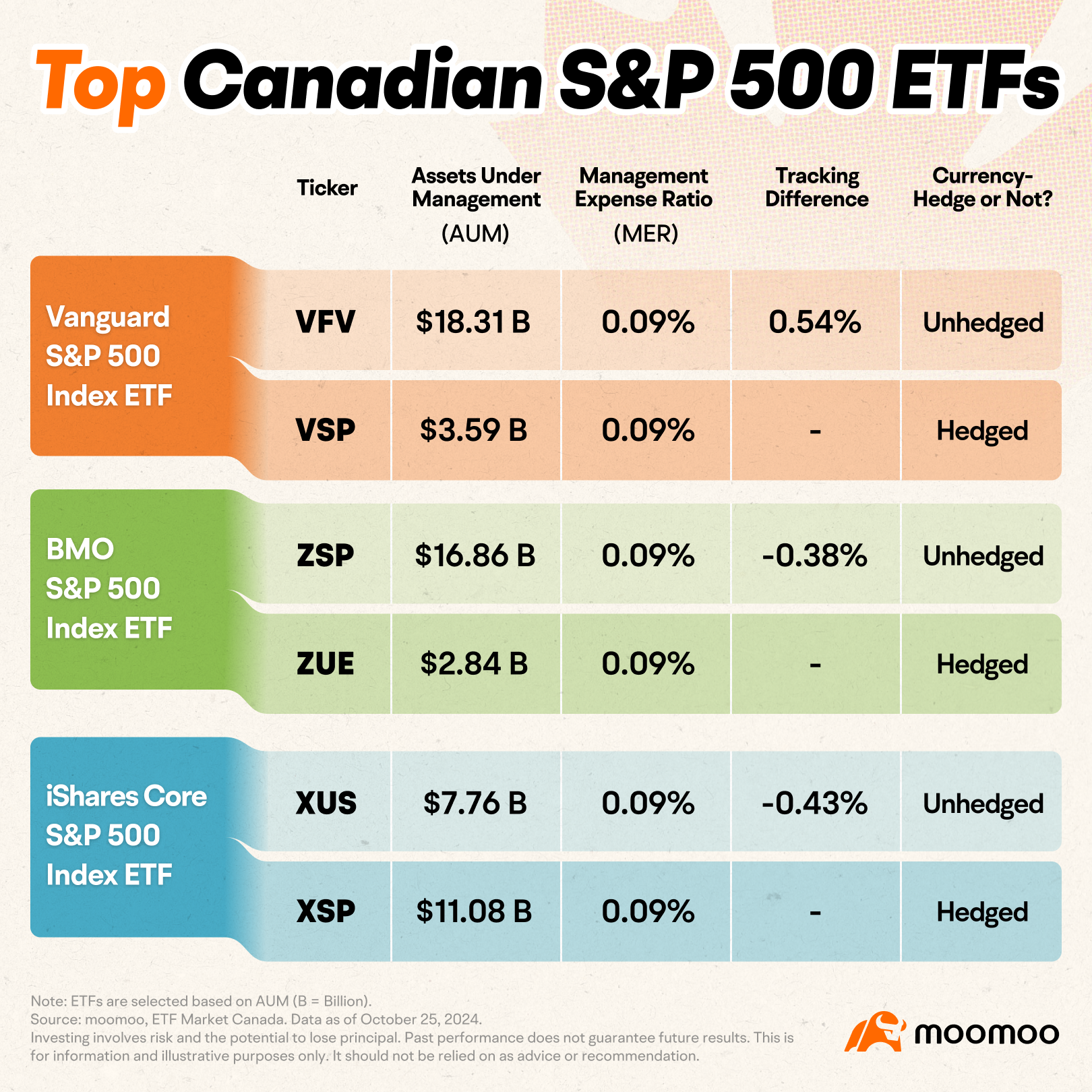
The Canadian market offers a variety of S&P 500 ETFs, with Vanguard, BMO, and BlackRock iShares providing the most popular funds, ranked by assets under management.
Below is a selection of Canadian-listed S&P 500 ETFs that feature low fees, broad diversification, and significant assets under management. The chart includes both unhedged and currency-hedged ETFs to help you find the best fit for your investment needs.
Vanguard S&P 500 Index ETF
The Vanguard S&P 500 Index ETF $VANGUARD S&P 500 INDEX ETF TR UNIT (VFV.CA)$ is the most popular S&P 500 ETF in Canada, with assets under management (AUM) of $18.31 billion. It features a low management expense ratio (MER) of 0.09% and a tracking difference of 0.54%. This ETF has a currency-hedged version called the Vanguard S&P 500 Index ETF (CAD-hedged) with the ticker $VANGUARD S&P 500 INDEX ETF CAD HEDG TR UNIT (VSP.CA)$ .
BMO S&P 500 Index ETF
The BMO S&P 500 Index ETF $BMO S&P 500 INDEX ETF UNIT (ZSP.CA)$ is another strong contender in the Canadian market, with an AUM of $16.86 billion. It shares the same competitive MER of 0.09% as the Vanguard ETF, which is advantageous for investors seeking to minimize costs. Like Vanguard, BMO offers both unhedged and currency-hedged versions of its ETF, with the hedged version ticker $BMO S&P 500 HEDGE TO CAD INDEX ETF S&P 500 INDEX ETF HGD CAD (ZUE.CA)$ . This gives investors the flexibility to choose based on their comfort with currency risks.
iShares Core S&P 500 Index ETF
The iShares Core S&P 500 Index ETF $ISHARES CORE S&P 500 INDEX ETF ETF UNIT CAD (XUS.CA)$ has $7.76 billion in AUM. Like the other two ETFs, it boasts a low MER of 0.09%. This ETF also offers a currency-hedged version $ISHARES CORE S&P 500 INDEX ETF (CAD-HEDGED) UNIT (XSP.CA)$ , catering to investors who prefer to hedge against currency risk.
How to find Canadian S&P 500 ETFs on moomoo
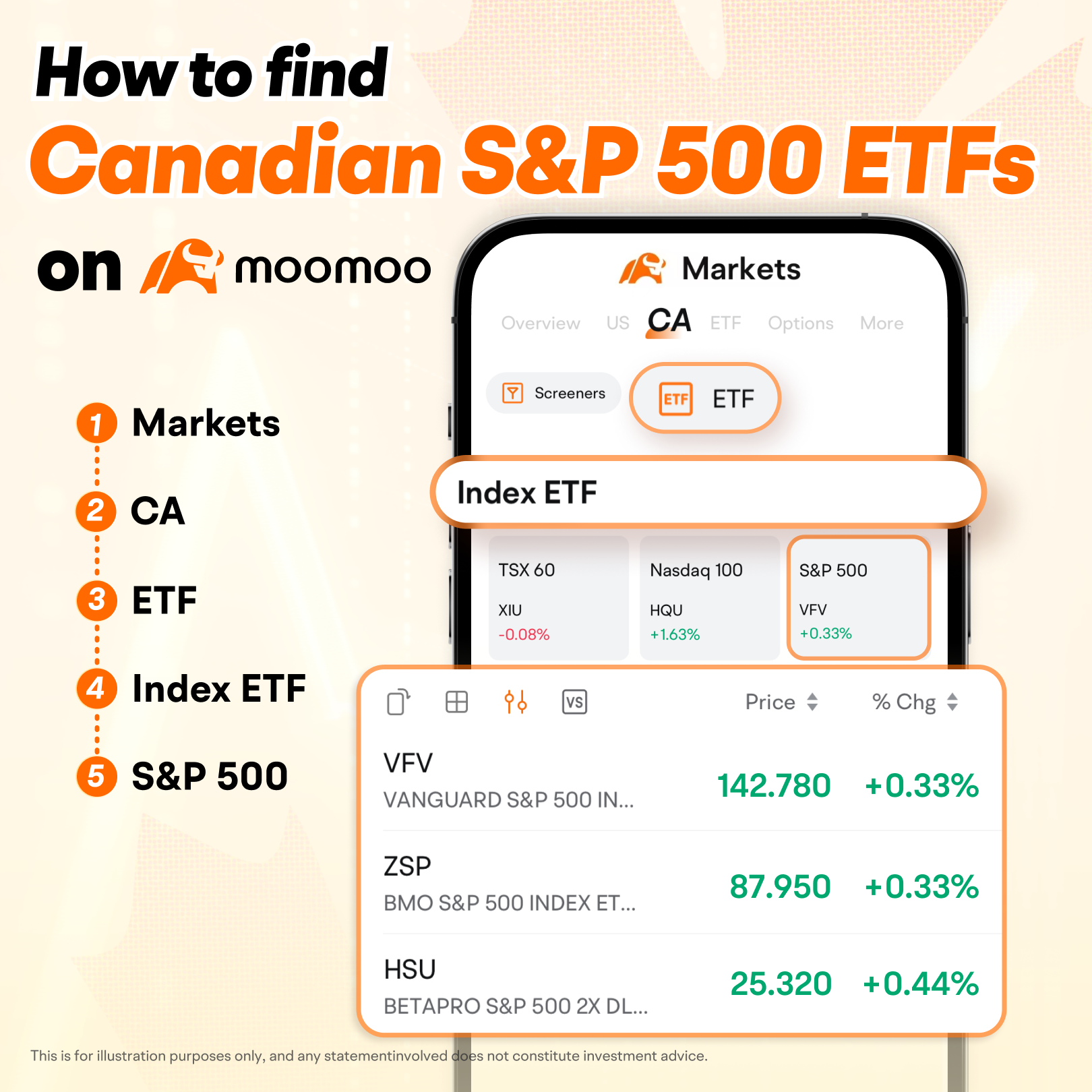
To find Canadian S&P 500 ETFs on moomoo, open the app and click on Markets. Next, select CA and navigate to ETF. From there, click on S&P 500 under the Index ETF section to view the Canadian ETFs available on moomoo.
On the detailed list page, you can sort the ETFs based on various criteria, such as price changes, trading volume, transaction value, and market capitalization. Additionally, you can compare different ETFs by using the VS function on the top.
Pros of investing in S&P 500 ETFs
Diversification: Gain exposure to a wide range of industries, reducing individual stock risk.
Low Costs: Typically have lower expense ratios than mutual funds, making them cost-effective.
Liquidity: Can be bought and sold throughout the trading day on stock exchanges, offering flexibility.
Tax Efficiency: Generally more tax-efficient than mutual funds, leading to lower capital gains distributions.
Cons of investing in S&P 500 ETFs
Market Risk: Still subject to market volatility, which can affect performance during economic downturns.
Currency Risk: Canadian investors may face exchange rate fluctuations impacting returns, especially with non-hedged ETFs.
Limited Canadian Exposure: Heavy investment in S&P 500 ETFs may reduce exposure to Canadian equities.
Tracking Difference: There may be discrepancies between the ETF's performance and the underlying index due to fees.
Conclusion
Investing in S&P 500 ETFs can be an effective way for Canadian investors to diversify their portfolios and access the U.S. equity market. While they offer many benefits, it's important to consider the associated risks and limitations. Conducting thorough research and evaluating your financial situation is essential before making investment decisions.
This presentation is for informational and educational use only and is not a recommendation or endorsement of any particular investment or investment strategy. Investment information provided in this content is general in nature, strictly for illustrative purposes, and may not be appropriate for all investors. Read more