US dollar doubt creates uncertainty in the 2025 currency market

US dollar weakness and global response
Important developments in currency markets in the first half of 2025 will continue to echo through the second half of the year. In particular, questions about the status of the US dollar, and the divergence between the stance of the Bank of Japan and its peers, could continue to drive trading in major currencies.
The sudden introduction of US tariffs on its trading partners in April rattled investors’ nerves everywhere. While it was sharemarket response that grabbed the headlines, there were more significant moves in bonds and currencies.
It’s widely thought the sell-off in longer dated US bonds was the key factor in US President Donald Trump changing direction on tariffs. The potential to pay hundreds of billions more in interest on US government debt was no doubt a brake on his aggressive trade initiatives. However, it may have been the slide in the US dollar that really caught the eye of those in the White House.
In times of financial crisis in the past there was often support for the US dollar. It was the safe haven that others turned to as economic doubt rose. But that’s not what happened in April. And it would have powerfully affected US decision makers, when coupled with American investors pulling investments back by selling off bonds.
In less than three weeks following the tariffs announcement on April 2, the US dollar shed 6.5% against the Japanese yen. Between that date and the end of the first half, the greenback dropped by more than 8.5% versus the euro. Shock at the weakness of the US dollar, rather than its expected strength may have also shaped the president’s thinking.
The unanticipated outcome re-raised already established arguments around de-dollarisation. A number of nations have argued in the past that the US gains an unfair advantage through its national currency acting as the global reserve. The US maintains an orderly bond market, and its reward for doing so is that it can seemingly borrow into perpetuity, giving it enormous financial flexibility.
This brings us to the first big question for the second half of 2025: Has the US dollar passed its peak?
Bank of Japan divergence and the yen's potential
The second major question revolves around the Japanese yen. Inflation and activity remain hot in Japan, meaning the central bank’s tightening stance is in contrast to the rest of the world’s.
Generally, interest rate differentials work in favour of a currency, and a tightening central bank means a rising currency. In Japan’s case that is not yet a driver, as its cash rate is still down at 0.5%. However, the lift in 10-year bond yields from close to zero to nearer 1.5% suggests the day may not be far away.
These factors play out against rising geopolitical tensions and uncertainty about the outlook for international trade and global growth. With trade relationships up for grabs there is potential for sharp and dramatic shifts, and remaining alert to shifting currents as the world recasts itself is more important than ever.
How the US dollar compares with peers
Euro momentum driven by repatriation
The outlook for the world’s most traded single market is for trend continuation.
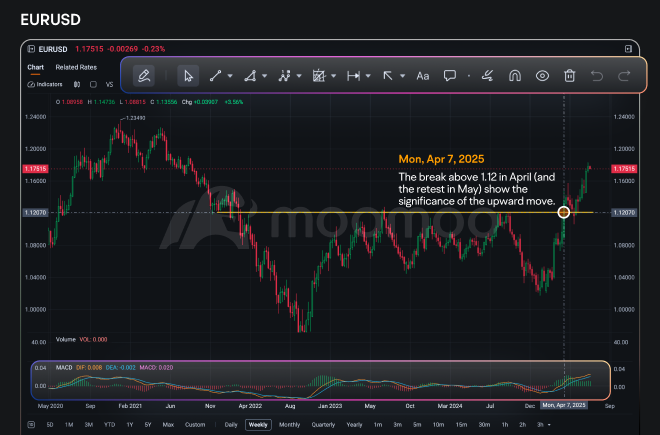
The break above 1.12 in April (and the retest in May) show the significance of the upward move. The pair strengthened as the US dollar weakened and investors moved funds away from the disruptive elements. Note the strong upward momentum illustrated by the moving average convergence divergence line at the bottom of the chart.
These trends may continue, with European investors continuing to repatriate funds and the dollar suffering from unintended consequences of an aggressive foreign policy and an unconvinced US Federal Reserve.
Rising yields and a stronger yen
The Japanese yen is also likely to benefit from a weakening US dollar. The currency outlook alone is enough to motivate Mrs Watanabi to bring funds home. The addition of positive (nominal) interest rates at home and upward momentum in the Nikkei 225 index provide further incentives to buy yen, and could see USD/JPY drop, through 1.40.
Trade war may devalue the yuan
Although not free-floating, the outlook for the externally traded yuan is steadier. The pair may enter a period of competitive devaluation, as both the US and China seek to import demand and support exports. Most sensitive to the trade relationship is any resolution of trade tensions, which may spur the yuan higher.
The Aussie is at the world's mercy
Often traded as a proxy for world growth, the Australian dollar is a cork bobbing on the global economic ocean. Although domestic interest rates and fiscal policy will play a part, the fortunes of AUD/USD are outside the control of Australian authorities. A drop below US60¢ caused concern in April, but the recovery back to US65¢ has paralleled the calming of trade and sharemarket tensions. While trade remains relatively peaceful AUD/USD is biased to the upside.
Final note: the currency market only looks calm
Traditional currencies tend to trade at lower volatilities than many other markets. As the half-year ended, the major pairs were trading at volatilities of 5% to 7%, well down from close to 15% seen in April. The increasingly unpredictable nature of international relations means volatility could explode again at any time.
This information is general in nature and has been prepared without considering your financial objectives, situation or needs. Consider the appropriateness of this information in light of your personal circumstances before making investment decisions.
This presentation is for informational and educational use only and is not a recommendation or endorsement of any particular investment or investment strategy. Investment information provided in this content is general in nature, strictly for illustrative purposes, and may not be appropriate for all investors. Read more