Navigating the AI trade with the Nasdaq-100®: risks, returns and the road ahead

As we enter the second half of 2026, navigating the artificial intelligence trade will require more intense scrutiny than ever. A host of fast-moving developments are shifting the landscape in 2026 – smarter models, falling computing costs, better financial returns and AI tools that are much easier for everyday people to use.
Investors must also weigh rising geopolitical and regulatory risk factors, especially as the technical gap narrows between US frontier AI models and open-source alternatives developed in China.
Yet the market rewards remain compelling. With the Nasdaq-100® approximately doubling the return of the broader S&P 500 on the back of strong, AI-driven corporate earnings, the first half of the year delivered clear wins for investors in US large caps that are focused on innovation. The index continues to function as the ultimate barometer of this dynamic trade.
Investors demand return as business invests in AI
The first half of 2026 marked a clear structural shift for technology investors. Markets have officially transitioned from an era of initial hype and experimentation into a period defined by heavy infrastructure build-out, deep market dispersion and aggressive operational monetisation.
More broadly, equity markets are no longer rewarding listed companies simply for using the term ‘AI’ on quarterly earnings calls. The market is now demand-testing real-world execution and punishing unearned valuation multiples.
According to recent research from Morgan Stanley, companies successfully embedding AI tools to cut internal operating costs or drive entirely new revenue lines are seeing cash-flow margin expansion outpace the global corporate average by two times.
Approximately 25% of S&P 500 firms explicitly cited measurable bottom-line financial impacts from AI initiatives in early 2026, which is up significantly from 13% reported through 2025. Major technology enterprises are reporting efficiency gains of between 15% and 30%. For instance, Microsoft recently revealed that roughly 35% of its internal software code is now entirely AI-generated.

An inside look at the Nasdaq-100® index performance
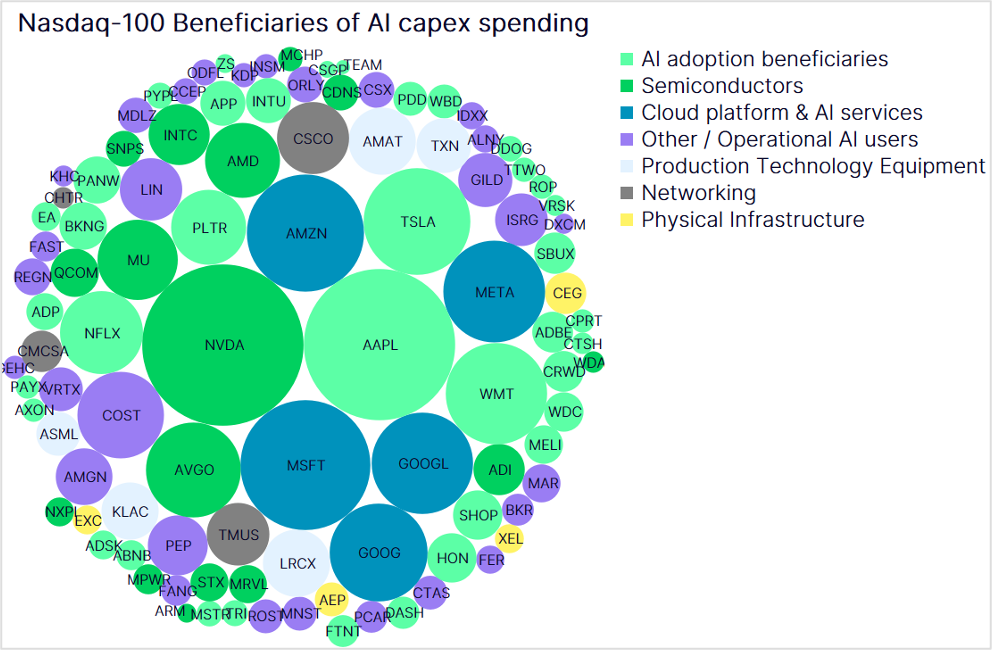
As a benchmark, the Nasdaq-100® tracks dozens of key players across every layer of the AI technology stack. These range from the hyperscalers spending hundreds of billions of dollars on data centre capital expenditure – including Amazon, Microsoft, Alphabet and Meta – to an extensive ecosystem of semiconductor businesses.
The outsize importance of the semiconductor sector means it’s worth breaking down into:
graphics processing units (GPUs) designers such as Nvidia and AMD
application-specific integrated circuits (ASICs) such as Broadcom and Marvell
central processing units (CPUs) including Intel and Arm
memory chipmakers such as Micron, SanDisk and Western Digital
semiconductor capital-equipment specialists such as Lam Research, KLA and Applied Materials.
The index also captures vital supporting hardware players such as Cisco and Apple, alongside software firms experiencing the full brunt of AI disruption anxiety.
With these constituents, the Nasdaq-100® has delivered powerful fundamental growth in 2026. The index turned in 45% year-on-year growth in earnings per share in the first-quarter company reporting season. This fundamental strength helped the index shake off its geopolitical-risk-driven hiccup from the first quarter, roaring back with a 27.5% gain in the second quarter.
Semiconductors skyrocketed as software slumped
With a year-to-date price return of 19.9% as of June 30, investors might assume that market strength was broad-based across the Nasdaq-100®’s various thematic and subsector exposures – especially when considering its outperformance against the S&P 500, which was up only 9.55%. To understand why this was not the case, we need only look at the performance of the semiconductor names in the Nasdaq-100®.
Semiconductors represent the largest Industry Classification Benchmark (ICB) subsector exposure in the index, and the group was up more than 72% as a collective. Contrast this with the second biggest subsector exposure, software, which was down more than 15% as a group.
This performance differential of more than 80 percentage points easily ranks as the largest in the history of the index across its top two subsectors. This dynamic continues a stark divergence that first emerged in the final quarter of 2025, when investors began discounting software valuations, considering these companies at risk from generative AI model capabilities. At the same time, buyers bid up the valuations of semiconductor companies amid historic supply shortages, exponential compute demand curves and soaring corporate profit margins.
Performance of key sectors
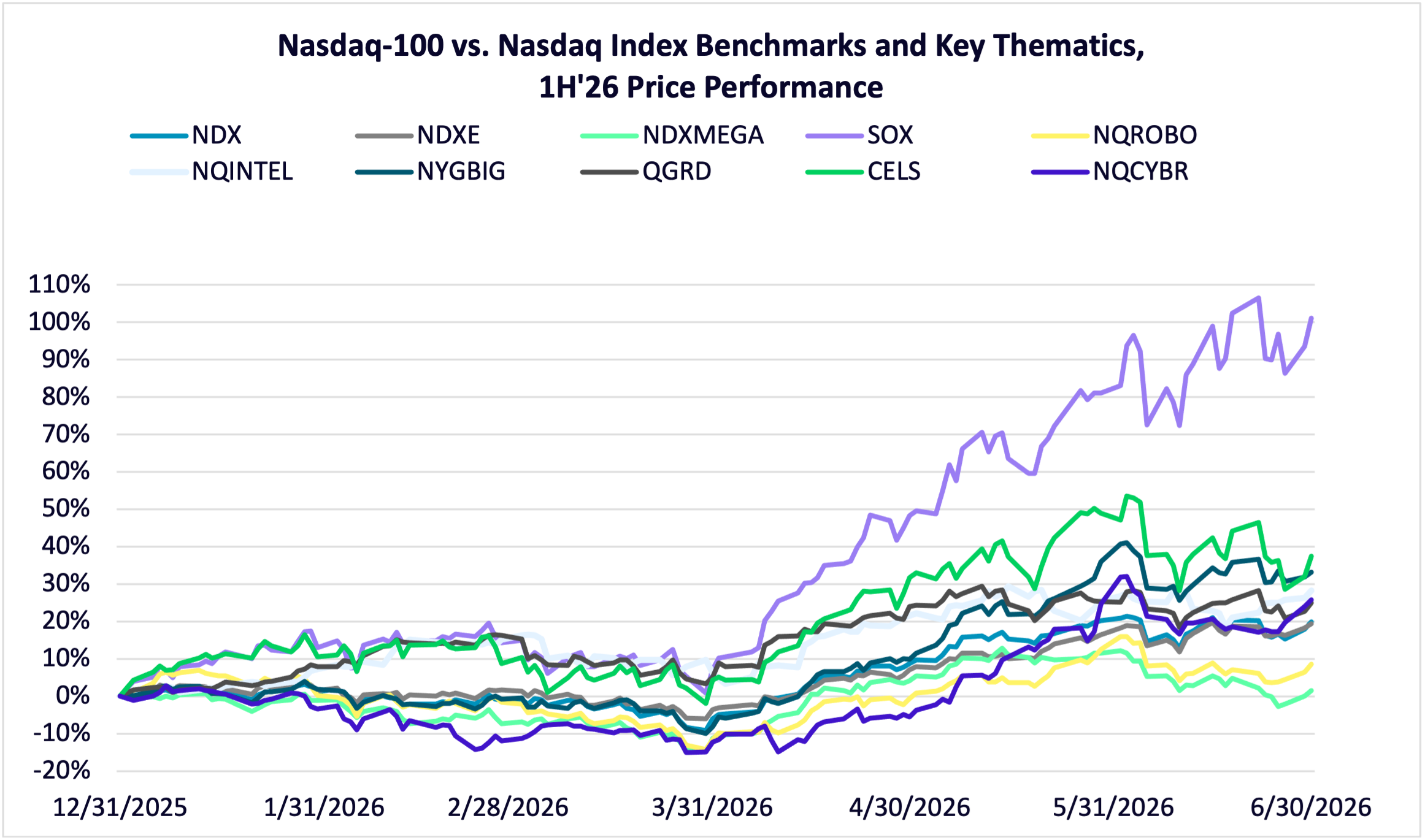
Looking at the performance of the Nasdaq-100® Equal Weighted™️ index – up 19.3% year-to-date – against the Nasdaq-100® Mega™️ index – up only 1.6% – provides another layer of insight into this year’s market dynamics.
Index / subsector group | first-half return |
PHLX Semiconductor® Index (SOX®) | +101.1% |
Nasdaq-100 semiconductor names | up >72.0% |
Nasdaq CTA AI™️ Index (NQINTEL™️) | +50.4% |
Nasdaq Clean Edge Green Energy™️ Index (CELS™️) | +37.4% |
Nasdaq Global AI & Big Data™️ Index (NYGBIG™️) | +33.2% |
Nasdaq CTA Cybersecurity™️ Index (NQCYBR™️) | +25.9% |
Nasdaq Clean Edge Smart Grid Infrastructure™️ Index (QGRD™️) | +25.0% |
Nasdaq-100 Index® (NDX®) | +19.9% |
Nasdaq-100 Equal Weighted Index | +19.3% |
S&P 500 Index | +9.55% |
Nasdaq CTA AI & Robotics™️ Index (NQROBO™️) | +8.5% |
Nasdaq-100 Mega Index | +1.6% |
Nasdaq-100 Software Names | down >15.0% |
Source: Nasdaq
Thematic AI trends across global markets
Turning to the performance of some of Nasdaq’s flagship thematic indexes reveals the highly uneven distribution of rewards from the AI investment wave across global equity markets.
The PHLX Semiconductor index soared by 101.1% in the first half of 2026, already matching its best full year of performance on record from 1999, when it gained 101.0%. Conversely, AI thematic indexes that were tilted towards robotics, such as the Nasdaq CTA AI & Robotics index, underperformed with a gain of only 8.5% as the physical AI trade remains in its early stages.
Other AI-focused thematic benchmarks showed stronger momentum. The Nasdaq Global AI & Big Data index was up 33.2%, while the Nasdaq CTA AI index rallied 50.4%.

Green energy makes big gains on AI wave
The central role of energy and power infrastructure in the AI investment wave has also become well established. The Nasdaq Clean Edge Smart Grid Infrastructure index climbed 25.0% over the half. Meanwhile, the Nasdaq Clean Edge Green Energy index continued its recent rebound after a few years of weak performance, posting a gain of 37.4%.
This green energy move illustrates that even renewables are receiving a major lift from artificial intelligence trends. Hyperscalers and other major data centre investors are employing an ‘all of the above" approach to energy procurement to secure the gigawatts necessary to power what is becoming perhaps the largest physical infrastructure buildout in human history.
The most resilient software sector: cyber security
Meanwhile, pockets within the broader software space showed resilience. Cybersecurity companies, tracked by the Nasdaq CTA Cybersecurity index, demonstrated that not all technology themes are the same – even within the software sector itself. The cybersecurity index rallied 25.9% in the first half of the year, bouncing 48% off its local lows (hit on April 10). This indicates that investors continue to evolve their understanding of where the structural risks, and tangible opportunities, truly reside for AI-adjacent market themes.
Funding the AI buildout (as spend heads to US$2 trillion a year)
The physical infrastructure needed to power the next generation of large-scale AI models has triggered a capital expenditure boom of historic proportions. Global infrastructure spend is projected to eclipse US$2.2 trillion by 2028. The core Nasdaq hyperscalers (Amazon, Alphabet, Meta and Microsoft) are on track to exceed US$600 billion in capital expenditure for 2026 alone, up from US$360 billion in 2025.
Because traditional commercial bank balance sheets cannot easily absorb infrastructure debt of this magnitude on their own, private credit funds have stepped in as a core financing mechanism. Private credit funds are currently providing between 60% and 75% of early-stage AI data centre development capital. These funds are structuring creative, multi-billion-dollar ‘triple-net lease’ asset deals to back massive computing clusters featuring specialised chips like the Nvidia GB200 Blackwell architecture.
Importantly, our internal tracking of the corporate debt dynamics within the Nasdaq-100® reaffirmed the view that the funding of this AI capex buildout remains remarkably balanced. The structural risks tied to excessive leverage, to the extent they exist in this technological wave, largely reside outside the balance sheets of the main index constituents.
This presentation is for informational and educational use only and is not a recommendation or endorsement of any particular investment or investment strategy. Investment information provided in this content is general in nature, strictly for illustrative purposes, and may not be appropriate for all investors. Read more