What you should know before investing in Japan ETFs
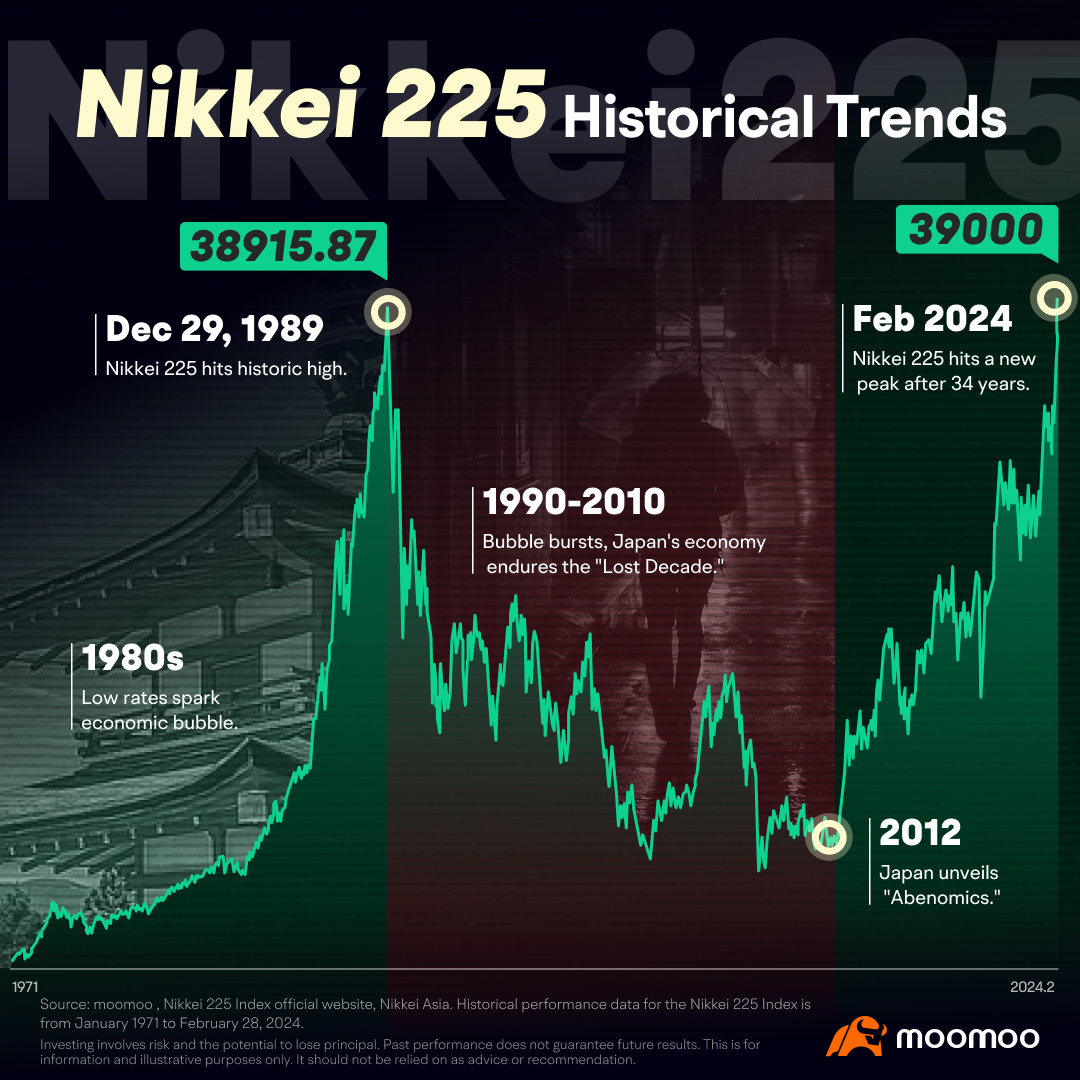
Since the end of 2012, the Nikkei 225 Index has embarked on a sustained upward trajectory, culminating in a fresh all-time high in 2024.
During this period, the Nikkei 225 Index amassed a cumulative gain of over 300%, even outperforming the S&P 500 Index over the same timeframe.
Many investors are eager to seize investment opportunities. A popular entry point for many is through Japan ETFs. These ETFs allow investors to gain exposure to the Japanese market without the need to research individual stocks, while also spreading out risk.
In the following sections, we'll introduce:
- Some Japanese stock ETFs listed in the U.S.
- Discuss the opportunities and risks of investing in the Japan stock market.
What Japan ETFs are available?
In the U.S. market, there are very few ETFs that directly track the Nikkei 225 Index. Most Japan ETFs track the MSCI Japan Index or some currency-hedged indices.
We can categorize these Japanese stock ETFs into two groups: those without currency hedging and those with currency hedging.
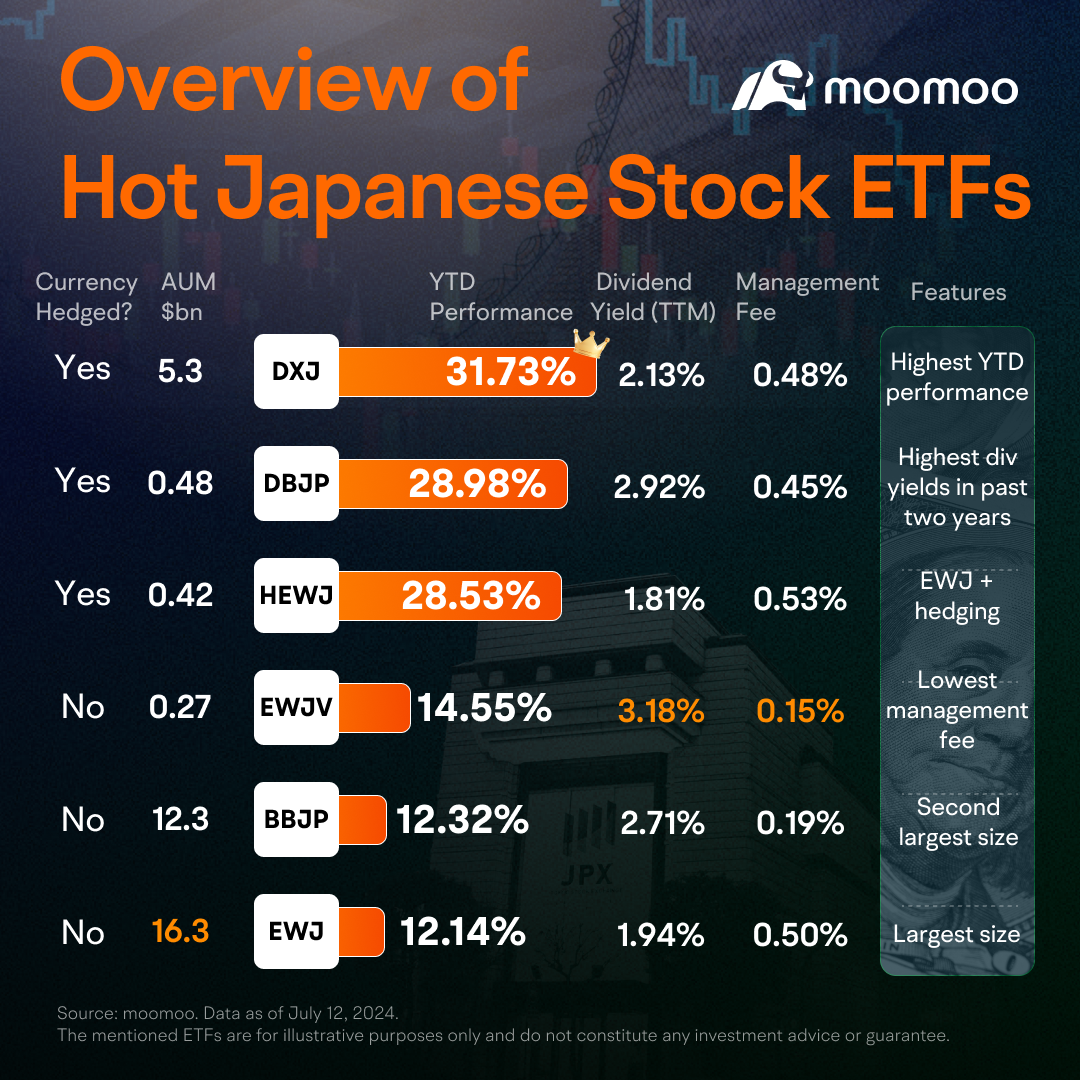
Based on screening criteria such as fund size, expense ratio, dividend yield, and other relevant metrics, we've identified several representative Japanese equity ETFs in the U.S. market.
Currency-hedged ETFs
The performance of this type of ETF is largely insulated from fluctuations in the yen-to-dollar exchange rate, enabling them to effectively capture the trends of the Japanese equity market.
$WisdomTree Japan Hedged Equity ETF (DXJ.US)$
Features: Highest historical returns
Overview: DXJ has been the best-performing Japanese stock ETF in 2024. In fact, it has consistently been a strong performer, earning a five-star Morningstar rating over the past 3, 5, and 10 years.
Target Demographic: Stability-seeking; buy-and-hold
$iShares Currency Hedged MSCI Japan ETF (HEWJ.US)$
Features: EWJ Holdings; hedging tools
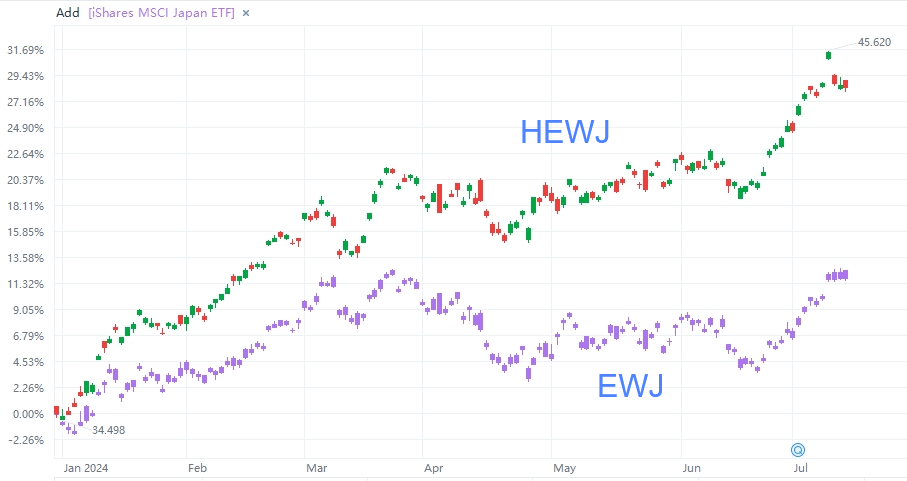
Overview: This ETF holds 99% of its assets in shares of EWJ, while simultaneously employing derivatives to hedge against fluctuations in the yen-to-dollar exchange rate, thereby providing a more accurate reflection of the true performance of Japanese equities. However, its drawback lies in its relatively small fund size.
Target Demographic: prefer a more diversified portfolio
$Dbx Etf Tr X-Trackers Japan Hedged Equity Fund (DBJP.US)$
Features: High dividends in recent years
Overview: DBJP tracks the same index as HEWJ, resulting in nearly identical returns and similar fund sizes. However, DBJP has a slightly lower management fee and higher dividend yields.
Target Demographic: High dividend lover
ETFs without currency hedging
Since 2021, the widening interest rate differential between the US and Japan has led to a sustained depreciation of the yen against the dollar, causing Japanese equity ETFs without currency hedging to underperform those with hedging mechanisms (exchange losses). However, this scenario is poised to reverse when the yen begins to appreciate.
$iShares MSCI Japan ETF (EWJ.US)$
Features: Established fund; largest in size
Overview: Launched in 1996, EWJ is one of the oldest funds, boasting the largest AUM and excellent liquidity. It invests in major Japanese companies such as Toyota, Mitsubishi UFJ Financial, and Sony. The holdings are well-diversified, with the top ten stocks comprising only 27% of the total portfolio.
Target Demographic: Stability-seeking
$JPMorgan BetaBuilders Japan ETF (BBJP.US)$
Features: Second largest in size; low fees
Overview: BBJP is the second-largest fund in its category. Although it tracks a different index, its holdings are quite similar to those of EWJ, with nearly identical performance. BBJP’s main advantage is its lower expense ratio of 0.19%.
Target Demographic: Stability-seeking; fee-sensitive
$iShares MSCI Japan Value ETF (EWJV.US)$
Features: High dividends; lowest fees; long-term investment
Overview: EWJV focuses on value stocks, offering a higher dividend yield. However, its smaller size of $270 million might mean slightly lower liquidity.
Target Demographic: Buy-and-hold
How to find the ETFs mentioned above
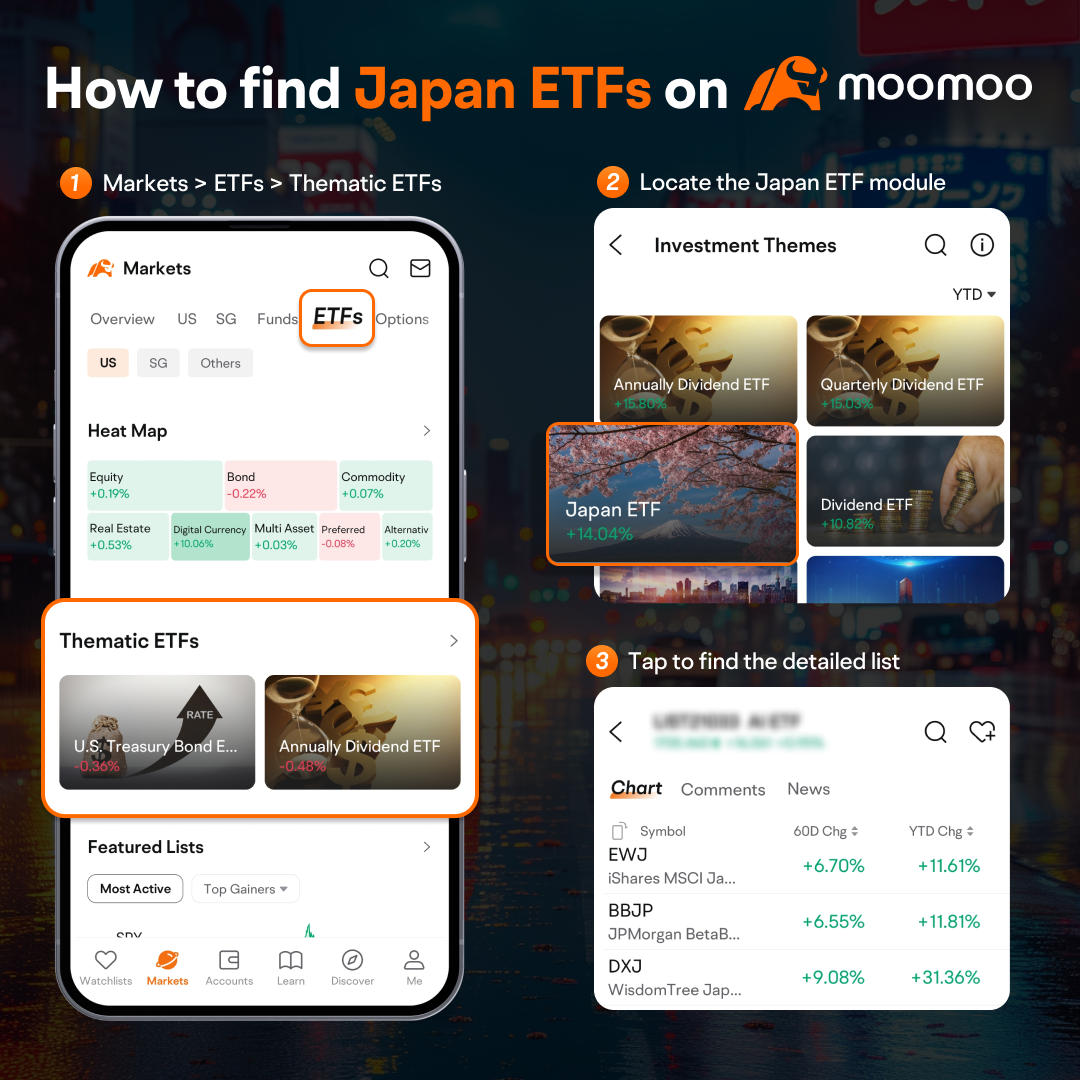
Open moomoo > Click on Markets > ETFs > Thematic ETFs.
What Drives the Prolonged Strength of the JP Stock Market?
The strength can be attributed to two main factors: fundamentals and capital flow.
1. Fundamentals: rising corporate earnings
From 2012 to 2023, the Nikkei 225 Index achieved a compound annual growth rate (CAGR) of 11.2%, while the earnings per share (EPS) of its constituent companies grew at a CAGR of 9.3%. This indicates that EPS growth has significantly contributed to the market's rise.
Several factors have boosted the profitability of Japanese companies:
Global Expansion: By 2024, approximately 70% of the revenue of publicly listed Japanese companies comes from international markets.
Yen Depreciation: The weakening yen has made Japanese products more competitive abroad and boosted profits (exchange rate gains).
2. Capital flow: influx of foreign investment
Warren Buffett's Influence: Warren Buffett has been bullish on Japanese stocks since 2020, citing their low valuations and strong corporate governance, which has encouraged more foreign capital to flow into the market.
Carry Trade: It refers to the practice of foreign investors borrowing yen at ultra-low interest rates to invest in higher-yielding assets. A prime example of this is Warren Buffett's borrowing of yen to invest in five major Japanese trading companies.

Risks
From the analysis above, we can outline the logic chain driving the rise in Japanese stocks:
Ultra-loose monetary policy > High interest rate differential > Yen depreciation > Increased corporate earnings and foreign capital inflow > Rise in Japanese stocks
As long as this logic chain remains intact, Japanese stocks are likely to continue their upward trend. In this scenario, hedged Japanese stock ETFs, such as DXJ, HEWJ, and DBJP, may continue to thrive in a bull market. Unhedged ETFs, like EWJ, BBJP, and EWJV, can also benefit, although their gains may be less pronounced.
However, the logic chain above cannot sustain indefinitely.
The Bank of Japan's conclusion of its negative interest rate policy in March 2024, alongside its first rate hike in 17 years, marks a historic turning point in Japanese monetary policy. Meanwhile, the Federal Reserve is edging closer to rate cuts. As bilateral interest rate differentials narrow, the yen's further depreciation becomes increasingly unlikely, and it may even reverse course and appreciate. In such a scenario, Japanese equities could come under pressure.
On July 31st, the Bank of Japan's announcement to raise the policy rate to 0.25% triggered a surge in the yen and widespread unwinding of carry trades. Consequently, the Nikkei index plummeted for three consecutive days, culminating in an unprecedented daily decline of 12.4% on August 5th.
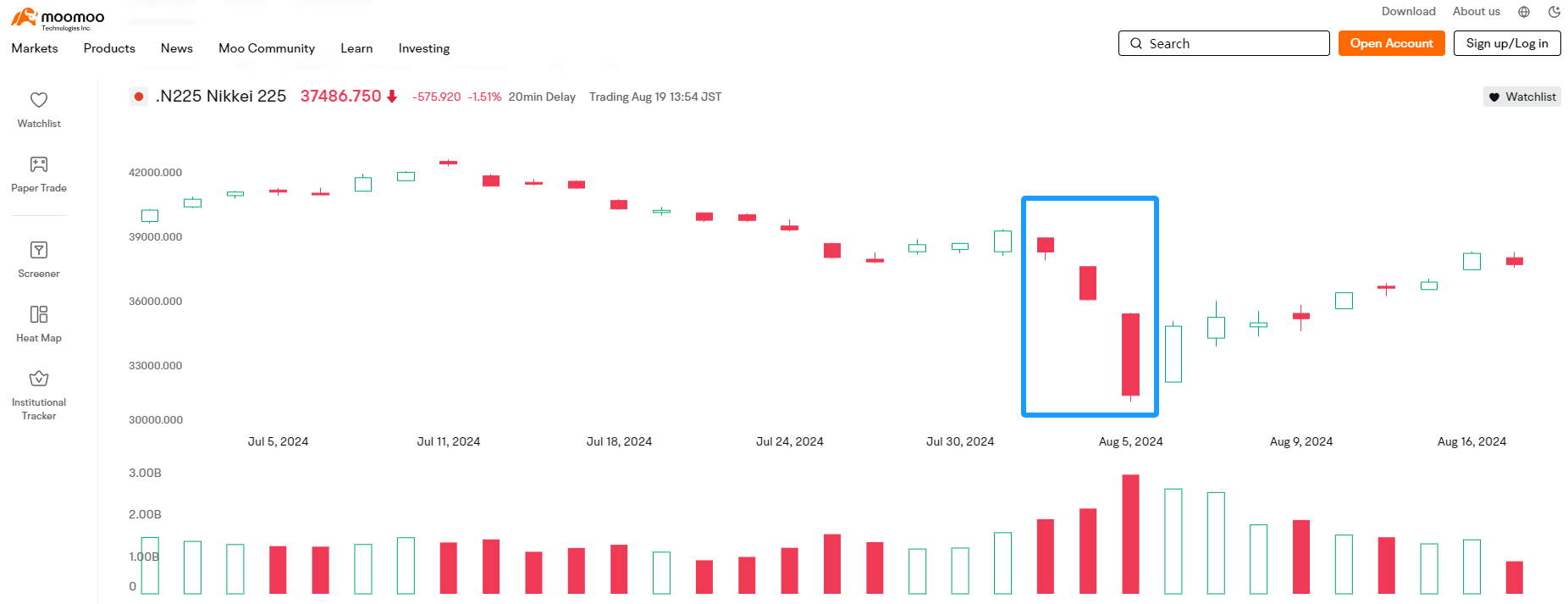
Hence, investing in Japanese stocks necessitates a keen eye on the country's monetary policy and the movement of the yen. Given the prevalence of Carry Trade strategies, Japanese stock markets may experience significant volatility during certain periods.
This presentation is for informational and educational use only and is not a recommendation or endorsement of any particular investment or investment strategy. Investment information provided in this content is general in nature, strictly for illustrative purposes, and may not be appropriate for all investors. Read more