Buying China at the dip: ETFs to watch
China, the world's second-largest economy, is expected to grow by 5.0% in 2024, according to the IMF's July 2024 outlook. This outpaces the 1.7% growth of developed economies and the 4.3% of emerging markets.
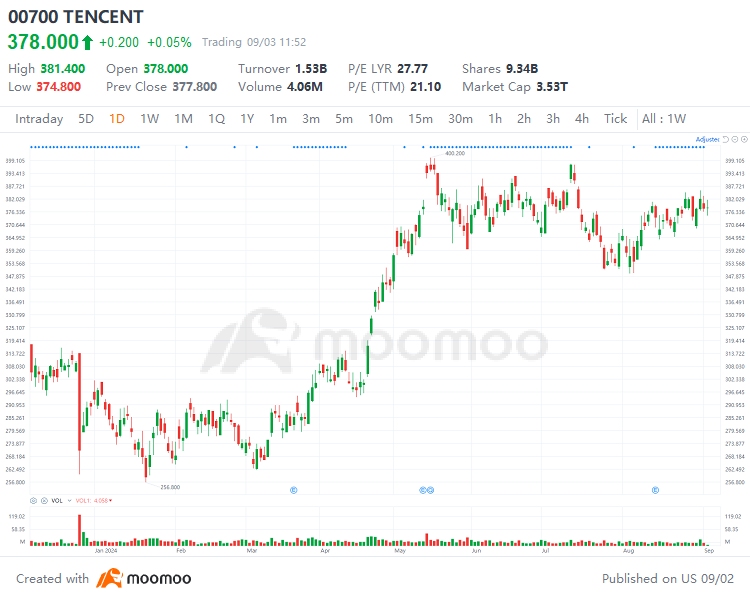
Despite setbacks after 2021, 2024 appears to mark a turnaround for China stocks. For instance, in the first eight months of 2024, $TENCENT (00700.HK)$ surged 32% and $Alibaba (BABA.US)$ 10%.
This content is for reference only and does not constitute investment advice. Past performance is not indicative of future results. Invest cautiously.
Several factors suggest Chinese stocks are becoming increasingly attractive:
- Ultra-low valuations: As of July 2024, the MSCI China Index had a PE ratio of just 11.6, near historical lows.
- Interest rate cuts: With the Federal Reserve lowering rates, international capital may seek higher returns in emerging markets like China.
- Yuan appreciation: The strong dollar may be ending with rate cuts, and the yuan has been appreciating since July, boosting Chinese assets.
If you're looking to invest in China but aren't familiar with individual stocks, explore China ETFs could be an option to consider. ETFs closely track an index, diversify risk, and keep costs low, making them popular for both beginners and seasoned traders. In the following sections, we'll explore various China ETFs available in the U.S. market to help you find the right fit.
Overview
Chinese companies can be categorized based on their listing locations into overseas China stocks and domestic A-shares.
I. Overseas China stocks
These stocks are primarily listed in Hong Kong and the U.S. Many are dual-listed, like Alibaba (US: BABA; HK: 9988), while some, like Pinduoduo (US: PDD), are only in the U.S.
Hong Kong listings are diverse in sector allocation (Internet, consumer, financial, healthcare, etc), while U.S. listings are concentrated in the Internet sector.
Most China ETFs focus on overseas stocks, with minimal currency risk since they're priced in USD or HKD.
II. A-shares
A-shares are listed in mainland China and priced in RMB, concentrated in financials, energy, consumer goods, and materials. They have a higher proportion of state-owned enterprises.
ETFs for A-shares access the market via Stock Connect or QFII and carry currency risk due to RMB holdings.
Overseas China stock ETFs: investing in the new economy
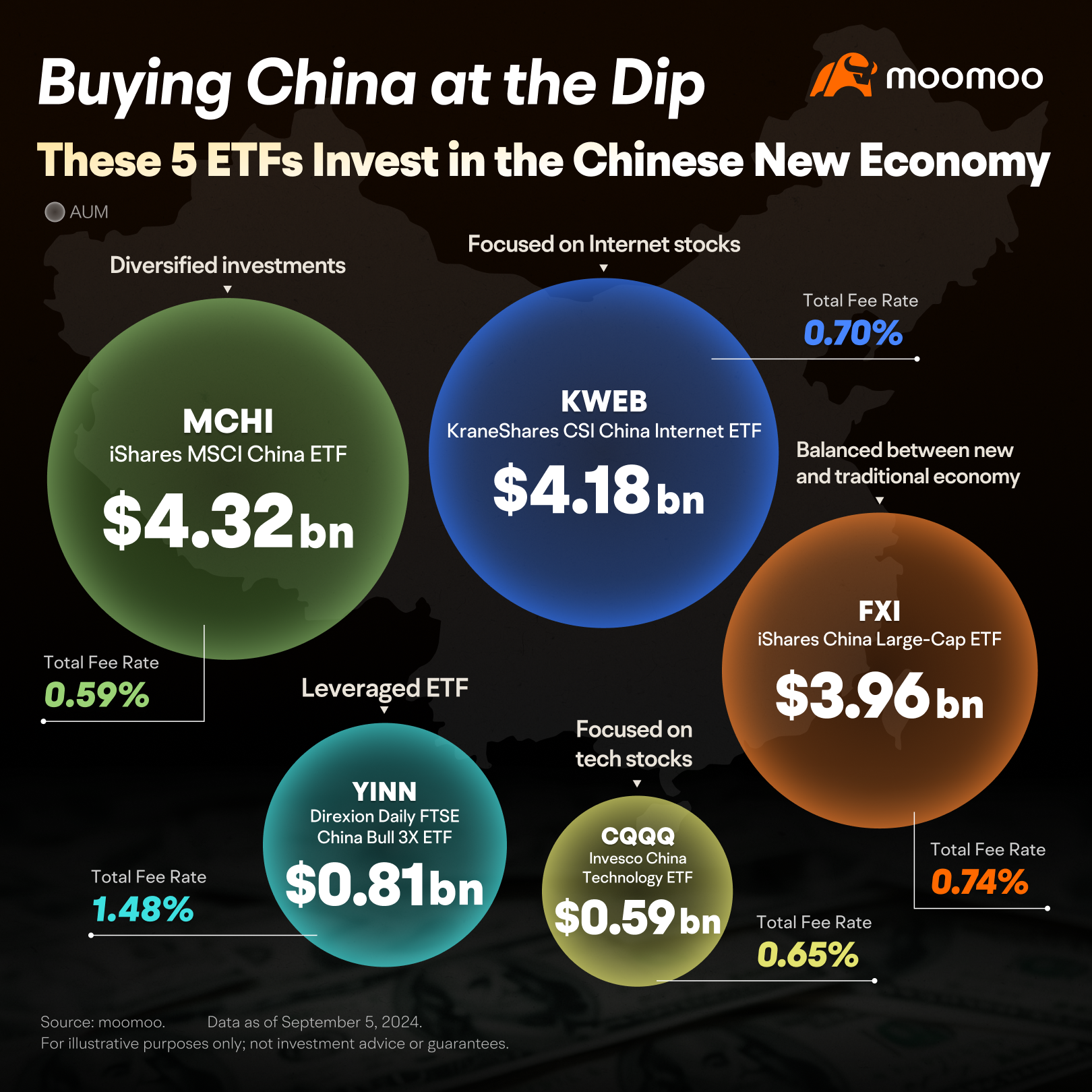
If you want exposure to China's new economy, including companies like Tencent and Alibaba, consider investing in overseas China stock ETFs. The largest and most actively traded China ETFs are MCHI, KWEB, and FXI.
$iShares MSCI China ETF (MCHI.US)$ tracks the MSCI China Index, offering a comprehensive reflection of China stock performance. As of the end of August 2024, it heavily invests in Tencent (17.2%) and Alibaba (8.5%), with a balanced mix across other stocks and sectors.
$KraneShares CSI China Internet ETF (KWEB.US)$ focuses exclusively on Chinese Internet companies listed overseas, holding about 30 stocks, leading to higher concentration.
$iShares China Large-Cap ETF (FXI.US)$ targets large-cap overseas China stocks listed in Hong Kong. It has a broader focus on traditional sectors like financials and energy, in addition to Internet companies.
Another actively traded option is $Direxion Daily FTSE China Bull 3X Shares ETF (YINN.US)$ , a leveraged ETF that magnifies the index's movements three times. (View What are the different types of ETFs? to learn more. ) While it offers higher potential returns, it also comes with increased risk and is not suitable for long-term holding.
Additionally, $Invesco China Technology ETF (CQQQ.US)$ by Invesco is notable for its focus on Chinese technology stocks. Beyond internet firms, it includes companies in electronics, semiconductors, and artificial intelligence, providing varied exposure to China's tech sector.
A-Shares ETFs: tapping into the world's second-largest stock market
There aren't many ETFs in the U.S. market that directly invest in A-shares, but the largest is $Xtrackers Harvest CSI 300 China A-Shares ETF (ASHR.US)$ .
As of September 2, 2024, ASHR has assets of approximately $1.12 billion, an expense ratio of 0.65%, and a year-to-date return of -1.7%.
ASHR tracks the CSI 300 Index, which is the most representative large-cap index for A-shares. This index includes leading companies from various sectors such as financials, consumer goods, industrials, technology, and materials. Historically, the CSI 300 Index has shown higher volatility than major indices in developed markets.

This content is for informational purposes only and does not constitute investment advice. Past performance is not indicative of future results. Investing involves risk; proceed with caution.
Other popular ETFs
- $Direxion Daily FTSE China Bear 3X Shares ETF (YANG.US)$ : An inverse ETF that amplifies the FTSE China 50 Index's movements thrice in the opposite direction. The expense ratio is 1.11%. Used for shorting or hedging, it carries high risk and isn't suited for long-term holding.
- $iShares MSCI Hong Kong ETF (EWH.US)$ focuses on Hong Kong stocks, mainly large-cap financial and real estate companies. Known for its high dividend yield, which was 4.83% as of September 2, 2024.
Final thoughts
Many China stocks offer significant growth potential and solid corporate governance, presenting opportunities for sustained investor returns. However, China stocks tend to be more volatile compared to those in developed markets.
Investors should also remain mindful of macroeconomic and geopolitical risks.
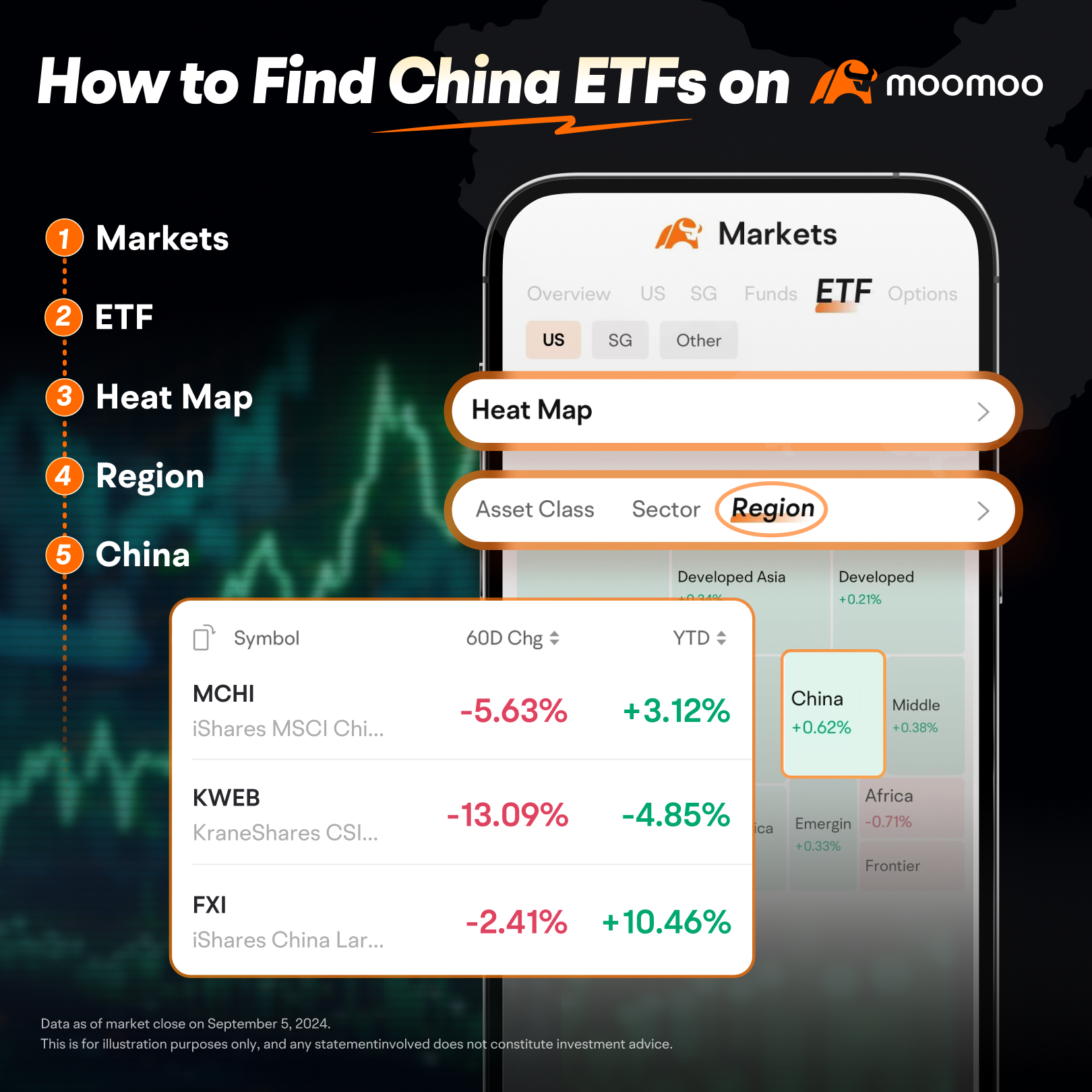
To explore and invest in China ETFs, you can follow these steps on moomoo:
This presentation is for informational and educational use only and is not a recommendation or endorsement of any particular investment or investment strategy. Investment information provided in this content is general in nature, strictly for illustrative purposes, and may not be appropriate for all investors. Read more