Afraid of NVDA's heights? Try an AI ETF!
Artificial Intelligence (AI) is leading the U.S. stock market to new historical highs. Following a massive 240% surge in 2023, $NVIDIA (NVDA.US)$ has continued to skyrocket by over 150% in 2024! With Nvidia at the helm, the AI ecosystem's stocks are also reaching new heights, delivering substantial gains to many investors.
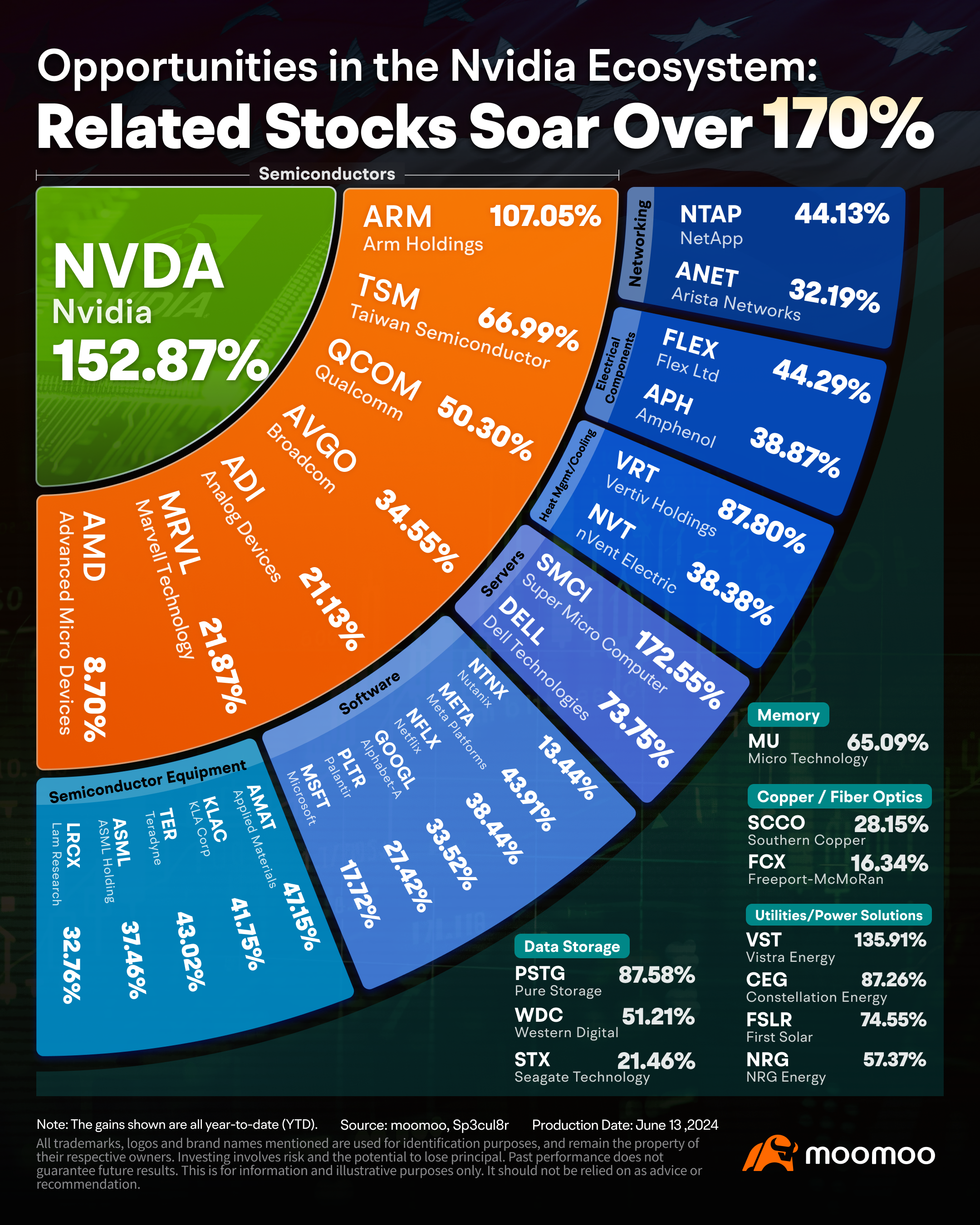
However, some investors are hesitant to dive into AI, perhaps wanting to invest in Nvidia but fearing the high risk after its rapid rise; or they wish to diversify into AI concept stocks but are unsure of how to choose. Are you in the same boat?
At such times, investing in an AI ETF might be a choice. In this article, we will discuss how to invest in AI ETFs. If you are not familiar with the basic concept of ETFs, you may want to read the following section.
What should you look for when choosing an AI ETF?
When choosing an AI ETF, the most important thing to look at is the holdings. There are two main points to consider: first, the concentration of holdings, and second, the AI areas that the holdings emphasize.
Concentration
Some AI ETFs allocate a significant portion of their funds to AI industry leaders, while others adopt a more diversified approach. Deciding between the former and the latter may be the first important decision you need to make.
Microsoft, Nvidia, and Apple are currently among the largest companies in the U.S. and globally, each having strong ties with AI leader OpenAI. In some AI ETFs, the combined share of these three major companies can account for as much as half of the total. Additionally, Google and Meta are also among AI industry leaders.
While ETFs heavily invested in these leaders might perform exceptionally well in boom times (as seen in 2024), they could also be more vulnerable during downturns.
AI areas emphasized
The AI industry can be divided into three layers: the infrastructure layer, the algorithm layer, and the application layer.
The infrastructure layer, represented by AI chips and cloud computing, is developing the best, with companies along the industry chain already beginning to realize performance; the algorithm layer, represented by large models, is making rapid technological progress but is not yet mature in terms of commercialization; the application layer, represented by autonomous driving and robotics, is currently advancing slowly, but has great potential for the future.
When selecting an AI ETF, you need to consider which of these areas its holdings emphasize.
In addition to the holdings, factors such as fund size, historical performance, expense ratio, and institutional ratings should also be considered when selecting an AI ETF. Taking the U.S. market as an example, we have identified 10 representative AI ETFs based on a comprehensive consideration of these factors. Here is an overview of their holdings.
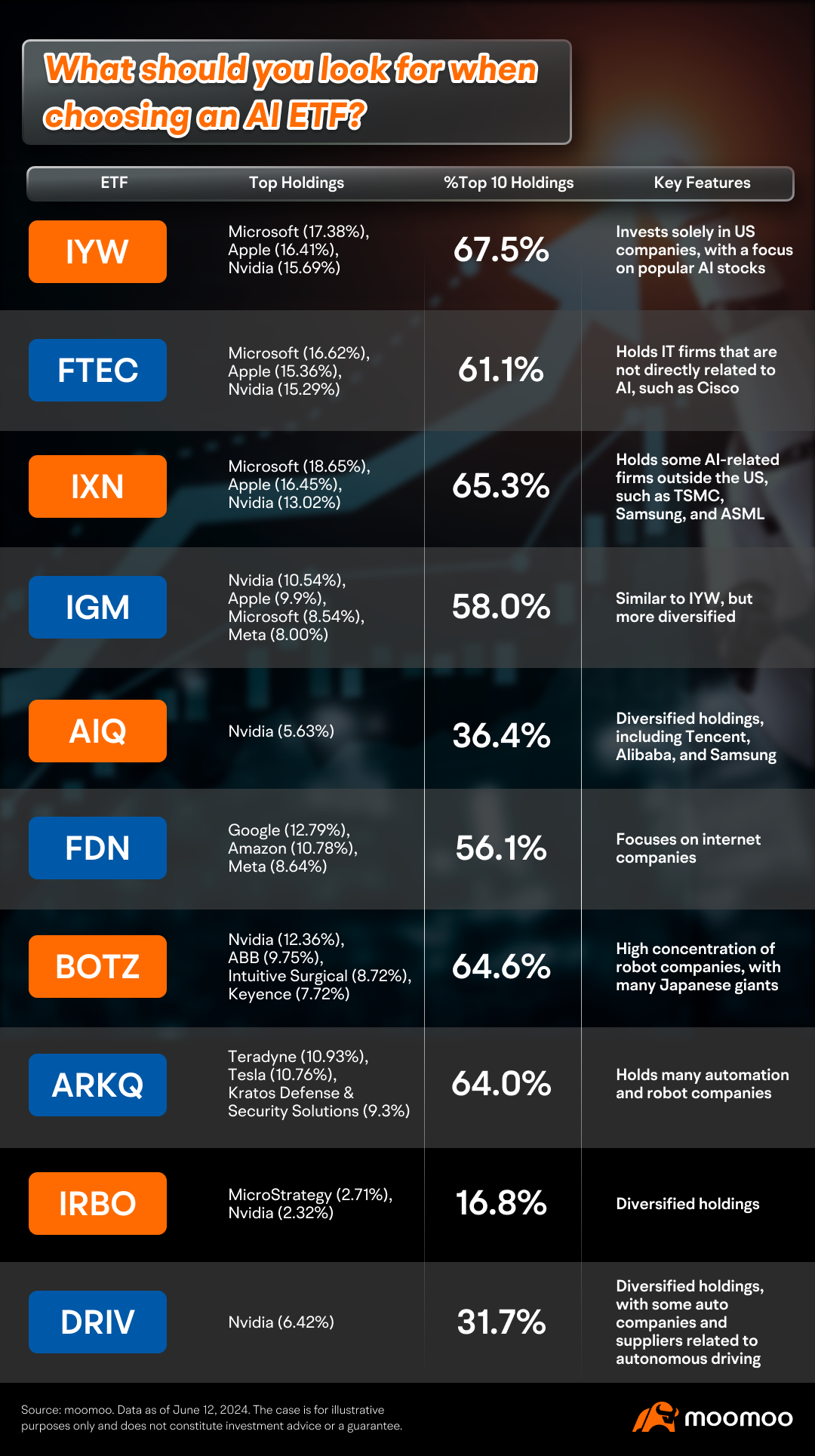
How do different holdings affect the performance of an ETF? Let's take a look at the returns of the aforementioned AI ETFs next.
How's the performance of AI ETFs?
As of June 12, 2024, the year-to-date performance of the aforementioned ETFs is shown in the table below:
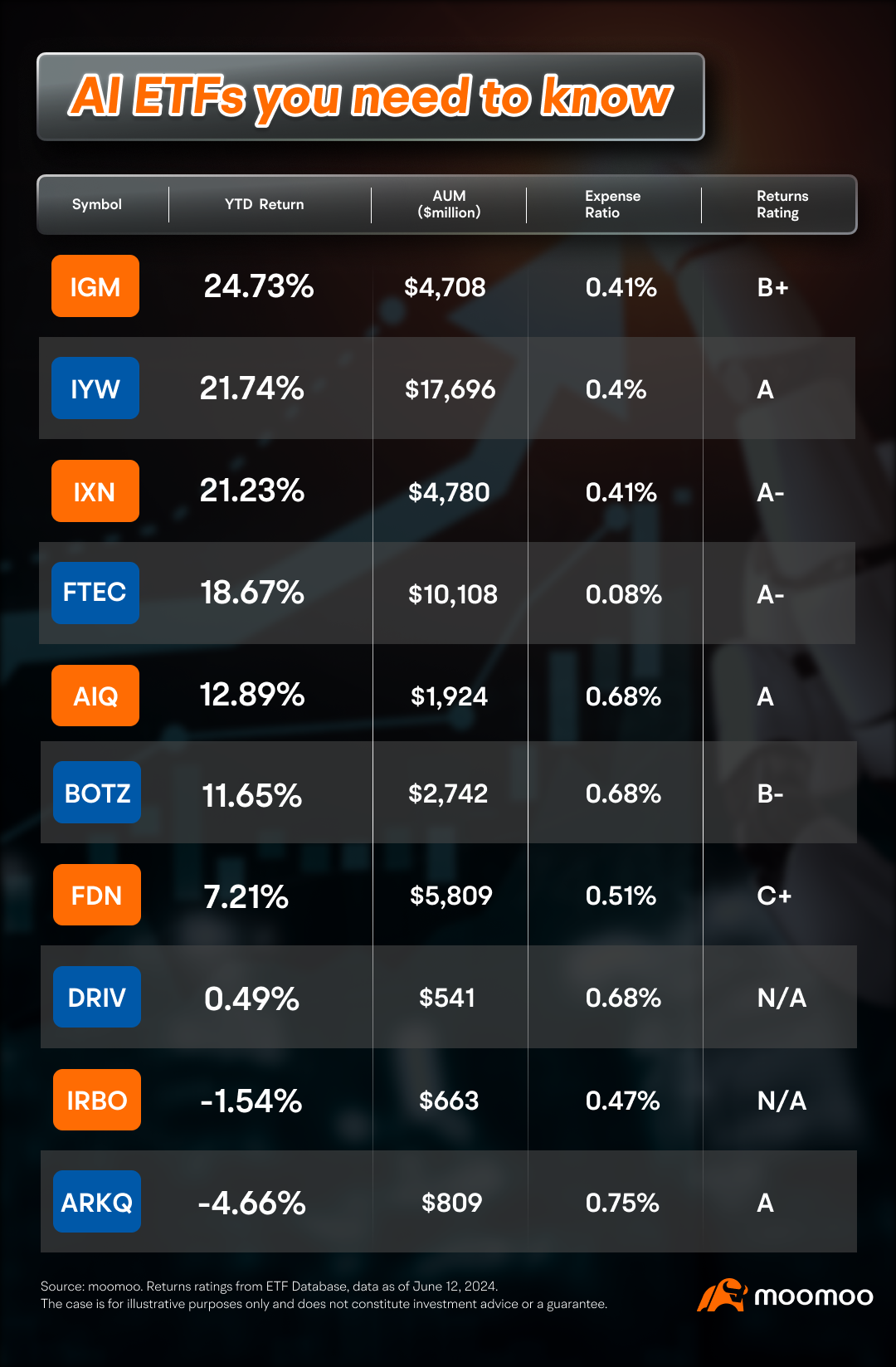
It is evident that not all AI ETFs can generate substantial returns for investors. What factors contribute to this disparity? Let's analyze a few ETFs to understand better.
"Over-achievers"
$iShares US Technology ETF (IYW.US)$
$Fidelity Covington Trust Msci Information Technology Index Etf (FTEC.US)$
$Ishares Global Tech Etf (IXN.US)$
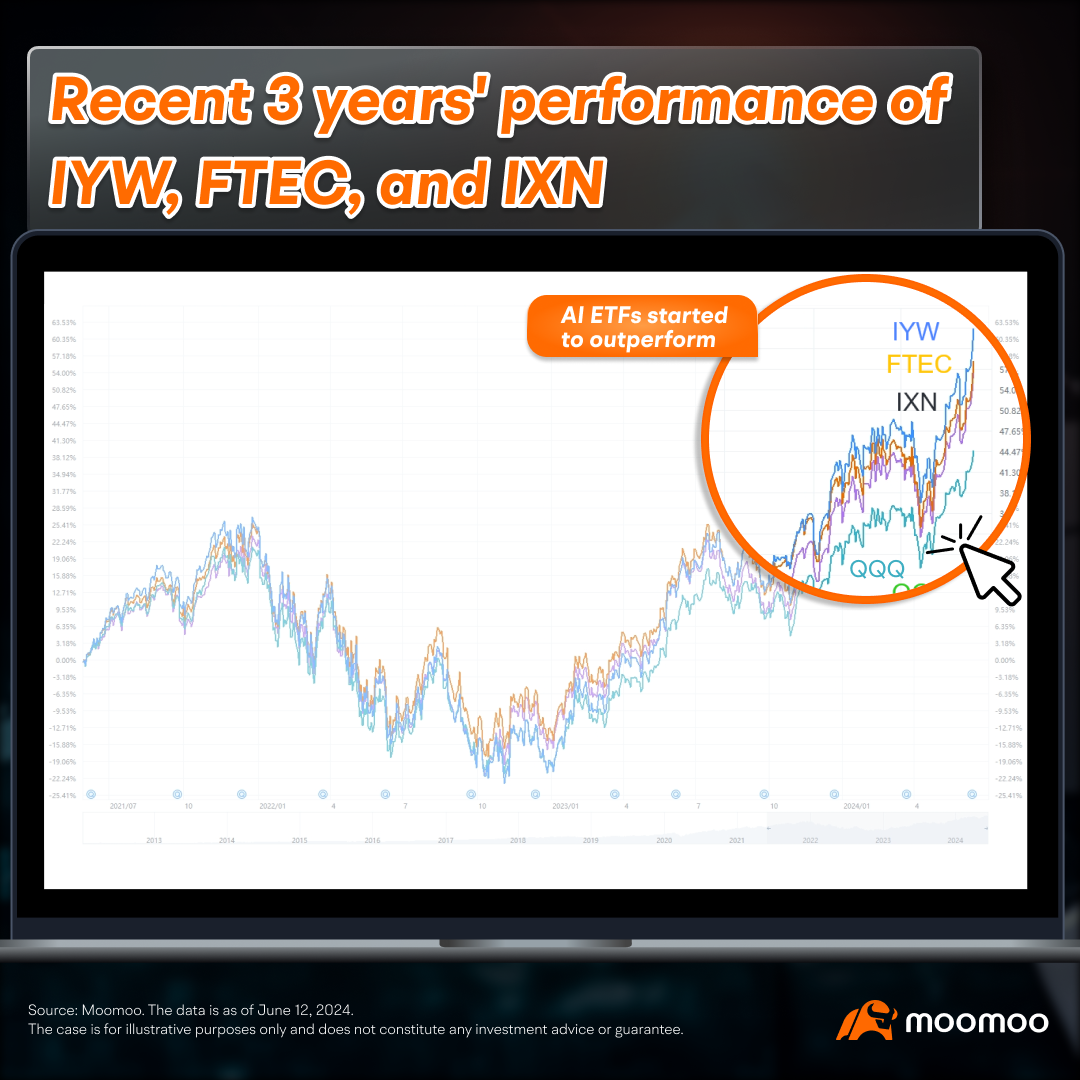
The following chart shows the performance of the top three performing ETFs (IYW, FTEC, and IXN) in the first half of 2024 and a comparison with $Invesco QQQ Trust (QQQ.US)$. It can be seen that all three AI ETFs have outperformed QQQ, but their volatility is also higher than QQQ. Among the three, FTEC has the highest volatility.
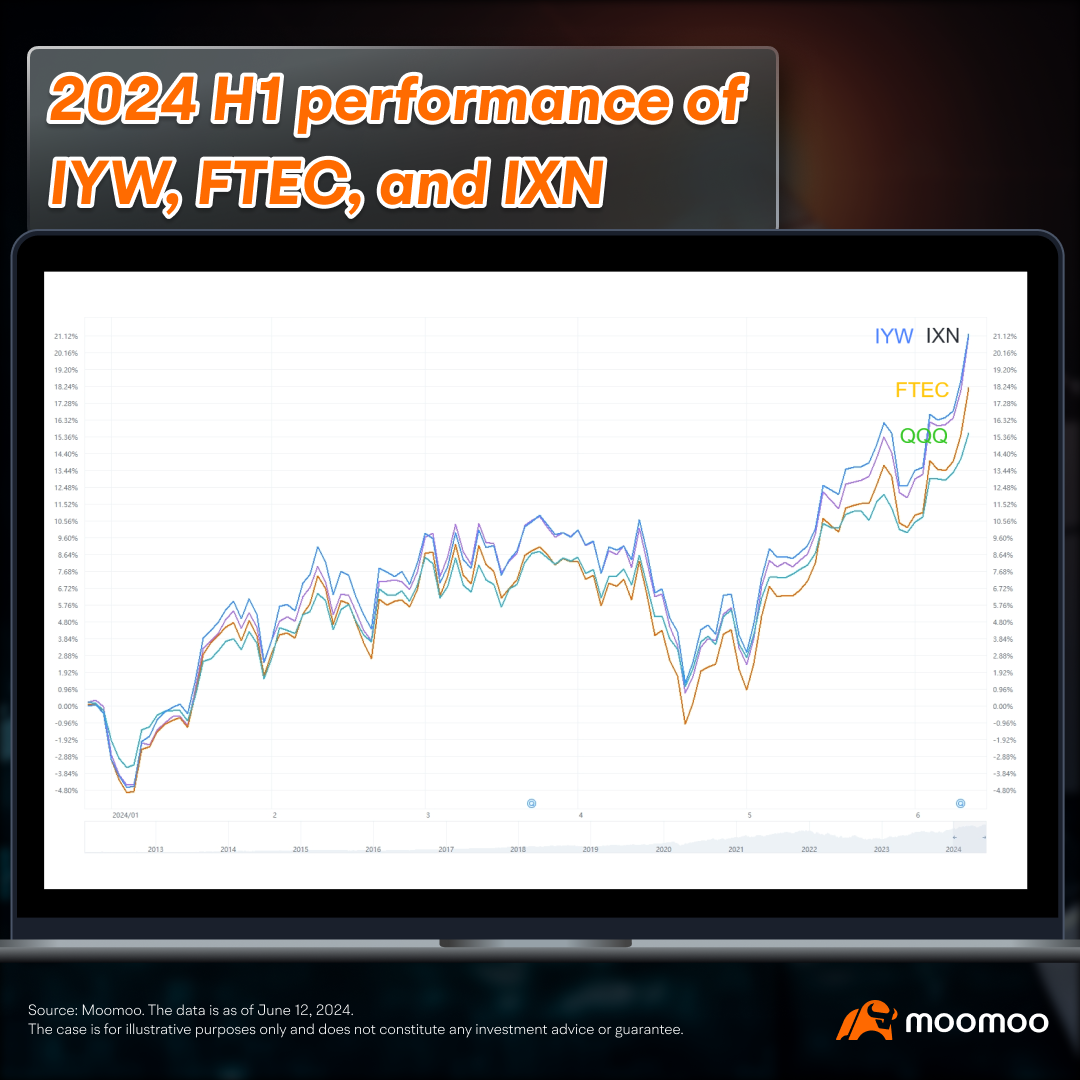
These three ETFs outperformed QQQ mainly due to their high concentration of holdings in Microsoft, Apple, and Nvidia, each comprising around 15% of the portfolio. These companies, recognized as leaders in AI, have shown strong performance in the first half of 2024, with Nvidia standing out in particular.
If we look at a longer timeframe, these three ETFs have outperformed QQQ by at least 10% in three-year cumulative returns, with the gap gradually widening after 2023. In the beginning of that year, generative AI emerged, and the investment opportunities of AI ETFs started to become apparent.
"Underachievers"
$ARK Autonomous Technology & Robotics ETF (ARKQ.US)$
$Ishares Robotics And Artificial Intelligence Multisector Etf (IRBO.US)$
$Global X Autonomous & Electric Vehicles ETF (DRIV.US)$
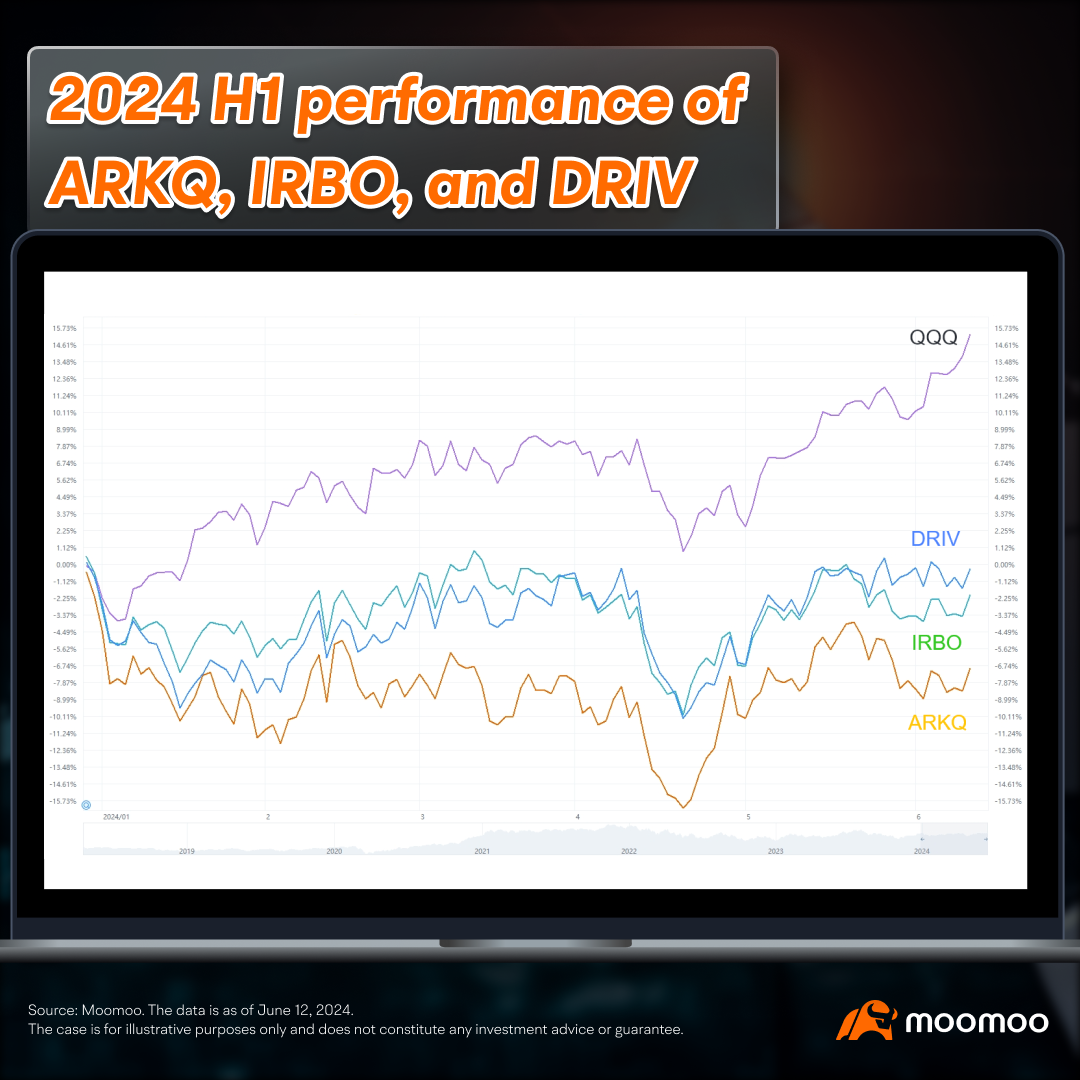
Now let's discuss the ETFs that have not performed well. These three ETFs have not generated much profit this year and have significantly underperformed QQQ.
Even when we extend the timeframe to three years, they still underperform QQQ, and all of them have negative growth.
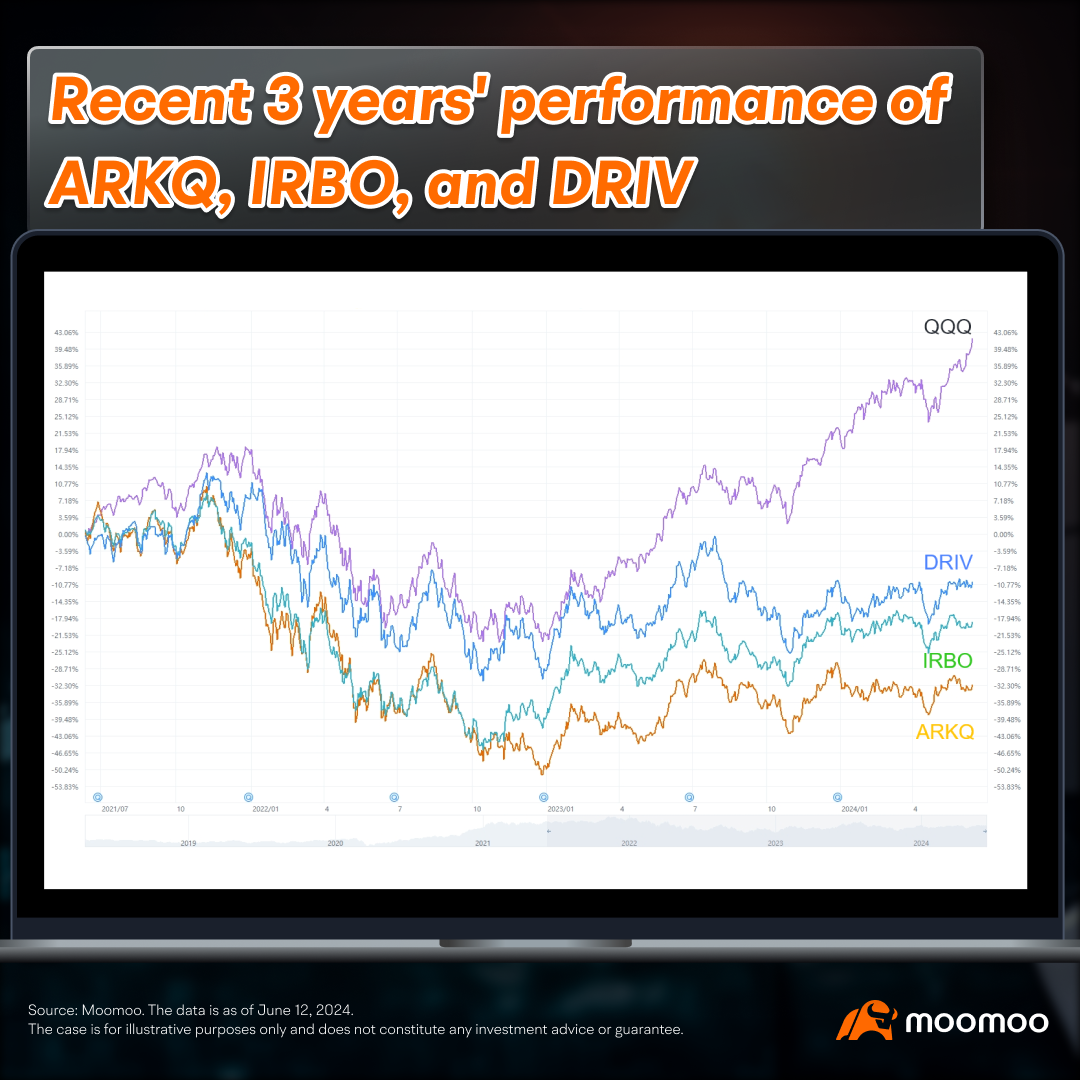
Why did these three AI ETFs underperform? It's because they focus on the fields of robotics, automation, and autonomous driving, which have not performed well in 2024 and the past three years. Although they also hold popular AI stocks such as Nvidia, their proportion is not large enough to reverse the overall trend of their holdings.
Although robotics, automation, and autonomous driving are not directly related to generative AI, their huge prospects for AI applications cannot be ignored. Therefore, when investing in AI ETFs, we should not solely rely on their recent performance but also consider their prospects.
AI ETF Investment Takeaways
1. If the trend of AI leaders like Nvidia appears to be continuing upward, AI ETFs with a higher concentration in these leaders, such as:
$iShares US Technology ETF (IYW.US)$
$Fidelity Covington Trust Msci Information Technology Index Etf (FTEC.US)$
$Ishares Global Tech Etf (IXN.US)$
$Ishares North American Tech Etf (IGM.US)$
might be an option to explore. However, be mindful of the potential for corrections in these AI leaders.
2. For diversification of holdings in AI concept stocks across the U.S. and internationally, globally-oriented AI ETFs, such as:
$Ishares Global Tech Etf (IXN.US)$
$Global X Artificial Intelligence & Technology ETF (AIQ.US)$
could be options to explore. However, be mindful that exchange rate factors could potentially impact portfolio performance.
3. If AI appears to have potential in areas like robotics and autonomous driving, AI ETFs that focus more on these sectors, such as:
$Global X Robotics & Artificial Intelligence Thematic ETF (BOTZ.US)$
$ARK Autonomous Technology & Robotics ETF (ARKQ.US)$
$Ishares Robotics And Artificial Intelligence Multisector Etf (IRBO.US)$
$Global X Autonomous & Electric Vehicles ETF (DRIV.US)$
may be worth exploring. However, be aware that short-term returns might not be satisfactory.
4. Additionally, if investments are intended for long-term hold, ETFs with a larger fund size, lower expense ratio, and more diversified holdings might be more suitable for long-term investment, such as:
$Fidelity Covington Trust Msci Information Technology Index Etf (FTEC.US)$
$Ishares North American Tech Etf (IGM.US)$
On moomoo, you can navigate to Market > ETF > Theme ETFs to find the AI ETF section, where you can see a more detailed list of AI ETFs.
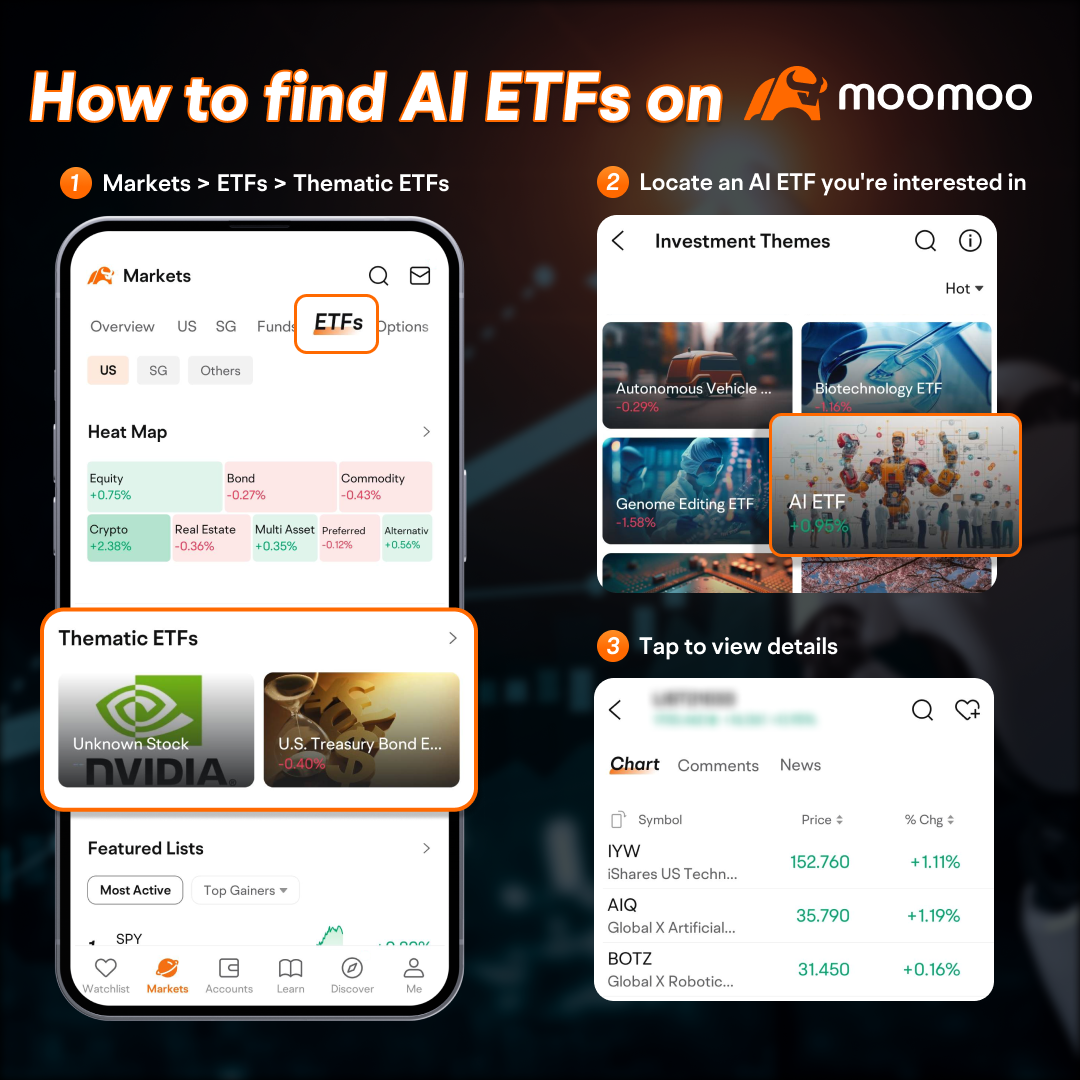
For the key screening criteria we mentioned earlier (holdings, fund size, expense ratio), here's how to find them on moomoo: Click on a specific ETF product, then click on Fund, where you can see the ETF's holdings in Holding Details, the fund size in Asset Size, and the management fee in Basic Information.

This presentation is for informational and educational use only and is not a recommendation or endorsement of any particular investment or investment strategy. Investment information provided in this content is general in nature, strictly for illustrative purposes, and may not be appropriate for all investors. Read more