The SMSF trustee's guide: corporate trustee vs individual trustee smsf
SMSF trustee structure, corporate trustee vs individual trustee, SMSF setup, SMSF property borrowing, ATO SMSF rules.
What is an SMSF Trustee?
In Australia, an SMSF is legally structured as a trust. The trustee is the person or entity legally responsible for managing the fund, making investment decisions, and ensuring strict compliance with superannuation and tax laws.
Individual Trustee Structure: Each member of the fund is appointed as an individual trustee.
Corporate Trustee Structure: A special-purpose company acts as the trustee, and all fund members are appointed as directors of that company.
Regardless of the structure chosen, all trustees and directors share equal responsibility under the Superannuation Industry (Supervision) Act 1993 (SIS Act) and must meet the ATO's compliance requirements.

Individual Trustee Structure: Overview, Pros & Cons
Under an individual trustee structure, assets are registered under the personal names of all trustees on behalf of the fund.Under Australian SMSF trustee rules, an SMSF with individual trustees must have at least two trustees.For a single-member SMSF, a second individual trustee must be appointed (who cannot be an employer unless they are relatives).
Pros of Individual Trustees
Lower Upfront Setup Costs: You don’t need to register a new company, saving initial establishment and ASIC fees.
No Annual ASIC Maintenance Fees: Because no corporate entity is established, there are no ongoing annual ASIC review fees.
Simpler Initial Governance: Fewer corporate compliance requirements, such as maintaining a company constitution or holding formal board meetings.
Cons of Individual Trustees
Administrative Headache During Member Changes: If a member joins, leaves, divorces, or passes away, the legal ownership title of every single fund asset (bank accounts, shares, real estate) must be updated.
Penalty Exposure: ATO administrative penalties for non-compliance are imposed on a per-trustee basis. For example, a two-member individual fund faces double the total penalty amount of a corporate trustee for the exact same breach.
Strict Succession Rules: If an individual trustee dies or resigns, the fund has only 6 months to appoint a replacement, convert to a corporate trustee, or wind up.
Lending Restrictions: Many Australian banks and commercial lenders impose strict limitations or higher hurdles on lending to SMSFs with individual trustees.
Corporate Trustee Structure: Overview, Pros & Cons
Under a corporate trustee structure, a private company (usually registered as a Special Purpose SMSF Company) is incorporated to act as trustee. The fund’s assets are registered solely in the legal name of the company.
Pros of Corporate Trustees
Seamless Member and Asset Management: When members join or leave, you simply update the company's director details with ASIC and the ATO. The legal title of the fund assets remains unchanged in the company’s name.
Greater Succession & Single-Member Flexibility: A corporate trustee allows a single individual to act as sole member and sole director. If a director passes away, the company structure continues seamlessly.
Lower ATO Penalty Exposure: Because a corporate trustee is treated as a single entity, ATO administrative penalties apply once at the corporate level rather than per person.
Preferred Structure for Property & Borrowing: Lenders strongly prefer corporate trustees when establishing Limited Recourse Borrowing Arrangements (LRBA) for property purchases.
Clear Asset Protection & Separation: Having a corporate entity creates a clear boundary between personal/business assets and fund investments, reducing audit and asset-mixing risks.
Cons of Corporate Trustees
Higher Initial & Ongoing Costs: Requires company registration fees with ASIC upfront and annual ASIC review fees (though special-purpose SMSF companies enjoy reduced ASIC fees).
Additional Corporate Compliance: In addition to complying with superannuation and tax laws, directors must also comply with the Corporations Act 2001, company constitutions, and obtain a unique Director ID prior to registration.
At a Glance: Individual vs Corporate Trustee Comparison
Feature | Individual Trustee | Corporate Trustee |
Asset Ownership Title | Personal names of all trustees | Company name |
Single-Member Funds | Not allowed; requires 2 individual trustees | Allowed; member can be sole director |
Member Changes Admin | High; must re-title every asset | Low; update ASIC/ATO director records |
ATO Administrative Penalties | Levied per individual trustee (higher overall) | Levied per corporate entity (lower overall) |
Setup & Ongoing Costs | Lower upfront; no ASIC fees | Higher upfront; annual ASIC review fees |
Lender Preference (LRBA) | Strict restrictions or lower approval rates | Highly preferred by Australian lenders |
Which Structure Should You Choose?
Choose an Individual Trustee Structure if:
You are setting up a simple fund with a stable membership (e.g., a couple) and expect no changes.
You want to minimize upfront setup expenses and avoid ongoing ASIC annual fees.
You do not intend to borrow funds or purchase property using an LRBA.
Choose a Corporate Trustee Structure if:
You are a single-member SMSF.
You plan to buy property using an SMSF loan (LRBA).
You anticipate future membership changes (e.g., adding adult children or future estate transitions).
You want peace of mind regarding compliance, asset protection, and lower penalty risks.
FAQ
1. Can I change from an individual trustee to a corporate trustee later?
Yes, you can restructure your fund at any time. However, doing so requires updating the SMSF Trust Deed, registering a new company, and formally transferring/re-titling all existing fund assets, which can incur significant legal, accounting, and administrative costs.
For this reason, it is generally recommended that you choose your long-term trustee structure at the outset.
2. What is a corporate trustee smsf?
A corporate trustee SMSF is a self-managed super fund structure where a company (usually established as a special-purpose SMSF company) acts as the legal trustee of the fund. Instead of members holding fund assets in their personal names, the corporate entity holds the legal title to all investments on behalf of the SMSF, while the fund members serve as directors of the company.
3. Do corporate trustee directors need a Director ID?
Yes. Under Australian law, all corporate trustee directors must apply for a Director Identification Number (Director ID) before the SMSF registration process can be finalized.
4. How many trustees can an SMSF have?
An SMSF can have between 1 and 6 members/trustees.
For an individual trustee structure, the fund must have a minimum of 2 individual trustees and a maximum of 6.
For a corporate trustee structure, the fund can have between 1 and 6 directors, allowing a single-member SMSF to operate with just 1 director.
How to start SMSF investing with moomoo?
If you don't have an SMSF account:
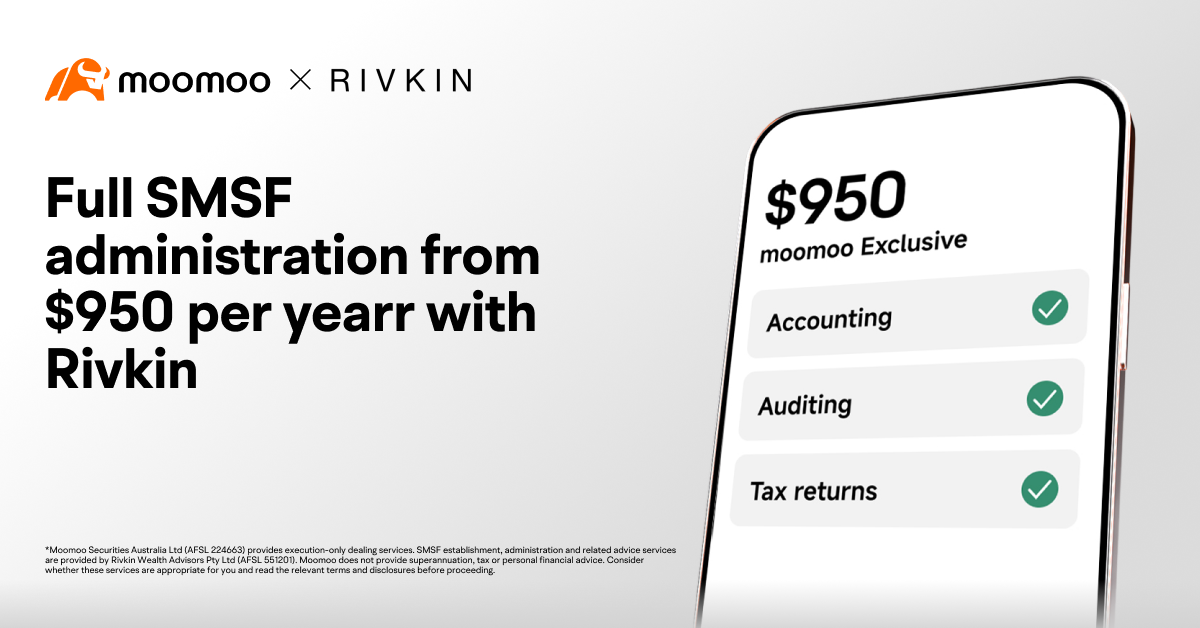
To provide comprehensive SMSF support, we partner with Rivkin, a trusted Local-based SMSF specialist with more than 40 years of industry experience.
Trusted local expertise
Partner with local SMSF specialists with more than 40 years of experience helping Australian manage their investments.
2. Streamlined all-in-one setup
It's all covered in one simple procress, from setting up a trust to opening your moomoo trading account.
3. Competitive pricing
Exclusive SMSF pricing for moomoo clients, whether you're setting up a new SMSF or need ongoing support for an existing one. Annual service fees from $950.*
Open an SMSF account->
Automate your SMSF data flow
Moomoo has partnered with Class to enable an automated data feed for moomoo SMSF accounts. With your consent, your transaction and portfolio data can be securely shared with the Class software widely used by your accountant or SMSF administrator, helping reduce manual data entry and improve reporting efficiency.
If you already have an SMSF account:
To open an SMSF trading account, you are required to provide the following information: the full name of the SMSF trust, Australian Business Number (ABN), Tax File Number (TFN), and identity verification documents. For more details, please visit: How to open and manage an SMSF trading account with moomoo
Once you have prepared the above documents, you can open your moomoo SMSF Account via the following 3 methods:
Option 1: Open directly in 4 simple steps by clicking the link:
New users:opening an moomoo SMSF Account.
Existing moomoo users:add an moomoo SMSF Account.
*You can also contact support anytime through the moomoo app.
Option 2: Book a 1-on-1 consultation
Book a 1-on-1 consultation with moomoo’s SMSF specialist team, where you can learn about moomoo SMSF account opening procedures and relevant investment strategies.
Option 3: Visit team moomoo in personOpen your moomoo SMSF account at our Chatswood store with in-person support.
Address: Shop 66, 427–441 Victoria Avenue, Chatswood NSW
please include disclaimer when refering the above pricing $950.
*Fees are Inclusive of GST. Moomoo AU may receive fees from the above third-party SMSF administrators for referrals that result in the purchase of their services. Moomoo AU does not provide any advice or recommendations with regard to the providers' services or the suitability of establishing an SMSF in general. Please seek professional advice from a qualified financial adviser and/or accountant where necessary.
Moomoo Securities Australia Ltd (AFSL 224663) provides execution-only dealing services. SMSF establishment, administration and related advice services are provided by Rivkin Wealth Advisors Pty Ltd (AFSL 551201). Moomoo does not provide superannuation, tax or personal financial advice. Consider whether these services are appropriate for you and read the relevant terms and disclosures before proceeding.
This presentation is for informational and educational use only and is not a recommendation or endorsement of any particular investment or investment strategy. Investment information provided in this content is general in nature, strictly for illustrative purposes, and may not be appropriate for all investors. Read more