Buying The Dip: What Should You Know During Market Volatility?
In early April 2025, the Australian stock market experienced a significant downturn, with the S&P/ASX 200 shedding approximately $100 billion in value—one of the largest single-day drops in recent years.. This sharp drop was triggered by the announcement of sweeping tariffs by U.S. President Donald Trump, which raised concerns about a potential global trade war and its potential impact on the Australian economy.
This downturn raises a crucial question for investors: Should you buy the dip? The phrase "buy the dip" refers to the strategy of investing in the stock market after it has experienced a significant decline, with the hope of securing undervalued assets. In this article, we'll delve into the nuances of the "buy the dip" strategy, exploring its potential benefits and risks for Australian investors navigating bear markets.
What does buy the dip mean?
"Buy the dip" is an investment strategy that involves purchasing stocks or assets after their prices have fallen, with the expectation that they will rebound. This approach is based on the principle of "buy low, sell high," where investors aim to capitalize on temporary market downturns by acquiring undervalued assets at discounted prices. The strategy is often discussed during market declines, such as those triggered by significant economic events like President Trump's tariff announcements.
In essence, buying the dip requires identifying assets that have strong fundamentals but have been sold off due to broader market sentiment or overreaction. Investors then increase their exposure to these assets, anticipating a recovery that could yield higher returns. However, this strategy carries risks, as market downturns can persist, leading to further losses if not managed carefully.
What is a buy the dip strategy?
The "buy the dip" strategy involves purchasing assets during periods of downward price pressure, with the expectation that their prices will recover. This approach is based on the theory that market fluctuations and short-term declines are often followed by price recoveries and potential long-term growth. Investors employing this strategy aim to capitalize on temporary market corrections, buying assets at discounted prices and selling them when prices rebound.
How does buy the dip work?
Markets tend to move in cycles, with prices fluctuating within longer-term trends. Buy the dip investors seek to identify cyclical low points as optimal entry points and exit during cyclical highs, often referred to as "buy the dip" and "sell the rip". This strategy can be aligned with market cycles, which typically include four phases: accumulation, markup, distribution, and markdown. Investors often look to enter trades during the accumulation phase and sell during the distribution phase.
Examples of buying the dip
A notable example of the "buy the dip" strategy in action is the stock market's response to the COVID-19 pandemic in early 2020. During this period, the S&P 500 Index experienced a significant decline of about 31% due to economic shutdowns and uncertainty. However, after hitting its low, the index rallied substantially. Investors who bought into the market during this dip were able to capitalize on the subsequent recovery, earning substantial returns as the market rebounded.
Another example can be seen in the case of a company like NVIDIA. Suppose NVIDIA's stock price drops significantly due to a broader market downturn or a short-term negative news event, despite its strong fundamentals remaining intact. An investor using the "buy the dip" strategy would purchase NVIDIA shares during this period, anticipating that the stock price will recover as the market stabilizes or as NVIDIA continues to perform well. If the stock price rebounds, the investor can sell the shares at a higher price, potentially earning a profit.
In both scenarios, the key to success lies in identifying assets with strong underlying fundamentals and timing the purchase correctly to maximize returns while managing risk.
When to buy on the dip?
Implementing a "buy the dip" strategy can be beneficial when an asset's long-term price trajectory is upward, as acquiring shares during temporary declines lowers the average purchase cost and potentially enhances future returns. However, this approach carries risks, particularly if price declines persist over an extended period, leading to increased exposure and potential further losses.
A clear example of market overreaction was during the early days of the COVID-19 pandemic in February and March 2020. Uncertainty around the global economic impact led to sharp declines in the stock market. The S&P 500 Index, which reflects the performance of 500 leading U.S. companies, dropped around 31% before bottoming out and beginning a strong recovery. This rebound was largely driven by swift fiscal and monetary responses, along with growing clarity around the virus.
S&P 500 Index Historical Chart
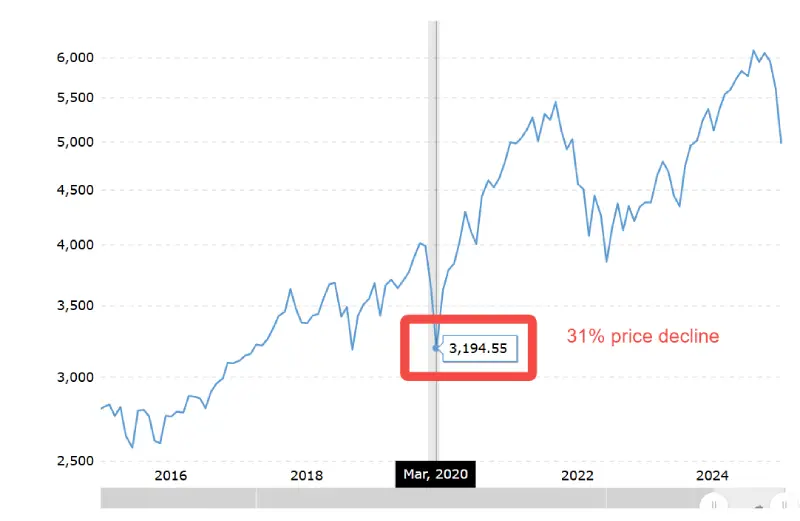
Source from: https://www.macrotrends.net/2324/sp-500-historical-chart-data
However, not all dips recover as quickly—or at all. If governments hadn’t acted fast, or if the virus had caused more severe damage, markets might have continued to decline. In many other cases, stocks or sectors that dip never fully bounce back. That’s why investors must carefully assess the reason behind a dip before jumping in. Blindly buying into a falling market without proper analysis can lead to increased risk and potential losses.
Common strategies for buying the dip
For Australian investors looking to capitalize on market downturns, several strategies can be employed to "buy the dip" effectively. These approaches aim to optimize entry points and enhance potential returns during periods of market volatility.
Buy top stocks in a struggling sector
One smart way to approach buying the dip is to focus on strong companies in sectors that are temporarily out of favour. Sometimes an entire industry—like tech, energy, or consumer discretionary—can see a sharp decline due to short-term issues, such as rising interest rates, regulatory changes, or global events. However, if the sector’s long-term outlook remains solid, this dip could present a valuable entry point.
Instead of buying every stock in that struggling sector, look for the strongest players—companies with solid balance sheets, competitive advantages, and strong management. These businesses are more likely to recover quickly and outperform when the sector rebounds.
For example, during the tech sell-off in early 2022, top-performing companies like NVIDIA and Apple fell alongside the rest of the sector, but they were among the first to bounce back once sentiment improved. By focusing on quality within a beaten-down sector, investors can position themselves for potential long-term gains when the market regains confidence.
Check our detailed guide: How to Buy Shares in Australia?
Buy a sector ETF
Investing in sector ETFs during a market downturn is one of the most effective ways to "buy the dip" because it combines diversification, lower risk, and long-term growth potential—all while avoiding the pitfalls of picking individual stocks.
Here are some benefits of investing in ETF:
Built-in diversification reduces risk: ETFs spread your money across multiple stocks, so if one fails, others can balance the loss.
Lower volatility than individual stocks: ETFs move more steadily than single stocks because they hold many companies at once.
Captures broad market recoveries: Historically, markets rebound after crashes, and sector ETFs let you ride the recovery without needing to time individual stocks.
Trade Smart on moomoo
For Australian investors looking to implement a "buy the dip" strategy by investing in ETFs, moomoo offers a convenient and cost-effective platform. With moomoo, you can access over 4,400 ETFs across various markets, including the ASX, US, and Hong Kong, allowing for diversified investment opportunities.
For Australian investors looking to implement a "buy the dip" strategy by investing in ETFs, moomoo offers a convenient and cost-effective platform. With moomoo, you can access over 4,400 ETFs across various markets, including the ASX, US, and Hong Kong, allowing for diversified investment opportunities.

Buy index funds to invest in the market
If you prefer not to put in the effort to invest in individual stocks or specific sectors, you can still invest in the market through an index fund.
Investing in index funds is also a popular strategy for buying the dip, as it allows investors to gain broad market exposure while minimizing the risk associated with individual stocks. Index funds track a specific market index, such as the S&P/ASX 200 in Australia, by holding a representative sample of the stocks within that index. This approach provides immediate diversification, reducing the specific risks associated with investing in individual companies.
Here are some benefits of index funds:
Diversification: By investing in an index fund, you automatically spread your investment across multiple sectors and companies, reducing reliance on any single stock.
Passive management: Index funds are typically managed passively, which means they aim to match the performance of the underlying index rather than try to outperform it. This often results in lower management fees compared to actively managed funds.
Consistency: Index funds generally provide consistent returns that mirror the performance of the tracked index, making them suitable for long-term investors.
Use dollar-cost averaging for automated investing
Dollar-cost averaging (DCA) is a powerful strategy for buying the dip by automating investments through regular, fixed-amount purchases. This approach helps reduce the impact of market volatility and timing risks, making it an attractive option for investors seeking to capitalize on dips without trying to predict market movements.
How dollar-cost averaging works
Fixed investments: Regardless of how the market performs, invest a set sum of money on a regular basis, such as weekly or monthly.
Variable shares: When the market is down, your fixed amount buys more shares, and when it's up, you buy fewer shares. Over time, this can lower your average cost per share.
Reduced volatility impact: By investing consistently, you smooth out the effects of market fluctuations, reducing the stress of trying to time the market.
Implementing dollar-cost averaging with moomoo!
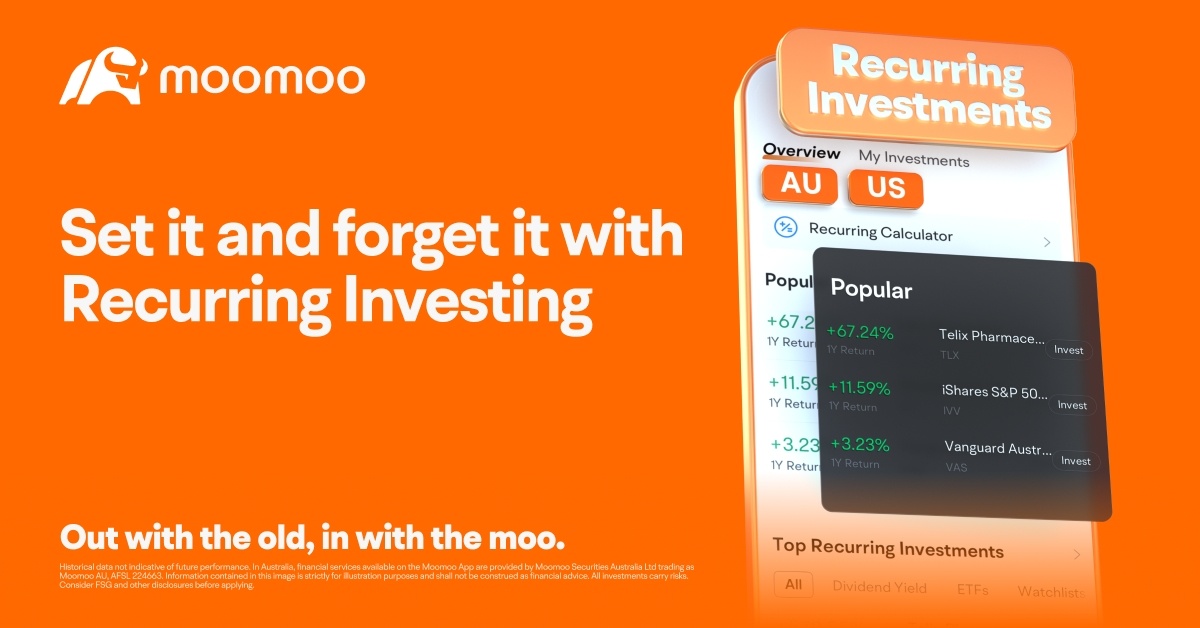
Moomoo offers a recurring investment feature that allows you to automate your dollar-cost averaging strategy. Here’s how:
Flexibility: Choose from daily, weekly, or monthly investment schedules to fit your financial plan.
Low threshold: Start investing with as little as $10 per month, making it accessible for new investors.
Fractional shares: Use fractional shares trading to lower your average investment cost and build a diversified portfolio.
Easy setup: Create a recurring investment plan directly through the Moomoo app by selecting your stock, investment amount, and frequency.
By leveraging dollar-cost averaging through moomoo's recurring investment feature, you can systematically buy the dip without the need for constant market monitoring, helping you build wealth over time while managing risk effectively.
How to buy the dip?
Whether you choose to buy top stocks in a struggling sector, invest in a sector ETF or index funds, or use a Dollar-Cost Averaging (DCA) strategy to buy the dip, you first need to have a brokerage account to make investments. Using a reliable and user-friendly trading platform is crucial for executing this strategy effectively.
Moomoo is an excellent choice for buying the dip, offering a secure, transparent, and cost-effective way to invest in both local and international markets. With its intuitive interface, real-time data, and competitive brokerage fees, moomoo empowers investors to make informed decisions and capitalize on market opportunities.
Here are the steps to buy the dip using moomoo:
Step 1: Set up your moomoo account
You can open a live account or practise with a demo account.

Step 2: Identify a market or asset pullback
Look for a significant price drop in a stock, ETF, or index you’re interested in. Not every dip is worth buying—make sure it’s part of a broader temporary decline, not a sign of fundamental weakness. You can use moomoo’s advanced tools like charts, news, and market sentiment to assess whether the dip is part of a short-term correction or a deeper issue.
Step 3: Check the fundamentals
Before investing, assess the underlying strength of the asset. For stocks, this includes looking at financial statements, earnings reports, future growth prospects, and industry position. A quality company with good fundamentals is more likely to recover after a dip.
Moomoo offers access to valuation ratios, financial metrics, and analyst ratings to help you make informed decisions!
Step 4: Choose your investment method
Single stocks – Target top-performing companies temporarily affected by broader market moves.
Sector ETFs – Gain exposure to an entire industry (e.g., healthcare, tech) using thematic ETFs, like those offered via moomoo’s ETF tools.
Index funds – If you're unsure which sector or stock to pick, investing in broad index funds like the ASX 200 or S&P 500 offers diversified exposure.
Dollar-cost averaging (DCA): Consider using Dollar-cost averaging (DCA) strategy.
Step 5: Monitor and stay patient
After buying, monitor your investments—but don’t panic during short-term volatility. The goal of buying the dip is to benefit from recovery over time. Make sure the original reasons you bought still hold, and be ready to adjust your strategy if fundamentals change.

How to manage the risk of buying the dip?
Managing the risk of buying the dip involves several strategies to mitigate potential losses while attempting to capitalize on market downturns. Here are some key approaches that investors can consider:
1. Maintain a long-term investment perspective
Avoid panic selling: Focus on long-term trends rather than short-term market fluctuations. Historically, U.S. equities have trended upward over time, despite intra-year drawdowns.
Prioritize fundamentally strong companies: Invest in companies with strong financials and growth potential, rather than selling quality assets during market corrections.
2. Hedge against market downside with inverse ETFs and volatility products
For investors wary of continued market declines, hedging strategies like shorting major indices or using volatility-linked instruments can provide valuable protection. One effective approach is investing in inverse ETFs, which are designed to move in the opposite direction of benchmark indices. These ETFs can act as a buffer during downturns, helping to offset losses in a traditional long portfolio.
Depending on your risk appetite, you can choose from 1x, 2x, or 3x leveraged inverse ETFs—though it's important to understand that the higher the leverage, the greater the risk and price swings. These products are generally best suited for short-term tactical use rather than long-term investment, as they tend to exhibit significant volatility and tracking error over time.
Using moomoo’s ETF Screener tool, here are the six largest inverse ETFs by assets under management:
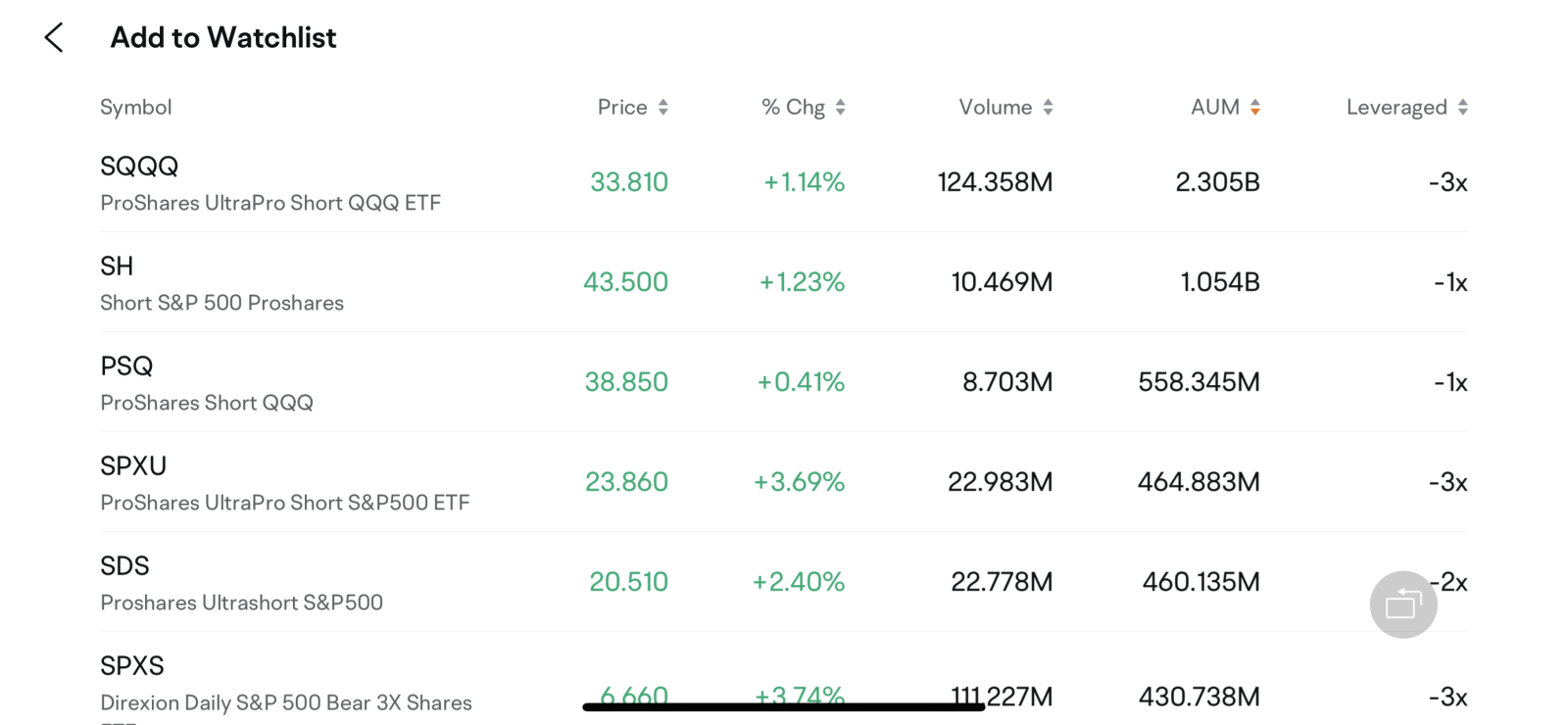
Source from: moomoo, data as of April 8, 2025
3. Utilize dollar-cost averaging
Regardless of how the market performs, invest a set sum of money on a regular basis. This helps reduce the impact of market volatility and timing risks.
4. Focus on quality investments
Prioritize investing in businesses with sound fundamentals during downturns, such as stable balance sheets, steady earnings, and a track record of surviving economic downturns. When the market recovers, these businesses have a better chance of recovering and doing well.
5. Cash flow management
Ensure you have a stable cash flow and an emergency fund to cover unexpected expenses or market downturns.
Do not invest more than you can afford to lose, especially during market volatility.
Buying the dip summed up
For Australian investors looking to capitalise on market downturns, learning how to buy the dip can be a powerful long-term strategy—when approached with caution and a clear plan. Buying the dip involves purchasing stocks, ETFs, or other assets when their prices have fallen, under the belief that they will eventually recover.
However, success in this approach depends on more than just timing; it requires an understanding of market trends, solid research, and risk management. Platforms like moomoo offer helpful tools for Aussie traders, including valuation indicators and analyst ratings, making it easier to identify quality opportunities even in volatile markets.
If you're exploring how to buy the dip, it's important to use a strategy that suits your goals and risk profile. From dollar-cost averaging to investing in diversified ETFs or high-quality stocks within downbeat sectors, there are several ways to navigate a bear market with confidence. With the right tools and a disciplined mindset, buying the dip can be a smart move to build long-term wealth.
FAQs about buying the dip
Is buy the dip a good strategy?
"Buying the dip" can be a good strategy for long-term investors who identify fundamentally strong assets at discounted prices, as it offers potential for higher returns by lowering the average cost of investment. However, it is challenging to time the market perfectly, and there is a risk that the price may continue to fall. It works better during confirmed uptrends and requires careful analysis and risk management.
What are the risks when buying the dip?
When buying the dip, several risks are involved:
Poor timing: The biggest risk is mistiming the market. If you buy during a dip that turns out to be part of a larger downtrend, you could end up losing more money as the price continues to fall.
Falling knife situation: This occurs when you buy an asset as its price is falling, only to see it continue dropping. This can lead to significant losses if not managed properly.
Misestimating the dip: Not all dips are temporary. Some may signal a more profound issue with the asset or market, leading to sustained price declines.
Leveraged trades: Using derivatives like CFDs to buy the dip can amplify both profits and losses, potentially resulting in losing more than your initial deposit.
Market sentiment shifts: Economic downturns can lead to significant contractions in market multiples, causing prices to drop sharply even if earnings only decline modestly.
Should you buy the dip in the stock market?
Whether you should buy the dip in the stock market depends on your investment goals, time horizon, and risk tolerance. For long-term investors with a diversified portfolio and a disciplined approach, buying quality stocks or ETFs during market pullbacks can be a smart way to build wealth over time.
However, it's important to avoid emotional decisions, assess the reasons behind the dip, and use tools like fundamental analysis, analyst ratings, and valuation metrics, such as those offered by platforms like moomoo, to make informed choices!
What does Warren Buffett think about buying the dip?
Warren Buffett, the renowned investor and CEO of Berkshire Hathaway, has consistently advocated for purchasing quality stocks during market downturns. He believes that market dips present opportunities to acquire strong companies at favorable prices. Buffett has stated, "Whether we're talking about socks or stocks, I like buying quality merchandise when it is marked down."
However, Buffett emphasizes the importance of focusing on companies with solid fundamentals and long-term prospects rather than reacting impulsively to market fluctuations. He advises against attempting to time the market, suggesting that waiting for a market crash to buy stocks is akin to a mortician waiting for an epidemic. Instead, he recommends a disciplined approach to investing, focusing on the intrinsic value of businesses.
This presentation is for informational and educational use only and is not a recommendation or endorsement of any particular investment or investment strategy. Investment information provided in this content is general in nature, strictly for illustrative purposes, and may not be appropriate for all investors. Read more