Options Wheel Strategy Explained: How to Do the Wheel Strategy?
Key Takeaways
The Options Wheel Strategy merges income generation with strategic stock acquisition by selling options and managing 100-share positions.
Income Generation: Collects premiums by selling options for potential steady income.
Stock Acquisition: Facilitates buying stocks at reduced costs through option exercises.
Market Fit: Excels in stable or slightly rising markets for premium collection.
Investor Suitability: Ideal for long-term investors with funds for 100-share trades and regular monitoring.
Success Factors: Hinges on quality stocks, smart option pricing, and preparedness to hold shares.
Risks: Faces losses in bearish markets and limited upside in strong rallies; outcomes not assured.
Moomoo Canada streamlines the Options Wheel Strategy with efficient tools for effective trade execution.

Introduction
Imagine earning extra money from your investments while having a chance to buy stocks you like at a lower price. The Options Wheel Strategy may offer a way to pursue this goal. It’s a step-by-step plan where you sell options to collect payments, potentially buy stocks if needed, and sell more options to seek additional income. This creates a repeating cycle, like a wheel, balancing potential income with managing stocks. The strategy may attract those who want to own well-known stocks or ETFs and are comfortable making regular trading decisions. It may offer opportunities for income and stock ownership, but it requires careful planning, as all investments involve risks.
To address what is Options Wheel Strategy, does the Wheel Strategy work, and is the Wheel Strategy profitable, this article will explore its steps, benefits, risks, and implementation using the moomoo platform, focusing on cash-secured puts, covered calls, and effective trade execution.
What is the Options Wheel Strategy?
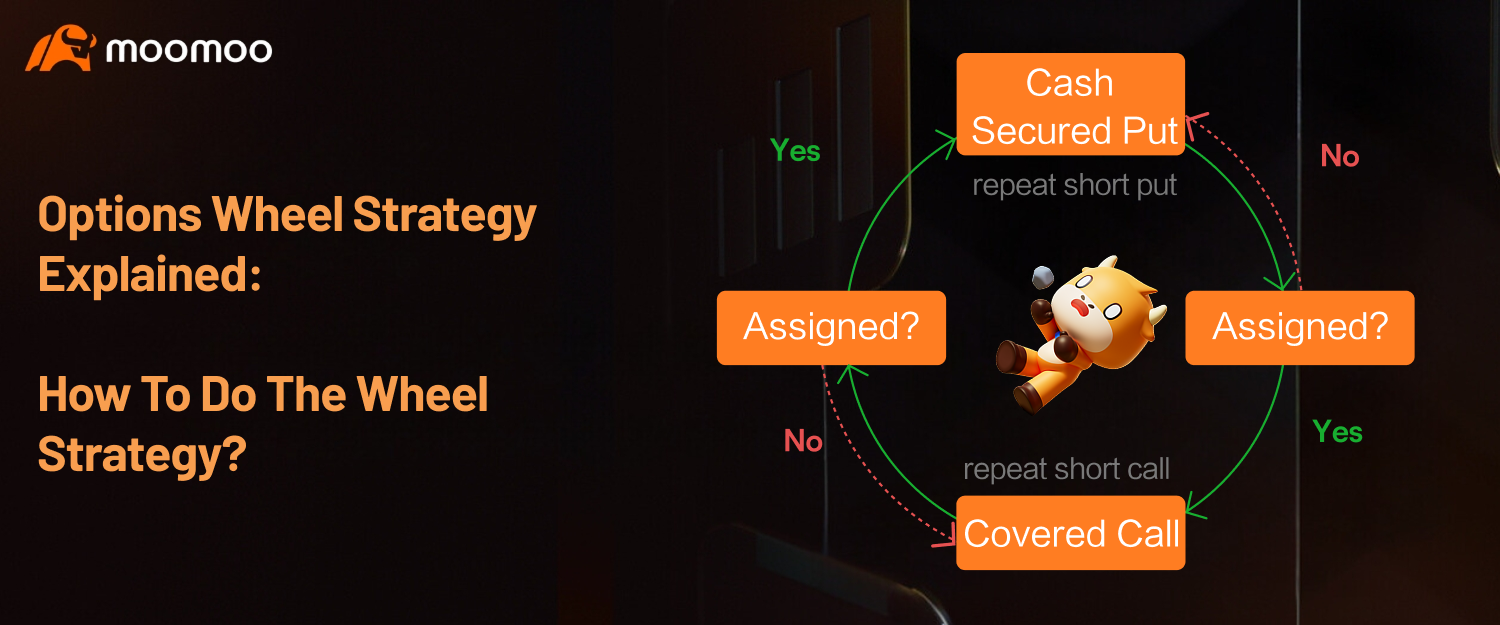
The Options Wheel Strategy is a straightforward options trading method that may allow investors to seek income through three steps: selling a cash-secured put, possibly acquiring shares if the put is assigned, and selling a covered call. These steps may repeat, forming a cycle that combines potential income with stock ownership. It may suit investors comfortable managing options and prepared to own shares if the market moves unfavorably.
Cash-Secured Put
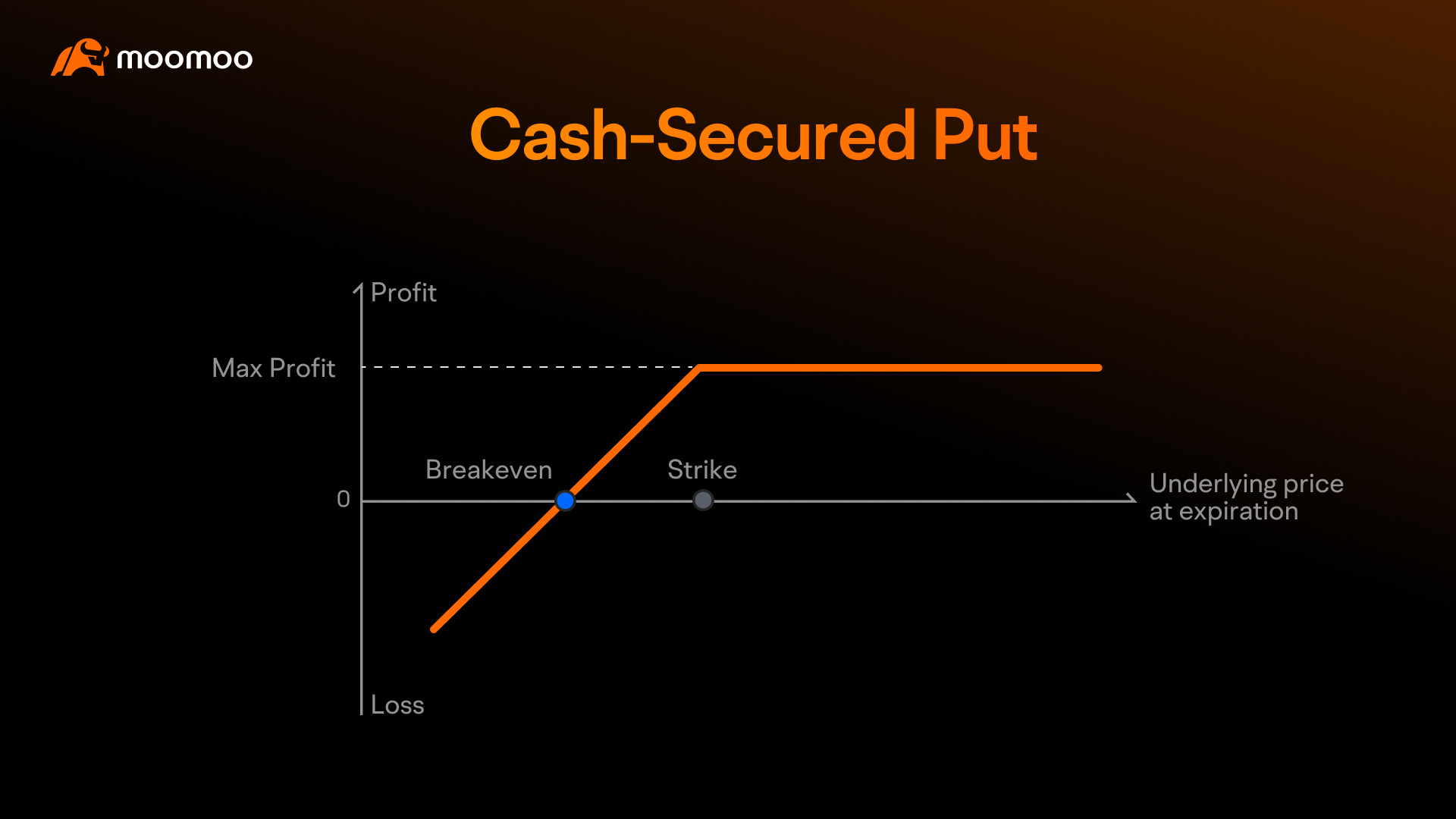
The first step involves selling a cash-secured put. You sell a put option, agreeing to buy 100 shares of a stock at a set price (the strike price) if the buyer exercises it, and you receive a premium. You need enough cash set aside to buy those shares if required. If the option expires unused, you may keep the premium. If you buy the shares, the premium may lower your effective cost. For example, if you’re comfortable owning a stock at $150 per share, you might sell a put option at that price, collect a premium, and either keep the money or buy shares at a slightly lower cost due to the premium.
Covered Call
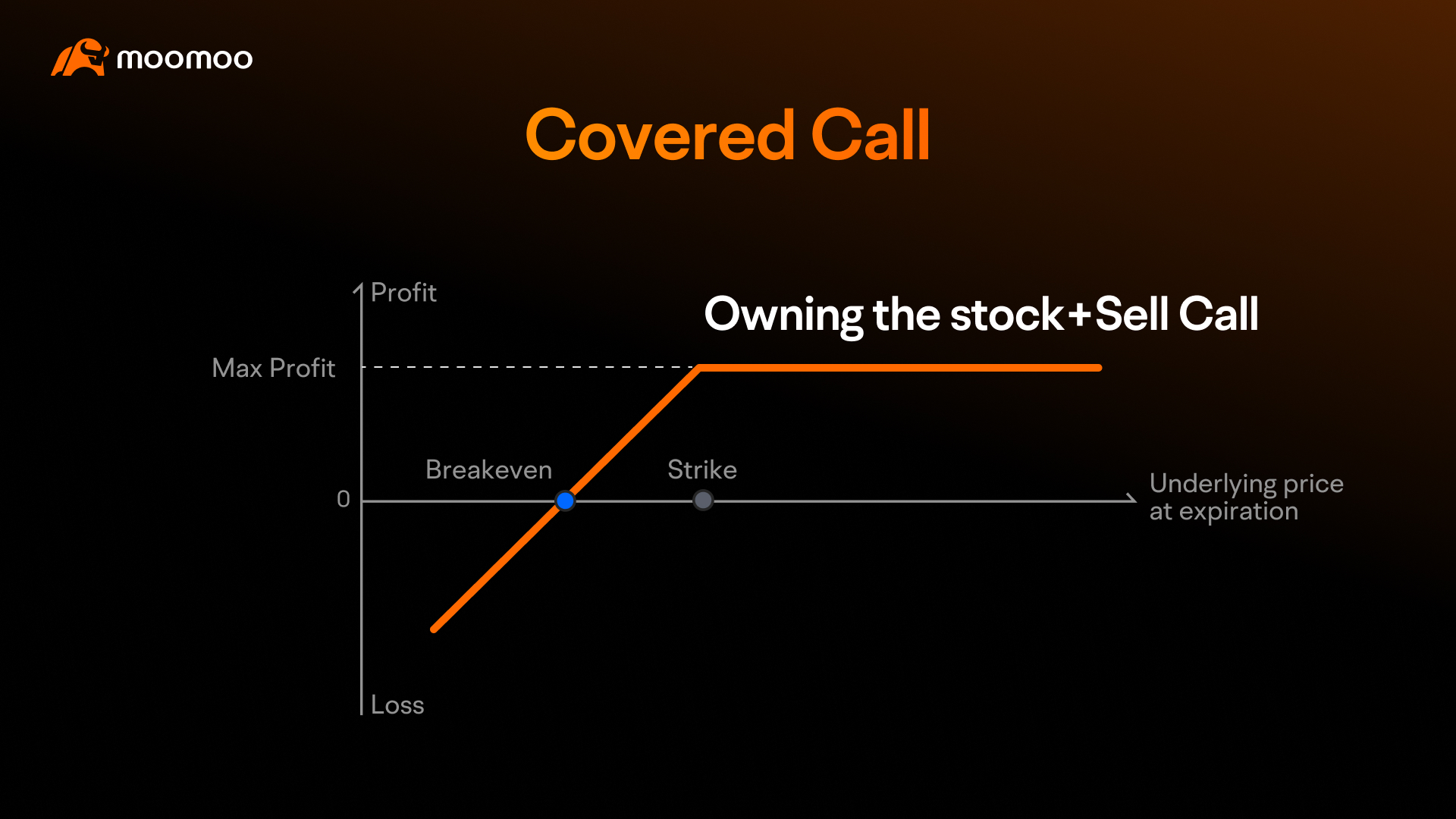
If you own shares, often after a put is assigned, you may sell a covered call, agreeing to sell your shares at a set price if the buyer exercises the call, earning a premium. This may provide extra income while holding the stock and can serve as a plan to sell shares if their price rises. For instance, if you own 100 shares of a stock, you might sell a call option agreeing to sell them at $160, earning a premium while keeping the option to sell if the price increases.
Moomoo Canada enhances this process with robust tools, supporting 13 options trading strategies, including covered calls, customizable options chains, and real-time data like volatility analysis and profit/loss calculators, enabling efficient execution and informed decision-making for the Options Wheel Strategy.
Key Characteristics of the Options Wheel Strategy
The Wheel Strategy may appeal due to its organized approach to seeking income and managing stocks. It may allow premium collection from selling options, potentially providing cash flow. If you end up owning shares, put premiums may lower your cost, possibly making stock ownership more affordable. The strategy requires enough money to cover buying 100 shares at a time, which may limit how many stocks you can trade but could reduce certain risks compared to other options strategies. It may perform well when stock prices are stable or rise slightly, potentially supporting premium collection. Since puts and calls are backed by cash or stocks, the strategy may carry less risk than some other options trades, though losses are possible.
How to Do the Wheel Strategy?
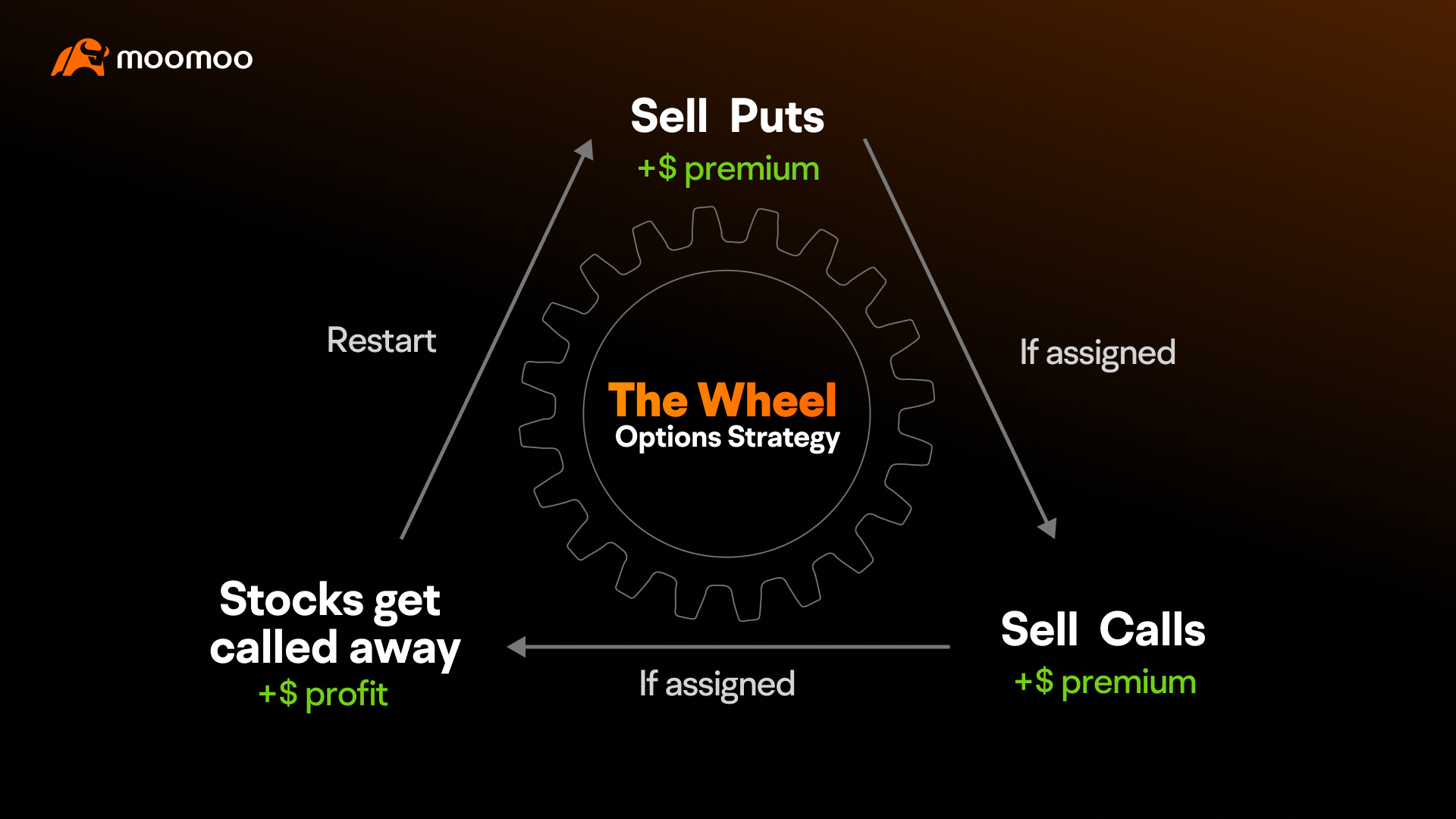
The Wheel Strategy follows a clear cycle that may be easy to learn with practice. Each step connects to the next, potentially creating a smooth process for seeking income and managing stocks. Let’s explore each step with examples to clarify for beginners.
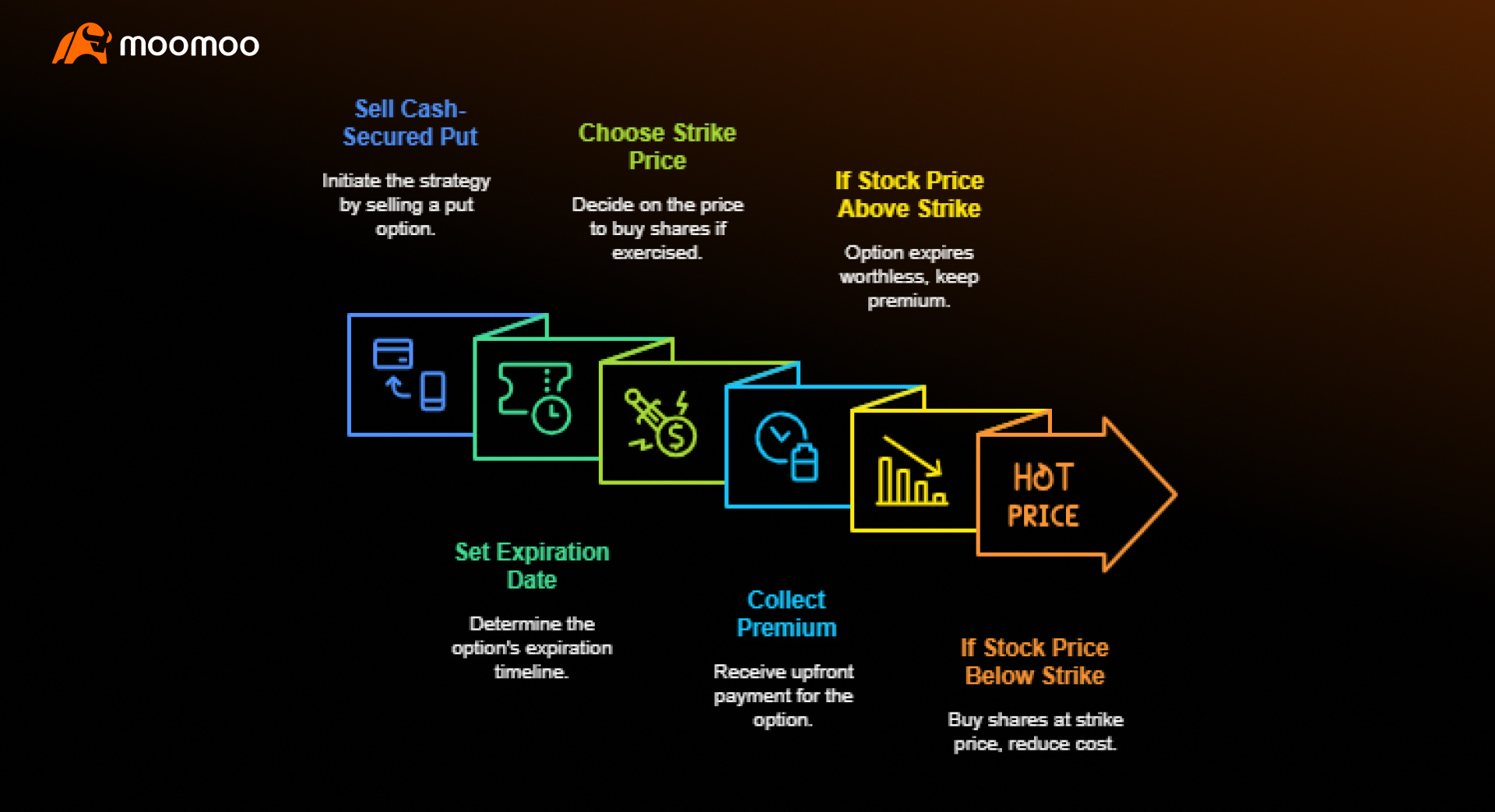
Step 1: Selling a Cash-Secured Put
You begin by selling a cash-secured put on a stock or ETF you’re willing to own, promising to buy 100 shares at a specific strike price if the option is exercised, while collecting a premium upfront. The strike price and expiration date may affect your potential income and whether you own the stock.
For example, suppose a stock trades at $50 per share, and you’re comfortable buying it at $45. You sell a put option with a $45 strike price, expiring in two weeks, and receive a $2 premium per share ($200 total for 100 shares). You need $4,500 ready in case you must buy the shares.
Choosing the strike price balances potential income and the risk of owning the stock. An at-the-money (ATM) put, near $50, may offer a larger premium but could increase the chance of buying the stock. An out-of-the-money (OTM) put, like $45, may provide a smaller premium but could reduce the likelihood of owning shares, suiting those prioritizing income over immediate stock ownership.
The expiration date matters too. A short-term expiration (1-2 weeks) may offer smaller premiums but could let you trade again soon, ideal for active traders. A longer expiration (1+ month) may provide larger premiums but could tie up your money longer, better for patient investors.
At the end of the two weeks, two outcomes may occur:
If the stock’s price stays above $45, the put may expire worthless, allowing you to keep the $200 premium. You may sell another put to seek more income.
If the price falls below $45, you may need to buy 100 shares at $45 each. The $2 premium reduces your effective cost to $43 per share. You now own the shares and move to the next step.
Before selling a put, ensure you’re okay owning 100 shares at the strike price, as this may happen if the stock price drops.
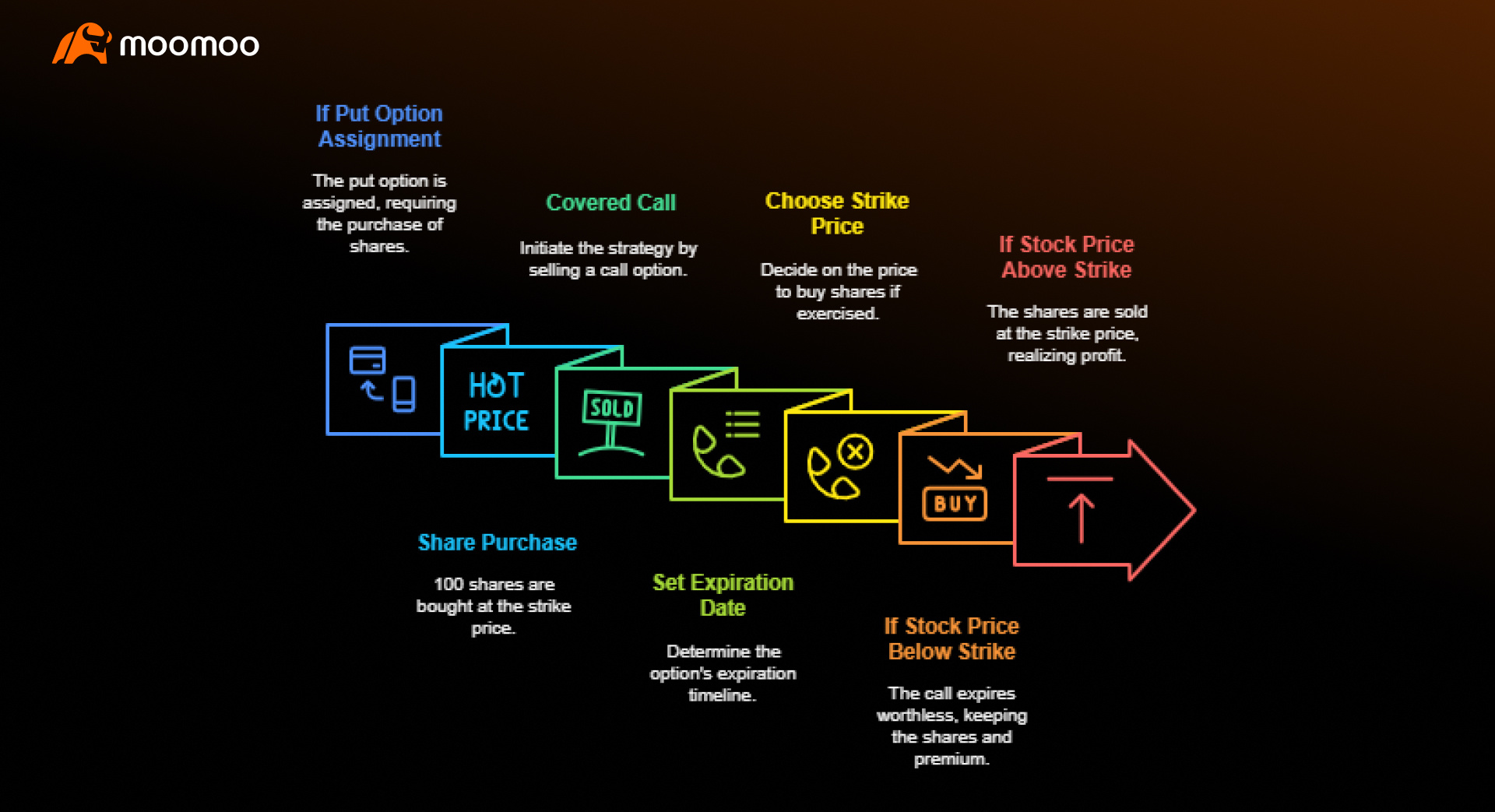
Step 2: Owning the Stock (If Assigned)
If the put is assigned, you buy 100 shares at the strike price. In the example above, you own 100 shares at an effective cost of $43 per share. You may sell the shares immediately for a potential profit or loss, depending on the market price, or sell a covered call to seek more income while holding the stock. In the Wheel Strategy, selling a covered call is typically the next step to continue seeking income.
Step 3: Selling a Covered Call
With 100 shares, you may sell a covered call, agreeing to sell the shares at a chosen strike price if the option is exercised, while collecting a premium. This may provide additional income and a plan to sell shares if their price rises.
For the same stock, suppose it’s now at $50. You sell a call option with a $55 strike price, expiring in two weeks, and receive a $1.50 premium per share ($150 total). An at-the-money call, near $50, may offer a higher premium but could increase the chance of selling your shares. An out-of-the-money call, like $55, may provide a smaller premium but could let you keep the shares while seeking income.
Expiration date choices mirror puts. A short-term expiration (1-2 weeks) may provide smaller premiums but could allow quicker trading. A longer expiration (1+ month) may offer larger premiums but could keep your money tied up.
At expiration, two outcomes may occur:
If the stock’s price stays below $55, the call may expire worthless, allowing you to keep the $150 premium and the shares. You may sell another call.
If the price rises above $55, your shares may be sold at $55 each. You may keep the $150 premium and earn $12 per share ($55 - $43 cost basis), totaling $1,350 ($1,200 capital gain + $150 call premium + $200 put premium).

Step 4: Repeating the Process
After the call expires or your shares are sold, you may restart the cycle by selling another cash-secured put. If your shares were sold at $55, you may sell another put on the same stock or a different one, aiming to collect more premiums. This repetition may create a cycle of seeking income, with the potential to buy and sell stocks at favorable prices. Success may depend on choosing reliable stocks, suitable strike prices, and expiration dates that align with your goals.
Example of the Wheel Strategy
Let’s walk through a cycle with a stock, starting at $105 per share, to show how the Wheel may work.
Step 1: Selling a Cash-Secured Put
Strike Price: $100
Expiration: 2 weeks
Premium Collected: $3 per share ($300 for 1 contract)
If the stock stays above $100, the put may expire worthless, allowing you to keep the $300 premium, a return of $300 / $10,000 (cash set aside) = 3% in two weeks. You may sell another put.
If the stock falls below $100, you buy 100 shares at $100, but the $3 premium lowers your effective cost to $97 per share.
Step 2: Selling a Covered Call
Stock Price: $105
Strike Price: $110
Expiration: 2 weeks
Premium Collected: $2 per share ($200 for 1 contract)
If the stock stays below $110, the call may expire worthless, allowing you to keep the $200 premium and the shares, a return of $200 / $9,700 (cost basis) = 2.06% in two weeks. You may sell another call.
If the stock rises above $110, your shares may be sold at $110. Your potential profit includes:
Capital Gain: $110 - $97 = $13 per share ($1,300 total)
Call Premium: $200
Total Potential Profit: $1,500
Return: $1,500 / $9,700 = 15.46%.
You may sell another put to restart the cycle.
This example shows how the Wheel Strategy may seek income and manage stocks, but outcomes may vary based on market movements.
Effect of Time on the Options Wheel Strategy
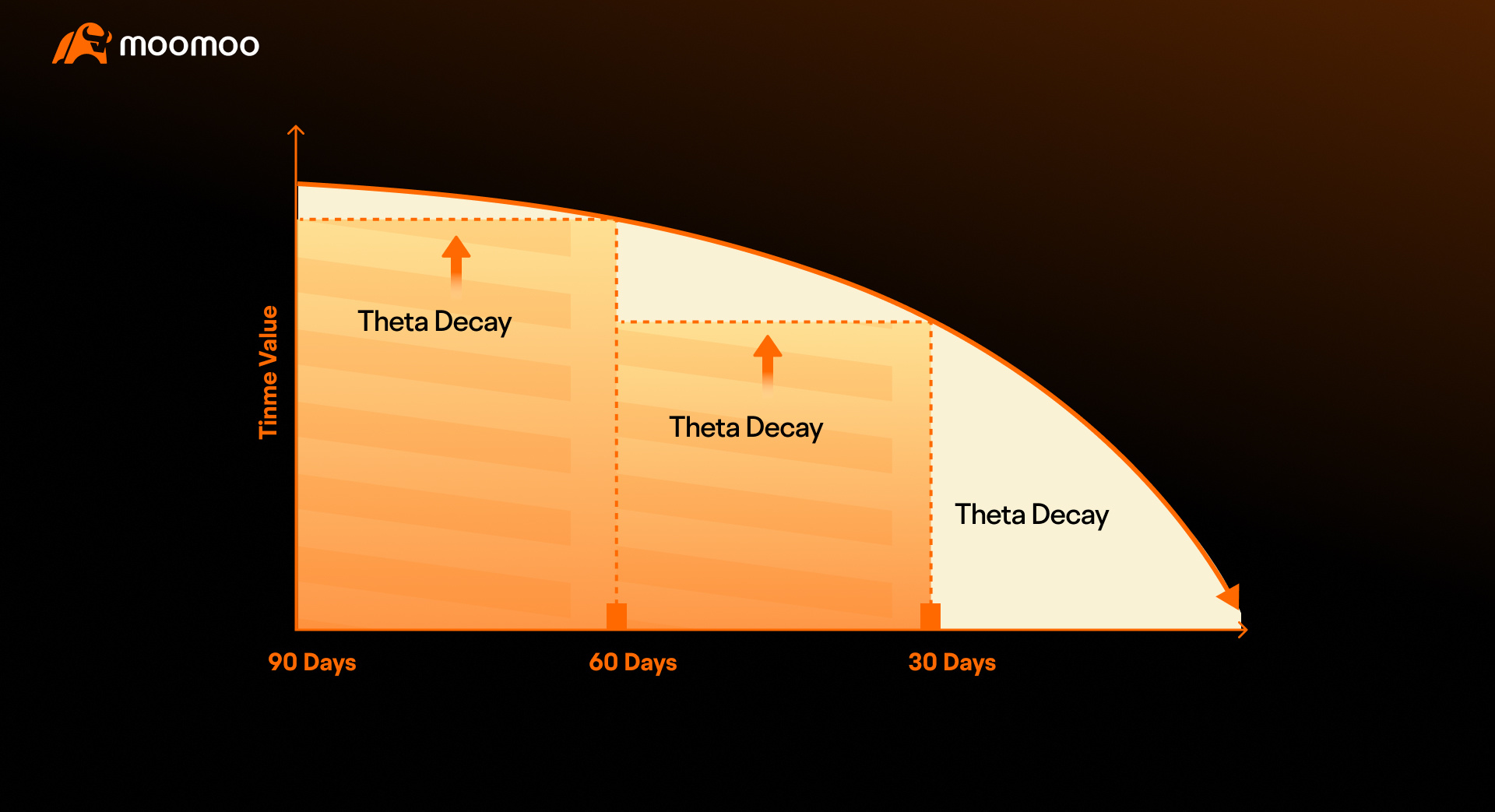
Time influences the Wheel Strategy through time decay, or theta, where an option’s value may gradually decrease as its expiration date approaches, similar to depreciation, potentially benefiting you as the seller. In the cash-secured put step, time decay reduces the option’s value over time, increasing the chance of keeping the premium if the stock price stays above the strike price. For example, if you sell a two-week put at a $50 strike for a $2 premium when a stock is at $52, the option’s value may decline as expiration nears. If the stock price remains above $50 at expiration, the option expires worthless out-of-the-money, letting you keep the full $200 premium.
If the stock price falls below $50 at expiration, you may be assigned 100 shares at $50, but the $2 premium reduces your effective cost to $48 per share, and you move to the holding stock step. Short-term expirations (1-2 weeks) may maximize rapid time decay for frequent trades, while longer expirations (1+ month) may offer higher premiums but tie up capital longer.
In the holding stock step, after a put is assigned in the cash-secured put step, you own shares, and time decay doesn’t apply since no options are open. Your focus shifts to selling a covered call to resume generating income. In the covered call step, time decay reduces the option’s value over time, helping you keep the premium if the stock stays below the strike price.
For instance, if you sell a two-week $55 strike call when the stock is at $50 for a $1.50 premium, the option’s value may decrease as expiration approaches. If the stock price remains below $55 at expiration, the option expires worthless out-of-the-money, letting you keep the full $150 premium. If the stock price exceeds $55 at expiration, you may be assigned, selling your 100 shares at $55 each, keeping the $150 premium, and realizing a profit based on your cost basis (e.g., $55 - $48 = $7 per share plus the $2 put premium, totaling $900 for 100 shares), before restarting the cycle with a new put.
The Wheel Strategy assumes you’re prepared for assignment, so time decay supports income in the put and call steps. Choose expirations based on your trading frequency, balancing premium size with flexibility.
Volatility and the Wheel Strategy

Volatility, measured by implied volatility (IV), affects the Wheel Strategy by influencing option premiums and assignment likelihood in the cash-secured put and covered call steps. Higher IV reflects the market’s expectation of larger price swings, increasing option premiums because buyers are willing to pay more for the potential of significant stock movements. In the cash-secured put step, this impacts your strategy in two scenarios. First, if IV rises before you sell a put, you may collect a higher premium, boosting income. For example, with a stock at $52, a $50 strike put might offer a $2 premium in a low-IV market, but if IV increases due to market uncertainty, the premium might rise to $3, allowing you to collect $300 instead of $200 per contract.
Second, if you’ve already sold the put at $2 and IV rises afterward, the option’s value may increase temporarily, say to $2.50, potentially showing an unrealized loss if you were to buy it back. However, this isn’t a concern in the Wheel Strategy, as you plan to hold until expiration, aiming to keep the $2 premium if the option expires worthless or accept assignment at $50 (effective cost $48 after the $2 premium), aligning with the strategy’s design.
In the holding stock step, after a put is assigned in the cash-secured put step, volatility may cause the stock’s price to fluctuate, but this doesn’t directly affect your strategy, as you focus on selling a covered call to generate income. In the covered call step, higher IV affects your approach in two ways. If IV increases before you sell a call, you may earn a larger premium, enhancing income. For instance, when a stock is at $50, a $55 strike call might yield a $1.50 premium in a low-IV market, but a rise in IV could increase it to $2, letting you collect $200 instead of $150 per contract.
Alternatively, if you sold the call at $1.50 and IV rises afterward, the option’s value might climb to $2, which could reflect an unrealized loss if you closed the position early. This is not a worry in the Wheel Strategy, as you intend to hold until expiration, keeping the $1.50 premium if the option expires worthless or selling shares at $55 if assigned, allowing you to restart the cycle. In stable markets, lower IV may reduce premiums but also assignment risk. Use charts or news to assess volatility and choose strike prices to maintain the Wheel’s income cycle.
Potential Pros and Cons of the Wheel Options Trading Strategy
The Wheel Strategy may offer benefits but involves risks that beginners should understand.
Potential Benefits
Selling puts and calls may provide premiums, potentially offering cash flow, like small regular payments.
Put premiums may lower your cost if you buy shares, potentially making stocks more affordable.
Covered calls may offer a plan to sell shares at a target price, potentially securing gains.
The strategy may work well in stable or slightly rising markets, potentially supporting premium collection.
Backed by cash or stocks, the strategy may carry less risk than some other options trades.
Risks Associated with the Wheel Strategy
You may need significant funds to cover puts and hold shares, potentially limiting how many stocks you can trade.
Covered calls may limit gains if a stock’s price rises far above your strike price, potentially missing larger profits.
A sharp stock price drop may require buying shares at a loss, potentially reducing returns.
In declining markets, you may hold shares that lose value or sell calls at lower prices, potentially reducing income.
The strategy may require regular monitoring, which could take time.
Choosing unreliable or volatile stocks may lead to losses if you own them.
Inappropriate strike prices may increase assignment risk or reduce income, requiring careful analysis.
Trading Options on moomoo!
Moomoo empowers both beginner and advanced traders with powerful, intuitive options trading tools. Whether you're just starting out or executing advanced strategies, moomoo simplifies the experience while enhancing decision-making.
Key product highlights:
Strategy Builder: Supports 13 popular options strategies with multi-leg capability—easily set up spreads, iron condors, and more.
Real-Time Market Data: Access Level 2 quotes and real-time data to identify optimal strike prices with precision.
Volatility & Risk Tools: Analyze market sentiment and assess risk with tools like implied volatility and Greeks (Delta, Theta, Vega, etc.).
Smart Research Integration: Stay informed with real-time news, analyst ratings, earnings data, and stock reports—directly in the platform.
Optimized for a wide range of options strategies: Strategies such as the Wheel Strategy with cash-secured puts and covered calls – moomoo empowers traders with efficient execution and powerful tools at every level.
All-in-one tools on moomoo make executing your options strategy smarter, faster, and more confident.
Step 1: Selecting the Underlying Stock
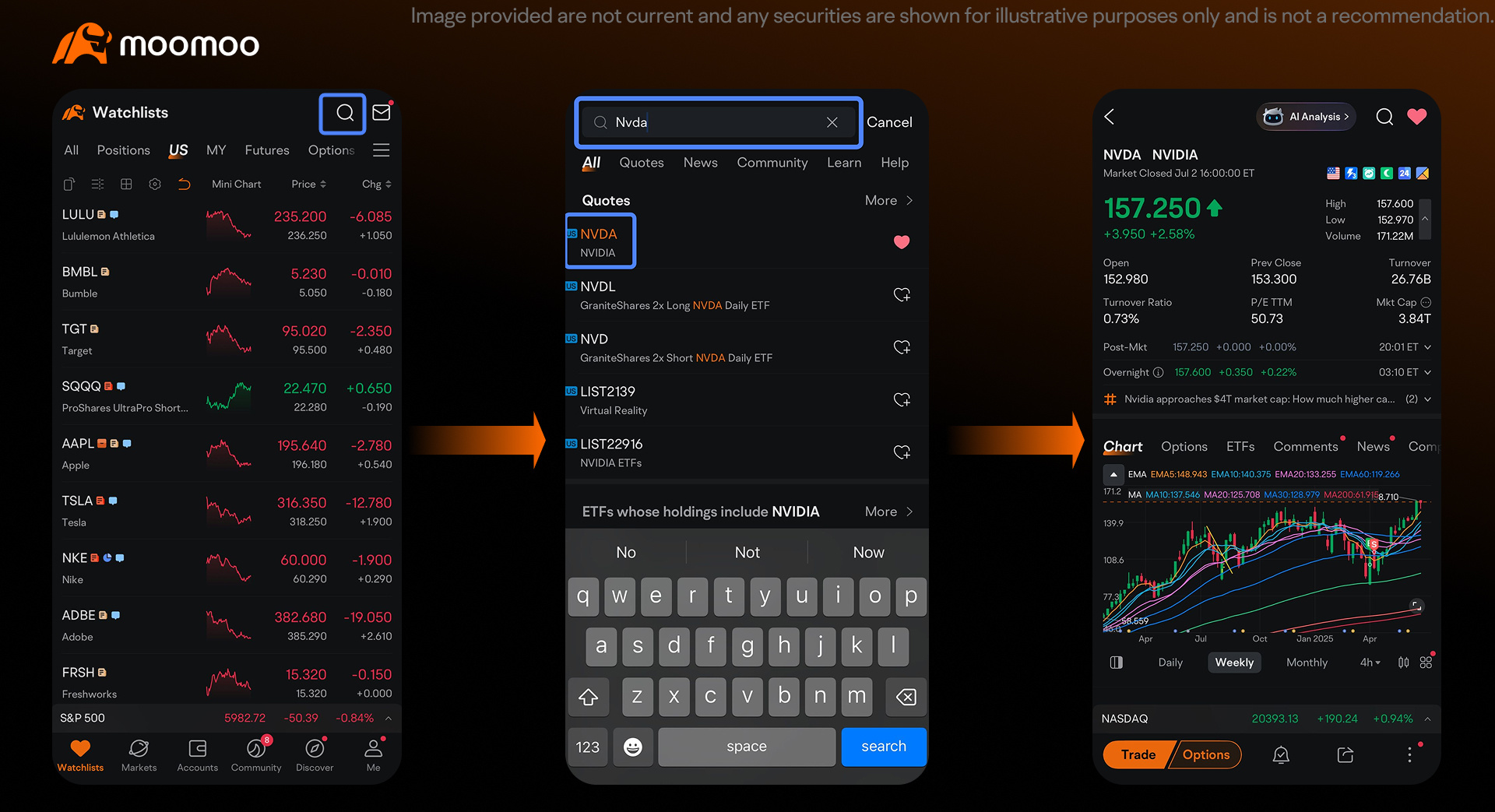
Search for the stock you want to use for the Wheel Strategy.
Navigate to the stock's page.
Step 2: Accessing Options and Volatility Analysis
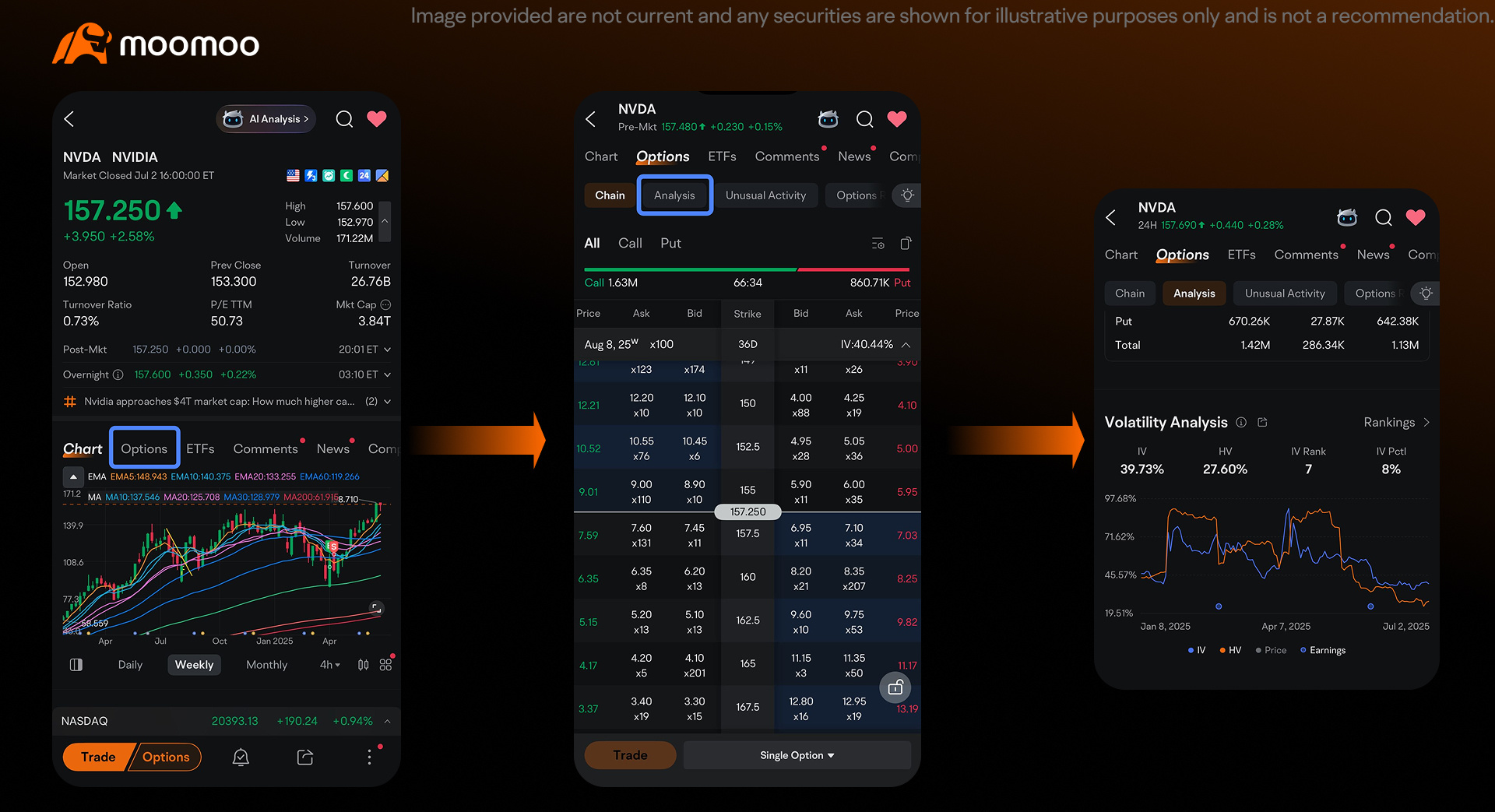
Click on the Options tab.
Scroll to the Analysis section and navigate Volatility Analysis.
Here, we’ve got you covered if you want to check implied volatility. You can review historical volatility, implied volatility (IV), IV Rank, and IV Percentile to gauge whether the current IV of the underlying's option is expensive or reasonable, helping you make a well-informed decision.
Step 3: Cash Secured Put
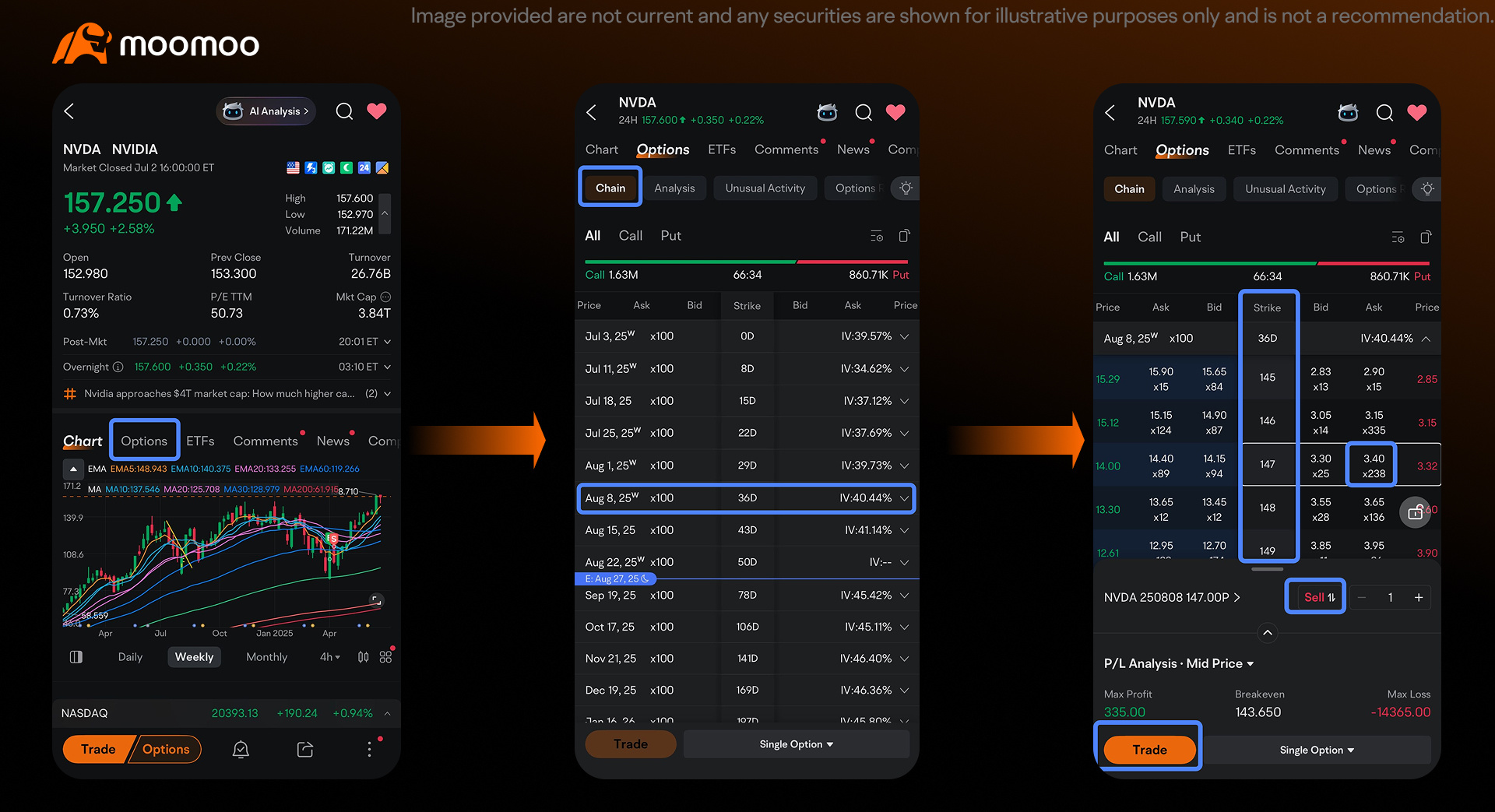
Once you have the information about the volatility, return to the Options tab and click back on the Chain tab to view the option chain.
Choose your desired expiration date by clicking on it to expand the chain.
Select a strike price where you're willing to buy the stock if assigned.
Click the Ask price on the right side (Put option) for your chosen strike.
A dialog will appear at the bottom; ensure the direction is set to Sell.
Click Trade to proceed to the order tab and place your order.
Outcome:
If the option expires out-of-the-money (OTM), you keep the premium.
If the option expires in-the-money (ITM), you’ll be assigned 100 shares per contract at the strike price.
Note: Only proceed to Step 4 if you are assigned 100 shares.
Step 4: Covered Call
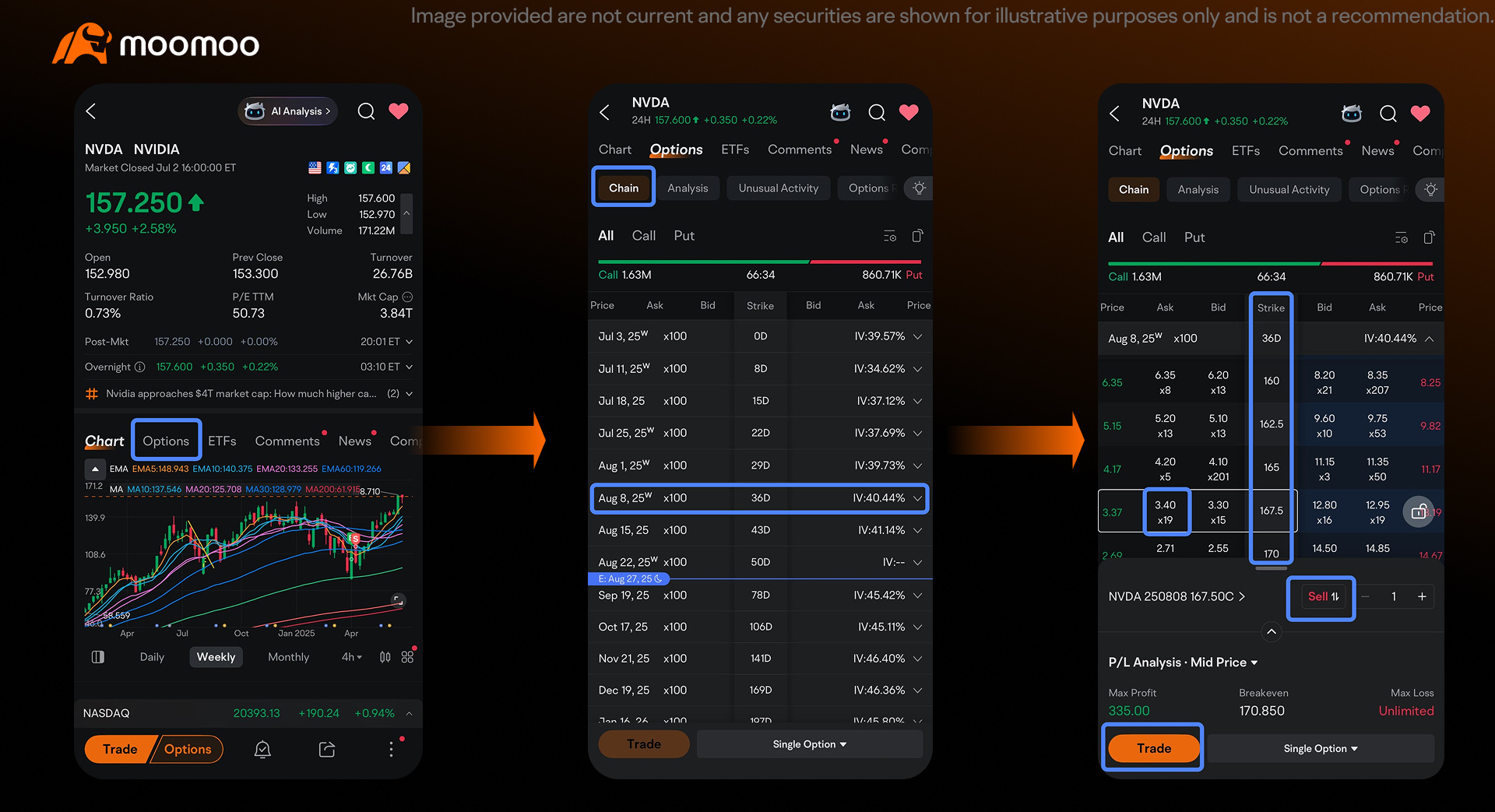
In this step, since you already own the 100 shares of stock from the assigned put option, you can now proceed with a covered call.
Visit the same stock’s page.
Click the Options tab and navigate to the Chain.
Choose your desired expiration date by clicking on it to expand the chain.
Choose a strike price where you're willing to sell the stock if assigned.
Click the Ask price on the left side (Call option) for your chosen strike.
A dialog will appear; ensure the direction is set to Sell.
Click Trade to proceed to the order tab and place your order.
Frequency Asked Questions
What Are Some Common Mistakes Traders Make When Using the Wheel Strategy?
Beginners may face challenges by: - Choosing risky or low-quality stocks, potentially leading to losses if assigned. - Selecting strike prices too close to the stock’s price, possibly increasing assignment risk, or too far, reducing income. - Ignoring market swings, which may cause unexpected assignments or lower premiums. - Lacking funds to cover puts or hold shares, potentially straining your budget. - Not monitoring trades regularly, possibly missing chances to adjust strategies.
How Does the Wheel Strategy Compare to Other Options Trading Strategies?
The Wheel Strategy may focus on seeking income and managing stocks: - Compared to holding stocks, it may provide premium income but could limit gains if prices soar. - Unlike only selling covered calls, it may include puts, potentially earning income before owning shares. - Compared to riskier options trades, its use of cash and stocks may reduce certain risks. - Unlike complex strategies like iron condors, it may be simpler but could require more attention. The Wheel’s clear cycle may be approachable for beginners, though it may need more management than hands-off strategies.
This presentation is for informational and educational use only and is not a recommendation or endorsement of any particular investment or investment strategy. Investment information provided in this content is general in nature, strictly for illustrative purposes, and may not be appropriate for all investors. Read more