RRSP vs TFSA vs FHSA: What Are the Differences?
When saving and investing in Canada, understanding the differences between a Registered Retirement Savings Plan (RRSP), a Tax-Free Savings Account (TFSA), and a First Home Savings Account (FHSA) is essential to making smart financial decisions. Whether you’re planning for retirement, saving for a major purchase, or looking to buy your first home, these accounts offer unique benefits tailored to specific financial goals.
Now you might be curious about FHSA vs TFSA vs RRSP, what's the difference? Don't worry, this article will cover everything you want to know! Keep reading to discover more!
Overview of RRSP vs TFSA vs FHSA
What is RRSP?
A Registered Retirement Savings Plan (RRSP) is a tax-advantaged savings account designed to help you save for retirement. You can make tax-deductible contributions of up to 18% of your previous year's earned income, up to an annual limit of $31,560 for 2024. Contributions are not taxed in the year you make them, which can reduce your taxable income for that year.
An RRSP can also help you pay for your first home through the Home Buyers’ Plan (HBP) or cover education and training costs with the Lifelong Learning Plan (LLP).
What is TFSA?
A Tax-Free Savings Account (TFSA) is a flexible, tax-advantaged savings account. You can contribute up to $7,000 for 2026 and any unused contribution room can be carried forward to future years. TFSA contributions cannot reduce your taxable income, but any investment growth, including interest, dividends, and capital gains, is completely tax-free. Withdrawals are also tax-free and can be made at any time, with the amount withdrawn added back to your contribution room in the following year.
Once your account is open—whether you chose RRSP or TFSA—if you plan to buy individual stocks in a TFSA, here’s the real challenge: you already know TFSA gains and dividends are tax-free, making stock picking incredibly appealing. But with thousands of listed companies, where do you start? Which stocks have robust fundamentals? Which names are favored by Wall Street analysts? Which companies in the same industry chain may grow together? And are big institutions quietly building positions? Traditional research—reading filings, combing through analyst reports, tracking news—can take weeks. Worse, when you finally place a trade, you can’t see true market depth: how many orders are queued at each price, if large players are buying or unloading, or whether liquidity is thin. In a TFSA with limited contribution room, that information gap can be costly.
Moomoo solves this with institutional-grade tools tailored to TFSA investors. First, Moomoo provides free, real-time U.S. Stock Level 2 data—something other platforms often charge $20–$30 CAD per month for. Level 2 reveals up to 60 levels of bids and asks, refreshing every 0.3 seconds and integrating data from six major sources (including NASDAQ TotalView, NYSE ArcaBook, and NYSE OpenBook). With the depth chart, green zones show buy order accumulation and red zones show sell pressure, helping you spot likely support (e.g., 15,000 shares stacked at $50.00) and resistance (e.g., 12,000 shares at $55.00). Wealthsimple doesn’t provide Level 2, while Questrade and Webull Canada require paid upgrades—only Moomoo makes 60-depth, multi-exchange Level 2 free, saving you $200+ per year.
Beyond execution, Moomoo helps you find ideas fast: use Stock Screeners to filter by financials, technicals, and custom criteria; follow the Institutional Tracker to monitor Berkshire Hathaway, Goldman Sachs, and J.P. Morgan through 13F filings and position changes; explore the Industry Chain map across 30+ sectors to uncover upstream–downstream opportunities; and consult Analyst Ratings for consolidated Buy/Hold/Sell views and target ranges. When it’s time to trade, 8 order types—from market and limit to trailing stops—give you precise control.
Ready to elevate your TFSA stock investing? Register with Moomoo today>>
What is FHSA?
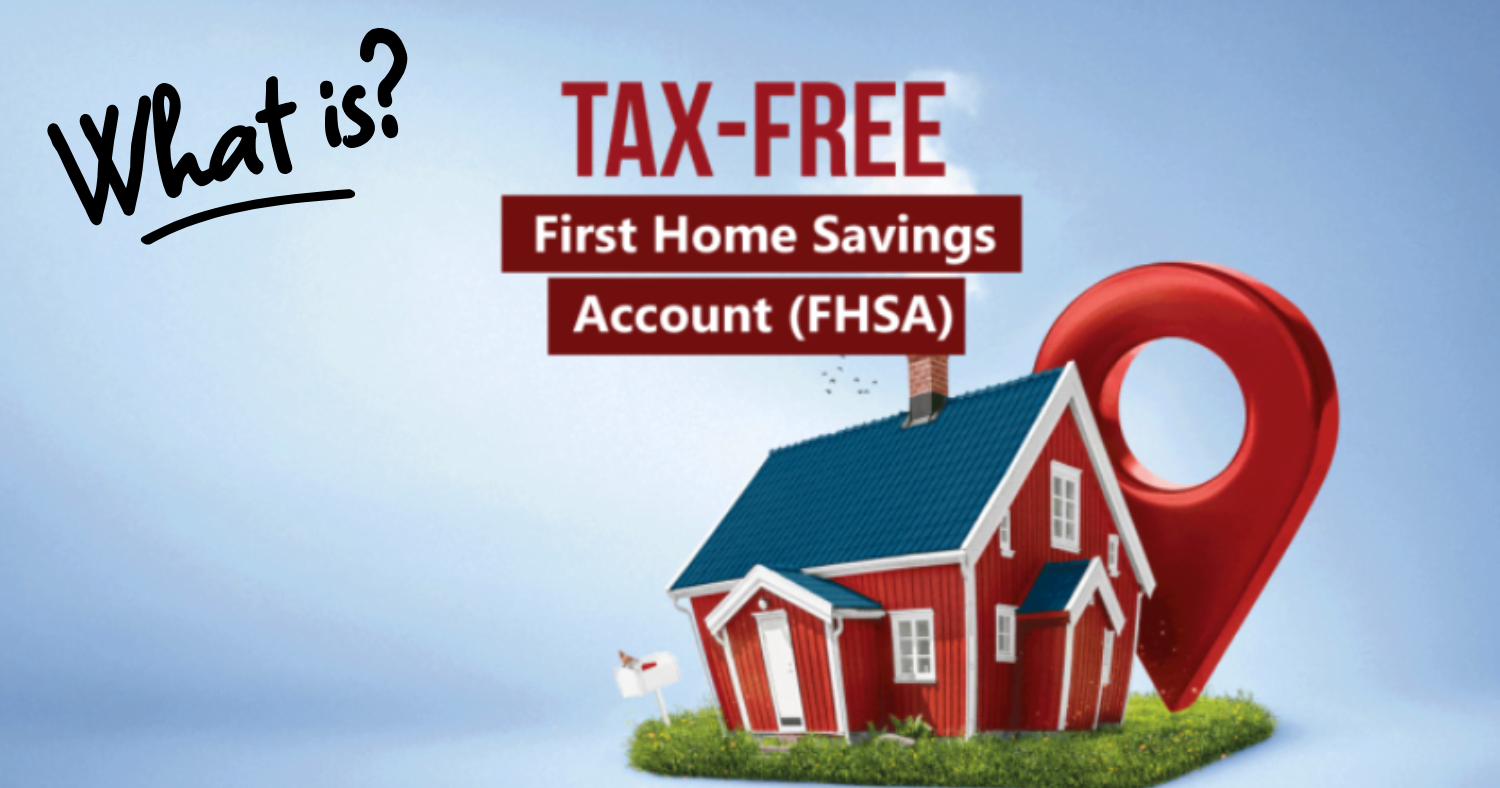
The FHSA, launched in 2023, is a new savings vehicle to help Canadians save purcahsing of a first home. With an annual contribution limit of $8,000, you can hold the same types of investments in a FHSA as in a TFSA or RRSP, including GICs, mutual funds, as well as cash where investment growth is tax sheltered, and your money can grow tax-free. The FHSA allows for tax-free qualified withdrawals for purchase of a qualified home, while any other withdrawals are subject to taxes. Like an RRSP, contributions to your FHSA are tax-deductible, helping reduce your taxes each year.
You may also like: FHSA vs TFSA: Which One Is Better?
RRSP vs TFSA vs FHSA
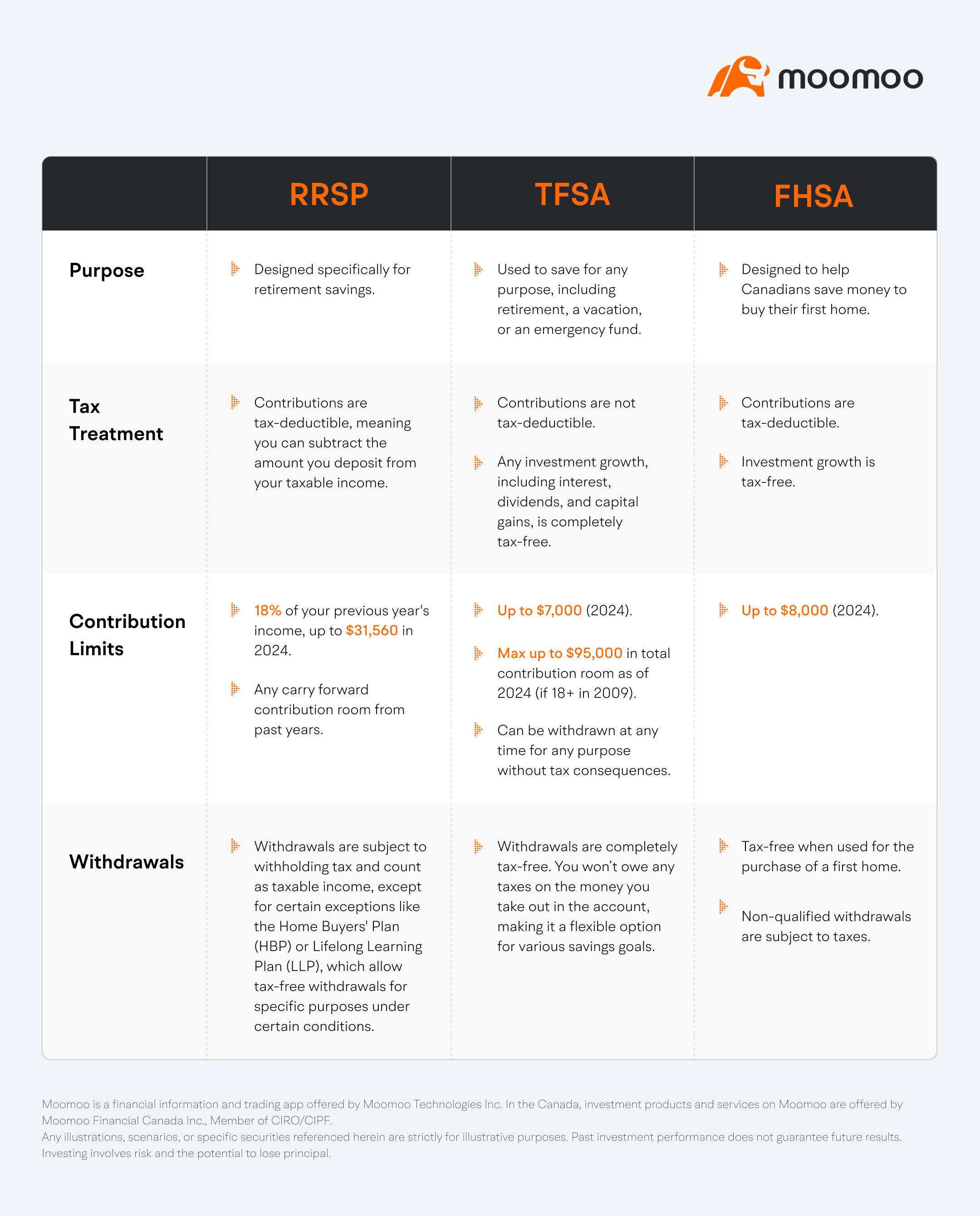
The below picture provides a clear visual comparison of the FHSA vs TFSA vs RRSP, focusing on key aspects such as their purpose, tax treatment, contribution limits, and withdrawal rules. This side-by-side comparison is designed to help you quickly grasp the unique features of each account type.
How to open TFSA or RRSP in Canada?
Opening a TFSA or RRSP in Canada involves a few straightforward steps. First, you'll need to choose a financial institution, such as a bank, credit union, or online broker, like moomoo Canada that offers these accounts. Once you have selected a provider, you will typically need to provide personal information, including your Social Insurance Number (SIN), proof of identity, and potentially some initial investment funds.

For a TFSA, you must be a Canadian resident aged 18 or older with a valid SIN.
For an RRSP, you must have earned income and filed a tax return in Canada. After setting up your account, you can begin contributing up to the annual limit set by the Canada Revenue Agency (CRA) for each account type. It's a good idea to consult with a financial advisor if you're unsure about which account best fits your financial goals.
This presentation is for informational and educational use only and is not a recommendation or endorsement of any particular investment or investment strategy. Investment information provided in this content is general in nature, strictly for illustrative purposes, and may not be appropriate for all investors. Read more