When Is Tax Season in Canada and How Should You Save Tax?

Tax season is an annual event for Canadians, and as 2025 approaches, every Canadian should be prepared in advance. Understanding the tax filing schedule and implementing effective tax saving strategies are important steps to ensure that tax season goes smoothly and maximize your return. Whether you plan to tackle your tax filing independently or seek the assistance of a professional, having a clear grasp of the process will enable you to confidently deal with the tax situation.
In this guide, we will outline the key tax filing and payment dates you need to remember for 2025 and offer some practical tips that Canadian investors can use during tax season!
When is tax season in Canada?
Many Canadians often ask about the start of tax season. While you can begin filing online in late February, which many consider the unofficial start of tax season, there are several key dates that investors should keep in mind to stay organized.
March 1: RRSP contribution deadline
February 28: Employers must issue T4s, T4As, and T5s by this date, so ensure you have these documents ready.
April 30: This is the filing deadline for most individuals, and also when any remaining tax balance is due.
June 15: If you're self-employed, you have until this date to file your taxes, although any balance owed is still due by April 30.
Tax filing deadline 2025 in Canada
For the 2025 tax year, Canadian investors should note that the deadline to file taxes is April 30, 2025. Any taxes owed must also be settled by this date, unless you're in a special situation that requires installment payments, like having a second job or rental income.
The Canada Revenue Agency (CRA) will activate its NETFILE service on February 17, 2025, allowing you to submit your returns online. If you're self-employed, you have until June 15, 2025, to file your taxes, but remember that any taxes owed are still due by April 30.
What happens if you file personal taxes late?
You may be so busy that you miss the April 30 tax deadline. For Canadians, it's good to know that you can request an extension, usually granting you an extra six months to file your taxes. However, keep in mind that this extension only applies to submitting your return; any taxes owed still need to be paid by the original April 30th deadline.
Sound the alarm! For Canadians who owe taxes and miss the deadline, the CRA imposes a penalty of 5% of the owed amount, plus an additional 1% for each month it's late, up to 12 months. If you're unable to pay the full amount on time, the CRA will allow late payments but will charge compound daily interest on any outstanding balance.
What can you do if you are unable to pay your taxes by the due date?
If you're unable to pay your taxes on time, reach out to the CRA to explore alternative solutions. They might offer a payment arrangement, allowing you to pay your balance over time rather than all at once.
The CRA also provides assistance through the Taxpayer Relief Provision (TRP). This program can waive penalties and interest charges, reducing your tax bill. To qualify, you'll need to show that you can't meet your tax obligations due to extraordinary circumstances, financial hardship, or specific actions by the CRA.
If you don't qualify for the TRP, you can request a remission review. This option is a last resort and is only granted in rare situations where existing tax laws offer no solutions. To qualify, you must demonstrate that your circumstances, such as severe financial distress, a serious illness, or errors made by the CRA, prevent you from paying your taxes.
What are the important changes for the 2025 tax season?
Every year, changes to the Canadian tax system might impact how you file your taxes. Here are the important updates you need to know for the 2025 tax season:
Increased RRSP Contribution Limit: The Registered Retirement Savings Plan (RRSP) contribution limit has increased to $32,490 for 2025, up from $31,560 in 2024. Make sure to use any unused contribution room to maximize your tax benefits.
Increased RESP Contribution Limits: Beginning in 2025, families can contribute up to $50,000 per child over the lifetime of an RESP, with government subsidies providing additional benefits for eligible contributors.
Tax-Free First Home Savings Account (FHSA): You can make tax-free contributions up to $40,000 under the FHSA if you're saving for your first house. Contributions made in 2025 are deductible, giving first-time homebuyers a fantastic chance to save money.
Tax Bracket Adjustments: Tax brackets are adjusted each year for inflation. In 2025, these income thresholds will increase, meaning more of your income could fall into a lower tax bracket, possibly reducing your overall tax bill.
New Tax Credits and Deductions: In 2025, keep an eye out for newly added or expanded credits, such as those for childcare, energy efficiency, and other specific deductions that the federal government may propose.
What Canadian investors need to know in tax season?
During tax season, Canadian investors should be prepared to navigate the complex tax regulations and maximize their returns. Understanding how different investment income is taxed is essential to ensure that you're not leaving money on the table.
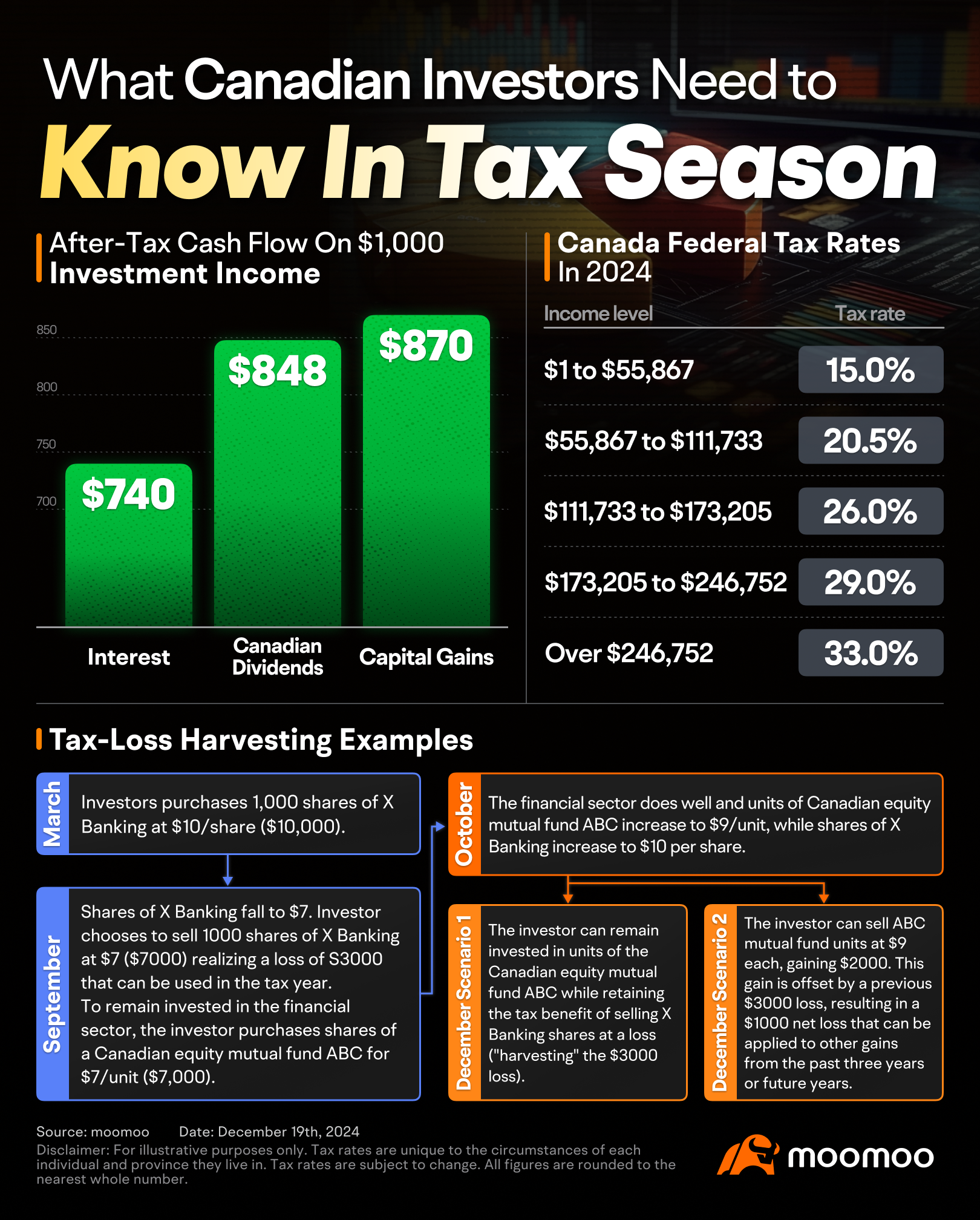
Investment income comes in various forms, with the most common types being interest, dividends, and capital gains.
Interest: Interest income, much like wages, usually comes from investments like Guaranteed Investment Certificates (GICs) or savings accounts. In Canada, this type of income is taxed at your highest marginal tax rate, making it the least tax-efficient form of investment income.
Dividends: If you earn dividends from shares in Canadian companies, you'll need to report the grossed-up amount and claim a federal dividend tax credit. Dividends are categorized on your tax slips as either eligible or other-than-eligible. The type of dividend you receive determines both the taxable amount and the tax credit you can claim, so it's important to understand these distinctions for accurate reporting.
Capital gains: When investments are sold for more than their book value, capital gains are realized. In Canada, capital gains enjoy preferential tax treatment, similar to dividend income. This means that only 50% of your capital gains are taxable, making them a more tax-efficient form of investment income.
What strategies can investors use during tax season in Canada?
As tax season rolls around, Canadian investors have a unique opportunity to implement strategies that can optimize their financial outcomes. In this section, we will explore a range of effective strategies that Canadian investors can employ during tax season. Let’s have a look!
1. Invest within the TFSA
A Tax-Free Savings Account (TFSA) is a versatile tool for a variety of savings goals. Its main benefit is that any capital gains, interest income, and dividends earned within the TFSA are completely tax-free, both while they grow and when you take them out. In a TFSA, you can hold a diverse range of investments, including stocks, bonds, mutual funds, and Guaranteed Investment Certificates (GICs), as long as they meet TFSA rules. For 2025, Canadians can contribute up to $7,000 to their TFSA, making it an excellent option for tax-efficient savings.
If you don’t have a TFSA yet, you can open one on moomoo Canada in just a few minutes, and there are no account management fees. You can trade US stocks, Canadian stocks, bonds and mutual funds on moomoo with low trading fees.

2. Invest within the RRSP
The Registered Retirement Savings Plan (RRSP) is another valuable tool for Canadian investors, offering tax benefits and helping you systematically save for retirement and other financial objectives. Contributions to an RRSP can reduce your taxable income for the year, provided you have enough contribution room, effectively deferring taxes until a later date.
Taxes are only due when you withdraw from the RRSP, at which point the funds are taxed as regular income. Many investors choose to withdraw during retirement, expecting to be in a lower tax bracket. For 2024, Canadians can contribute up to 18% of their earned income from the previous year, up to a maximum of $31,560, plus any unused contribution room carried forward from previous years.

3. Tax-loss harvesting
Tax-loss harvesting is a useful strategy for Canadian investors with non-registered investments like stocks, bonds, mutual funds, and ETFs that have dropped in value. By selling these underperforming assets, you can realize a capital loss, which can offset capital gains in the same tax year. You can also apply these losses to capital gains from the past three years or carry them forward indefinitely to reduce future gains.
For example, you could sell bank stocks at a loss and purchase Canadian bank stock ETFs. This allows you to benefit from the tax break while still staying invested in the financial sector, as ETFs are considered "significantly different" from individual stocks.
However, remember that you can't claim a capital loss if you repurchase the same or an identical security within 30 days. This rule also applies to purchases made by "affiliates," such as your spouse or a corporation you control. Following these guidelines ensures compliance with the Canada Revenue Agency's regulations.
4. Go for eligible dividends
Investing in eligible dividends from Canadian companies can be a smart tax strategy. Eligible dividends are taxed at a lower rate, providing you with a bigger tax break compared to non-eligible dividends. While both types can be worthwhile investments, prioritizing companies that issue eligible dividends can enhance your tax efficiency when filing your return.
This presentation is for informational and educational use only and is not a recommendation or endorsement of any particular investment or investment strategy. Investment information provided in this content is general in nature, strictly for illustrative purposes, and may not be appropriate for all investors. Read more