8 Costly TFSA Mistakes to Avoid
In personal financial planning, Canada's Tax-Free Savings Account (TFSA) is a crucial tool. Since its introduction in 2009, the TFSA has become a popular choice for many Canadians for saving and investing. The portion of your assets that grows within a TFSA is tax-free, and even if you withdraw this money in the future, you do not have to pay taxes on it. This is a huge advantage for accumulating wealth over the long term.
However, despite the many benefits of the TFSA, it can also miss opportunities or encounter some problems if not used correctly. Many people may make decisions that are not conducive to their financial situation due to a lack of understanding of the rules and penalties of TFSA. For example, not knowing the annual contribution limit, not knowing how to deal with over-contribution, and other issues can lead to unnecessary trouble or fines.
In this article, we will discuss eight common mistakes in using a TFSA and give corresponding advice to help you avoid these problems, so as to better use the TFSA to achieve your financial goals.
8 costly TFSA mistakes to avoid
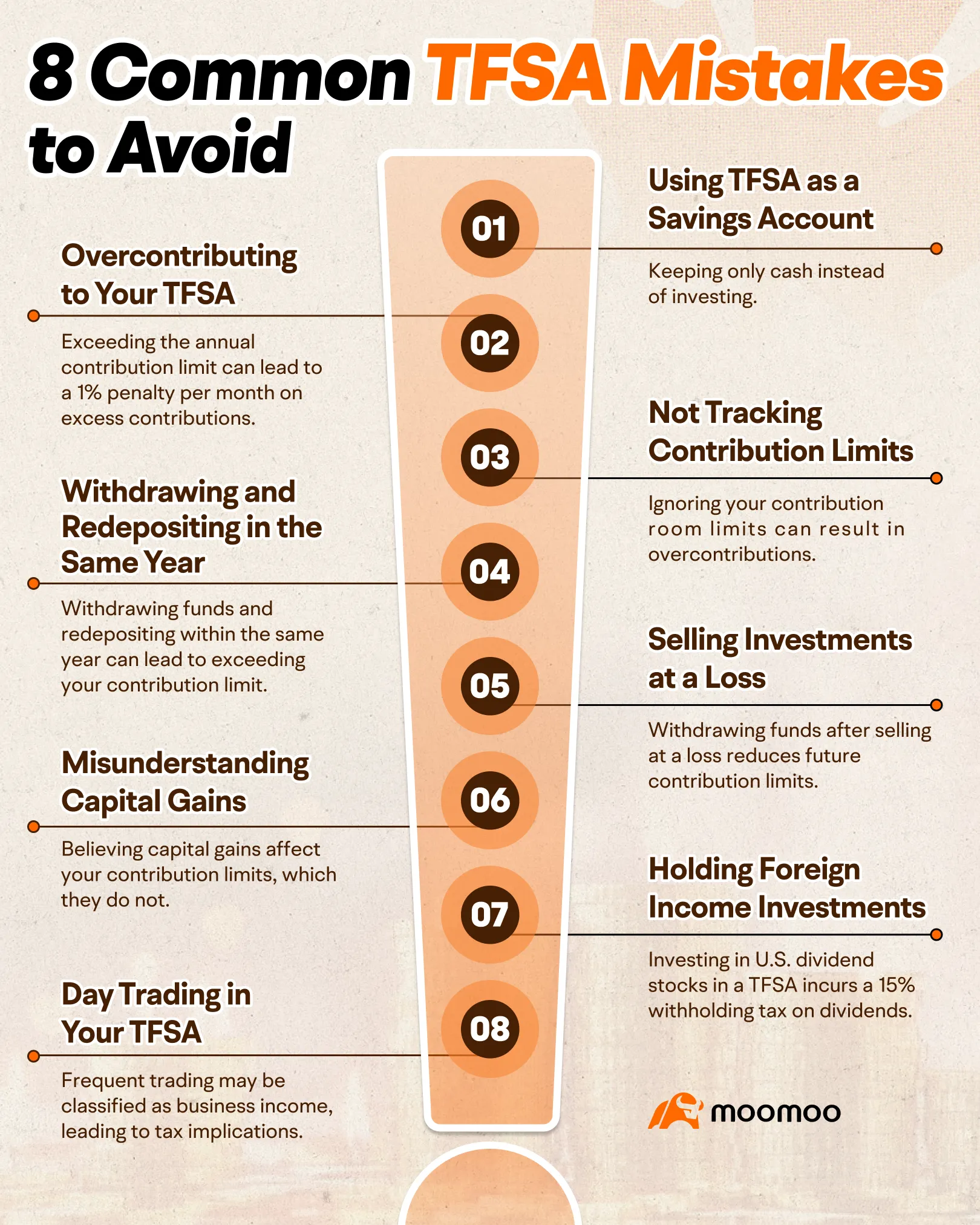
Using TFSA as a savings account
The introduction of the TFSA was designed to encourage Canadian investors to save, so its rules are not set up to facilitate frequent withdrawals. On the other hand, the biggest advantage of the TFSA is that the income and asset appreciation you earn from investments within the account are tax-free. Therefore, to maximize the benefits of the TFSA, please try to avoid holding cash in the account. You can invest in stocks, mutual funds, ETFs, and bonds through the TFSA. If you are risk-averse, you can also choose to invest in some low-risk targets, as the TFSA offers a wide range of investment options for you to choose from.
You might have been treating your TFSA like an ordinary savings account, settling for the 1%–3% annual interest offered by banks. But that barely taps into the true potential of tax-free growth. With inflation staying elevated, such low returns mean your purchasing power is shrinking over time. You want higher returns, yet you’re understandably cautious—TFSA contribution room is limited and precious, and you don’t want to risk losing principal.
The real challenge is the overwhelming research required: thousands of stocks and ETFs to sift through, and you’re trying to find those that combine stable dividend income with long-term growth. Manually checking dividend yields, payout histories, and financial health is time-consuming and frustrating. What you need is an efficient screening toolkit that quickly surfaces quality, income-focused assets appropriate for conservative investors building dependable cash flow inside a TFSA.
That’s where moomoo steps in. Our Dividend Ranking Lists and Dividend Calendar are built specifically for TFSA investors seeking steady returns. The Dividend Ranking Lists let you filter and sort dividend-paying stocks and ETFs by yield, market cap, price, and payout frequency—instantly narrowing thousands of candidates to the ones that fit your criteria. A unique "Consistent Growth" list highlights companies with stable and growing dividends, which is exactly what cautious investors value most. Compared with other platforms, Wealthsimple doesn’t provide a dedicated dividend leaderboard, so you’re stuck with basic filters; Questrade’s comparable tools often sit behind paid subscriptions. On moomoo, these features are free. Pair that with our Dividend Calendar for a clear, visual schedule of upcoming payouts and alerts so you never miss a distribution. Prefer ETFs? Go to Markets > ETFs > High Dividend Yield to access a curated module that ranks and compares income-focused ETFs by trailing twelve-month yield, payout stability, and frequency.
Join Moomoo and start using the Dividend Ranking Lists and Dividend Calendar to quickly discover dividend assets with target yields in the 5%–8% range or higher. New clients? We provide 6% cash Back for you, time limited!
Overcontributing to your TFSA
Over-contribution is a common issue when using the TFSA. There are many factors that affect over-contribution, but as long as you understand the rules regarding contribution limits set by the TFSA, you can avoid over-contributing on your own.
Simply put, the Canada Revenue Agency (CRA) sets an annual contribution limit, which is granted to Canadian residents who are 18 years old or older, and this limit accumulates annually to become your contribution room. If your total contributions exceed your unused contribution room, you will be subject to a monthly 1% tax on the excess amount until you withdraw the excess or a new contribution limit is added to cover the excess.
For example, the Canada Revenue Agency (CRA) sets the contribution limit for 2026 at $7,000, and you still have $3,000 in contribution room left from before, then your contribution room for this year increases to $10,000. Suppose you contributed $11,000 at the beginning of this year; this would result in an over-contribution of $1,000. If you do not withdraw the excess amount, by the end of this year, you will face a tax bill of $120.
Not tracking contribution limits
From the above issue, you should understand that keeping track of the annual additional contribution limit and your remaining contribution room is important. If you contribute to a TFSA without being clear about this information, it is very likely to lead to over-contribution. It is also necessary to keep records of withdrawals and contributions from the TFSA , which will help you know your remaining contribution room when contributing.
To know about the contribution limit, you can learn more: TFSA over contribution penalty
To know about your personal TFSA's remaining contribution room, you can click: My Account for individuals
Withdrawing and redepositing in the same year
In the TFSA withdrawal rules, there is an important stipulation that your contribution room will not be immediately restored after you make a withdrawal; it will only be restored at the beginning of the following year. Therefore, please note that if you do not have remaining contribution room or if your contribution room is insufficient, making a withdrawal from your TFSA will not increase your contribution room for that year, and making a contribution within the same year after the withdrawal may likely result in over-contribution.
For example, if you contribute to your TFSA at the beginning of the year and exhaust your contribution room, and then make a withdrawal of $3,000 in the same year during the summer, please note that you should not deposit the $3,000 back into your TFSA within that year, or you will face taxes due to over-contribution. You can wait until the following year to deposit the $3,000 back and make additional contributions within the contribution limit set for that year. This is because at the beginning of the next year, the amount corresponding to your withdrawal will be restored to your contribution room without affecting the new contribution limit you should receive for that year.
Selling investments at a Loss
During the use of the TFSA, selling an asset that has incurred a loss and withdrawing it is not cost-effective, as it may reduce your contribution room.
For example, suppose you just turned 18 this year and received a contribution limit of $7,000. You deposited $7,000 and invested in stocks, which lost value to $5,000. If you then withdraw $5,000, you will only have an additional contribution room of $5,000 restored the following year. As a result, you will have incurred a loss in both principal and contribution room.
Misunderstanding capital gains
It is important to note that only contributions, withdrawals, and the annual addition of contribution limits affect the contribution room. Therefore, some investors may worry unnecessarily that the capital gains generated in their TFSAs will encroach on their contribution room. This is not the case. Neither losses nor profits from investments made within the TFSA will affect your contribution room. As in the previous example, even if there is a loss, the contribution room will only incur a loss when you make a withdrawal.
Holding foreign income investments
The TFSA's tax exemption on investment income applies only to income generated from Canadian assets. If you hold foreign assets through the TFSA, you may be subject to additional taxes as stipulated by the laws of the country where the assets are located.
For example, holding or indirectly holding US stocks may result in dividend withholding tax, which is 15% for Canadian investors. It is worth mentioning that Canadian investors can avoid dividend withholding tax by holding US stocks through the RRSP(Registered Retirement Savings Plan). In summary, holding foreign assets in the TFSA may not be cost-effective.
Day trading in your TFSA
Please note not to use the TFSA for day trading. Although you can freely manage your investment portfolio within your TFSA, even if you are a professional day trader, it is not recommended to use the TFSA for day trading. Frequent trading may attract the attention of the Canada Revenue Agency (CRA), and if they consider you to be conducting a business activity, you may face taxation on your "business income."
Conclusion
After understanding the 8 mistakes mentioned above, you should have a clear idea of what to pay attention to when using the TFSA. In summary, keep track of the annual contribution limit and your remaining contribution room to avoid over-contribution. Also, be mindful not to hold foreign assets in your TFSA and to avoid using the TFSA for day trading. By doing so, you should be able to easily manage your own TFSA.
If you would like to learn more about the TFSA contributions and withdrawals, you can see details here: TFSA Withdrawal Rules and TFSA-Over Contribution: How to Fix It?

This presentation is for informational and educational use only and is not a recommendation or endorsement of any particular investment or investment strategy. Investment information provided in this content is general in nature, strictly for illustrative purposes, and may not be appropriate for all investors. Read more