Buying US Stocks in a TFSA: 6 Things You Need to Know

Since its launch in 2009, the Tax-Free Savings Account (TFSA) has become a vital component of the investment and financial life for many Canadian residents. This flexible investment tool not only allows investors to enjoy tax benefits but also provides them with a variety of investment options. According to the latest data from the Investment Industry Regulatory Organization of Canada (IIROC), over 75% of Canadian investors have expressed interest in diversifying their investment portfolios by purchasing US stocks. This may indicate that many Canadian investors have already, or will soon, utilize TFSAs to venture into the US stock market.
The TFSA is suitable not only for those who wish to increase additional savings without affecting their existing retirement plans but also attracts investors who hope to achieve potentially higher returns by investing in the US market. However, before deciding to use a TFSA to purchase US stocks. There are several important factors to consider. From tax implications to currency exchange fees, and the choice of investment strategy, every step requires careful planning.
Therefore, this article will provide a detailed introduction to six things to keep in mind when using a TFSA to buy US stocks, helping you to move forward with more confidence on your investment journey.
Can you buy US stocks in a TFSA?
According to the Canada Revenue Agency (CRA), the allowable investment range for TFSA is the same as for Registered Retirement Savings Plan (RRSP), which includes securities listed on designated stock exchanges, mutual funds, guaranteed investment certificates, bonds, cash, and certain shares of small business corporations. Therefore, you can certainly use a TFSA to invest in US stocks. Additionally, you can use a TFSA to purchase stocks from many other countries within the CRA's allowed range, such as Australia, the United Kingdom, Germany, Japan, etc.
Moreover, purchasing foreign stocks will naturally involve the currency of that country, so investors using a TFSA to buy US stocks will need to consider currency exchange fees and currency risks. Alternatively, you can indirectly hold US stocks through some ETFs on the Canadian market, which can avoid the hassle of currency exchange.
Do you have to pay taxes on US stocks in a TFSA?
Of course, the tax-free nature of capital gains within a TFSA applies to taxes levied by the Canadian government. When holding foreign stocks through a TFSA, any taxes imposed by the country of the stocks cannot be avoided unless there is a bilateral agreement for exemption. Therefore, US stocks held within a TFSA are subject to a 15% dividend withholding tax as stipulated by the US government. This tax is specific to dividends, so any gains resulting from an increase in stock prices remain untaxed.
For example, suppose you hold 100 shares of Johnson & Johnson (JNJ) with a cost of $150 per share through a TFSA, with a total cost of $15,000. Johnson & Johnson's dividend yield is 2.96%. A 15% dividend withholding tax would reduce your actual net dividend yield to 2.516%. Now, if the share price of Johnson & Johnson has risen to $164, and you choose to sell it for $16,400, the gain from the increase in stock price is $1,400, which is tax-free.
Additionally, if the Canadian ETF you purchase also holds US stocks, then a 15% dividend withholding tax will also be levied.
Benefits of investing US stocks in TFSA

Despite the requirement to pay withholding taxes on US stocks held through a Tax-Free Savings Account (TFSA), there are several significant advantages:
Tax benefits
When you invest in US stocks through a TFSA, any capital gains are tax-free. This means that if you sell these stocks at a higher price in the future, the profits you make will not be subject to taxes by the Canadian government. This is a significant advantage for investors seeking long-term capital appreciation without the impact of income tax on their earnings. It should be noted that dividends from US stocks within a TFSA are subject to a 15% dividend withholding tax by the US government.
Diversification - spreading investment risk
Holding US stocks within a TFSA can increase the diversity of your investment portfolio. By spreading your investments across different markets, you can reduce the impact of fluctuations in a single market or industry. For instance, if Canada's economy takes a downturn, having investments in the US market might provide stability and potentially higher returns. Additionally, many US companies have global operations, which can also offer you indirect exposure to international markets.
Growth potential
The US stock market is home to some of the world's largest and most innovative companies. Investing in US stocks gives you access to these leading companies and their potential for significant growth. The S&P 500 Index, composed of 500 large US companies, has generally shown an upward trend with substantial gains over the past fifteen years. While past performance is not indicative of future results, it does suggest that US stocks have the potential to offer significant growth over the long term. For investors hoping to profit from established and emerging industry leaders, US stocks are an attractive option.
Risks of investing in US stocks in TFSA
Risks always accompany returns, and although investing in US stocks has many advantages, there are certainly risks involved. Here are the three major risks to consider when investing in US stocks within a TFSA:
Exchange rate fluctuations
Changes in exchange rates can impact your investment returns, especially if the Canadian dollar appreciates against the US dollar. Since you are purchasing US dollar-denominated stocks with exchanging Canadian dollars for US dollars, the difference in exchange rates between the time of purchase and the time of sale can affect your final return, even if the value of the stocks themselves has not changed. This uncertainty brought about by exchange rate fluctuations adds to the risk of investment.
Market volatility
The US stock market may experience price fluctuations, which can affect the value of your investments. The stock market is influenced by a variety of factors, including but not limited to, company finacial reports, macroeconomic conditions, geopolitical events, etc. When the market experiences volatility, even companies with strong fundamentals may be at risk of stock price declines. Therefore, investors need to be prepared to face potential short-term fluctuations and ensure that their investment decisions align with their risk tolerance.
Economic and regulatory factors
The economic conditions and regulatory environment in the United States can impact the performance of stocks. For example, the Federal Reserve's monetary policy, tax reforms, trade policies, and so on, can all affect a company's profitability and the overall performance of the stock market. Additionally, regulatory changes can lead to increases or decreases in the operating costs of specific industries or companies, thereby affecting their stock prices. Therefore, investors should pay attention to economic developments and policy changes in the United States to better assess potential investment risks.
How much can you earn by investing US stocks with TFSA?
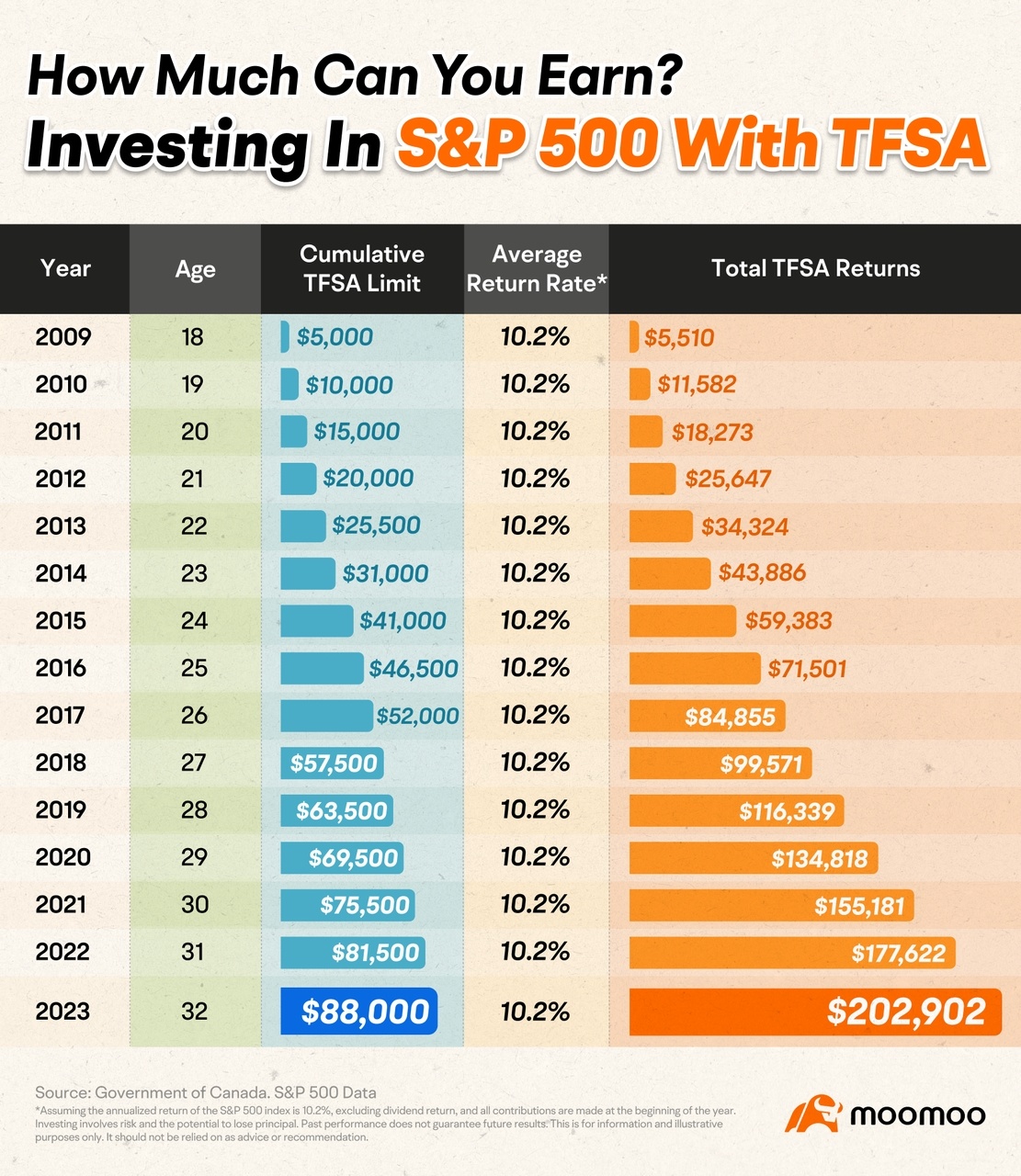
After calculations, from the end of 2009 to the end of 2023, the average annual return rate of the S&P 500 Index was 10.2% (excluding dividends).
Assuming that you have been making the maximum annual contributions to your TFSA since 2009 and investing all of it in the S&P 500 Index ETF, by the end of 2023, after 15 years, your total returns would be substantial. It has been calculated that by the end of 2023, your total contributions to the TFSA (i.e., principal) would amount to $88,000, while your account assets would reach $202,902, with a return rate as high as 130%.
However, that's not all. This year, the S&P 500 Index has performed very well, so following the example above, you will achieve even greater returns. However, it is also important to note that the rise and fall of the stock market are not smooth, so the actual annual return rates are not the same, but overall, the returns on long-term investments are considerable.
Best way to hold US stocks in TFSA
There is a vast array of stocks available for investment in the US stock market, making the choice of investment targets potentially overwhelming for investors. If you are tired of selecting investment targets and want to benefit from the gains of the US stock market, investing in an ETF that tracks the S&P 500 index might be a good choice. The S&P 500 index includes 504 stocks, covering multiple sectors of the US economy and providing broad market coverage. Purchasing an S&P 500 index ETF allows for easy exposure to these stocks. Below are two S&P 500 index ETFs that Canadian investors can hold through a TFSA:
Vanguard S&P 500 ETF (VOO): Registered in the United States and trades in US dollars (USD).
Vanguard S&P 500 ETF (VFV): Registered in Canada and trades in Canadian dollars (CAD).
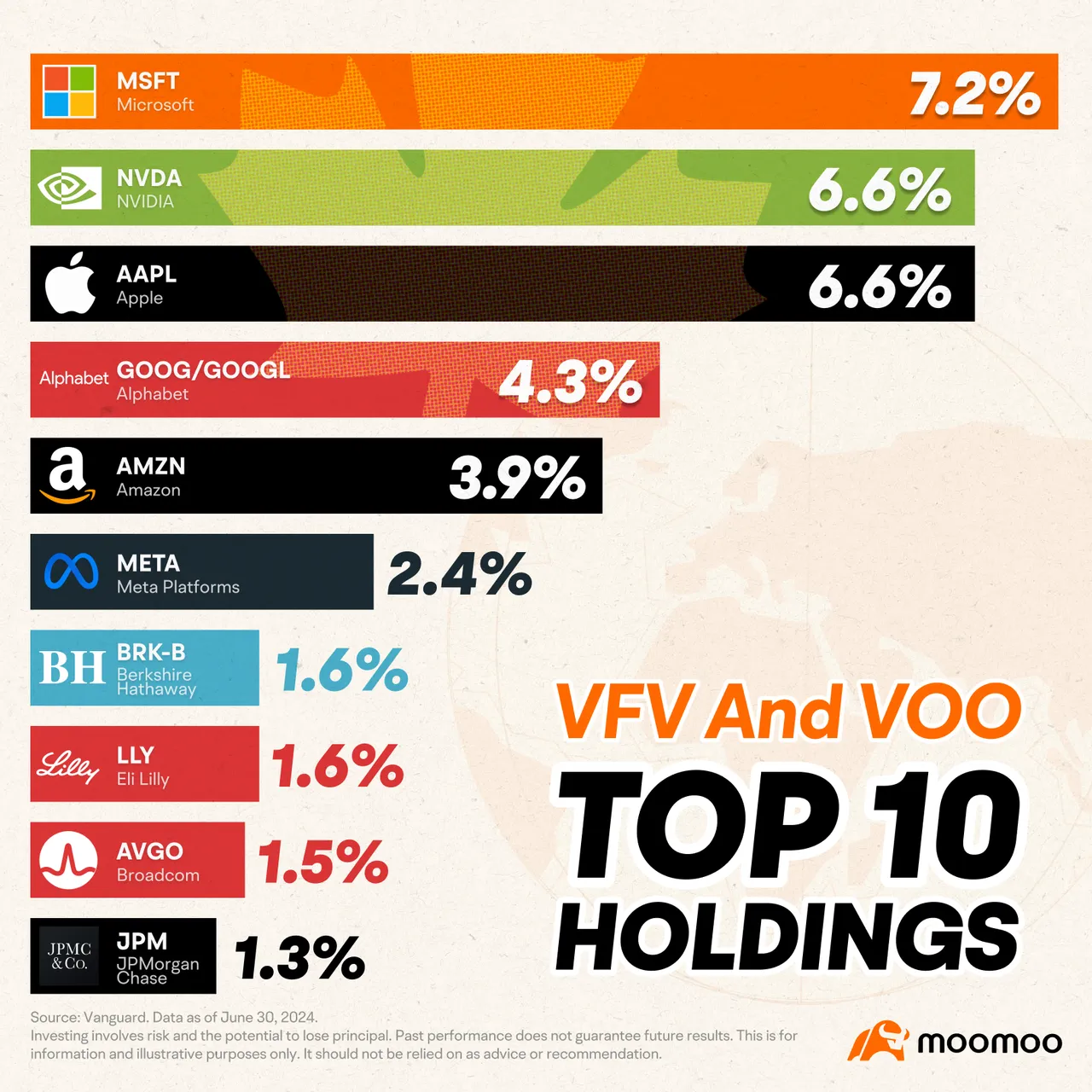
Both ETFs are managed by Vanguard, and VFV operates by holding VOO and both ultimately track the S&P 500 Index, so they have almost identical holdings. The following chart shows the top ten holdings data for both ETFs as of June 30, 2024, for reference. The latest data can be obtained by visiting the official websites of the respective funds.
If you are bullish on stocks in a particular industry in the US stock market, you can also hold industry-specific ETFs through your TFSA. For instance, this year, sectors like utilities, finance, and communication services have shown good performance. Therefore, you can hold the following related ETFs through your TFSA:
Utilities Select Sector SPDR Fund(XLU)
Financial Select Sector SPDR Fund(XLF)
The Communication Services Select Sector SPDR Fund(XLC)

Final words on buying US stocks in TFSA
For Canadian investors looking to gain exposure to US stocks, they can certainly use a TFSA to hold US equities. However, it is crucial to understand and assess the risks associated with investing in US stocks through a TFSA, which can help investors make wiser investment decisions. Although investing in US stocks via a TFSA requires considering risks such as currency fluctuations, market volatility, and economic and regulatory factors, tax-free capital gains, international asset allocation, and strong potential for returns still make investing in US stocks through a TFSA an attractive option for many Canadian investors. In summary, it is hoped that investors will correctly assess the returns and manage risks, making full use of the advantages of the TFSA while minimizing the impact of adverse factors.
This presentation is for informational and educational use only and is not a recommendation or endorsement of any particular investment or investment strategy. Investment information provided in this content is general in nature, strictly for illustrative purposes, and may not be appropriate for all investors. Read more