What is a TFSA in Canada? Tax-Free Savings Account Beginner's Guide
A Tax Free Savings Account (TFSA) is a savings vehicle introduced by the Canadian government in 2009. It allows individuals to save and invest money in a tax-efficient manner. TFSA account is now a very popular account for Canadian investors when investing in stocks, ETFs, options or other type of investments.
So what is a TFSA and how a TFSA account works exactly? What are the benefits of opening a TFSA account? Let's dive into it!
What is a TFSA (Tax-Free Savings Account)?
A Tax-Free Savings Account (TFSA) is a savings account to help Canadians to save and invest money in a tax-efficient manner. Contributions made to a TFSA are not tax-deductible, but any investment growth, including interest, dividends, or capital gains, is tax-free. This means that any money earned within a TFSA and withdrawals made from it are not subject to income tax.
How Tax-Free Savings Accounts Work
TFSA vs Savings Account
While a regular savings account offers minimal interest and is subject to income tax on the interest earned, a TFSA provides tax-free growth on various investment options. Unlike a savings account, TFSAs allow individuals to invest in a wide range of assets, including stocks, bonds, mutual funds, and more. This versatility enables the potential for higher returns, making TFSAs an attractive option for long-term savings goals.
Tax-free Savings Account Interest Rates
The interest rates for TFSAs vary depending on the financial institution and the type of investment within the account. Generally, savings accounts within TFSAs offer competitive interest rates compared to regular savings accounts. Other investment options, such as GICs (Guaranteed Investment Certificates), mutual funds, and stocks, may offer higher potential returns but carry different levels of risk. It is important to research and compare interest rates and investment options offered by different financial institutions to find the best fit for your financial goals and risk tolerance.
Who is eligible for a TFSA?
Any Canadian resident who is 18 years of age or older and has a valid Social Insurance Number (SIN) is eligible to open a TFSA. Non-residents of Canada who is 18 years of age or older and has a valid Social Insurance Number (SIN) is also eligible. There is no upper age limit or requirement of earned income to contribute to a TFSA. However, it is crucial to stay within the annual contribution limits set by the government to avoid penalties.

What are the benefits of opening a TFSA?
Tax-Free Growth: One of the primary advantages of a TFSA is that any investment income earned within the account, including interest, dividends, or capital gains, is tax-free.
Flexibility: TFSAs allow individuals to withdraw funds at any time without incurring tax consequences. This flexibility makes TFSAs suitable for both short-term and long-term savings goals.
Contribution Room: Unused contribution room in a TFSA carries forward to future years. This means that if you don't max out your contributions in a particular year, you can contribute more in subsequent years.
No Impact on Government Benefits: TFSA withdrawals do not affect eligibility for government benefits like the Canada Child Benefit (CCB) or the Goods and Services Tax (GST) credit.
Wide Range of Investment Options: TFSAs offer the flexibility to invest in various assets, including stocks, bonds, mutual funds, GICs, and more, allowing individuals to tailor their investment strategy to their risk tolerance and financial goals.
What are the investment options available for a TFSA?
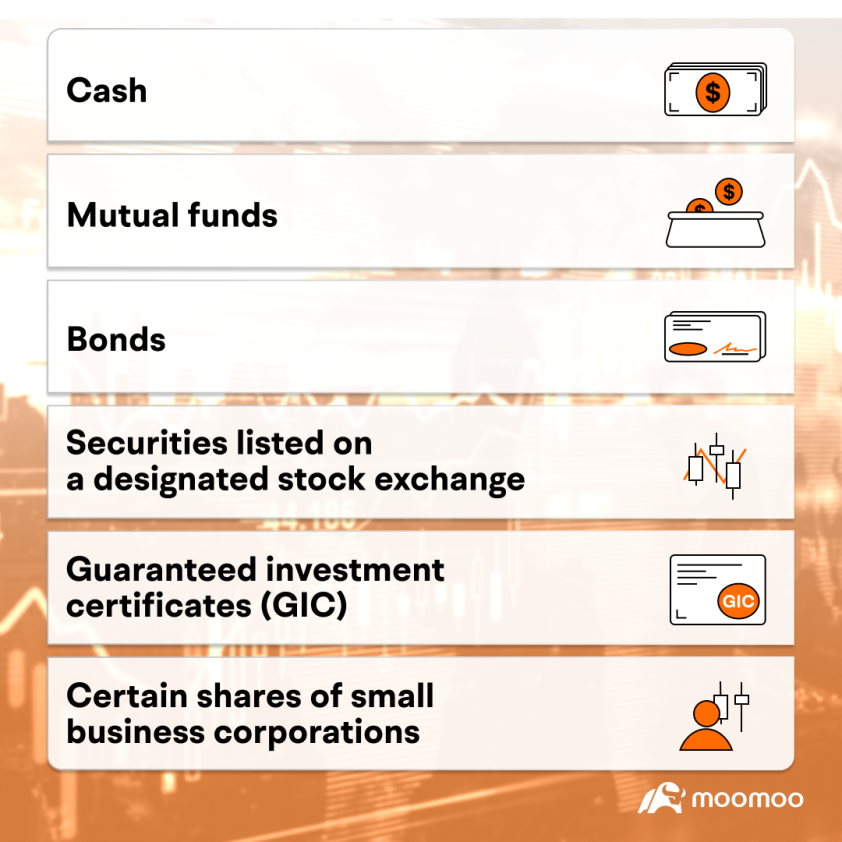
TFSAs offer a wide range of investment options, including:
Savings Accounts: Provide a secure and easily accessible option with competitive interest rates.
Guaranteed Investment Certificates (GICs): Low-risk investments that offer a fixed rate of return over a specific period.
Mutual Funds: Professionally managed investment funds that pool money from multiple investors to invest in a diversified portfolio of stocks, bonds, or other securities.
Stocks: Investing in individual company stocks can provide potential high returns but carries higher risk.
Bonds: Fixed-income securities that provide regular interest payments and lower risk compared to stocks.
Exchange-Traded Funds (ETFs): Similar to mutual funds, ETFs are traded on stock exchanges andtrack the performance of a specific index or sector.
If you’ve already decided ETFs are the backbone of your TFSA for diversification and efficiency, you’re probably facing the real-world challenge: there are hundreds of ETFs out there, and it’s hard to know where to begin. Which are best for long-term holding? Which deliver steady dividends? Which track hot themes like AI or clean energy? Manually checking each ETF’s prospectus, fee ratio, holdings, and history is slow and overwhelming—leading to herd-following or decision paralysis that can cause you to miss opportunities. You need a powerful ETF screening and comparison tool that aligns with your goals, risk tolerance, and preferred market themes, and helps you quickly pinpoint high-quality ETFs fit for a TFSA.
Moomoo’s ETF screener is one of the most capable and user-friendly research tools on the market, with the core advantage of supporting 50+ customizable filters. You can filter simultaneously by investment theme, asset type, expense ratio, dividend yield, and performance—surfacing the right candidates in seconds. For example, find “expense ratio under 0.20%, dividend yield above 4%, tracking the U.S. large-cap index” with a few taps—speed that manual research can’t match. Even better, Moomoo offers 26 thematic ETF categories, covering spot crypto, NVIDIA concept ETFs, artificial intelligence, clean energy, gold, self-driving, and more of the market’s most timely trends. By comparison, Wealthsimple provides only nine basic themes and Webull Canada offers eleven; while Questrade has portfolio services, they often come with extra management fees—Moomoo offers rich theme coverage for free.
To match risk and style at a glance, the unique ETF Style Box visualizes equity and fixed income ETFs in a 3x3 grid by market cap (large/mid/small) and style (value/blend/growth. Conservative investors can focus on large value or high-credit fixed income; growth-seekers can explore small-cap growth.
Plus, the Index ETFs list allows targeted filtering by underlying index and leverage (e.g., S&P 500, Nasdaq 100; 1.5x, 2x, 3x), and landscape mode reveals sortable data columns like price change, volume, and market cap. If income is your goal, the High Dividend Yield module lets you discover, filter, and compare dividend-centric ETFs, use an integrated Dividend Calendar for ex-dates, and compare up to six ETFs side-by-side by performance, payout stability, and expense ratios.
Register with Moomoo and equip your TFSA with professional-grade ETF research. 50+ filters help you zero in on ideal ETFs, 26 themes keep you on top of market trends, and the style box makes risk matching intuitive—all free, without extra subscription fees. Whether you want stable dividend income or to capture growth, Moomoo helps you build an optimal TFSA ETF mix. With 3,000+ free courses and 24/7 Chinese-language support, you’ll make smarter choices, faster. Start today and let powerful tools guide your ETF selection—then let tax-free TFSA growth compound over time.
TFSA contribution room: How to Determine
The TFSA contribution room is the maximum amount you can contribute to your TFSA without incurring penalties. The contribution room is calculated based on the annual TFSA contribution limit set by the government, as well as any unused contribution room from previous years.
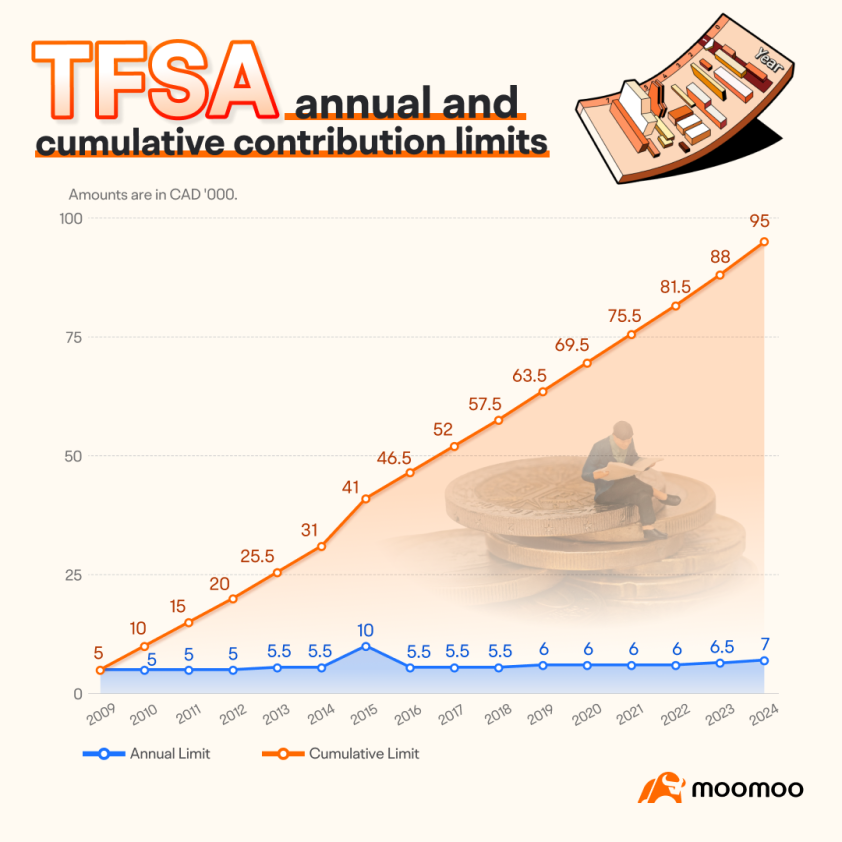
Starting from 2009 when TFSAs were introduced, the annual contribution limit has gone through adjustments. As of 2026, the annual contribution limit is $7,000. However, it's important to note that contribution limits may change in future years, so it's essential to stay updated with the latest information from the Canada Revenue Agency (CRA).
To determine your available contribution room, you can check your CRA My Account, contact the CRA directly, or refer to your Notice of Assessment received after filing your tax return. It's crucial to track your contributions to ensure you stay within the allowable limits. Over-contributing to your TFSA can result in penalties, including a 1% tax per month on the excess amount.
Withdrawals from a TFSA
One of the key advantages of a TFSA is the flexibility it offers for withdrawals. Unlike Registered Retirement Savings Plans (RRSPs), withdrawals from a TFSA are not taxable and can be made at any time. Whether you need to access your funds for a short-term expense or a long-term financial goal, you can withdraw money from your TFSA without incurring tax consequences.
When you make a withdrawal from your TFSA, the amount withdrawn is added back to your contribution room in the following calendar year. This means that if you withdraw $5,000 from your TFSA in 2023, you can recontribute that amount, plus any additional contribution room, in 2024.
It's important to note that recontributions can only be made in the following year. If you recontribute the withdrawn amount in the same year, it will be considered an over-contribution and may be subject to penalties.
How to open a TFSA?
Step 1: Complete registration using your phone number or email address.
Step 2: Get your residential address and SIN ready!
Step 3: Fill out your personal information and sign using your full name.
Step 4: Submit your application! Account approval usually takes 1-3 business days.

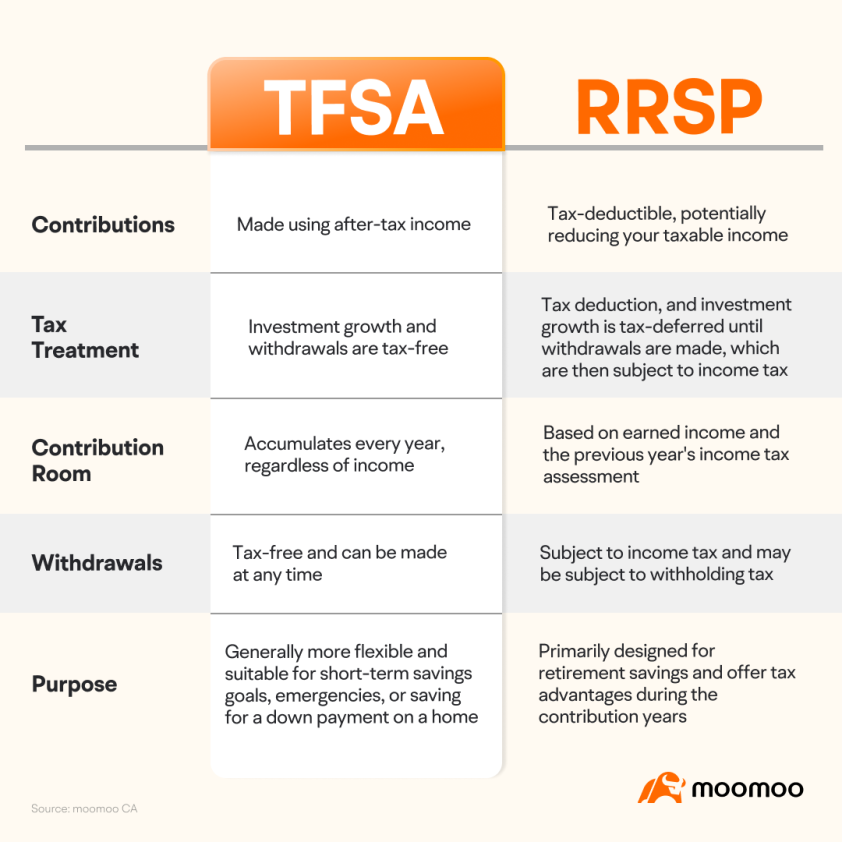
TFSA vs. RRSP: What's the difference?
TFSAs and Registered Retirement Savings Plans (RRSPs) are both popular savings and investment vehicles in Canada, but they have key differences.
Frequency Asked Questions
2. How many TFSAs can I have?
You can have multiple TFSAs, but the contribution room is shared among all your TFSAs. The total amount you contribute across all your TFSAs cannot exceed your available contribution room for the year. It's crucial to track your contributions and ensure you don't over-contribute to avoid penalties.
3. Can I keep my TFSA if I move to USA?
If you move to the USA, you can keep your TFSA. However, it's important to note that TFSA contributions and earnings may be subject to US tax laws. The tax treatment of TFSAs in the US can be complex, and it's advisable to consult with a tax professional who specializes in cross-border taxation to understand the implications and reporting requirements based on your specific situation.
This presentation is for informational and educational use only and is not a recommendation or endorsement of any particular investment or investment strategy. Investment information provided in this content is general in nature, strictly for illustrative purposes, and may not be appropriate for all investors. Read more