How to invest in the S&P 500 from Australia in 2025
In this era of globalised investing, geographical boundaries are no longer a barrier to investors in choosing investment opportunities. Investors in Australia are increasingly expanding their investment horizons beyond their domestic market, which can lead to more diversified portfolios and higher potential returns.
The U.S. stock market is the largest and most influential in the world, which means more investment opportunities for investors. The S&P 500 Index, as one of the most well-known indices in the U.S. stock market, is naturally a popular investment option for investors.
This guide will explore how to invest in the S&P 500 in Australia, understand its basics, and provide strategies for managing the risks of S&P 500 investments to help you better seize investment opportunities and achieve wealth growth.
How to buy S&P 500 in Australia?
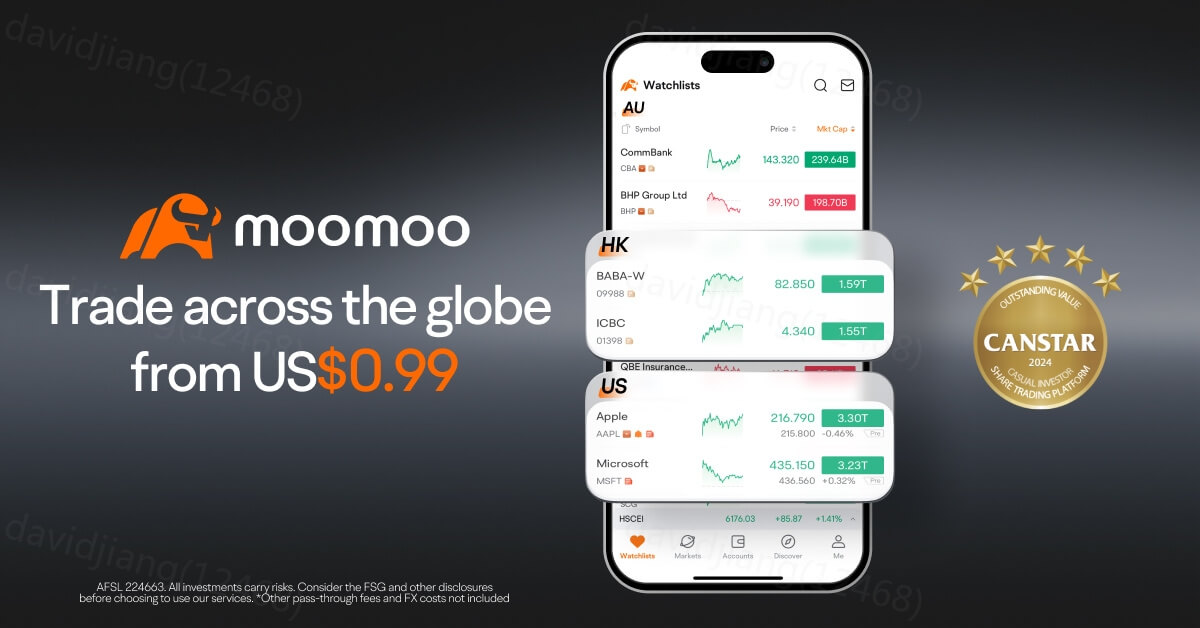
The S&P 500 index cannot be directly invested in, and for individual investors, buying all the constituent stocks of the S&P 500 index means a huge cost and complex operations, so investors can only invest through index funds or ETFs. At this time, using moomoo trading platform is an efficient and convenient choice for investors. You can easily find ETFs related to the S&P 500 index by scrolling down to the details page of the S&P 500 on moomoo.
Here's the step-by-step guide to buying S&P 500 in Australia on moomoo:
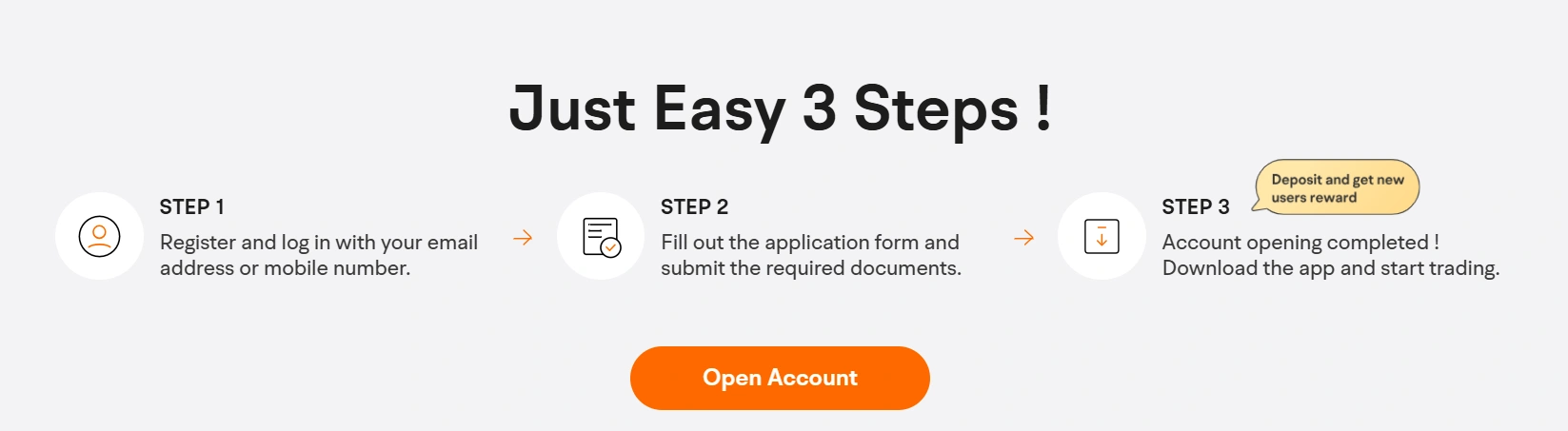
Step 1: Open and fund your moomoo account
Firstly, sign up with your personal details and complete the necessary identity verification steps. Then, deposit funds into your moomoo account using your preferred payment method.
Step 2: Navigate to the US market
Within the moomoo app, tap on the 'Markets' tab, and then navigate to the US section to explore available investment options.
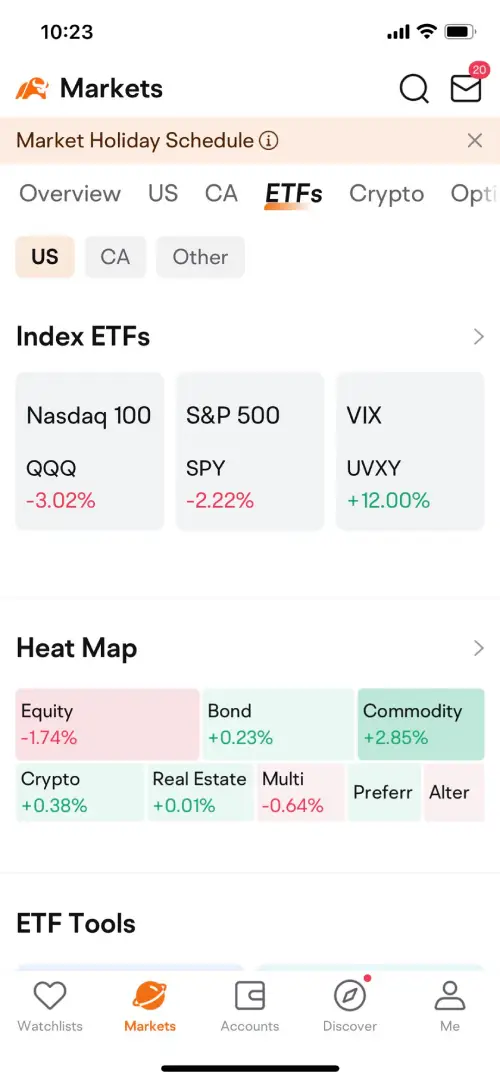
Step 3: Choose an S&P 500 investment option
Since the S&P 500 is an index and cannot be purchased directly, you can invest in it through:
S&P 500 ETFs: Exchange-Traded Funds that track the performance of the S&P 500. Examples include SPDR S&P 500 ETF (SPY) and Vanguard S&P 500 ETF (VOO).
S&P 500 Index Funds: Mutual funds designed to replicate the S&P 500's performance.
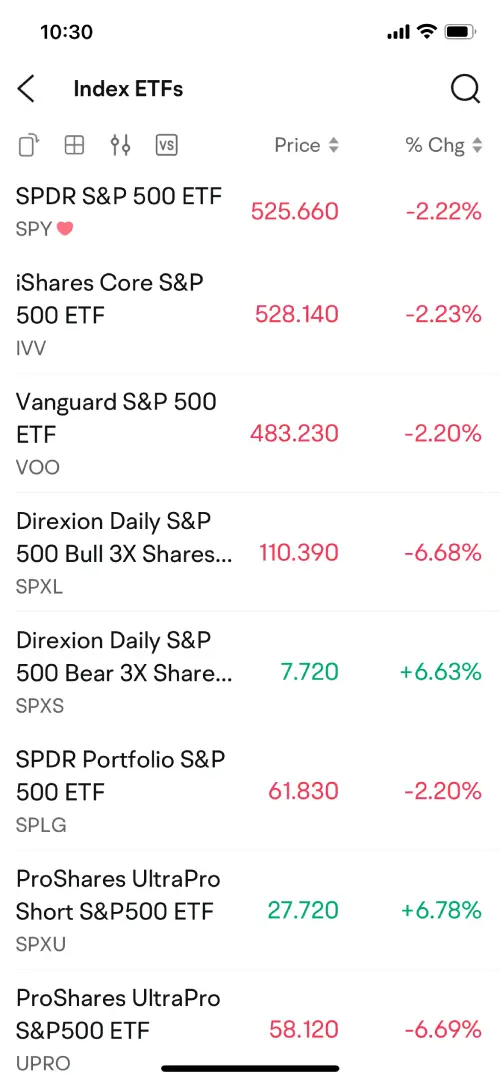
Step 4: Review fund details
Before making a purchase, examine the fund's:
Expense Ratio: The annual fee expressed as a percentage of assets.
Historical Performance: Past returns to gauge potential future performance.
Dividend Yield: The annual dividend payment as a percentage of the fund's price.
Holdings: The individual companies that make up the fund.
Step 5: Place your order
Select the fund: Tap on your chosen ETF or index fund.
Tap 'Buy': Initiate the purchase process.
Enter purchase details: Specify the number of shares or the investment amount.
Choose order type: Select between a market order (buy at current price) or a limited order (set a specific price).
Confirm the order: Review and submit your purchase.
Step 6: Monitor and manage your investment
Monitor how your investment is performing over time. You can use moomoo's tools to set price alerts or news updates related to your investment.
You can also find S&P 500 index ETFs listed in Australia through the following process.
Step 1: Open the moomoo App and select "Markets - ETFs - Other".
Step 2: Enter the "AU ETFs" page and click on "Index ETFs".
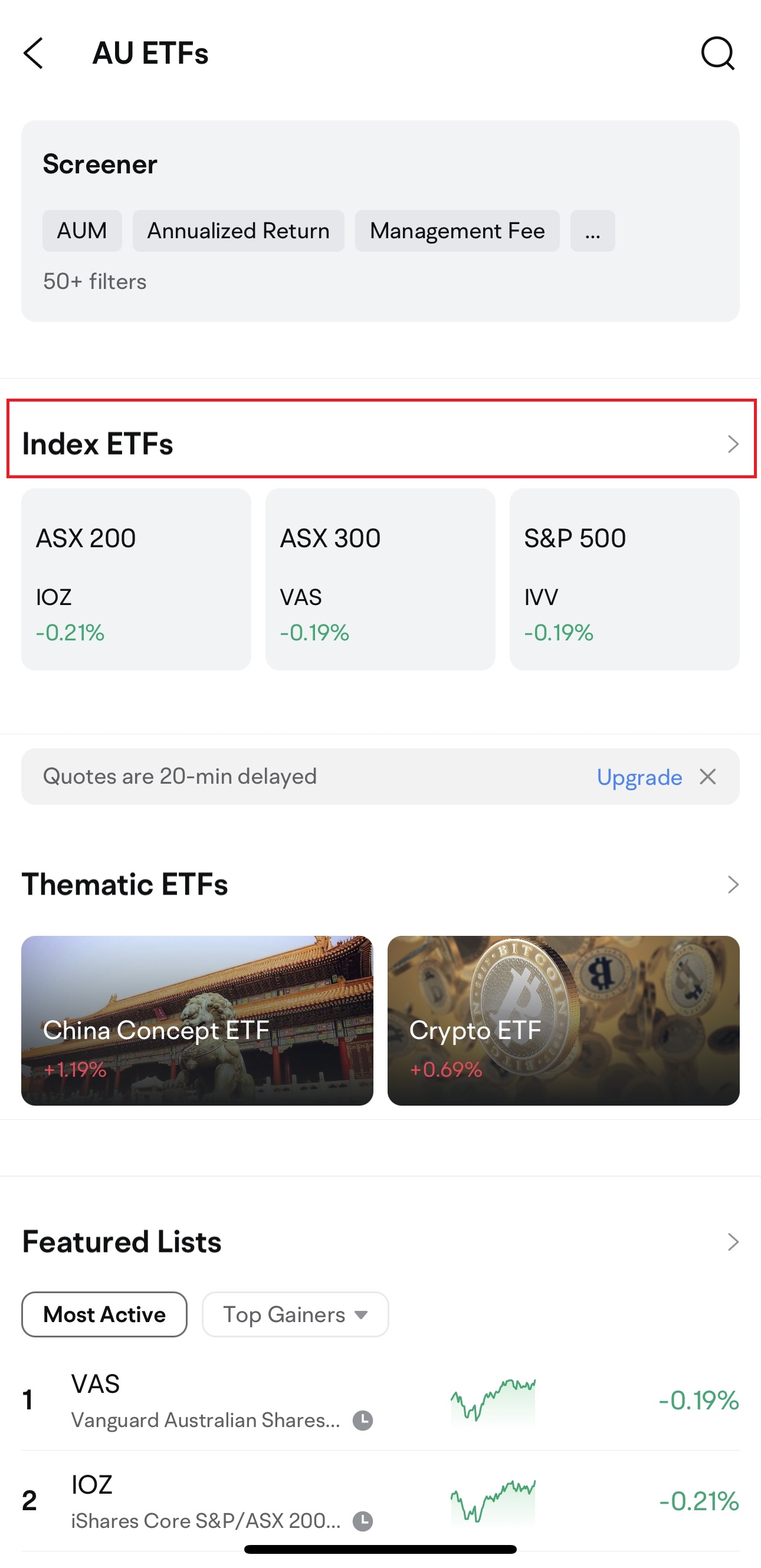
Step 3: Filter the index and select the S&P 500.

What is the sector breakdown of the S&P 500?
As of April 2025, the S&P 500 Index is composed of 11 sectors, each representing a portion of the total market capitalization. Here's the sector breakdown:
S&P 500 Sector Breakdown (as of March 24, 2025)
Sector | Approximate Weight (%) |
Information Technology | 28% |
Financials | 13% |
Health Care | 12% |
Consumer Discretionary | 14% |
Communication Services | 9% |
Industrials | 8% |
Consumer Staples | 6% |
Energy | 4% |
Utilities | 2% |
Real Estate | 2% |
Materials | 2% |
The top four sectors—Information Technology, Financials, Health Care, and Consumer Discretionary—collectively account for approximately 67.52% of the index's total weight. This concentration means that the performance of these sectors, particularly Information Technology, has a significant impact on the overall movement of the S&P 500.
Top 10 largest companies in the S&P 500
The following is a list of the top ten S&P 500 stocks:
Symbol | Name | Market Cap (USD) | YTD Performance |
AAPL | Apple | 2.92T | -21.96% |
NVDA | NVIDIA | 2.55T | -23.17% |
MSFT | Microsoft | 2.76T | -12.67% |
AMZN | Amazon | 1.85T | -21.48% |
GOOG | Alphabet-C | 1.88T | -18.79% |
GOOGL | Alphabet-A | 1.88T | -19.58% |
META | Meta Platforms | 1.27T | -14.82% |
TSLA | Tesla | 776.95B | -38.08% |
BRK.B | Berkshire Hathaway-B | 1.11T | 13.27% |
LLY | Eli Lilly and Co | 696.68B | -5.85% |
*Data as of Apr 17, 2025. | |||
How to select an S&P 500 Index Fund?
Investors can choose to invest in the S&P 500 through index funds. There are various types of index funds, with two different operational models available for investors: index mutual funds and index ETFs. Investing in index funds also provides investors with a multitude of S&P 500 index funds to choose from. Among the ten largest index funds listed on the ASX, two are S&P 500 index funds.
For more details, you can refer to our guide to the 10 best Australian index funds >>
When selecting S&P 500 index funds, investors need to consider the following factors:
Expense ratio: This is the percentage of the fund's assets that investors pay annually for fund management. Generally, index funds that track benchmarks like the S&P 500 have minimal costs associated with them since they don't need active portfolio management. This low cost structure allows a greater portion of your investment profits to be retained by you.
Tracking error: This refers to the difference between the fund's performance and the performance of the benchmark index it tracks. A good S&P 500 index fund should closely replicate the performance of the index. A smaller tracking error indicates that the fund has efficiently tracked the index's performance.
Fund size: Larger funds often have better liquidity, and in addition, large funds may have advantages in trading costs.
Minimum investment: Some funds may require a higher initial investment amount, which may not be suitable for all investors. If you are a small investor, look for funds that offer a lower minimum investment threshold.
Fund type: You can choose between mutual funds or ETFs. ETFs can be traded like stocks on stock exchanges and typically have lower expense ratios and higher liquidity. Mutual funds are usually purchased directly through the fund company and may have different fee structures and redemption policies.
Dividend policy: Different funds may have different dividend handling methods. Some funds may pay dividends regularly, while others may reinvest dividends back into the fund. Depending on your personal financial goals, this could be an important consideration.
Best ways to invest in the S&P 500 from Australia
Investing in the S&P 500 from Australia, investors can choose between ETFs (Exchange-Traded Funds) or traditional index funds (index mutual funds). Both methods have their own characteristics and differences, which are outlined below for investors to compare.
Investing in S&P 500 ETFs
Trading flexibility: ETFs can be bought and sold on stock exchanges like stocks around the clock, which means you can buy or sell at any time based on market conditions.
Lower expense ratio: Most S&P 500 ETFs have a lower management expense ratio.
Liquidity: Since ETFs can be traded in real-time on the market, they typically have very high liquidity.
Transparency: The holdings of ETFs are published daily, allowing investors to clearly know what they are holding.
Investing in S&P 500 Index Funds
Purchase and redemption: Index funds are typically bought and redeemed directly from the fund management company, not traded on an exchange. This means you can only trade at the net asset value at the end of each trading day.
Minimum investment: Some index funds may have a higher minimum investment requirement, but there are also funds with no minimum investment requirements.
Expense ratio: Although the expense ratio of index funds is usually low, it may be slightly higher than average when compared to ETFs.
Automatic reinvestment of dividends: Many index funds automatically reinvest dividends back into the fund, which helps with long-term growth.
What ETFs Track the S&P 500 in Australia?
The following are three ETFs tracking the S&P 500 listed on the ASX.
Symbol | Name | AUM (AUD) | YTD Performance | Expense Ratio |
SPY | SPDR S&P 500 ETF | 562.58B | -10.81% | 0.09% |
UMAX | BetaShares S&P 500 Yield Maximiser ETF | 258.32M | -12.52% | 0.79% |
IVV | iShares S&P 500 ETF | 549.98B | -10.81% | 0.04% |
*Data source: moomoo. Data as of Apr 17, 2025. | ||||
Learn more about S&P 500 ETFs in Australia, you can refer to 6 Best S&P 500 ETFs on the ASX for Australians >>
What Index Funds Track the S&P 500 in Australia?
The following are three index funds that track the S&P 500, and from their operational model, they all belong to mutual funds. Since the latest disclosed data on each fund's official website is not uniform, the following content is for reference only, and for more detailed information, please visit the official websites of the funds.
Symbol | Name | YTD Performance | Expense Ratio | Investment Minimum |
Fidelity 500 Index Fund | 28.05% | 0.015% | No Minimum | |
Schwab S&P 500 Index Fund | 20.93% | 0.02% | No Minimum | |
Vanguard 500 Index Fund | 28.02% | 0.04% | $3,000 (USD) | |
*Data source: Retrieved from individual fund official websites on Apr 17, 2025. | ||||
What are the strategies of investing in the S&P 500?
Investors can invest in the S&P 500 through index funds using various strategies. Here are some common investment strategies:
Buy-and-Hold (Passive Investing)
Description: This is the simplest and most traditional strategy. You buy an S&P 500 index fund or ETF and hold it for the long term, aiming to achieve average market returns.
Advantages: Low transaction costs, low maintenance costs, and historically, the S&P 500 has provided strong returns over the long term.
Considerations: Requires patience and the ability to withstand short-term market fluctuations.
Dollar-Cost Averaging (DCA)
Description: Invest a fixed amount regularly (e.g., monthly) in an S&P 500 index fund or ETF, regardless of the stock price.
Advantages: Reduces the impact of volatility by averaging purchase prices over time. Avoids the pitfalls of trying to time the market.
Considerations: May be less efficient than a lump-sum investment if the market continues to rise, but it is a good method for reducing risk and fostering discipline.
Implementing dollar-cost averaging with moomoo!
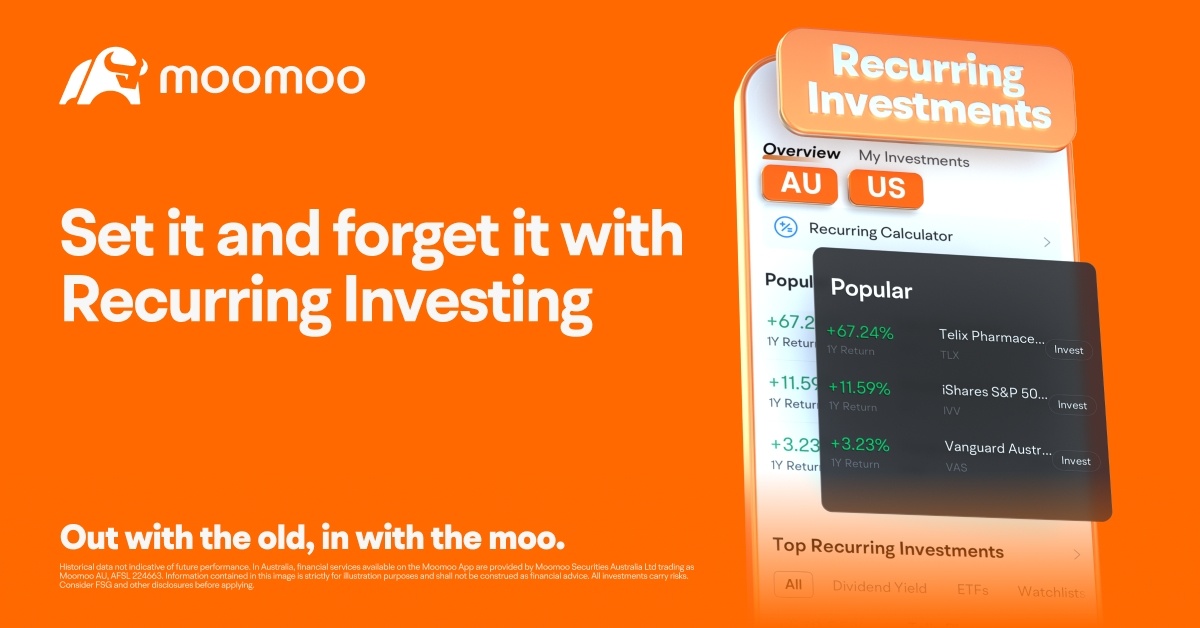
Moomoo provides a recurring investment feature to automate your dollar-cost averaging strategy effectively. Here's how it works:
Flexible scheduling: Opt for daily, weekly, or monthly investment intervals to align with your financial goals.
Low entry point: Begin investing with just $10 per month, making it ideal for newcomers.
Fractional shares: Leverage fractional shares trading to reduce average investment costs and diversify your portfolio.
Simple setup: Easily establish a recurring investment plan via the Moomoo app by selecting your desired stock, investment amount, and frequency.
Value Averaging
Description: Similar to DCA, but instead of investing a fixed amount, you invest enough funds to reach a predetermined portfolio value.
Advantages: Buys more when prices are low and less when prices are high, potentially increasing returns.
Considerations: Requires more active management and may involve selling shares to achieve the target value, which could have tax implications.
Rebalancing
Description: Regularly adjust your investment portfolio to maintain a specific asset allocation. For example, if your goal is 80% in S&P 500 and 20% in bonds, you would rebalance annually or semi-annually.
Advantages: Helps maintain your desired level of risk and can enhance returns by systematically buying low and selling high.
Considerations: Involves some transaction costs and may trigger capital gains taxes.
It is important to note that when investors formulate their investment strategies, they need to fully understand their own risk tolerance. The S&P 500 may experience significant short-term fluctuations, so investors need to develop appropriate investment strategies, pay attention to diversification, and control risk levels to match their risk tolerance. At the same time, investors in the S&P 500 need to have a long-term perspective. From historical data, the S&P 500 has historically provided strong returns from a long-term perspective, but it can also experience significant short-term fluctuations.
Potential advantages of investing in the S&P 500
Diversification: The S&P 500 covers the 500 largest companies in the U.S. stock market, spanning multiple industries and sectors. This diversified investment can help reduce risk as funds are spread across different companies, thus not overly reliant on the performance of any single company.
Transparency and liquidity: Since the S&P 500 is composed of well-known large-cap stocks, information about these constituent stocks is very transparent. Additionally, these stocks generally have high liquidity, meaning they can be bought and sold quickly without significantly affecting their prices.
Long-term growth potential: Historically, the S&P 500 has shown positive returns over the long term, which is attractive to long-term investors. While past performance is not indicative of future results, the index has traditionally provided a way to grow wealth over time, especially when dividends are reinvested.
Dividend income: Many companies in the S&P 500 pay dividends, providing investors with a source of income. Over time, this portion of the returns, if reinvested to purchase more shares, can significantly increase total returns.
Potential disadvantages of investing in the S&P 500
Market capitalisation weighting risk: The S&P 500 is an index where the weight of each company is determined by its market capitalisation; as a result, companies with larger market caps carry more influence in the index. If these large companies perform poorly, they can disproportionately affect the overall performance of the index. For example, tech giants like Apple and Microsoft have a significant weight in the index, and if they encounter problems, it can have a substantial impact on the overall index.
Inability to beat the market: Investing in the S&P 500 through index funds incurs a certain opportunity cost for investors. Since S&P 500 index funds aim to track the index's performance, they cannot actively seek to outperform the market. For those investors seeking returns above the market average, this could be a disadvantage.
Economic data and policy factors: Economic indicators such as U.S. economic growth, inflation, interest rates, as well as the Federal Reserve's monetary policy and government fiscal policies, can all impact the performance of the S&P 500 index.
Final words on investing in the S&P 500 from Australia
Investing in the S&P 500 index is a simple and effective way for investors to gain broad exposure to the U.S. stock market. By selecting the right index fund, investors can enjoy the benefits of low costs, professional management, and diversified risk. Whether for long-term growth or stable income, the S&P 500 index is a consideration-worthy investment option. However, investors should be aware of market volatility and currency risk, and make wise investment decisions based on their financial goals and risk tolerance. It is recommended to consult a financial advisor before investing to ensure the choice of the most suitable investment tool.
FAQs on buying S&P 500 in Australia
How much does it cost to invest in the S&P 500?
The cost of investing in the S&P 500 is relatively low, primarily depending on the investment tool you choose. With low-cost S&P 500 ETFs or index funds, the minimum investment can range from zero to several thousand dollars, and the annual management fee (expense ratio) is typically below 0.10%. If purchased through an online broker that offers commission-free trades, there may be no additional trading fees. Overall, investing in the S&P 500 is a highly cost-effective option.
How should a beginner invest in the S&P 500?
Beginners can invest in the S&P 500 by purchasing low-cost index funds or ETFs, choosing a cost-effective online broker like moomoo, and adopting a dollar-cost averaging strategy to diversify market volatility risks and leverage the power of compound interest for long-term wealth growth.
Should I choose S&P 500 ETFs or Index Funds?
Choosing between an S&P 500 ETF and an index fund depends on your specific needs: if you wish to buy and sell at any time during the trading day and may engage in more frequent trading, an ETF is the better choice; if you prefer to hold for the long term, then an index fund might be more suitable for you. Both offer low-cost ways to track the performance of the S&P 500 index.
Does Vanguard Australia have an S&P 500 ETF?
Yes, Vanguard Australia offers ETFs that provide exposure to U.S. equities, including the S&P 500. While there isn't a Vanguard Australia ETF that exclusively tracks the S&P 500, investors can consider the following options:
Vanguard US Total Market Shares Index ETF (ASX: VTS)
This ETF offers broad exposure to the entire U.S. equity market, encompassing large-, mid-, and small-cap stocks. As the S&P 500 comprises the largest U.S. companies, it represents a significant portion of this ETF. Therefore, VTS provides substantial exposure to the S&P 500 while also including additional U.S. companies.Vanguard MSCI Index International Shares ETF (ASX: VGS)
This ETF provides exposure to a wide range of large- and mid-cap companies in developed markets worldwide, including the U.S. While not exclusively focused on the S&P 500, it includes many of its constituent companies, offering indirect exposure.
For investors seeking direct exposure to the S&P 500, U.S.-listed ETFs such as the SPDR S&P 500 ETF Trust (SPY) or the Vanguard S&P 500 ETF (VOO) are available. These can be accessed through brokerage platforms that offer international trading capabilities.
How do I invest in S&P 500 for beginners?
Investing in the S&P 500 is a popular choice for beginners due to its diversification and historical performance. The S&P 500 is a stock market index comprising 500 of the largest publicly traded companies in the U.S., spanning various industries. It serves as a benchmark for the overall U.S. stock market performance.
To invest in the S&P 500 from Australia, you can purchase exchange-traded funds (ETFs) that track the index. Popular options include the iShares Core S&P 500 ETF (ASX: IVV), SPDR S&P 500 ETF Trust (ASX: SPY), and Vanguard S&P 500 ETF (VOO) listed on U.S. exchanges. These ETFs aim to replicate the performance of the S&P 500 and can be bought through brokerage platforms that offer access to U.S. markets. Ensure you consider factors like currency exchange rates, tax implications, and brokerage fees when investing in international ETFs.
This presentation is for informational and educational use only and is not a recommendation or endorsement of any particular investment or investment strategy. Investment information provided in this content is general in nature, strictly for illustrative purposes, and may not be appropriate for all investors. Read more