Top 10 Financial Services Stocks to Watch after Fed Rate Cuts in 2024

In financial markets, few events have the potential to reshape investment landscapes as dramatically as a Federal Reserve interest rate cut. As we step into September 2024, the Federal Reserve has officially entered a new era of rate cuts, marking a significant shift from the previous tightening cycle. This move, which saw a reduction of 50 basis points, is the first of its kind since March 2020, signifying a pivotal moment for investors looking to capitalise on the changing economic tide. Especially for those focused on financial services stocks.
The impact of an interest rate cut is widespread, making financial services sector one of the key beneficiaries. Traditionally, rate reductions have acted as a growth stimulant within this domain, as decreased borrowing expenses can invigorate lending operations and enhance market liquidity. With financial institutions poised to reap the benefits of these advantageous conditions, investors are eager to pinpoint the leading financial services stocks that are set to take the lead.
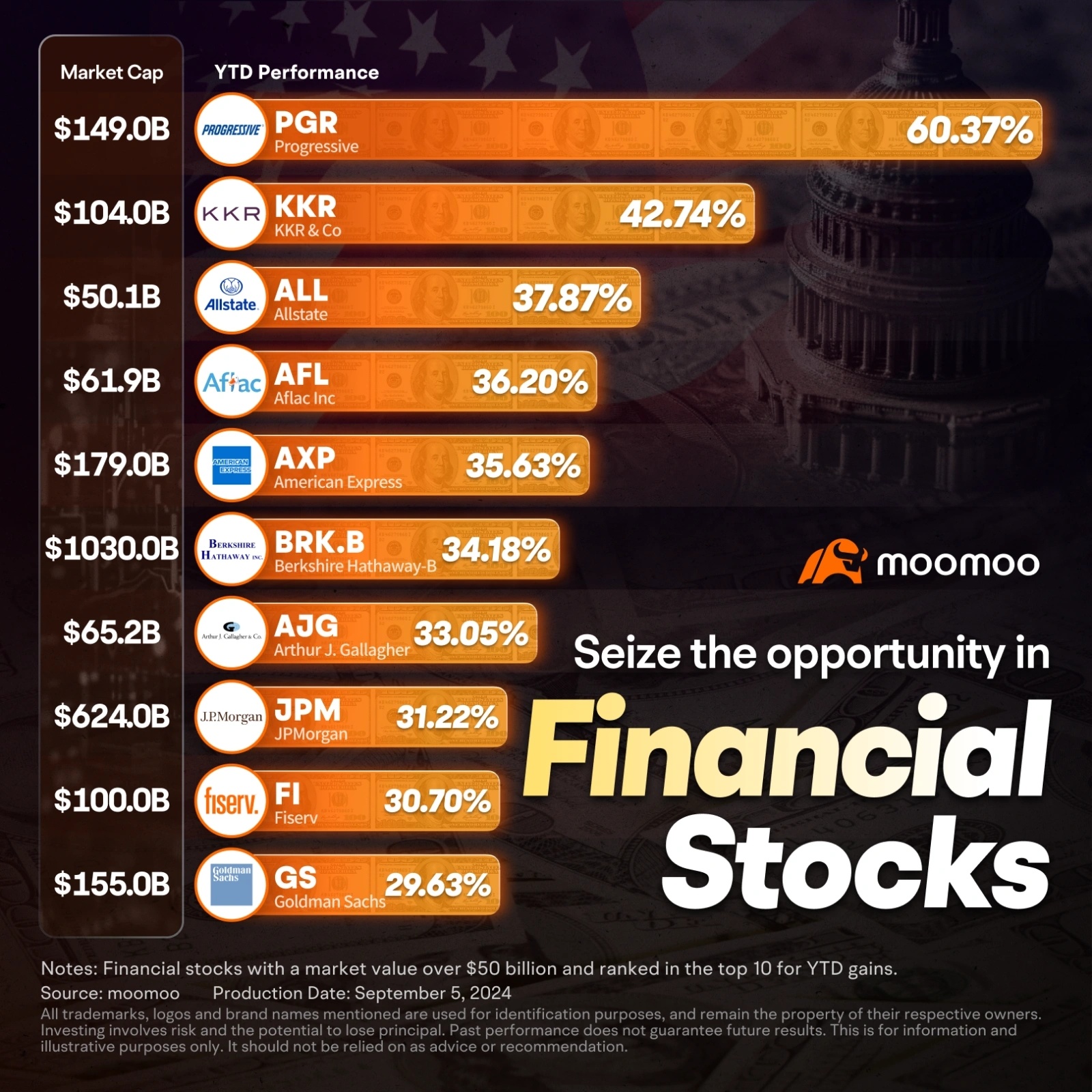
This article delves into the top 10 financial services stocks that have not only demonstrated robust market capitalisation but also have shown remarkable year-to-date performance as of September 5, 2024. These stocks represent a diverse cross-section of the industry, from banking giants to insurance behemoths, each with its own unique potential to benefit from the Fed's rate cuts.
Effects of Fed rate cuts on the financial services sector
The Federal Reserve's decision to cut interest rates can have a profound impact on the financial services sector. Here's a breakdown of the potential effects on seven key industries:
Banking industry
Interest rate cuts typically lead to a decrease in the interest rates on loans, which can stimulate borrowing activities. This can increase banks' lending revenues and enhance profitability. Additionally, lower interest rates reduce the cost of funds for banks, as they can attract deposits or borrow from other financial institutions at lower rates.
Insurance industry
Lower interest rates may increase the appeal of insurance products as the returns on fixed-income investments, such as bonds, decline. This could lead more investors to seek insurance products as investment and risk management tools.
Securities industry
Interest rate cuts usually lower the cost of borrowing for businesses, thereby improving their profit prospects and stock values. This is beneficial for the securities market, as investors might turn to the stock market in search of higher returns. Moreover, rate cuts can stimulate mergers and acquisitions activity, as companies can finance acquisitions at lower interest rates.
Fintech Companies
Fintech companies may benefit from interest rate cuts as they can offer loans at lower rates, attracting more customers. At the same time, the reduced interest rates may increase borrowing demand from consumers and businesses, leading to increased transaction volumes and revenues for fintech companies.
Real Estate Investment Trusts (REITs)
Interest rate cuts typically reduce mortgage rates, stimulating growth in the real estate market. This can increase the attractiveness of Real Estate Investment Trusts (REITs), as they offer relatively higher returns.
Consumer Credit
Lower interest rates may decrease the rates on credit cards and other consumer credit, reducing the repayment pressure on consumers. This could stimulate consumer spending, thus having a positive effect on the overall economy.
In summary, The Federal Reserve's interest rate cut policy has broad implications for the financial services sector. While rate cuts may enhance the profitability of banks and insurance companies, they can also pose challenges to financial institutions that rely on a high-interest-rate environment. Investors considering investments in financial services stocks should closely monitor interest rate changes and their effects on different financial products and markets.
Top 10 financial services stocks to watch after Fed rate cuts
Considering market capitalisation and year-to-date returns, we have identified the top 10 financial services stocks to monitor following the Fed's interest rate reduction, as illustrated below.
Progressive (PGR.US)
Progressive, established in 1937, is a leading U.S. insurer offering auto, motorcycle, boat, RV, and home insurance. Known for innovation and digital services like price comparison and online policy sales, Progressive has a strong market presence, especially in commercial auto insurance. The company operates through a network of independent insurance agencies across the U.S. and directly to consumers online, by phone, and via a mobile app. Progressive also values social responsibility and diversity. It's recognised for its financial strength and commitment to meeting customer needs.
KKR & Co (KKR.US)
KKR & Co. is a leading global investment firm that specialises in alternative asset management and provides capital markets and insurance solutions. The company's primary business is to source, manage, and grow investments across various asset classes. KKR sponsors investment funds that invest in private equity, credit, and real assets. They also have strategic partners that manage hedge funds. KKR’s insurance subsidiaries offer retirement, life, and reinsurance products.
Allstate (ALL.US)
Allstate Corporation is one of the largest insurance providers in the United States, offering a wide array of insurance products primarily through its subsidiaries. These products include auto, home, life, and commercial insurance. Allstate also provides financial products and services, such as retirement plans and investment management.
Aflac Inc (AFL.US)
Aflac Incorporated is a leading provider of supplemental insurance products in the United States and Japan. The company's primary business is to provide financial protection to policyholders dealing with medical emergencies and specific health-related needs. Aflac is well-known for its cancer and medical insurance policies in Japan and supplemental health insurance products in the United States.
American Express (AXP.US)
American Express is a globally integrated payments company with a long history dating back to 1850. It provides a wide array of charge and credit card products, as well as expense management, travel, and other related services to consumers and businesses around the world. The company is known for its premium services and loyalty programs, which provide cardholders with various travel and shopping perks.
Berkshire Hathaway-B (BRK.B.US)
Berkshire Hathaway Inc. is a conglomerate holding company known for its diverse portfolio of businesses, including insurance, railroad, utilities, energy, and various manufacturing, service, and retail operations. It is known for its chairman and CEO, Warren Buffett, who is considered one of the most successful investors in the world. The company's Class B shares are designed for individual investors who want exposure to Berkshire's diverse portfolio at a lower price point than the more expensive Class A shares.
The company's insurance segment is a significant contributor to its revenue, with subsidiaries like GEICO, Berkshire Hathaway Reinsurance Group, and Berkshire Hathaway Primary Group. Additionally, Berkshire Hathaway has major investments in BNSF (railroad), Berkshire Hathaway Energy, and a wide array of other companies.
Arthur J. Gallagher (AJG.US)
Arthur J. Gallagher & Co. is a worldwide provider of insurance brokerage, risk management, and consulting services. Established in 1927 and based in Rolling Meadows, Illinois, it has a presence in over 130 countries with a team of more than 52,000 experts. The company delivers an extensive array of solutions such as risk management, claims advocacy, employee benefits consulting, and property/casualty insurance placements.
JPMorgan (JPM.US)
JPMorgan Chase & Co. is a leading global financial institution offering a broad range of financial services, including investment banking, asset management, private banking, and commercial banking. The firm functions across four principal business divisions: Personal & Neighborhood Banking, Business & Investment Banking, Corporate Banking, and Asset & Wealth Management.
Fiserv (FI.US)
Fiserv, Inc. is a leading global provider of financial services technology solutions. The company specialises in payment systems, account processing, and digital banking solutions, serving a wide range of clients including banks, credit unions, and merchants. Fiserv operates through two main segments: Merchant Solutions and Financial Solutions. The Merchant Solutions segment offers credit and debit card processing, as well as other payment-related services. The Financial Solutions segment provides account processing, risk management, and other financial services.
Goldman Sachs (GS.US)
Goldman Sachs, known as a premier "white shoe" Wall Street firm, is a top-tier global provider of financial services, offering investment banking, securities trading, and wealth management to corporations, financial institutions, governments, and wealthy individuals. Established by Marcus Goldman in 1869, it has evolved into a highly respected financial institution with a substantial global market presence, significantly involved in M&A, securities underwriting, and trading across various asset classes. The bank's strategy revolves around its distinguished Global Banking & Markets and Asset & Wealth Management units, designed to foster growth and deliver value to its stakeholders. Additionally, Goldman Sachs is committed to making a social impact through programs like the 10,000 Small Businesses initiative, which seeks to foster economic opportunities and advance societal development.

Final thoughts on financial services stocks after Fed rate cuts
Federal Reserve rate cuts offer both opportunities and challenges for financial services stocks. While lower borrowing costs can stimulate lending and enhance market liquidity, they also narrow the net interest margins for banks and pose challenges for high-yield investors. Investors should be aware of the potential risks, including interest rate risk, credit risk, reinvestment risk, and volatility in equities.
Additionally, sector-specific sensitivities to rate changes, regulatory changes, operational risks in fintech, and market expectations can also impact the financial sector. It's crucial for investors to maintain a diversified portfolio and adopt a long-term investment strategy that accounts for these risks in the evolving interest rate landscape.
This presentation is for informational and educational use only and is not a recommendation or endorsement of any particular investment or investment strategy. Investment information provided in this content is general in nature, strictly for illustrative purposes, and may not be appropriate for all investors. Read more