Theta: Secrets Behind Time
In previous articles, we highlighted the difference between stocks and options concerning internal value versus external value (time value).
Time value is a crucial component of an option's premium. As time passes, it decreases the time value, making the buyer lose money while the seller gains more. In such situations, understanding Theta - an indicator for measuring the time value of options - can be beneficial.
1. What is Theta?
Theta, represented by the symbol θ, measures how much an option's price will change due to time decay as the expiration date approaches. In other words, Theta helps us understand how much the option's premium will decrease with each passing day until expiration.
Let's examine a random example on moomoo. As shown, this Tesla option has a Theta of -0.8501, which indicates that its premium will fall by US$0.8501 every day until expiration, all other things being equal. Therefore, we can calculate the new premium of the option using the following formula:
New Premium = Original Premium + θ * Elapsed Time
On moomoo, the new premium is readily available on the option's quote page.
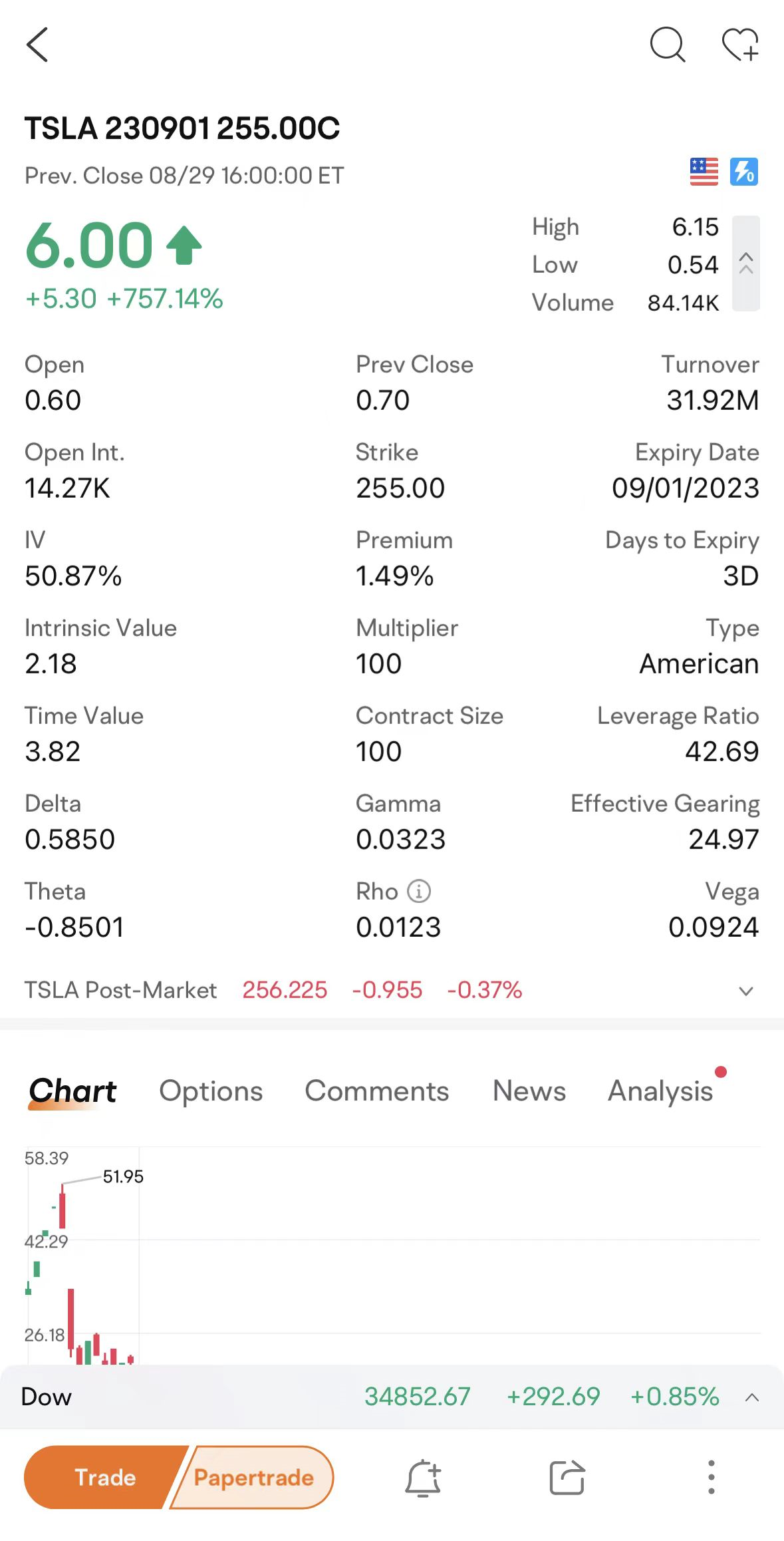
(Any app images provided are not current and any securities shown are for illustrative purposes only and is not a recommendation.)
2. Features of Theta
1)Theta is usually negative
Theta is usually negative, as it represents the impact of time decay on options prices, and option values decrease over time.
However, exceptions do occur. For instance, deep in-the-money European put options may have a positive Theta.
We might understand why such options have positive Theta by breaking them down into three parts: Deep In-the-money + European Option + Put Option
Deep In-the-money
We've discussed a lot about option's prices, so we'll do a quick recap here.
European Option
Generally speaking, European options refer to index options. European options do not allow early exercise, and option buyers have to exercise their options on the expiration date. In addition, cash settlement, instead of physical settlement, is adopted.
Put Option
Options traders may buy puts if they expect the underlying stock to drop, and may sell puts if they don't expect the underlying stock to drop.
After understanding these three elements, let's go back to the question: Why might deep in-the-money European put options have a positive Theta?
Let's say Alice buys a deep in-the-money European put option. That's to say, Alice can sell the underlying asset at the strike price upon expiration. When will the maximum profit be obtained? That's when the underlying asset's price drops to zero. In this case, Alice should exercise the put option immediately to ensure maximum profit. But since it's a European-style option that can only be exercised on expiration, the time value of the option has already turned negative, making the corresponding Theta positive.
2) At-the-money options have the highest Theta in absolute terms.
Theta measures the impact of time decay on option prices as the expiration date approaches. For an at-the-money option, the probability for it to become in-the-money and out-of-the-money is the same. In this case, it has the highest uncertainty and thus the largest absolute value of Theta.
Think about a soccer game. Imagine that the score is tied at 2-2 in a soccer game (compare it to the strike price of an ATM option). The probability of either team winning is 50% (becoming in-the-money or out-of-the-money). Therefore, how much time is left in the game (time left till expiration) becomes particularly important.
3) How does Theta change as the expiration date approaches?
As the expiration date approaches, time value decays in a parabolic manner, leading to a larger negative Theta.
In addition, the difference in Theta among in-the-money, at-the-money and out-of-the-money options becomes larger.
For in-the-money and out-of-the-money options alike, their Theta approaches zero as they near the expiration date because it is less likely for significant changes to occur that might impact their prices. Time value decays rapidly and can run out in advance, which will also push Theta to zero.
For at-the-money options, however, Theta's absolute value becomes larger as the expiration date approaches. This is because at-the-money options have a significant amount of time value, and there is a 50% probability for it to become either in-the-money or out-of-the-money. Therefore, Theta's absolute value becomes larger.
Now that we've learned the features of Theta, you may have a better understanding of the following words: Time is the enemy of buyers and the friend of sellers. During a volatile options market, if you want to go long as a buyer, you must be cautious, especially when holding options with high Theta in absolute terms for a long time.
3. Wheel Strategy: Work with Theta to Potentially Gain from Time Value
Many investors may choose to construct a Theta decay type of strategy: capitalizing on time value without predicting the price movements of the underlying assets. However, this is considered an advanced strategy with many variations. Additionally, with time working against your favor, you'd better stay out of this strategy if you don't know much about it.
One commonly-used variation is the Wheel Strategy, which may be a good choice for those who already have a long-term hold on an options asset.
The Wheel Strategy consists of two steps:
Step 1: Sell an out-of-the-money cash-secured put.
If the put isn't exercised, you can simply collect the option premium and continue selling more puts with different strike prices or expiration dates.
If the put is exercised, buy the underlying asset and hold the stock. Move on to step 2.
Step 2: Construct the Covered Call strategy
If the call isn't exercised, keep selling more calls and collect the option premium.
If the call is exercised, you're obligated to sell the underlying asset and you can go back to Step 1 by selling another put.
Although the Wheel Strategy sounds tempting and seems easy to earn option premiums, you should be careful in picking the underlying stock and choosing the puts and calls' strike prices. Otherwise, you may suffer a heavy loss. You should also be fine with holding the underlying stock for this type of strategy.
Always remember: Think twice before you act.
This presentation is for informational and educational use only and is not a recommendation or endorsement of any particular investment or investment strategy. Investment information provided in this content is general in nature, strictly for illustrative purposes, and may not be appropriate for all investors. Read more