Index Options VS. ETF Options: What to Learn?
Index options and ETF options have been gaining popularity among investors in recent years, and a 2021 study by Options Industry Council shows that index options have generally outperformed individual stock options by 30% over the past decade.
Today, let's take a closer look at index options and ETF options. We'll explore what index options and ETF options are, how they work, and how investors can use them to potentially enhance their investment strategies.
1. Index Options
What are index options? As the name suggests, index options are options contracts that track a stock market index. To understand how these options work, we first need to understand what a stock index is.
A stock index is like a basket of various stocks that together reflect the value of those stocks in the market. Stocks within the same index share common characteristics, such as trading on the same exchange or belonging to the same industry.
The stock index is a widely used benchmark that investors monitor to gauge the market's performance and its trend. In the US, the Dow Jones Industrial Average, S&P 500 Index, and NASDAQ Composite Index are the most commonly followed indices.
We'll briefly review one key stock indice: the NASDAQ Composite Index.
The NASDAQ Composite Index is a critical indicator of the US stock market's performance, comprising over 3,000 stocks listed on NASDAQ. Since the start of this year, it has shown an upward trend, reaching a new high of this year on July 19th, 2023. Now it retraces back to around 13500 as of November 7th, 2023.
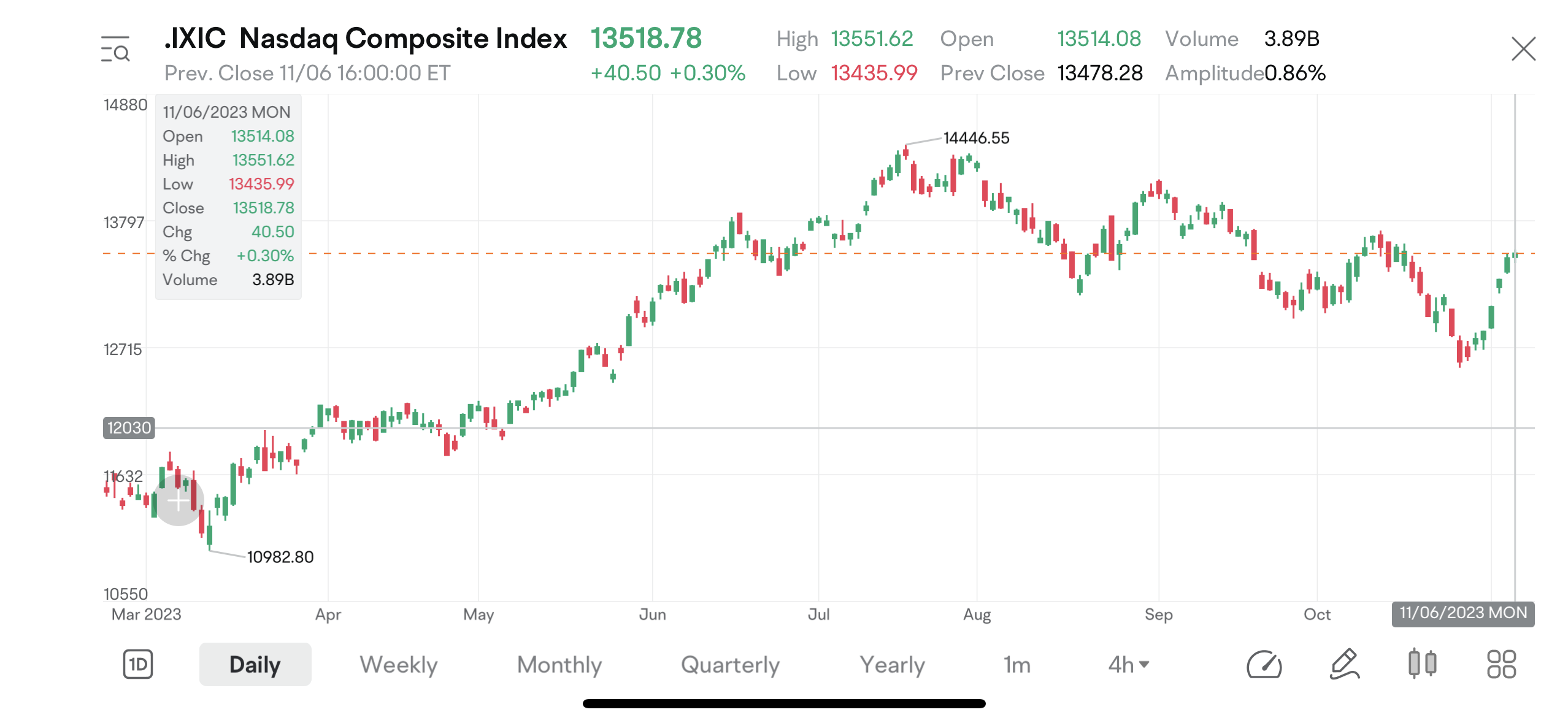
(Any app images provided are not current and any securities shown are for illustrative purposes only and is not a recommendation.)
Now that we have defined what Index Options are, let's compare them to Stock Options. There are three significant differences between the two types of options contracts:
1) Underlying Assets:
Index options represent a basket of stocks, while stock options represent a single company's stock.
2) Settlement Method:
Stock options use physical settlement, which means that the actual underlying stocks will be delivered upon exercise or assignment on the specified delivery date. However, index options use cash settlement because of their large contract size and pay a cash amount instead of delivering the underlying asset upon the specific delivery date.
3) Option Type:
All stock options are American-style options, meaning they can be exercised at any time before or on the expiration date. Conversely, most index options are European-style options, meaning they can only be exercised on the expiration date, and not prior to it.
2. ETF Options
Now let's look at ETF options, which track ETFs. An ETF, or Exchange-Traded Fund, is a fund that tracks an index and trades on a stock exchange. While index funds and ETFs both track indices, they have several differences:
1) Fees and Expenses:
ETFs are traded like stocks on an exchange, meaning investors could pay commissions to their broker per trade. Conversely, index funds are bought directly from the fund manager.
In addition, different dividend distributions result in varying fees and expenses. Index mutual funds automatically reinvest dividends into more shares, while ETF investors who use dividends to buy more shares may incur additional commission costs. It is also important to note that there are also other related fees for mutual funds, such as expense ratio and sales fees. For more information about that, you may go to help center for details.
2) Minimum Investments
ETFs allow for small investments, while index funds may require a minimum investment amount.
3) Liquidity
Liquidity is crucial for trading. ETFs are traded on stock exchanges like stocks, so investors can trade them anytime during market hours. By contrast, shares of index funds are traded after the market closes, meaning any orders placed during market hours will be executed at the closing price.
4) Trading Direction
Investors can long or short ETF shares, but can only long index fund shares.
5) Leveraging
Index funds do not offer leveraging, while some ETFs use leverage to potentially amplify returns but also magnify their risks.
3. Which One to Consider: ETF Options VS. Index Options?
When deciding between ETF options and index options, investors should consider several factors. Let's take options for an ETF tracking the S&P 500 and SPX (a stock index tracking the S&P 500) options as an example.
1) Option Types
ETF options are usually American-style options, which buyers can exercise anytime before the expiration date. Index options are mostly European-style options, which buyers can only exercise on the expiration date.
2) Settlement
ETF options are mostly settled in physical delivery, while index options are mostly settled in cash.
For instance, if Alice bought a call option for an ETF tracking the S&P 500 and the price went up beyond the strike price at expiration, she would be able to receive 100 shares of that underlying ETF. If Alice bought a call option for SPX and the price went up beyond the strike price at expiration, she would receive cash instead of securities.
3) Price
ETF options are typically much cheaper than index options tracking the same underlying asset, as ETFs have lower prices than index funds. For instance, an at-the-money ETF tracking the S&P 500 call option may be priced around US$150, while an equivalent SPX option could cost around US$2,350. This price gap should not be overlooked when choosing which options to trade.
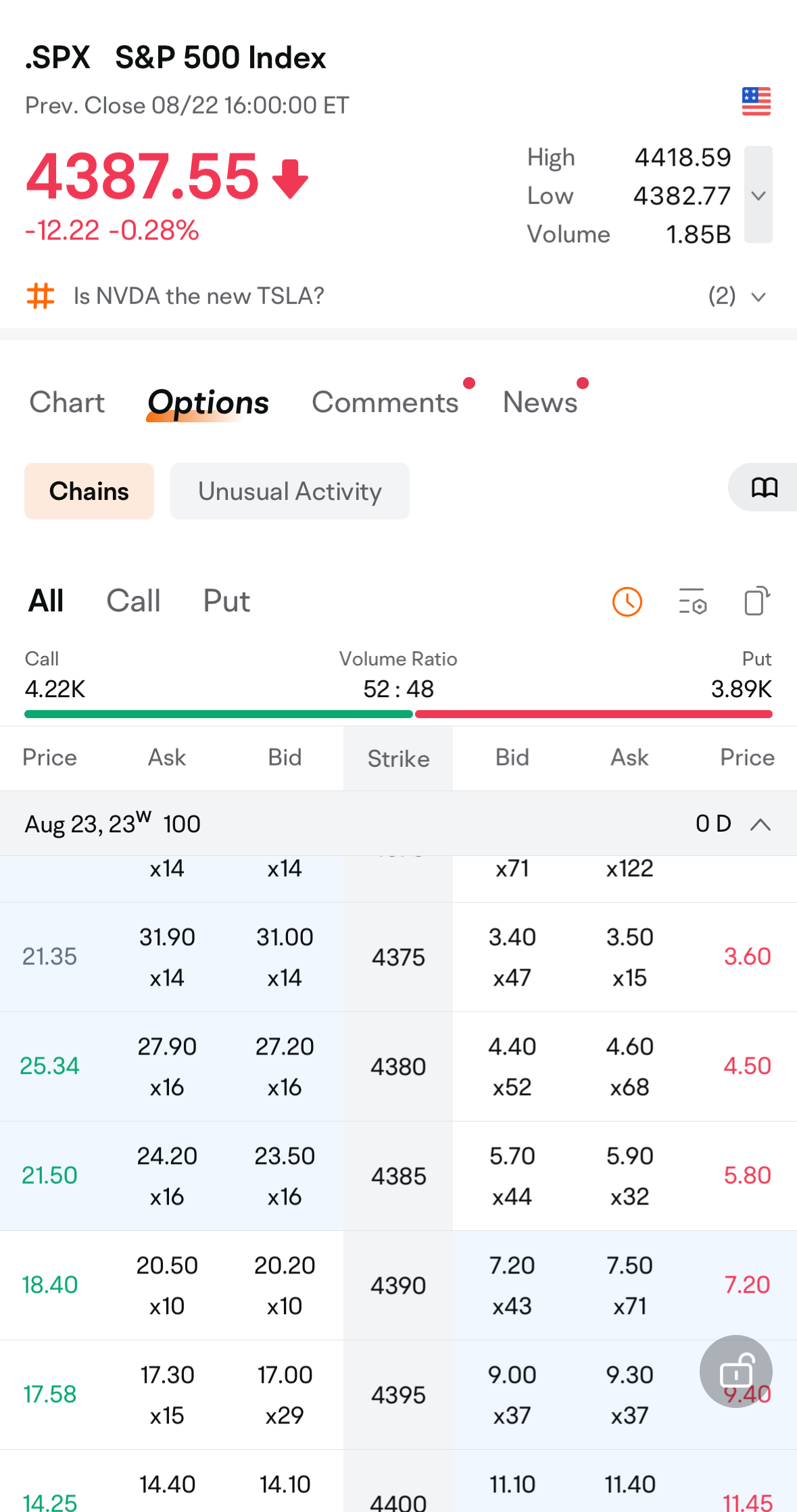
(Any app images provided are not current and any securities shown are for illustrative purposes only and is not a recommendation.)
4) Liquidity
ETF options have varying levels of liquidity, with popular options being more liquid than less well-known ones. In contrast, index options tend to have more evenly distributed liquidity. When trading ETF options, investors should prioritize liquidity and avoid illiquid options that may become worthless in their portfolios.
This presentation is for informational and educational use only and is not a recommendation or endorsement of any particular investment or investment strategy. Investment information provided in this content is general in nature, strictly for illustrative purposes, and may not be appropriate for all investors. Read more