Best Stock Brokers in Canada for 2026

For Canadian investors looking to grow their wealth in 2026, choosing the right stock broker is a key step. The Canadian market offers a variety of brokerage platforms, each with its own strengths in fees, account options, and trading tools. Whether you are just starting out or an experienced trader, selecting a broker that fits your needs can help you trade confidently on the Toronto Stock Exchange and major US exchanges.
In this comprehensive guide, we delve into the six best stock brokers in Canada for 2026: moomoo Canada, Questrade, Wealthsimple Trade, Qtrade Direct Investing, TD Direct Investing, and RBC Direct Investing.
We'll compare their fees, account types, investment options, research tools, customer service, user experience and more to help you make an informed decision. Our aim is to provide Canadian investors with a clear and concise overview, ensuring you choose the broker that best fits your individual needs and investment objectives!
Top 6 stock brokers in Canada: full comparison
Feature | moomoo Canada | Questrade | Wealthsimple Trade | Qtrade Direct Investing | TD Direct Investing | RBC Direct Investing |
Fees & Commissions | US Stocks & ETFs: US$0.0099/share; US Options: $0.65/contract; CA stocks & ETFs: CA$0.0149/share | Commission-free stocks & ETFs; Options: $0.99/contract | No commission fees for trading Canadian stocks and ETFs. Options: $2 USD per contract (core) | Stocks: $8.75; ETFs: free; Options: $8.75 + $0.75 per contract | Stocks: $9.99; Options: $9.99 + $1.25/contract | Stocks: $9.95; Options: $9.95 + $1.25/contract |
Minimum Balance | None | $0 | None | $1 | None – But fees apply to accounts holding less than 15K | None |
Supported Investment Options | US & CA Stocks, ETFs, US Options | Stocks, ETFs, Options, Mutual Funds, Bonds, GICs, IPOs | Stocks, ETFs, Options, Crypto | Stocks, ETFs, Options, Mutual Funds, Bonds, GICs | Stocks, ETFs, Options, Mutual Funds, Bonds, GICs, IPOs | Stocks, ETFs, Options, Mutual Funds, Bonds, GICs |
Supported Account Types | Cash, Margin, TFSA, RRSP/SRRSP | Cash, Margin, TFSA, RRSP, RESP, LIRA, Corporate | Cash, TFSA, RRSP | Cash, Margin, TFSA, RRSP, RESP, LIRA, Corporate | Cash, Margin, TFSA, RRSP, RESP, LIRA, Corporate | Cash, Margin, TFSA, RRSP, RESP, LIRA, Corporate |
Research Tools | Free Level 2 market data, advanced charting tools, technical indicators (Gann Fans, Fibonacci), Heat Maps, Stock Screener, Institutional Tracking | Market data, Analyst reports, Morningstar research | Basic research tools; limited advanced data | Comprehensive research tools and market data | Extensive research tools including reports, screeners, and market news | Extensive research tools including reports, screeners, and market news |
Educational Resources | Extensive library, Courses, Tutorials | Webinars, Video tutorials, Articles | Basic articles, Limited content | How-to videos, Guides, Portfolio simulator | Master classes, Video content | Educational videos, Practice accounts |
Customer Service | 24/7 live support via chat, phone, email; highly rated mobile app support | Live chat, Email, Phone support | Email and chat support; limited phone support | Phone, Email support | Phone support (Mon–Fri) | Phone, Email support |
User Experience | Highly rated mobile app (4.5+ stars); desktop app available | User-friendly web and mobile platforms; customizable dashboards | Simple, easy-to-use mobile and web apps | Robust web and mobile platforms; intuitive but more traditional interface | Comprehensive platforms with advanced features; may be complex for beginners | Comprehensive platforms with advanced features; may be complex for beginners |
Promotions | $50 in free trades | $50 off | $150 cashback | 1% cash back | / | |
Best For | Active traders seeking low fees and advanced tools | Cost-conscious investors seeking a wide range of investment options | Beginners preferring a simple, commission-free platform | Investors seeking robust tools and educational resources | Investors desiring comprehensive services from a major bank | Investors valuing stability and comprehensive services from a major bank |
Disclaimer: Competitors' fees/function obtained from their official websites as of May 25, 2026, we do not guarantee that the foregoing material is accurate, current, or complete. All logos and trademarks referenced are for identification purposes only and remain the property of their respective owners.
Moomoo Canada - the best stock broker in Canada
Moomoo Canada, launched in September 2023, has swiftly established itself as a premier stock trading platform for Canadian investors. As a subsidiary of Futu Holdings Limited—a NASDAQ-listed company with a market capitalization exceeding $14 billion, moomoo brings a wealth of global experience to the Canadian market.
The platform boasts a robust user base of over 25 million globally, reflecting its widespread appeal and reliability. In Canada, Moomoo Financial Canada Inc. is a registered member of the Canadian Investment Regulatory Organization (CIRO) and the Canadian Investor Protection Fund (CIPF), ensuring that investors' assets are protected under Canadian regulations.
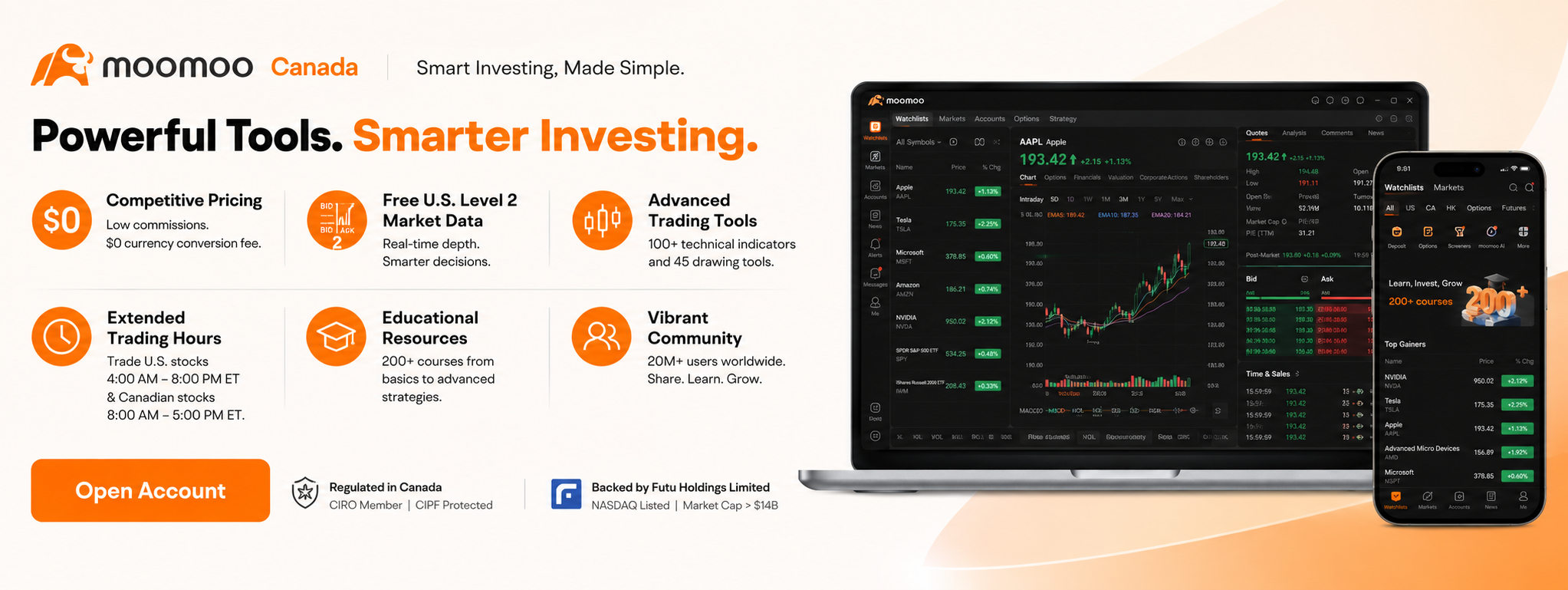
Key strengths of moomoo
Competitive pricing
Moomoo offers low commissions for trading U.S. stocks, ETFs and options. Additionally, its currency conversion fee is $0, making it cost-effective for trading U.S. securities.
Free access to U.S. Level 2 market data
Moomoo provides free access to U.S. Level 2 market data, which includes real-time bid and ask prices across multiple price levels, offering traders deeper insights into market dynamics. This level of data is typically a premium feature on other platforms but is readily available to moomoo users with a minimum deposit of $100.

Advanced trading tools
Moomoo Canada equips investors with advanced trading tools, including over 100 technical indicators and 45 drawing tools, catering to both novice and experienced traders.
Extended trading hours
Moomoo offers extended trading hours, allowing users to trade U.S. stocks from 4:00 AM to 8:00 PM ET and Canadian stocks from 8:00 AM to 5:00 PM ET.
Educational resources
Moomoo offers an extensive library of over 200 courses covering topics from basic investing principles to advanced trading strategies.
Community engagement
The platform hosts a vibrant community of over 20 million users worldwide, fostering an environment where investors can share insights, strategies, and experiences.

Pros and cons of moomoo
Pros
Free level 2 market data: Access real-time Level 2 data for U.S. and Canadian stocks at no additional cost, providing deeper market insights.
Advanced trading tools: Utilize over 100 technical indicators, 45 drawing tools, and customizable charts for in-depth market analysis.
Strong customer service: Offer 24/7 live chat support to assist you at any time.
Asset protection: Your investments are secured through CIPF coverage.
Cons
Limited investment options: Currently, moomoo does not offer trading in mutual funds, bonds, cryptocurrencies, or forex.
Restricted account types: Only cash, margin, TFSA, and RRSP/SRRSP accounts are available; joint, RESP, or corporate accounts are not supported.
Complex interface for beginners: The platform's advanced features and tools may be overwhelming for new investors.
Questrade - low-cost broker in Canada
Questrade has become an even more appealing choice for Canadian investors as of March 2025, thanks to its move to commission-free trading on stocks and ETFs. Investors now enjoy $0 base trading fees. This pricing structure keeps Questrade among the most affordable platforms in Canada, appealing to both novice and seasoned investors alike.
The platform has seen noticeable improvements in recent years, with upgrades to both its web and mobile interfaces. These changes have enhanced overall functionality, offering smoother trade execution, improved portfolio management tools, and more customization for active users.
Pros and cons of Questrade
Pros
$0 commissions for trading stocks and ETFs.
Supports stocks, ETFs, options, mutual funds, bonds, GICs, and forex, offering great flexibility.
The Questrade Edge desktop platform and web-based platforms are highly customizable and feature-rich, suitable for both beginners and advanced traders.
Questrade offers detailed market data, customizable watchlists, analyst ratings, stock screeners, insider transaction info, and technical analysis tools powered by third parties like TipRanks and Recognia.
Regular promotions and incentives for new clients.
Cons
Some users report slow or unhelpful customer support experiences.
Wire withdrawal fees are expensive for clients outside Canada.
Cash can only be held in CAD or USD, limiting currency flexibility.
>> Learn more: Top 5 Trading Apps in Canada [Our Picks for 2026]
Wealthsimple Trade - commission-free trading platform
Wealthsimple Trade is a popular Canadian online brokerage known for its simple, mobile-first design and commission-free trading on Canadian and U.S. stocks and ETFs. It is ideal for beginner investors who want an easy way to start investing without worrying about trading fees or account minimums. The platform supports RRSP and TFSA accounts, allowing Canadians to invest tax-efficiently while enjoying a straightforward onboarding process that takes just minutes.
One of Wealthsimple Trade’s standout features is fractional share investing, which lets users buy portions of expensive U.S. stocks, making diversification affordable even with a small budget. While it lacks advanced order types and extensive research tools, its clean interface, real-time market data (with a premium option), and integrated crypto trading make it a convenient all-in-one platform for casual investors focused on long-term growth.
Pros and cons of Wealthsimple Trade
Pros
Wealthsimple Trade allows Canadians to buy and sell stocks and ETFs without paying any commissions, making it very cost-effective for new and casual investors.
Investors can buy fractional shares of U.S. stocks, allowing for easy diversification even with small amounts of money.
The platform is designed with beginners in mind, featuring an easy-to-use mobile app and web interface that simplifies the investing process.
Wealthsimple offers educational content such as investing masterclasses and personal finance guides to help new investors learn.
Cons
A 1.5% currency conversion fee applies when trading U.S. stocks, which can add up for frequent cross-border traders.
The platform lacks advanced research features, interactive charts, news integration, and customizable screeners, which may frustrate active or experienced traders.
Customer support is mostly limited to email and FAQs, with no phone support and generally low satisfaction ratings.
Although Wealthsimple offers crypto trading, crypto assets are not insured, and protection depends on custodial partners.

Qtrade Direct Investing – ideal for long-term investors
Qtrade Direct Investing is a leading Canadian online brokerage platform tailored for self-directed investors seeking a comprehensive suite of investment options and robust research tools. As a division of Aviso Wealth Inc., Qtrade has established a strong reputation over its 20-year history, consistently ranking among Canada's best stock brokers.
The platform offers access to a wide array of investment products, including stocks, ETFs, mutual funds, bonds, options, GICs, and IPOs, enabling investors to build diversified portfolios aligned with their financial goals. Qtrade's user-friendly interface is complemented by advanced tools such as Portfolio Creator™️, Portfolio Score™️, and Portfolio Simulator™️, which assist investors in planning, analyzing, and testing their investment strategies.
Qtrade's commitment to investor education is evident through its extensive library of resources, including articles, tutorials, and market insights, catering to both novice and experienced investors. The platform also provides exceptional customer support, having been ranked #1 online broker for client service multiple times in recent years.
Pros and cons of Qtrade Direct Investing
Pros
Excellent customer support that’s both responsive and easy to access through various channels.
Hassle-free account setup available on both desktop and mobile, making onboarding simple.
Comprehensive research tools and data to support well-informed investing decisions.
Great for students and younger investors, offering reduced fees and no minimum account balance requirements.
Cons
Trading fees and commissions remain above average compared to low-cost or commission-free brokers.
Updates to the platform tend to roll out slowly, with noticeable delays in major improvements.
The mobile app lacks some polish and features, falling behind competitors in overall user experience.
The platform’s target audience has become less defined, making it feel less inclusive than it once was.

Be among the first to experience Canada's first Moomoo Store, which opened on November 22, 2025, in Toronto's upscale Yorkville district. Visit the space to explore the Moomoo app in person, speak directly with trading specialists, and take part in live sessions focused on building financial confidence.
Exciting news! The second Moomoo Store is coming soon to Markham, bringing the same hands-on experience closer to the GTA's growing investor community. Stay tuned for opening details, and start planning your visit today.
Exciting news! The second Moomoo Store is coming soon to Markham, bringing the same hands-on experience closer to the GTA's growing investor community. Stay tuned for opening details, and start planning your visit today.
TD Direct Investing - comprehensive platform with advanced tools
TD Direct Investing stands out as the best stock brokers among Canada’s major banks. Launched back in 1984, it has maintained a leading position in the industry for decades. While its trading fees are higher than those of discount or zero-commission platforms, many investors find the cost worthwhile given the quality of the tools and user experience—particularly on the desktop version, which is often regarded as one of the best in the country. The mobile app, while not quite as polished, still receives generally favorable feedback.
For existing TD customers or those planning to make full use of the platform’s advanced features, TD Direct Investing is a logical and convenient option. Financial columnist Rob Carrick of The Globe and Mail has praised TD’s platform for its intuitive interface and robust suite of investor tools, reinforcing its strong reputation.
It’s worth noting that TD Easy Trade is a separate mobile app from TD Direct Investing, even though account access overlaps. Easy Trade, which evolved from TD GoalAssist, tends to receive lower ratings than the full-featured desktop experience.
If TD eventually offers more commission-free ETF options, it could become a serious competitor to lower-cost brokerages. But for investors who value security, convenience, and access to a powerful trading platform backed by one of Canada’s largest banks, TD Direct Investing remains a top-tier choice.
Pros and cons of TD Direct Investing
Pros
Seamless integration with TD's main banking site, making it easy to manage both banking and investments in one place.
A versatile platform suitable for both newcomers and seasoned investors.
Comprehensive market data and research tools to help evaluate stocks and ETFs.
Excellent educational support, including resources and tutorials to guide users through the platform.
Notable improvements in customer service, with faster and more helpful support in recent months.
Cons
Standard commissions of $9.99 per trade on stocks and ETFs are significantly higher than many discount brokers, making it costly for active traders or those with small trade sizes.
Unlike some competitors, commission-free ETF trading is limited to TD ETFs only, which restricts options for cost-conscious ETF investors.
Charges up to $150 for transferring accounts out, which can be a deterrent for switching brokers.
Charges $25 quarterly maintenance fees unless waived by meeting certain criteria such as minimum account balance or trading activity.
RBC Direct Investing - integrated banking and investment services
RBC Direct Investing is a premier self-directed brokerage platform in Canada, offering seamless integration with RBC's comprehensive banking services. This integration allows clients to manage their banking and investment activities through a unified interface, providing convenience and efficiency.
The platform provides access to a broad spectrum of investment products, including stocks, ETFs, mutual funds, GICs, bonds, options, and precious metals. Investors can choose from various account types such as TFSA, RRSP, RESP, FHSA, RRIF, and non-registered accounts, catering to diverse financial goals.
RBC Direct Investing offers three robust trading platforms: the Online Investing Platform, the Trading Dashboard, and the RBC Mobile app. These platforms are equipped with advanced tools, real-time streaming quotes, and in-depth research resources, including insights from Morningstar and Trading Central, to support informed decision-making.
For those new to investing, the platform provides a free Practice Account with $100,000 in virtual funds, allowing users to familiarize themselves with trading without financial risk.
Clients benefit from features like instant fund transfers between RBC accounts, the ability to trade with RBC Rewards points, and potential savings on banking fees through the Multi-Product Rebate program.
Pros and cons of RBC Direct Investing
Pros
Seamless integration with RBC banking services: For existing RBC clients, RBC Direct Investing offers a unified platform where you can manage both banking and investment accounts.
No minimum balance requirement: Investors can open an account without a minimum deposit, making it accessible for beginners or those with limited funds.
Comprehensive investment options: RBC Direct Investing provides access to a wide range of investment products, including stocks, ETFs, mutual funds, GICs, bonds, options, and precious metals.
Robust research and educational tools: The platform offers extensive research resources, including insights from Morningstar and RBC Capital Markets, as well as educational materials like the "Inspired Investor" magazine.
Cons
Higher trading fees: At $9.95 per trade, RBC Direct Investing's fees are higher compared to some competitors offering lower or zero-commission trades, which can impact frequent traders.
Account maintenance fees for lower balances: Accounts with balances under $15,000 may incur a quarterly maintenance fee of $25, unless certain conditions are met, such as setting up regular contributions or making a minimum number of trades.
No commission-free ETFs: Unlike some other platforms, RBC Direct Investing does not offer commission-free ETF trades, potentially increasing costs for ETF investors.
Mobile app limitations: While functional, the mobile app has been reported to have occasional glitches and may lack some features found in competitors' apps, affecting the user experience.
What to consider when choosing the best stock broker in Canada?
Choosing the best stock broker in Canada is an important step for any investor, whether you are just starting out or have years of experience. The right broker can affect your trading costs, the types of investments you can access, and the tools and support available to help you make smart decisions.
Since Canadian investors have many options—from bank-owned brokers to innovative online platforms, it’s essential to carefully evaluate what matters most for your investing style and goals.
1. Fees and commissions
Trading costs directly impact your returns. Look beyond just commission fees to also check for account maintenance fees, inactivity fees, and currency conversion charges if you trade U.S. stocks.
2. Platform usability
A user-friendly interface with clear navigation makes trading easier and reduces mistakes. Consider whether the broker offers a well-designed mobile app for trading on the go, and how fast and reliable their order execution is.
3. Supported investment options
Different brokers provide access to varying markets and products. Ensure the broker supports the types of investments you want, such as Canadian and U.S. stocks, ETFs, mutual funds, options, or even cryptocurrencies if that interests you.
4. Supported account types
Verify that the broker supports various account types, including Tax-Free Savings Accounts (TFSA), Registered Retirement Savings Plans (RRSP), and non-registered accounts, to suit your investment needs.

5. Regulatory compliance and security
Choose brokers registered with Canadian regulatory bodies like IIROC and insured by CIPF. This protects your investments and ensures the broker follows industry standards.
6. Customer support
If you're just starting out with online investing, expect a bit of a learning curve as you get comfortable managing your portfolio and placing trades. Choosing a brokerage known for strong customer support can make a big difference—ensuring you get timely answers and guidance when you need help.
Learn more: How to Choose the Best Stock Trading Platform in Canada?>>
FAQs about the best stock broker in Canada
Which broker is best for trading in Canada?
There is no single "best" broker for trading in Canada, as the ideal choice depends on your individual needs, trading style, and priorities.
If keeping costs low is your main concern, Questrade or Wealthsimple Trade could be more suitable options.
However, if you value advanced analytical tools and trading experience more, then moomoo Canada is the best choice for you.
Moomoo vs Wealthsimple, which is better?
When comparing Moomoo Canada and Wealthsimple Trade, the better choice depends on your individual trading needs and experience level.
Moomoo Canada is well-suited for active traders seeking advanced tools and in-depth market data. It offers low trading fees, free Level 2 market data, and a range of technical indicators, making it appealing for those who require detailed analytics and real-time insights.
On the other hand, Wealthsimple Trade is designed for beginners and passive investors. It provides commission-free trading on Canadian and U.S. stocks and ETFs, along with a user-friendly interface. However, it lacks some advanced features such as detailed charting tools and real-time data, which might be limiting for more experienced traders.
In summary, if you are a beginner looking for a straightforward, cost-effective platform, Wealthsimple Trade may be the better option. If you are an active trader seeking comprehensive tools and market data, moomoo Canada could be more suitable.
Is moomoo legit?
Yes, moomoo is a legitimate online brokerage. In Canada, it is regulated by the Canadian Investment Regulatory Organization (CIRO) and is a member of the Canadian Investor Protection Fund (CIPF), which protects investors up to $1 million in the event of insolvency.
Moomoo operates in multiple countries and is overseen by financial authorities in the USA, Singapore, Australia, Malaysia, and Japan.
How are stocks taxed in Canada?
In Canada, capital gains from selling stocks are taxed by including 50% of the gain as taxable income at your marginal tax rate. This means if you sell stocks for a profit, only half of that profit is subject to income tax.
For example, if you realize a $100,000 capital gain, $50,000 will be added to your taxable income for the year. This inclusion rate of 50% has remained in place for 2025 after the government cancelled a planned increase to 66.67% for most individuals until at least 2026.
Certain exemptions apply, such as for your principal residence or investments held in registered accounts like RRSP and TFSA, which are generally tax-sheltered. The exact tax payable depends on your total income, province of residence, and tax bracket.
Can you buy US stocks in your TFSA?
Yes, you can buy U.S. stocks in your TFSA. Canadian investors are allowed to hold U.S. stocks listed on designated U.S. exchanges like the NYSE and NASDAQ within their TFSA accounts. This means you can invest in major U.S. companies and ETFs through your TFSA, benefiting from tax-free capital gains in Canada.
However, it’s important to note that dividends paid by U.S. stocks are subject to a 15% withholding tax by the U.S. government, which cannot be recovered within a TFSA. Despite this, any profits from selling U.S. stocks (capital gains) inside the TFSA remain completely tax-free in Canada.
This presentation is for informational and educational use only and is not a recommendation or endorsement of any particular investment or investment strategy. Investment information provided in this content is general in nature, strictly for illustrative purposes, and may not be appropriate for all investors. Read more