How to Choose the Best Stock Trading Platform in Canada?

Choosing the best stock trading platform in Canada is a crucial decision for investors, whether you're just starting your investment journey or you're a seasoned market participant. The platform you select can significantly impact everything from trading fees and investment options to the research tools and portfolio management features available at your fingertips. In Canada's evolving financial landscape, options range from bank-affiliated brokers like TD Direct Investing and RBC Direct Investing to innovative online platforms such as Wealthsimple, Questrade, and moomoo Canada.
In this guide, we'll compare the 5 best stock trading platforms in Canada for 2026, breaking down the key factors you should consider before making your choice — including fees and commissions, platform usability, supported investment options, regulatory compliance, and research and educational resources. We'll also provide a detailed comparison of each platform's strengths and weaknesses to help you find the best stock trading platform Canada has to offer. By the end, you'll know exactly how to pick the right platform to grow your wealth!
What is a stock trading platform?
A stock trading platform is an online software or app that allows investors to buy and sell stocks and other securities, like bonds, ETFs, options and mutual funds. For Canadian investors, these platforms provide access to various markets, including the Toronto Stock Exchange (TSX) and other global exchanges. They offer essential features like real-time market data, research tools, and portfolio management options, making it easier for users to make informed investment decisions.
Online brokers vs traditional brokers, what’s the difference?
When it comes to choosing a stock trading platform, investors often weigh the differences between online brokers and traditional brokers. Both options offer distinct advantages and cater to different types of investors. Online brokers, known for their convenience and lower fees, appeal to tech-savvy individuals who prefer self-directed trading. Traditional brokers, on the other hand, provide personalized advice and in-depth financial planning, making them ideal for those who value a more hands-on approach.

To help you decide which option best suits your investment needs, the following table outlines the key differences between online and traditional brokers.
Aspect | Online Brokers | Traditional Brokers |
Fees & Commissions | Low or zero trading fees (e.g., Wealthsimple Trade, Questrade, moomoo Canada). | Higher fees (e.g., $9.99+ per trade at RBC Direct Investing, TD Direct Investing). |
Accessibility | 24/7 online and mobile access. Trade anytime, anywhere. | Limited to business hours; may require phone calls or in-person meetings. |
Service Model | Self-directed: Investors make independent decisions. | Full-service: Advisors provide personalized recommendations and portfolio management. |
Tools & Technology | Advanced platforms with real-time data, charts, and research tools. | Basic tools; focus on advisory services over tech features. |
Minimum Investment | No minimum deposit (e.g., $0 with moomoo Canada). | Higher minimums (e.g., $15,000+ for managed accounts at banks like CIBC). |
Investment Options | Access to stocks, ETFs, options, mutual funds, bonds and global markets | Focus on traditional products (stocks, mutual funds) and in-house offerings. |
Customer Support | They might provide online customer support, but in-person services are generally restricted. | They offer in-person consultations and phone assistance, which can lead to a more tailored experience. |
Best For | Online Brokers are ideal for low-cost, self-directed trading, with platforms like moomoo Canada and Questrade offering robust tools for active traders. | Beginners needing guidance, high-net-worth investors, or those preferring human advice. |
5 best share trading platforms in Canada
Choosing the right share trading platform can make a significant difference in your investment returns, especially when fees, account options, and available tools vary widely across brokers. Whether you're a beginner looking for a simple, low-cost way to start investing or an experienced trader seeking advanced research tools and diverse investment options, there's a platform tailored to your needs.
Below, we compare five of the most popular stock trading platforms available to Canadian investors in 2026.
Wealthsimple | Questrade | TD Direct Investing | RBC Direct Investing | ||
Minimum Deposit | $0 | $0 | $1,000 | $0 | $0 |
Commissions | $0.0049/share (min $0.99/order); $0 currency exchange fee | $0 commission on stocks & ETFs; 1.5% currency conversion fee | $0 commission on stocks & ETFs | $9.99 flat fee per trade | Up to 50 commission-free trades/year; $9.99 per trade after |
Supported Investment Options | Stocks, ETFs, Options | Stocks, ETFs, Options, Crypto, Gold | Stocks, ETFs, Options, Mutual Funds, Bonds, GICs, IPOs | Stocks, ETFs, Options, Mutual Funds, Bonds, GICs | Stocks, ETFs, Options, Mutual Funds, Bonds, GICs |
Supported Account Types | Cash, Margin, TFSA, RRSP | Cash, TFSA, RRSP, RESP, FHSA | Cash, Margin, TFSA, RRSP, RESP | Cash, Margin, TFSA, RRSP, RESP, RDSP | Cash, Margin, TFSA, RRSP, RESP |
*Disclaimer: Competitors' fees/function obtained from their official websites as of June 24, 2026, we do not guarantee that the foregoing material is accurate, current, or complete. All logos and trademarks referenced are for identification purposes only and remain the property of their respective owners.
Moomoo Canada
Moomoo Canada, operated by Moomoo Financial Canada Inc. and regulated by CIRO, has quickly become a favourite among cost-conscious Canadian traders since establishing its headquarters in Toronto . The platform stands out for its professional-grade tools at a fraction of the cost of traditional brokerages.
Key Features:
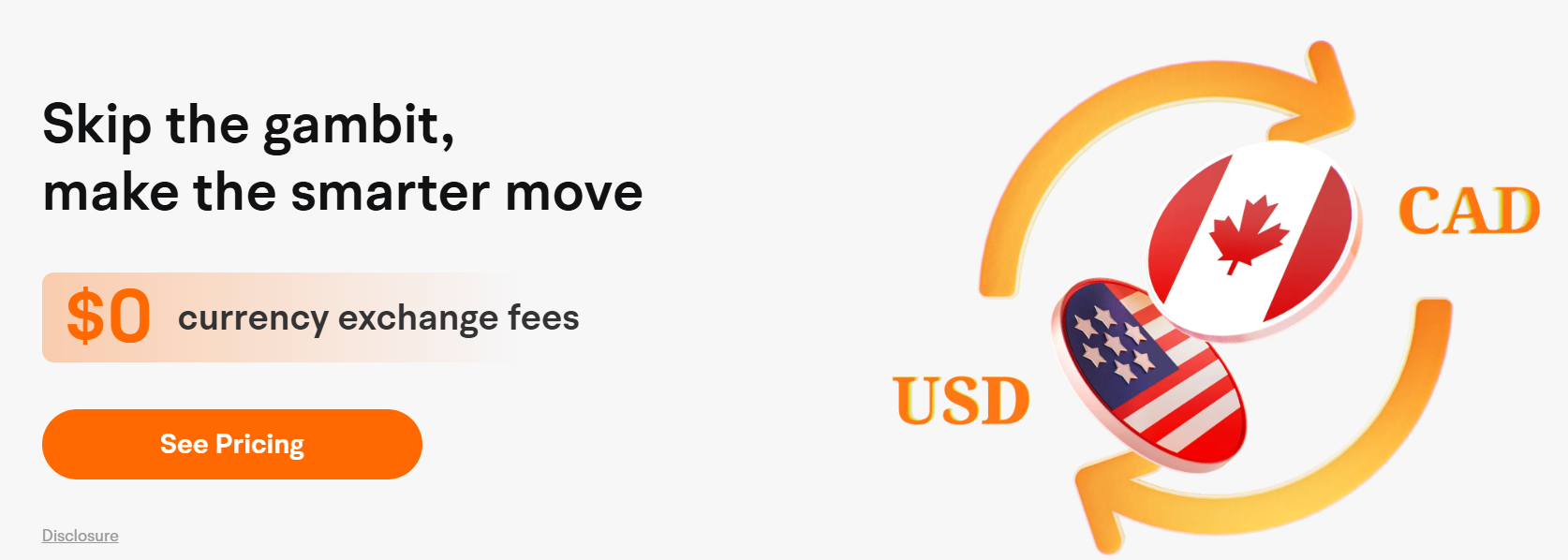
$0 currency exchange fee for CAD/USD conversions — a standout benefit for Canadians trading U.S. stocks
Free Level 2 market data, analyst ratings, and Morningstar reports built into the platform

Extended trading hours, giving you access to pre-market and after-hours sessions
Low options trading fees at US$0.65 per contract with a US$1.00 minimum — significantly cheaper than the industry standard of $9.99 + $1.25 per contract at traditional brokerages
No account fees, no withdrawal fees, and no minimum deposit required to get started
Pros:
Extremely low trading costs with transparent fee structure
Advanced charting, research tools, and real-time data suitable for active traders
No FX fees makes it ideal for Canadians investing heavily in U.S. markets
Flexible deposit methods including INTERAC e-Transfer®
Cons:
Does not offer mutual funds or bonds — focuses on stocks, ETFs, and options
The feature-rich interface may feel overwhelming for complete beginners
Not fully commission-free on stock trades (though fees are very low)
Wealthsimple
Wealthsimple is one of Canada's most recognized fintech brands, offering a streamlined, beginner-friendly investing experience with $0 commission trades on Canadian and U.S. stocks and ETFs . It's particularly popular among younger Canadians who value simplicity and a clean mobile app.
Key Features:
$0 commission on stocks, ETFs, and options trading
No minimum deposit required to open an account
Robo-advisory services for hands-off investors
USD account option to avoid repeated currency conversions (requires $10/month subscription or $100,000+ in assets)
Access to crypto and gold trading alongside traditional securities
Pros:
Truly commission-free trading on thousands of Canadian and U.S. securities
Intuitive, minimalist interface that's ideal for beginners
No account fees or minimum balance requirements
Supports FHSA (First Home Savings Account) — great for first-time homebuyers
Cons:
1.5% currency conversion fee when trading U.S. securities without a USD account
$10/month fee for USD accounts holding less than $100,000 in assets
Lacks advanced charting tools and in-depth research capabilities compared to competitors
$9.95 journaling fee for Norbert's Gambit (available on website only)
Questrade
Questrade is a well-established Canadian online brokerage that has long been a go-to choice for self-directed investors seeking a balance between low fees and robust trading tools. It's particularly popular among intermediate to advanced traders who want access to a wide range of investment products.
Key Features:
$0 commission on stock and ETF purchases (selling fees may apply)
No account fees or inactivity fees
Free practice account to test strategies before investing real money
Advanced research tools with comprehensive market data
Wide range of investment products including stocks, ETFs, options, mutual funds, bonds, GICs, and IPOs
Pros:
Commission-free buying on stocks and ETFs keeps costs low for buy-and-hold investors
Extensive selection of account types including Margin, RESP, and RRSP
Strong desktop and mobile platforms with advanced charting
Educational resources and practice accounts make it approachable for learning investors
Cons:
$1,000 minimum deposit required to open an account — a barrier for some beginners
Selling commissions still apply on stocks and ETFs
Platform can feel complex for brand-new investors
Currency conversion fees apply for U.S. stock trades (though Norbert's Gambit is supported)
TD Direct Investing
TD Direct Investing leverages the strength of one of Canada's largest banks, offering a full-service brokerage experience with extensive research tools, educational resources, and seamless integration with existing TD banking products. It's best suited for investors who value the security and ecosystem of a major bank.
Key Features:
Comprehensive trading platform (WebBroker and Advanced Dashboard) with powerful analytical tools
Extensive educational resources including webinars, articles, and in-branch support
Wide range of investment products: stocks, ETFs, options, mutual funds, bonds, and GICs
Seamless integration with TD Bank accounts for easy fund transfers
Access to TD Goal Assist and other planning tools
Pros:
Backed by one of Canada's Big Five banks — strong reputation and security
Excellent research tools and market analysis resources
Full range of registered account types including RDSP
In-person support available at TD branches across Canada
Cons:
$9.99 flat fee per trade — significantly higher than discount brokers
Higher overall costs make it less ideal for frequent traders
Platform can feel outdated compared to newer fintech competitors
Minimum $10,000 deposit required for certain promotional cash-back offers
RBC Direct Investing
RBC Direct Investing is the self-directed brokerage arm of Royal Bank of Canada, offering Canadian investors access to a broad selection of investments backed by the reliability of Canada's largest bank. It's a solid choice for existing RBC clients who want to consolidate their banking and investing under one roof.
Key Features:
Up to 50 commission-free trades per year for eligible accounts
No minimum deposit required to open an account
Free mutual fund trading — a unique advantage for fund investors
Integrated with RBC's banking ecosystem for seamless transfers and account management
Various account types including TFSA, RRSP, RESP, and non-registered accounts
Pros:
Commission-free trades available (up to 50/year) reduce costs for moderate traders
Free mutual fund purchases — ideal for long-term, passive investors
Strong brand trust and security as part of Canada's largest bank
Low non-trading fees compared to some competitors
Cons:
$9.99 per trade after free trades are used — expensive for active traders
Account maintenance fee applies if balance falls below minimum thresholds
Withdrawal fees for clients who don't hold other RBC products
Platform and tools are less innovative compared to dedicated online brokers
Not ranked among the best Canadian brokerages by many reviewers due to higher overall fee structure
How to choose the best stock trading platform in Canada?
Choosing the best stock trading platform in Canada requires careful consideration of various factors that can influence your trading experience and investment outcomes. Now, we will help you explore key considerations such as fees, platform usability, and available investment options, ensuring you choose a platform that aligns with your financial goals and provides a seamless trading experience in Canada.
1. Fees and commissions
Fees can eat into your returns, so it’s important to understand the cost structure of a platform. Look for:
Trading commissions: Some platforms, like Wealthsimple Trade, offer commission-free trading for Canadian stocks and ETFs, while others, like TD Direct Investing, charge $9.99 per trade.
Account management fees: Check for annual maintenance fees, inactivity fees, or fees for transferring accounts. Some online brokers, like moomoo Canada, do not charge account management fees.
Currency conversion fees: If trading U.S. stocks, platforms like Questrade charge a currency conversion fee (1-2%).

2. Platform usability
User-interface: A user - friendly interface is crucial. It should be easy to navigate, with clear menus and buttons. For example, you should be able to quickly find functions like placing orders, viewing your portfolio, and accessing research tools. A cluttered or confusing interface can lead to errors and a less enjoyable trading experience.
Mobile compatibility: In today's digital age, many investors trade on the go. A good trading platform should have a well - designed mobile app that offers the same functionality as the desktop version. This allows you to monitor your investments and execute trades from your smartphone or tablet.
Order execution speed: The platform should be able to execute your orders quickly and accurately. Slow order execution can result in missed opportunities or trades being executed at less favorable prices.
3. Supported investment options
Different platforms offer access to different markets and products.
Canadian and U.S. Stocks: Ensure the platform supports trading on the TSX, NYSE, and NASDAQ.
ETFs and mutual funds: Many Canadian investors prefer ETFs for low-cost diversification.
Options, bonds, and cryptocurrencies: If you’re interested in advanced trading or alternative investments, check if the platform supports them.
4. Supported account types
Cash accounts: In a cash account, you use your own funds to trade stocks. This is a good option for conservative investors who want to avoid the risks associated with borrowing money.
Margin accounts: Margin accounts allow you to borrow money from the platform to trade stocks, which can amplify your potential returns but also increase your risks. If you have experience with margin trading and are comfortable with the higher risk, a margin account might be suitable for you.
Registered accounts: Canada has various registered accounts like Tax Free Savings Accounts (TFSA), Registered Retirement Savings Plans (RRSP), and Registered Education Savings Plans (RESP). Make sure the platform supports the type of registered account you want to use, as they offer different tax advantages and are suitable for different financial goals.
5. Regulatory compliance
Safety is paramount when choosing a trading platform. You should ensure the broker is:
Registered with the Canadian Investment Regulatory Organization (CIRO): This ensures the platform adheres to Canadian financial regulations.
Insured by the Canadian Investor Protection Fund (CIPF): Protects your investments up to $1 million per account in case of broker insolvency.
6. Research and educational resources
It is better for you to choose platforms that provide robust research tools, market analysis, and educational resources. For example:
Market data and analysis: Real-time quotes, news, and analyst reports.
Educational content: Tutorials, webinars, and articles for beginners.
Trading tools: Advanced charting, screeners, and portfolio analysis tools.
7. Reputation and reviews
A platform’s reputation can give you insight into its reliability and customer satisfaction. You can consider the following aspects:
Customer reviews: Check online reviews on platforms like Trustpilot, Google Reviews, or financial forums. Other investors' experiences can give you insights into the platform's strengths and weaknesses, such as customer service quality, platform reliability, and any issues they may have faced.
Industry reputation: Consider the platform's reputation within the financial industry. A well - respected platform is more likely to provide reliable services and have a track record of customer satisfaction.
You may also like: How to Open a Brokerage Account in Canada?
FAQs about the best stock trading platform in Canada
1. Is moomoo Canada safe?
Moomoo, a trading platform offered by Futu Holdings, is generally considered safe as it is regulated by financial authorities in the regions where it operates. In Canada, any trading platform should be registered with the relevant provincial securities regulatory authorities to ensure it complies with local regulations.
While Moomoo's safety can be gauged by its regulatory compliance and security measures, potential users in Canada should verify whether it is properly registered with Canadian regulators such as the Investment Industry Regulatory Organization of Canada (IIROC) or the Canadian Investor Protection Fund (CIPF). It's also important for users to consider factors like the platform's security protocols, data protection measures, and customer reviews.
2. Which Canadian stock broker has no fees?
Several Canadian stock brokers offer commission-free trading, although the specifics may vary based on the type of trades and account features. Some popular options include: Wealthsimple Trade, National Bank Direct Brokerage, and moomoo Canada.
3. Which app is best for day trading in Canada?
For day trading in Canada, selecting an app with robust features, real-time data, and low fees is crucial. Here are a few popular platforms that are often recommended for day trading:
Questrade: Known for its advanced trading platforms, Questrade offers both Questrade Trading and IQ Edge. These platforms provide real-time data, customizable charts, and various order types, making them suitable for active traders.
Moomoo Canada: It provides a comprehensive trading experience with advanced charting, real-time data, and a wide range of technical analysis tools. It is designed to cater to active traders, offering features such as customizable screens and in-depth market insights. While Moomoo is relatively new to the Canadian market, it has gained popularity in other regions for its user-friendly interface and powerful trading capabilities.
Wealthsimple Trade: While primarily known for commission-free trading, Wealthsimple Trade can be a good option for beginners entering the day trading world.
4. Which trading platform is best for beginners?
Moomoo can be a compelling choice for beginners due to its user-friendly interface and comprehensive educational resources. The platform is designed to simplify the trading process, making it accessible for those new to investing. Moomoo offers a variety of educational resources, including tutorials, webinars, and articles, to help beginners understand the basics of trading and develop their skills.
Additionally, the platform provides a paper trading feature, allowing users to practice trading without risking real money, which is particularly beneficial for gaining experience before committing capital. While it is beginner-friendly, Moomoo also includes advanced tools such as charting and real-time data, which users can explore as they become more comfortable with trading. Furthermore, the platform's community features enable users to interact with other traders, share insights, and learn from the experiences of others.
This presentation is for informational and educational use only and is not a recommendation or endorsement of any particular investment or investment strategy. Investment information provided in this content is general in nature, strictly for illustrative purposes, and may not be appropriate for all investors. Read more