Top 10 Biotech Stocks to Watch after Fed Rate Cuts in 2024
The biotechnology industry is particularly sensitive to financial market interest rate fluctuations due to the huge initial investment required in its research and development process, and the long cycle from product development to marketization.
The Fed started its interest rate cut cycle. A reduction in interest rates lowers the cost of borrowing, making it easier for biotech firms to access the funds they need to do their research and expand their operations, which accelerates the advancement of innovative projects, and inject new vitality into the industry as a whole.
Under the new situation after the Federal Reserve's interest rate cut, biotech stocks may emerge as key highlights in the market.
Effects of Fed rate cuts on biotech sector
The biotechnology industry may experience a variety of changes under the influence of the Federal Reserve's interest rate cut cycle. Here are a few key points that have been compiled.
Reduced Financing Costs
A Federal Reserve interest rate cut typically means a decrease in borrowing costs. For biotechnology companies, this can reduce their debt burden and make debt financing cheaper. Since biotechnology companies usually require substantial funds for research and development activities, a lower interest rate environment can provide more financial flexibility, allowing companies to better focus on innovation and technological development.
Increased Investor Risk Appetite
Interest rate cuts usually increase investors' risk appetite because lower rates diminish the attractiveness of fixed-income investments, prompting investors to shift funds to asset classes that offer higher returns. Biotechnology stocks, with their high growth potential, often become targets for such funds. This helps to drive up the stock prices of related companies and facilitates their fundraising efforts.
Accelerated M&A Activity
In a lower interest rate environment, the cost of mergers and acquisitions for companies through methods such as bond issuance decreases, which may promote consolidation within the biotechnology industry. Large biotechnology companies may take this opportunity to acquire smaller companies with innovative technologies and products to quickly expand their product lines or technology platforms.
Increased R&D Investment
With the reduction in funding costs, biotechnology companies may be more capable of investing in long-term and high-risk research and development projects. This is crucial for driving technological progress in the industry, as breakthroughs in the biotechnology field often require persistent efforts. Additionally, more R&D activities may lead to more intellectual property accumulation and patent protection, creating long-term competitive advantages for companies.
Improved Market Sentiment
Interest rate cuts are usually seen as a measure to stimulate economic growth, which can improve market sentiment and strengthen investors' confidence in the economic outlook. This positive sentiment may spread to the biotechnology industry, especially for companies with research products that show good clinical trial data, which may attract more attention and support.
Changes in International Competitiveness
If the interest rate cut leads to a devaluation of the US dollar, it will be more advantageous for export-oriented biotechnology companies, as the overseas sales of their products will become more profitable due to the increased amount when foreign currency income is converted into US dollars. However, this also means that the cost of imported raw materials may rise.
Industry Outlook
Considering that the biotechnology industry is currently in a period of rapid development, many companies are working hard to advance the research and development of new treatment methods for diseases such as cancer and rare diseases. The positive impact brought about by the Federal Reserve's interest rate cut is expected to further promote the development of the industry. In the long term, with the inflow of funds and technological advancements, the biotechnology industry is expected to make breakthroughs in areas such as diversified treatment methods and precision medicine.
It is important to note that although interest rate cuts are generally positive for the biotechnology industry as a whole, the specific impact still needs to be comprehensively assessed in conjunction with the actual situation of each company and the global economic situation. In addition, the characteristics of the biotechnology industry itself determine that its performance depends not only on interest rate levels but also on various factors such as product development progress, regulatory policies, and changes in market demand.
Top 10 Biotech stocks to watch after Fed rate cuts
It can be seen that the impact of the Federal Reserve's interest rate cuts on the biotechnology industry is complex. Although the rate cuts are generally beneficial to the industry, this does not mean that individual stock prices will definitely rise. In this context, looking for investment opportunities in the biotechnology industry requires considering multiple aspects. Here are a few points summarized:
Company Fundamentals: Prioritize companies with solid finances, reasonable debt, and those that are already profitable or about to become profitable.
R&D Strength: Focus on companies with strong R&D pipelines, especially those with products in late-stage clinical trials.
Market Potential: Choose companies with a large target market size, strong growth potential, and competitive advantages.
Economic Background: Utilize the advantages of the low-interest-rate environment while being vigilant about the impact of global economic changes.
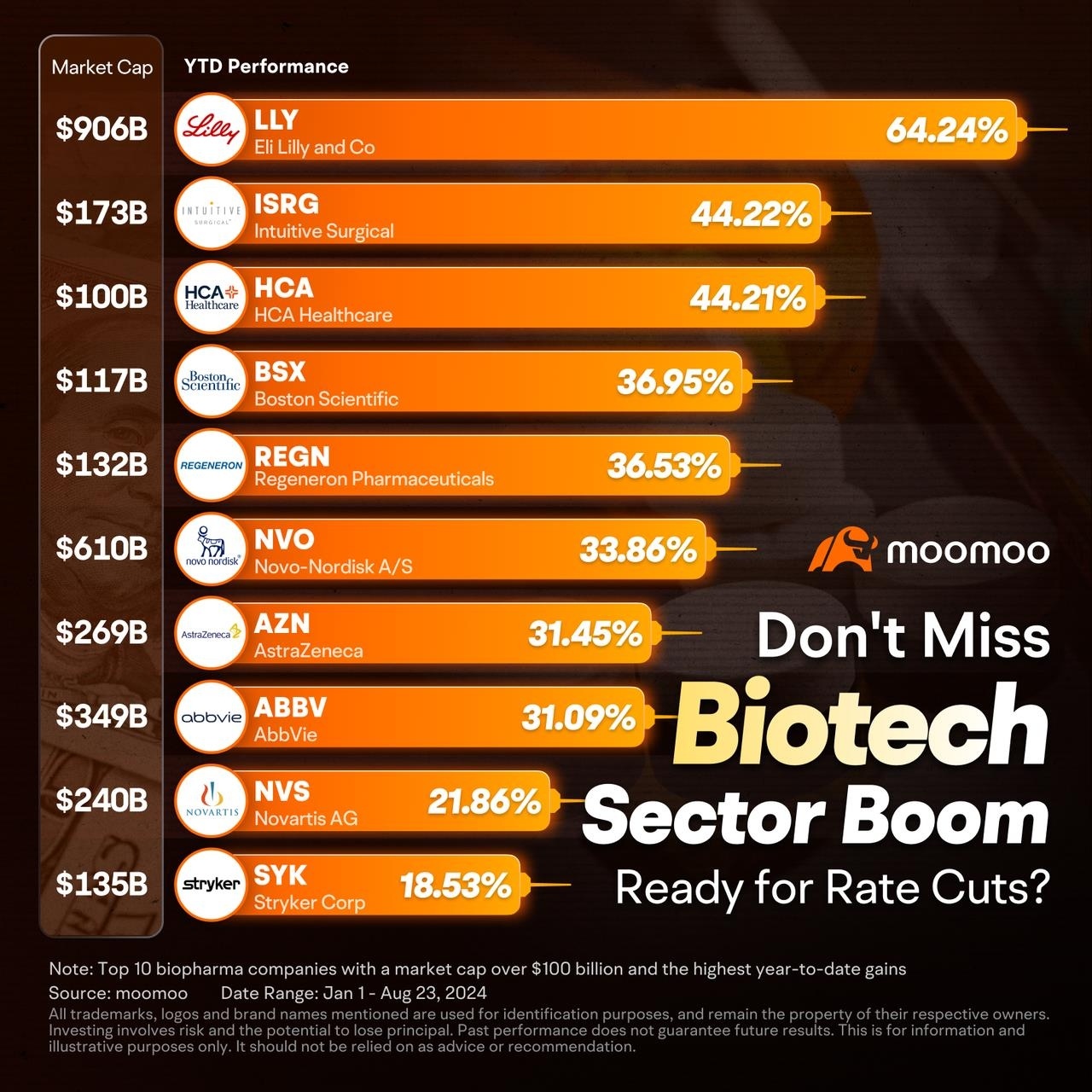
Based on this, here are ten stocks with a market capitalization of over USD 100 billion that have performed well year-to-date, compiled for investors' reference:
LLY - Eli Lilly and Company
This is an international pharmaceutical company headquartered in Indiana, USA, known for its innovative drugs in the treatment of diabetes, cancer, neurodegenerative diseases, and immune diseases. In recent years, it has also achieved significant success in the weight loss drug market, further enhancing Eli Lilly's position in the global pharmaceutical market and positively affecting its stock price. In a period of interest rate cuts, increased market risk appetite may attract more funds to flow into large pharmaceutical companies like LLY.
ISRG - Intuitive Surgical Inc.
The company is best known for its da Vinci Surgical System, a robotic-assisted device used to perform minimally invasive surgery. ISRG enjoys a high reputation worldwide, and its da Vinci system has become a standard configuration in many hospitals. With technological advancements and the growing demand for minimally invasive surgery in the medical industry, ISRG is expected to continue its strong growth momentum.
HCA - HCA Healthcare Inc.
As one of the largest healthcare service providers in the United States, HCA operates hospitals and other medical institutions throughout the U.S. and the UK, offering a broad range of medical care services. As a hospital operator, HCA may benefit from the increase in consumer spending driven by interest rate cuts. An increase in consumer spending could lead to a rise in demand for high-quality medical services, potentially boosting HCA's stock price.
BSX - Boston Scientific Corporation
This is a global medical device manufacturing company focusing on various interventional medical products, including cardiac pacemakers, catheters, stents, etc. Boston Scientific has a high market share in the medical device industry and its financial performance is stable, receiving positive evaluations from several financial institutions. For example, Barclays Bank and Raymond James have all given Boston Scientific positive ratings and high target prices.
REGN - Regeneron Pharmaceuticals Inc.
This is a research-based American biopharmaceutical company specializing in the research and development of biologics, especially in the treatment of eye diseases, cardiovascular diseases, allergic reactions, etc. Regeneron is known for its strong R&D capabilities. As a leading biotechnology company, Regeneron is committed to improving human health through its scientific and technological advantages and actively participates in community services and scientific education programs.
NVO - Novo Nordisk A/S
This is a Danish multinational pharmaceutical company mainly focused on diabetes care, and also produces drugs for hemostatic disorders and obesity. Novo Nordisk has always been committed to the development of new treatment methods, especially in diabetes management and obesity treatment. The company continues to invest a large amount of resources in research and development, aiming to provide better treatment plans for patients. Novo Nordisk has a strong market position worldwide, with stable financial performance and strong profitability. As a multinational company, a large part of Novo Nordisk's income comes from overseas markets. If the US dollar depreciates, it will increase the local currency value of its overseas earnings, thus having a positive impact on financial statements.
AZN - AstraZeneca PLC
This is a global biopharmaceutical company headquartered in the UK, focusing on the research and development of drugs for the treatment of heart disease, oncology, respiratory diseases, and other fields. AstraZeneca's business covers the globe, and its products are sold worldwide. At the same time, it invests heavily in R&D, committed to developing innovative drugs to meet unmet medical needs. The company has a strong R&D team and facilities, and collaborates with multiple research institutions worldwide to advance the development of biopharmaceutical science.
ABBV - AbbVie Inc.
AbbVie is a biopharmaceutical company focused on research and production of therapeutic biologics, one of the most famous products being Humira for the treatment of autoimmune diseases. ABBV is committed to developing new treatment methods, especially in the fields of immunology, oncology, neuroscience, metabolic diseases, and virology. The company invests a significant amount of funds in R&D every year to ensure the continuous updating and expansion of its product line. The reduction in borrowing costs brought about by interest rate cuts makes it easier for companies to secure funding for research and development.
NVS - Novartis AG
Novartis is a Swiss multinational pharmaceutical company with extensive business in various medical fields such as eye care, oncology, and immunology. Novartis places great emphasis on R&D investment, investing billions of dollars every year in the development of new treatment methods. The company has multiple patents and is committed to transforming cutting-edge scientific and technological advances into practical drugs.
SYK - Stryker Corporation
The company is committed to the production and sales of a range of medical devices used in orthopedics, neurotechnology, and spine as well as ear, nose, and throat fields. SYK has always been committed to medical technology innovation, expanding its product line through acquisitions and internal R&D. The company has multiple patent technologies aimed at improving the quality of patient care, while increasing surgical efficiency and success rates. As one of the world's leading medical device suppliers, Stryker has branches and offices in multiple countries and regions, serving the global healthcare market. The company holds an important position in the medical device industry with its extensive product portfolio and strong R&D capabilities.
Final thoughts on biotech stocks after Fed rate cuts
In the biotechnology industry, the vast majority of companies, especially large pharmaceutical companies, invest heavily in research and development. These companies often require continuous substantial financial support to advance the development of new drugs and technologies. The Federal Reserve's interest rate cuts may provide tangible assistance to these companies by reducing their financing costs, allowing them to more flexibly arrange their financial budgets and focus on innovation and technological development.
Nevertheless, the benefits brought by interest rate cuts do not equate to a rise in the stock prices of all biotech stocks. Investors should focus on the fundamentals of a company when selecting targets, prioritizing those with solid finances, reasonable debt, and companies that are profitable or close to profitability; research and development strength—particularly companies with a robust pipeline and late-stage clinical trial products; and market potential—choosing companies with a large market size, strong growth potential, and competitive advantages. Additionally, the impact of changes in the global economic backdrop on the industry must be considered.
In summary, while the Federal Reserve's interest rate cuts provide a more favorable market environment for the biotechnology industry, investors should still exercise caution in their choices, taking into account the specific circumstances of each company and the multiple factors they face.
The content of this article is for reference only and should not be considered as any investment advice.

This presentation is for informational and educational use only and is not a recommendation or endorsement of any particular investment or investment strategy. Investment information provided in this content is general in nature, strictly for illustrative purposes, and may not be appropriate for all investors. Read more