Understanding Selling Puts: A Structured Way to Buy The Dip
Why Investors Hesitate to Buy the Dip
If you are holding cash and waiting for opportunities, you have probably run into this:
A quality stock pulls back, but you hesitate to buy in case it keeps falling
The price rebounds quickly and you miss the entry point you planned
You want a lower entry point, but do not have a clear, structured way to get there
This is where options can help.
It is cash secured put, which allows you to set a target entry price while earning income for waiting.
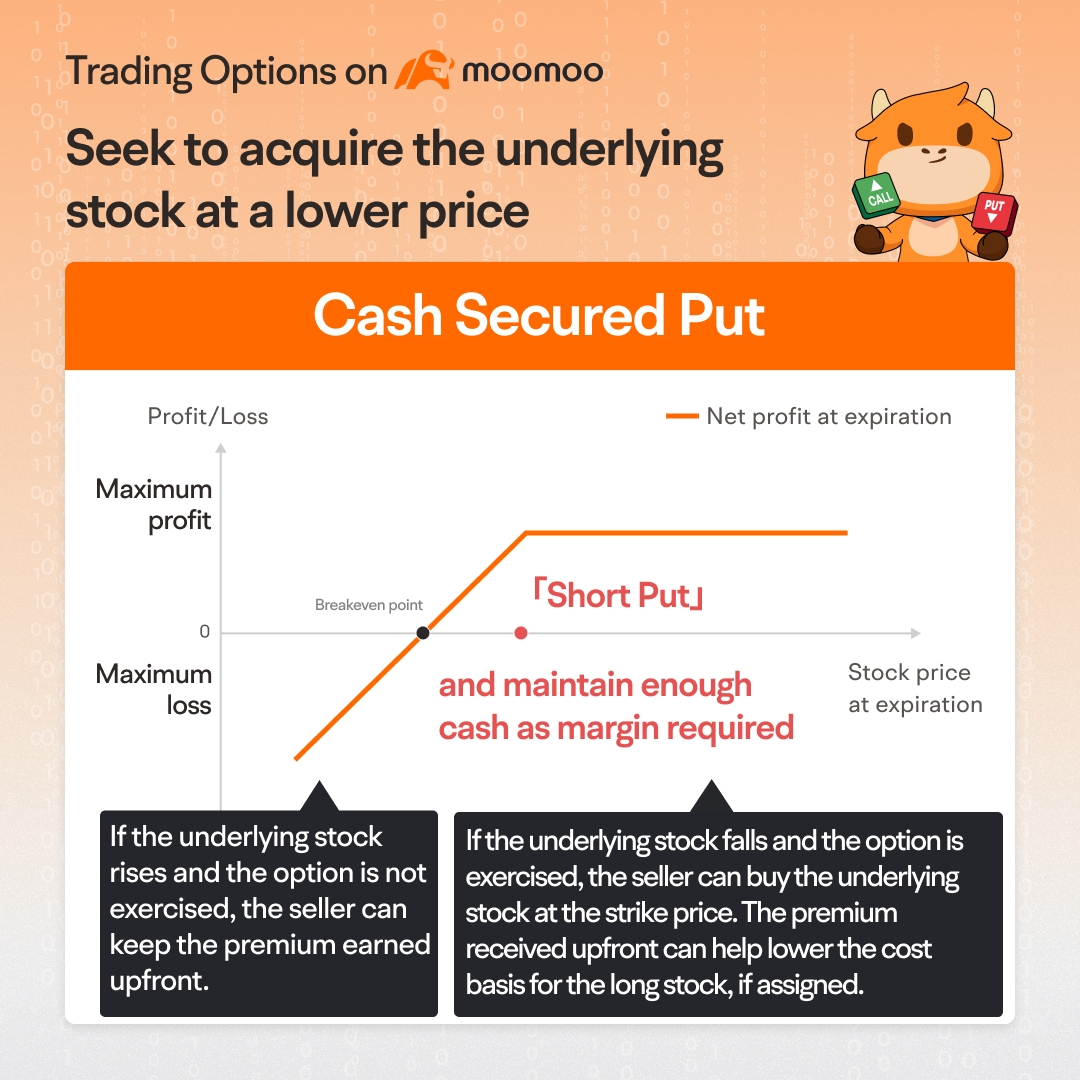
What is a Cash Secured Put?
A cash secured put involves:
Selling a put option on a stock you are willing to own at a lower entry price
Holding enough cash to buy the shares if required
In return, you receive a premium upfront.
What this means in practice:
If the stock falls below the strike price, you are required to buy the shares at that price if the option is assigned
If the stock stays above the strike price, the option expires worthless and you keep the premium
You do not have a choice if assigned. Buying the shares is an obligation
Key Characteristics of The Strategy
1. You earn income upfront
The premium is received as soon as the trade is placed. However, it is typically modest relative to the potential risk.
2. You may buy at your target price
If assigned, you purchase the stock at the strike price you selected.
However, it is important to understand:
If the stock continues falling, you will still incur losses
Your purchase price may end up above the current market price
You cannot opt out of the purchase unless you buy back the option at a loss
3. Limited upside, meaningful downside
Maximum profit is capped at the premium received
Potential losses can be significant if the stock drops sharply
4. Requires committed capital
You must hold enough cash to buy the shares at the strike price if assigned. This capital is tied up for the duration of the trade and cannot be used elsewhere.
Case Study
Let’s walk through a simplified example.
Setup
You believe $130 is a good entry price
You sell a put with:
Strike price: $130
Premium received: $3
Expiry: 2 months
Premium received: $300
Cash required: $13,000
Scenario 1: the stock falls sharply
Market movement: The stock drops to $110.
Outcome
You are assigned and buy at $130
Market value is $110
Paper loss: $2,000
After premium: net loss $1,700
Context: If you had bought at $140, the loss would have been $3,000.
Key takeaway: You still lose money, but your entry price is lower, reducing the impact.
Scenario 2: the stock rises
Market movement: The stock climbs to $150.
Outcome
Option expires worthless and you are not assigned the obligation to buy 100 shares at the strike price
You keep the $300 premium
You miss buying the stock at a lower level
Key takeaway: You earn income, but there is an opportunity cost if the stock runs higher.
Scenario 3: the stock trades sideways
Market movement: The stock stays between $135 and $140.
Outcome
Option expires
You keep the $300 premium
Key takeaway: You generate income while staying in cash and waiting for clearer opportunities.
Scenario 4: the stock dips, then rebounds
Market movement: The stock drops to $120, then recovers to $145 after expiry.
Outcome
You are assigned at $130
Stock value rises to $145
Share gain: $1,500
Premium: $300
Total profit: $1,800
Key takeaway: You secure a lower entry and still benefit from the rebound.
The Bottom Line
Selling puts can be a practical way to:
Enter stocks at a lower price
Earn income while waiting
Stay disciplined when markets are volatile
It works best when you are already willing to own the stock at the chosen price.
However, it is not risk free. If the stock falls significantly, losses can still occur, and your capital is committed throughout the trade.
Well known investors, including Warren Buffett, have used this approach to build positions in companies they want to own, while earning premium along the way. The key is to treat it as a structured entry strategy, not a shortcut to easy returns.
Risk warning: This information is general in nature and has been prepared without considering your financial objectives, situation or needs. Consider the appropriateness of this information in light of your personal circumstances before making investment decisions. Options trading involves substantial risks and may not be suitable for all investors. Losses could potentially exceed your initial investment. Please consider our Financial Services Guide (FSG), US Options Product Disclosure Statement (PDS) and US Options Target Market Determination (TMD) available on moomoo.com/au before trading options with us.
This presentation is for informational and educational use only and is not a recommendation or endorsement of any particular investment or investment strategy. Investment information provided in this content is general in nature, strictly for illustrative purposes, and may not be appropriate for all investors. Read more