Short Put Calendar Spread
Strategy Motivation
The Short Put Calendar Spread is a strategy for potentially profiting from an increase in volatility of an underlying asset while anticipating a subsequent decrease or moderate fluctuation in its price.
Construction of the Strategy
To construct the Short Put Calendar Spread, investors long near-term put options and short an equal number of longer-term put options with the same strike price.
Brief Description
The Short Put Calendar Spread is a strategy for potentially profiting from a big fluctuation in the price of an underlying asset. In most cases, an at-the-money option is selected when opening the position.
The strategy results in a net credit after opening the position since the near-term put option has a lower premium than the longer-term put option with the same strike price. The maximum potential profit is the net option premium received, which is only possible if the longer-term put option's time value decays faster than the near-term put option's time value.
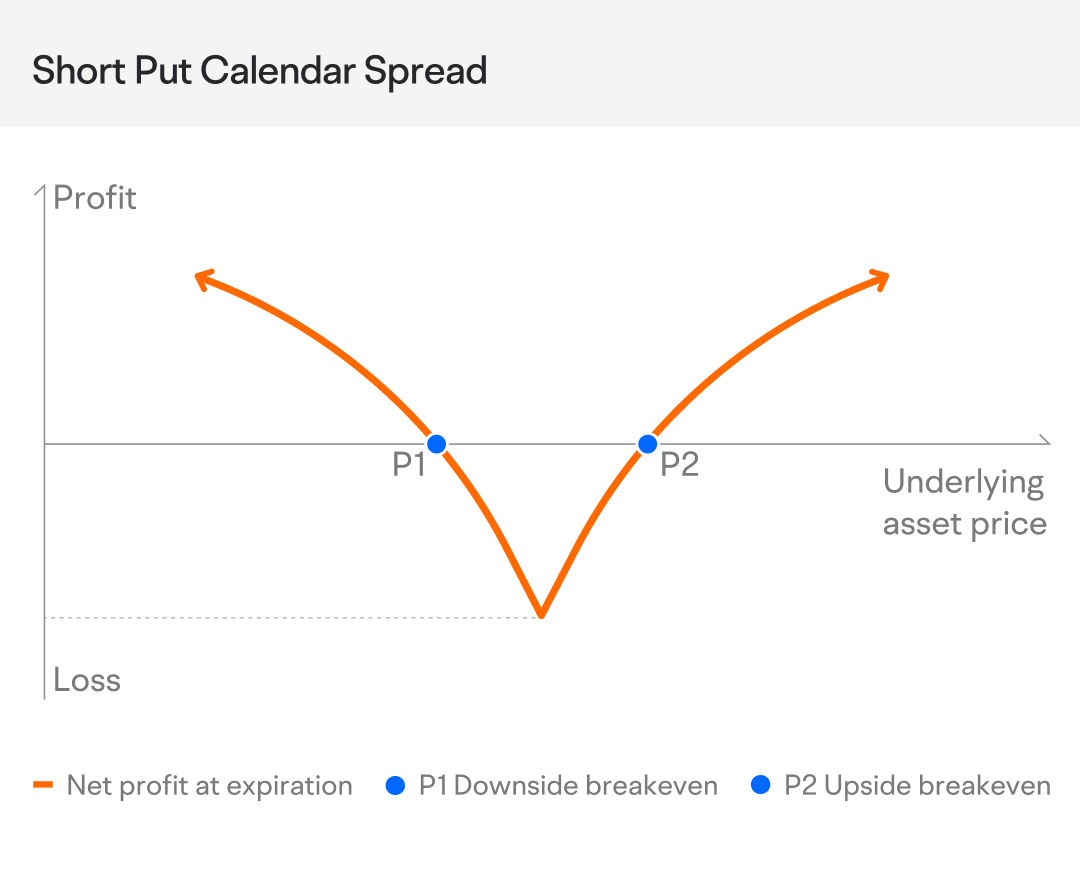
Suppose the asset's price experiences a significant rise or fall. In that case, the near-term and longer-term put options will tend to converge, resulting in a loss of time value. Closing the gap between the options' values can lead to maximum potential profit.
However, suppose the asset's price fluctuates too much. In that case, the cost of buying back the longer-term put option may exceed the near-term put option's potential profit, resulting in a loss.
Suppose the price of the underlying asset remains unchanged. In that case, the near-term put option will quickly lose value, while the longer-term put option will not lose as much time value, leading to potential losses.
After the near-term put option expires, investors can close the longer-term put option or construct a new strategy based on market conditions.
It is noteworthy that holding the longer-term put option after the near-term put option expires is risky. This is because it will become a naked short put with great loss potential and no further profit potential.
Gain & Loss
Breakeven
The short put calendar spread has two breakeven prices: one above the strike price and one below. The prices at which the short put's time value equals the spread's original price are the breakeven prices.
However, the breakeven prices cannot be known because the short put's time value depends on the underlying asset's volatility, which constantly changes.
Max gain
The potential maximum gain of a short put calendar spread is the money investors receive when investors open the spread. This profit is realized when the underlying asset price is either far above or below the strike price on the expiration date of the long put.
This is because the difference between the two puts approaches zero when the underlying asset price moves sharply away from the strike price, and the full amount received from the spread can be kept for the spread.
Max loss
When the long put is still open, the potential maximum loss will occur should the underlying stock remain steady. If the asset is at the strike price of the expiring option at the first expiration, that option will expire worthless. In contrast, the longer-term option would retain much of its time value. In that situation, the loss would be the cost of returning the longer-term option, less the premium received when the position was initiated. Suppose the near-term option expires worthless, and the investor takes no action. In that case, the strategy becomes a naked put whose potential loss is limited only because the stock cannot go below zero. The max loss equals the strike price minus the net premium.
This presentation is for informational and educational use only and is not a recommendation or endorsement of any particular investment or investment strategy. Investment information provided in this content is general in nature, strictly for illustrative purposes, and may not be appropriate for all investors. Read more