What are the basics?
A covered call is a simple trading strategy that combines holding a stock with selling call options.
It includes two transactions: buying a stock and selling the call options of that stock. The number of stock positions must be equal to the number of shares in the sold call options.
Buying stocks is the easy part, so let’s see what selling a call option means.
Options, like stocks, are securities that can be bought and sold. An option, in essence, is a form of contract. The person who buys the contract pays the premium (or option premium) to enjoy the rights to the contract, while the person who sells the contract (the writer) receives the premium is obligated to buy or sell the security to the buyer if the latter wish to do so.

The buyer of an option has the right to buy or sell a certain amount of an asset (the underlying asset), at an agreed-upon price (the strike price), within a specified period. When the buyer exercises this right, the seller is obligated to sell or buy the asset based on the contract terms.
A contract that grants the buyer the right to 「buy」 an asset is called a call option, while a contract that grants the buyer the right to 「sell」 an asset is called a put option.
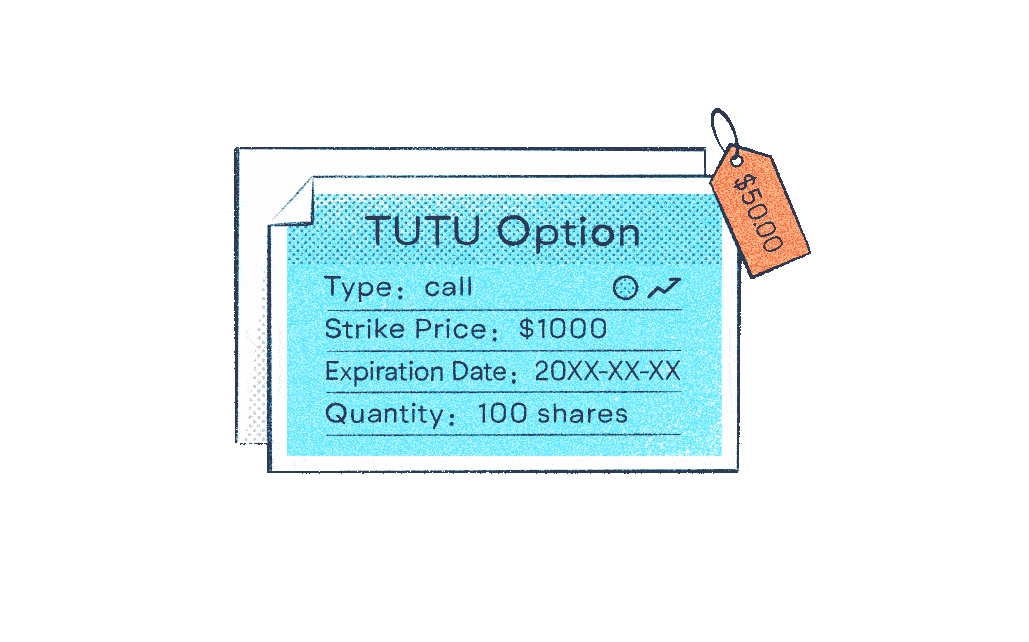
When you use the covered call strategy, you would be the seller of the call option. When you receive the option premium, you are obligated to sell the underlying asset (e.g., the stock) at the strike price within the specified period.
In addition, you can also buy back this contract from the market before the option is exercised (at any time) to release yourself from this obligation.
The theoretical loss of just selling call options is limitless. Imagine that the price of the underlying stock surges during the contract performance period, and the buyer exercises the option. You would have to buy the stock at very high prices from the market to sell it to the buyer at the strike price. The price difference would result in a significant loss.
Such options trading behavior is known as 「selling a naked call」. The return for selling naked calls is limited (the maximum return being the option premium collected), but the loss could be limitless. However, if you prepare a sufficient number of underlying shares before selling a call, you will have coverage in case the buyer exercises the option. This is called a covered call.
A covered call is a trading portfolio strategy that limits returns and losses. This strategy is suitable when you feel that a stock may stay bullish in the long run and that there will not be much price volatility in the short run.
For example:
Suppose in the US stock market, you are optimistic about the long‑term trend of TUTU stock (a theoretical stock), but believe that TUTU's stock price may fluctuate moderately in the short term, and there is little possibility for big ups and downs, so you buy 100 shares of TUTU stock at $950 per share while selling 1 TUTU call option (represents 100 shares) with a strike price of $1,000 at $50 cost per share, and the expiration date is MM DD, 202X.
This means that before MM DD, 202X:
Regardless of whether the stock price rises or falls, you have already received a credit of $5,000 (50 x 100 = 5,000).
When the price of TUTU shares is US$900, the buyer will not exercise the option, and the portfolio will break even: 5,000 + (900 – 950) x 100 = $0.
When the price of TUTU shares drops lower than $900, the portfolio will experience a loss. The maximum loss happens when the share price falls to 0 and will be 5,000 +(0– 950) x 100 =$-90,000.
When the price of TUTU shares rises to $1,050 (or even higher), the return of this portfolio is lower than simply holding the stock. Any further price increase in the stock would become irrelevant to you. At this point, the portfolio return is: 5,000 – (1,050 – 1,000) x 100 + (1,050 – 950) x 100 = $10,000. This is also the maximum return for the portfolio.
*The above calculations do not take into consideration transaction costs. In actual practice, transaction costs would also play a part.
From this, we can see that with covered calls, the return in case of a significant increase in stock price is limited, and the loss could be significant when the stock price falls sharply.
What, then, would be the most favorable scenario? This happens if the option doesn't hit the strike price before expiration, and the stock price rises sharply after the option expires. That is why covered calls are suitable when a stock is expected to be bullish in the long run, but the stock price will not fluctuate too much in the short run.
With this in mind, let us further discuss this strategy by separating the two parts: holding the stock and selling the call. Holding the stock is a stock transaction whereby you think the price of the underlying stock will be bullish. Selling the call is an options transaction whereby you believe the price of the underlying stock will not increase. Therefore, you may consider this strategy when you hold a stock whose price is expected to be bullish in the long run but may see moderate drops in the short run.
This presentation is for informational and educational use only and is not a recommendation or endorsement of any particular investment or investment strategy. Investment information provided in this content is general in nature, strictly for illustrative purposes, and may not be appropriate for all investors. Read more