JD Vance ETF Portfolio

The nomination of JD Vance as Trump's VP pick has caught the attention of Australian investors, particularly due to Vance's notable ETF portfolio, which includes major U.S. index funds and a diverse range of assets. The impact of his political influence is already evident in the market's reaction to his associated holdings, such as the entertainment platform Rumble, suggesting potential strategy cues for global investors.
This article will unpack how Vance's strategies might shape Australian investment approaches, focusing on the nuanced considerations of choosing between ASX-listed and U.S.-listed ETFs in an evolving market environment.
Unveil Trump's VP Pick JD Vance's portfolio
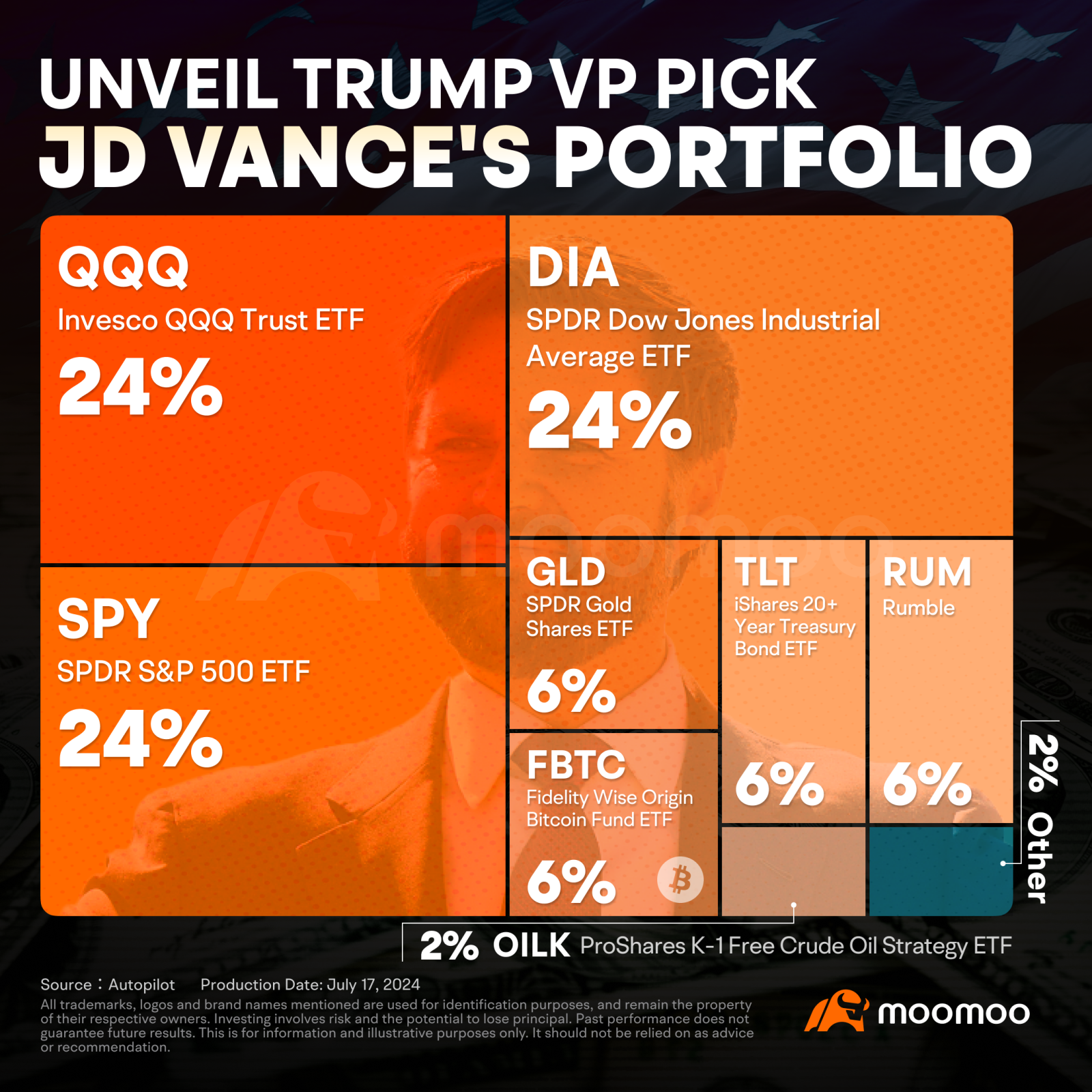
On July 15, 2024, former President Donald Trump officially nominated Ohio Senator JD Vance as his running mate for the 2024 US Presidential election. This announcement has drawn significant attention, not just politically but also in the financial world, particularly due to Vance's investment portfolio which is mainly composed of ETFs. Vance's top three holdings are 3 major US indices ETFs, including $Invesco QQQ Trust (QQQ.US)$, $SPDR S&P 500 ETF (SPY.US)$, and $SPDR Dow Jones Industrial Average Trust (DIA.US)$, each making up 24% of his portfolio. In addition, he holds positions in other ETFs, including those focused on Bitcoin, gold, and US Treasury bonds, as well as a stake in the entertainment platform $Rumble (RUM.US)$. Following the announcement, Rumble's stock saw a significant surge, closing up 20% after a 28% intraday rise on Monday.
Implications and risk for Australian investors
JD Vance's investment strategy, which heavily leans towards broad-based ETFs, indicates a conservative, well-diversified approach aimed at capturing the overall market's performance. The gains in QQQ, SPY, and DIA this year—21.5%, 19.6%, and 9.66% (YTD, as of July 17) respectively—signal a robust US market recovery. This momentum could gain further strength with political stability and pro-business policies under a potential Trump-Vance administration.
Moreover, with the potential for the US Federal Reserve to cut interest rates in September, the US dollar is likely to weaken. A weaker dollar generally boosts the price of gold, making it more attractive for investors holding other currencies. Lower interest rates typically increase the appeal of risk assets, such as equities and crypto. Both Trump and Vance have shown support for crypto, which could further enhance confidence in this asset class. Interest rate cuts also lead to higher bond prices. When interest rates fall, the yields on existing bonds become more attractive, driving up their prices.
JD Vance takes a tough stance on China, advocating for an economically nationalist approach that prioritizes US manufacturing, even at the expense of GDP growth. In the Senate, he co-sponsored the China Trade Relations Act to revoke China's permanent most-favored-nation status, underscoring his support for American manufacturing. Vance argues that the US should shift its focus from Ukraine to China, which he views as the real enemy. This tough stance on China could pose risks for Australian investors, given Australia's significant economic reliance on the Chinese market. Australia's trade relationship with China is substantial, as China is its largest trading partner. Any severe economic policies against China could negatively impact Australia's exports, particularly in sectors like mineral resources and agriculture.
Trade like JD Vance
Given these potential risks and opportunities, Australian investors might consider taking inspiration from JD Vance's investment approach to diversify portfolios.
Index ETFs:
$Invesco QQQ Trust (QQQ.US)$: This ETF tracks the Nasdaq-100 Index, providing exposure to 100 of the largest non-financial companies listed on the Nasdaq Stock Market. It is a good choice for investors looking to capitalize on tech-sector growth.
$SPDR S&P 500 ETF (SPY.US)$: This ETF tracks the S&P 500 Index, representing a broad cross-section of the US economy. It's ideal for those seeking diversified exposure to large-cap US stocks.
$SPDR Dow Jones Industrial Average Trust (DIA.US)$: This ETF replicates the performance of the Dow Jones Industrial Average, consisting of 30 large-cap US companies. It's suitable for investors favoring blue-chip stocks.
Crypto ETFs:
$Fidelity Wise Origin Bitcoin Fund (FBTC.US)$: This ETF offers exposure to Bitcoin, providing a way to invest in the cryptocurrency without directly holding it. It serves as a hedge against traditional market volatility.
Bond ETFs:
$iShares 20+ Year Treasury Bond ETF (TLT.US)$: This ETF invests in US Treasury bonds with maturities of 20 years or more, offering a fixed-income option that can add stability to a diversified portfolio.
Gold ETFs
$SPDR Gold ETF (GLD.US)$: This ETF is designed to track the price of gold, providing a safe-haven asset during market downturns.
Oil ETFs
$Proshares K-1 Free Crude Oil Strategy Etf (OILK.US)$: This ETF provides exposure to crude oil prices without the complications of K-1 tax forms, suitable for investors bullish on energy sector recovery.
Explore more ETF opportunities with our Thematic ETF feature!>>

Differences between ASX-listed ETFs and US-listed ETFs
For Australian investors, buying US-listed ETFs (e.g., SPY.US) directly versus buying ASX-listed ETFs (e.g., SPY.ASX) for US exposure can offer difference advantages:
Advantages of US-Listed ETFs
Higher Liquidity: US-listed ETFs generally have higher liquidity compared to their ASX counterparts. Higher liquidity often translates to tighter bid-ask spreads, making it easier and cheaper to buy and sell large amounts of shares without significantly impacting the price.
Access to Real-Time Market Movements: Investing directly in US-listed ETFs allows you to participate in the US market in real-time. This can be crucial for taking advantage of short-term opportunities and reacting to market news as it happens.
Advantages of ASX-Listed ETFs
No Currency Risk: When you invest in US-listed ETFs, your returns are subject to fluctuations in the AUD/USD exchange rate. Investing in ASX-listed ETFs that replicate US indices may mitigate this currency risk, as they are traded in AUD.
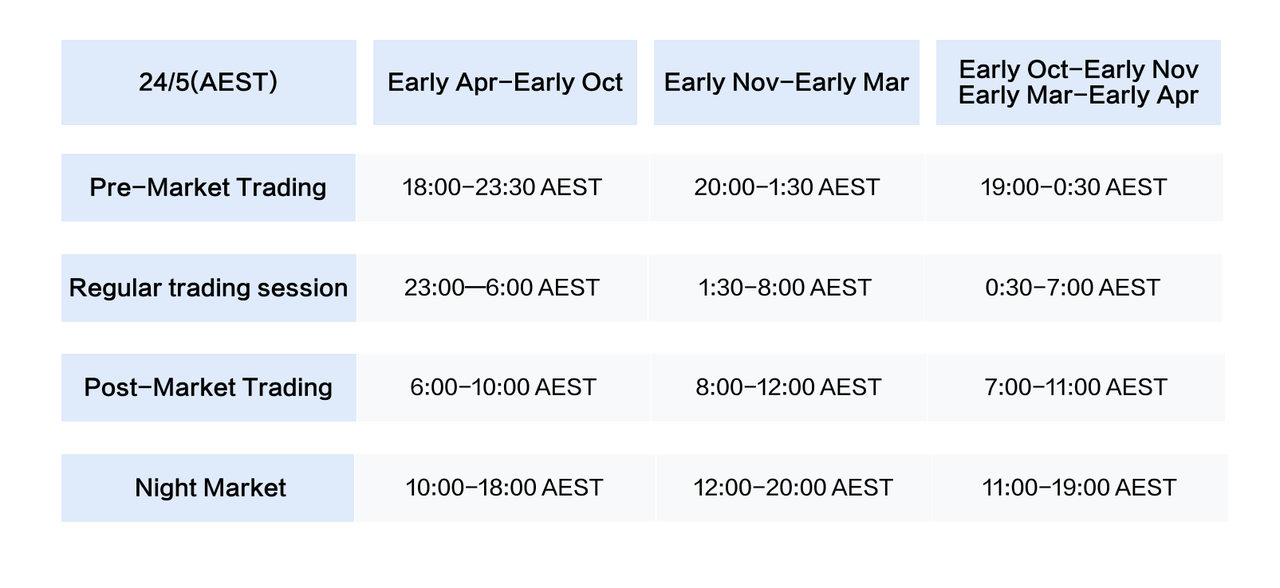
Trading Hours: US-listed ETFs trade during US market hours, which may not be convenient for Australian investors due to the time difference. ASX-listed ETFs trade during local market hours, providing more accessible trading opportunities.
Moomoo 24/5 trading feature, allowing you to trade US stocks not just during regular hours but also pre-market, after-market, and during the daytime!
Final Thoughts on JD Vance's ETF Portfolio
As Australian investors reflect on JD Vance's ETF portfolio and its implications amidst his VP nomination by Donald Trump, it becomes clear that his investment approach offers valuable insights into risk management and market engagement. Vance's diversified holdings across various asset classes, including his bullish stance on tech and his strategic positions in commodities and bonds, underscore a methodical strategy that balances growth with stability. While his political views, particularly on China, introduce an element of uncertainty, they also remind investors of the importance of staying agile and informed in a global financial landscape that is continuously shaped by the interplay of politics and economics.
This presentation is for informational and educational use only and is not a recommendation or endorsement of any particular investment or investment strategy. Investment information provided in this content is general in nature, strictly for illustrative purposes, and may not be appropriate for all investors. Read more