Recurring Investments: How to Automate Your Stock Investing
Key takeaways
Recurring investments are a strategic tool for long-term investors aiming to automate their stock purchases
They can help smooth market fluctuations and reduce emotional decision-making
Moomoo recurring investment supports auto investments in U.S. and Australian stocks and ETFs, offering flexible investment frequencies from just US$10 in Australia
What is a recurring investment?
People often say that timing the market perfectly is tougher than catching a falling knife. Everyone dreams of buying low and selling high, but predicting those perfect entry and exit points is relatively impossible.
To dodge the pitfalls of investing all your money at the wrong time, you can use recurring investments to spread out costs and smooth risks.
A recurring investment is an investment strategy where an investor commits to making regular, systematic contributions to an investment account or portfolio over time.
This approach can be applied to various types of investments, including stocks, mutual funds, and ETFs.
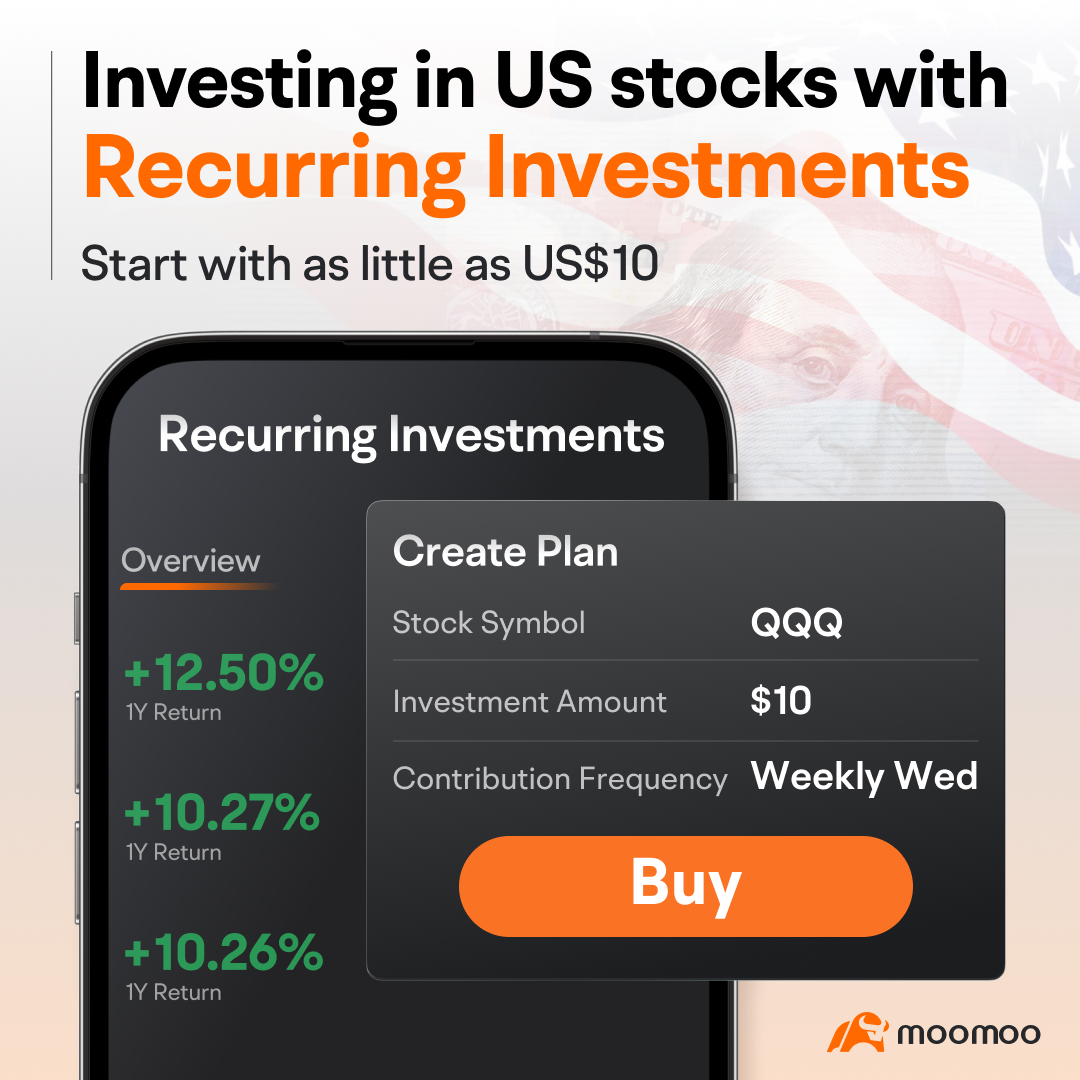
>> Start recurring investments on moomoo, available for U.S. stocks, Australian stocks, and ETFs.
>> Click to open an account and claim your welcome awards!
>> Click to open an account and claim your welcome awards!
How does recurring investment work?
Recurring investment works by establishing a systematic approach to investing, where an investor commits to regularly contributing a fixed amount of money into an investment account or portfolio.
Recurring investments are often referred to as auto investments because they automate the process of investing. This means that once you set up the investment parameters, such as the amount, frequency, and choice of stocks or ETFs, the system automatically executes these transactions on your behalf at the specified intervals.
This automation streamlines the investment process by eliminating the need for manual intervention each time you want to purchase assets, thereby enabling consistent investing without the requirement for active transaction management.
It is a disciplined approach that can help investors build wealth over time without the need to time the market perfectly. Auto investments also encourage a habit of regular saving and investing.
Moomoo equips you with a variety of tools, such as top recurring investment lists and a recurring investment calculator to help you explore and manage investment options.
Why should investors consider setting up recurring investments?
Recurring investments are attractive for several key reasons:
Dollar-Cost Averaging: Recurring investments allow investors to practice dollar-cost averaging, which involves investing a fixed amount of money at regular intervals, regardless of market conditions. This strategy helps reduce the impact of market volatility by buying more shares when prices are low and fewer shares when prices are high, potentially lowering the average cost per share over time.
Discipline and Consistency: Setting up automatic, recurring investments encourages a disciplined approach to investing. It ensures that investors consistently allocate funds towards their investment goals, helping to build wealth over time without the need to time the market or make frequent trading decisions.
Compounding Returns: By regularly investing and reinvesting earnings, investors can take advantage of compound interest. Over time, the earnings generated from investments are reinvested, leading to potentially exponential growth in the value of the investment portfolio.
Budget-Friendly: Recurring investments can be tailored to fit an investor's budget, allowing them to start investing with smaller amounts of money. On moomoo, you can begin your recurring investment for just US$10 (approximately A$15). For AU assets, the minimum investment amount is A$50. This accessibility makes it easier for individuals to begin investing early and gradually increase their contributions as their financial situation improves.
Reduced Emotional Decision-Making: Auto investments help minimize emotional decision-making, which can often lead to poor investment choices, such as buying high during market euphoria or selling low during market panic. With a set plan, investors are less likely to react impulsively to short-term market fluctuations.
Time Efficiency: Automating investments saves time and effort since investors don't need to manually execute trades or constantly monitor the market. Setting up a recurring investment on moomoo App is straightforward. No need to dig through endless menus or even power up your computer. You can even get it all sorted in just two minutes while you're on the metro. It's as easy as tapping a few buttons on your phone!
How do I set up recurring investments?
Recurring investment is a method sometimes used by investors with a long-term focus.
This strategy is getting popular, as recurring investments allow investors to engage in long-term investing amidst the recent surge in AI-related industries. This surge has contributed to a global bull market, offering potential growth opportunities. Investors who have consistently invested in sectors or companies involved in AI innovation through recurring investments could have experienced some returns.
Here’s a step-by-step guide on how to set up your recurring investment:
Step 1: Choose the stock or ETF you want to invest in
Auto investment is like having a financial autopilot that works towards your long-term goals. When the market dips, your regular investment buys more units; when it rises, it buys fewer.
Once set up, recurring investments are typically automated, making it easier for investors to stay committed to their investment plan without manual contributions each time.
Regular contributions, along with reinvested dividends and interest, may contribute to portfolio growth over time through compounding. Investment values can rise or fall, and returns are not guaranteed.
Let's illustrate this through a hypothetical example:
Assume XYZ is a well-performing listed company, and its current stock price is $50 per share. You start a recurring investment plan with $200 each month.
Month 1: XYZ’s share price is $50. You buy 4 shares ($200 / $50).
Month 2: XYZ drops to $40. You buy 5 shares ($200 / $40).
Month 3: XYZ rises to $55. You buy approximately 3.64 shares ($200 / $55).
Month 4: XYZ’s share price is $45. You buy approximately 4.44 shares ($200 / $45).
Month 5: XYZ is at $48. You buy approximately 4.17 shares ($200 / $48).
Month 6: XYZ is at $52. You buy approximately 3.85 shares ($200 / $52).
Six months later, after the announcement of a significant partnership agreement, XYZ's stock price soared to $65. At this point, you invested a total of $1,200 and purchased 25.1 shares, earning a total profit of $431.5.
Under a recurring investment approach, you were able to buy fewer shares when the price was high and accumulate more when the price was low. This approach ensured that you didn’t miss out on the price surge resulting from major events, as you continuously held and increased your position in XYZ stock.
While such movements can lead to gains, asset prices can also fall, and past performance is not a reliable indicator of future results.
For successful recurring investments, it's crucial to have a thorough understanding of the chosen investment and industry trends.
When selecting suitable assets for a recurring investment strategy, some assets are often considered better choices.
Industry Leaders & Blue-Chip Stocks (for Long-Term Holding)
Examples: Microsoft (MSFT), Nvidia (NVDA), Apple (AAPL)
These companies typically have stable businesses and strong cash flows, with lower stock volatility, making them ideal for beginners to start their recurring investments. They had offered significant compound returns over the long term.
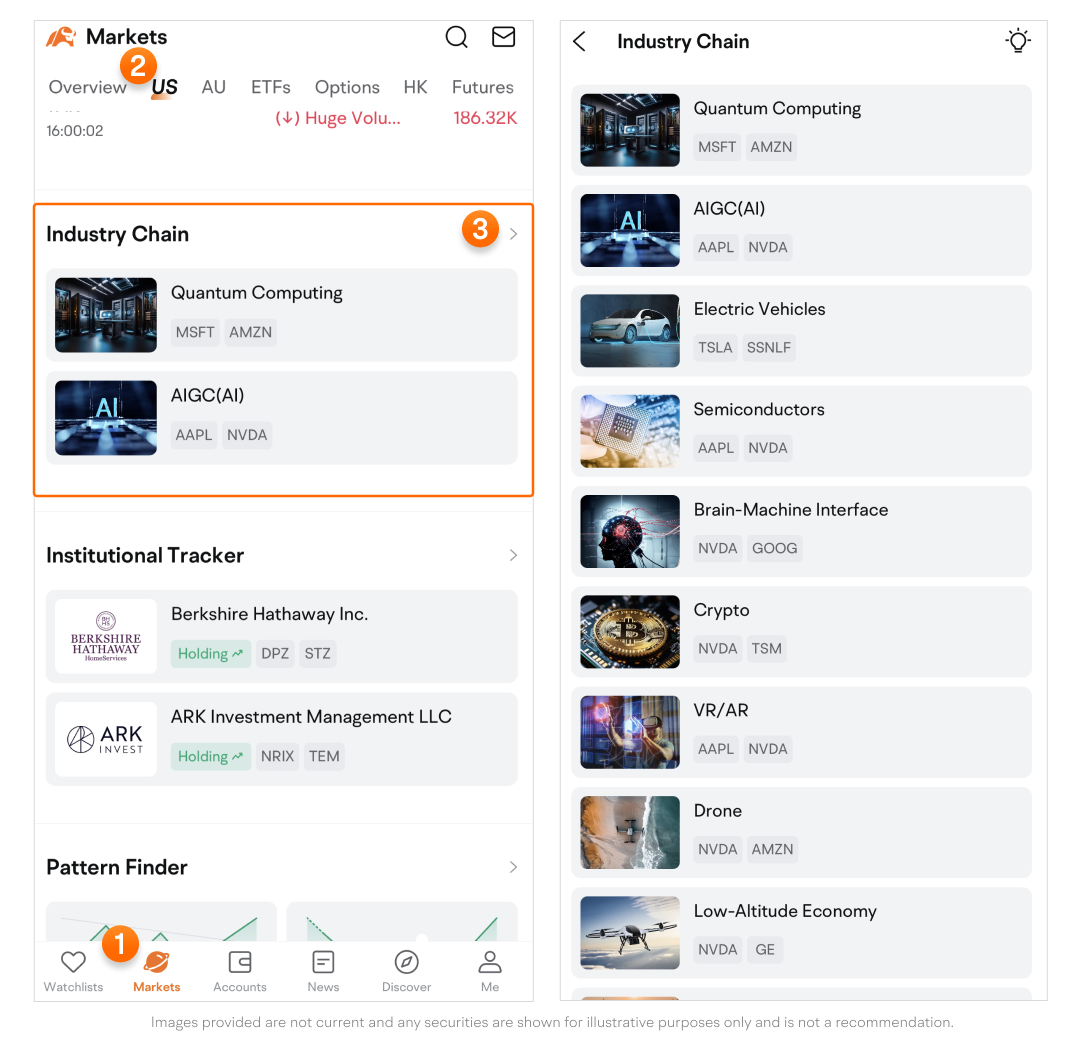
Moomoo offers Industry Chain for you to choose from. Here, you can discover popular market concept stocks such as quantum computing and AI.
Broad-Market ETFs (for Risk Diversification)
Examples: VOO (S&P 500 ETF), QQQ (Nasdaq 100 ETF), VTI (Total US Market ETF).
ETFs are essentially "stock baskets." A single purchase gives you exposure to dozens or even hundreds of companies—a steady starting point for new investors.
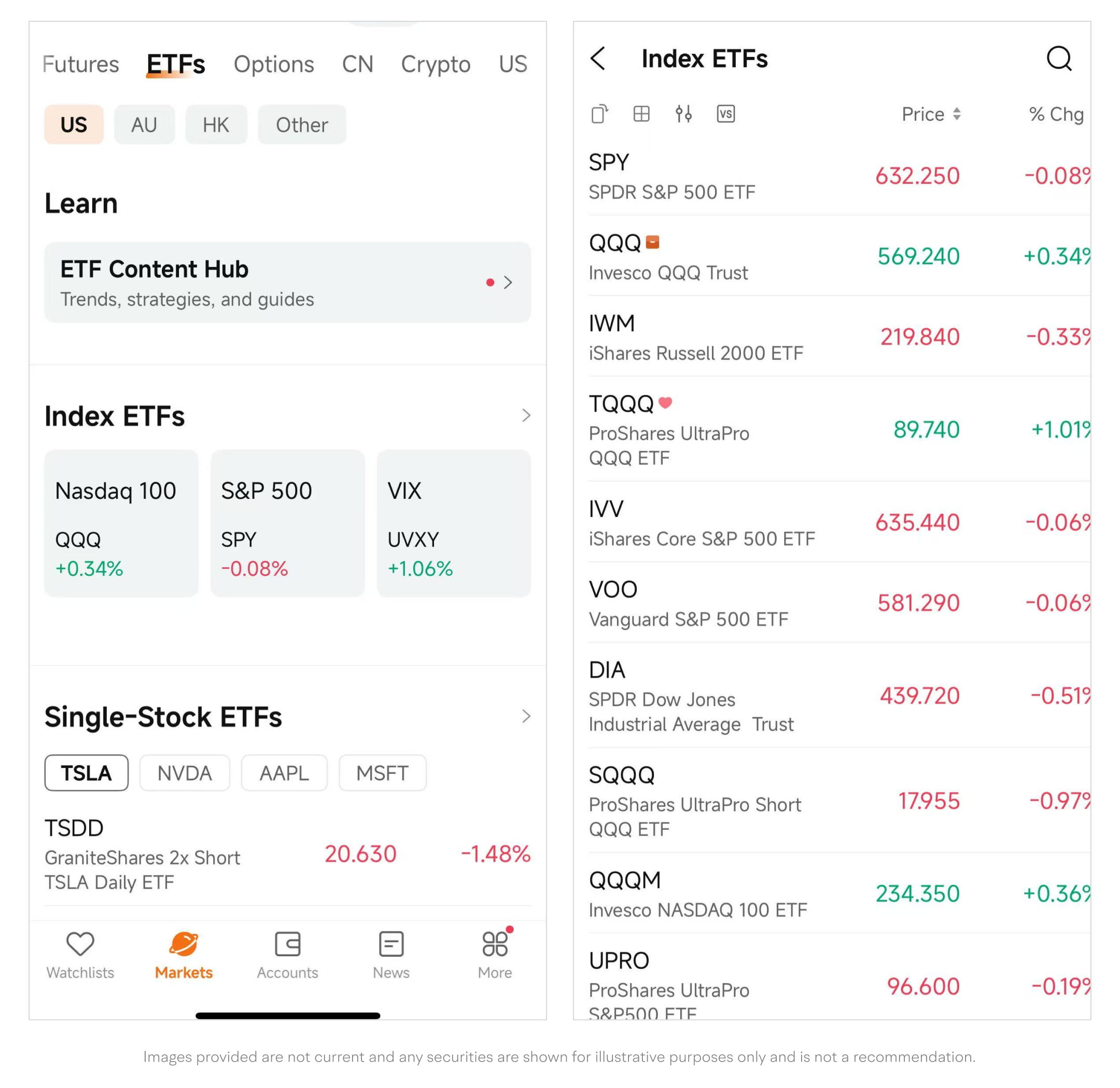
Moomoo offers a variety of index ETFs, including those tracking the S&P 500, Nasdaq, Russell 2000, and more.
High-Dividend, Stable Payout Stocks (for Cash Flow Seekers)
Examples: Coca-Cola (KO), Johnson & Johnson (JNJ), Procter & Gamble (PG).
Some companies have a history of paying dividends, which can be reinvested over time to support portfolio growth.
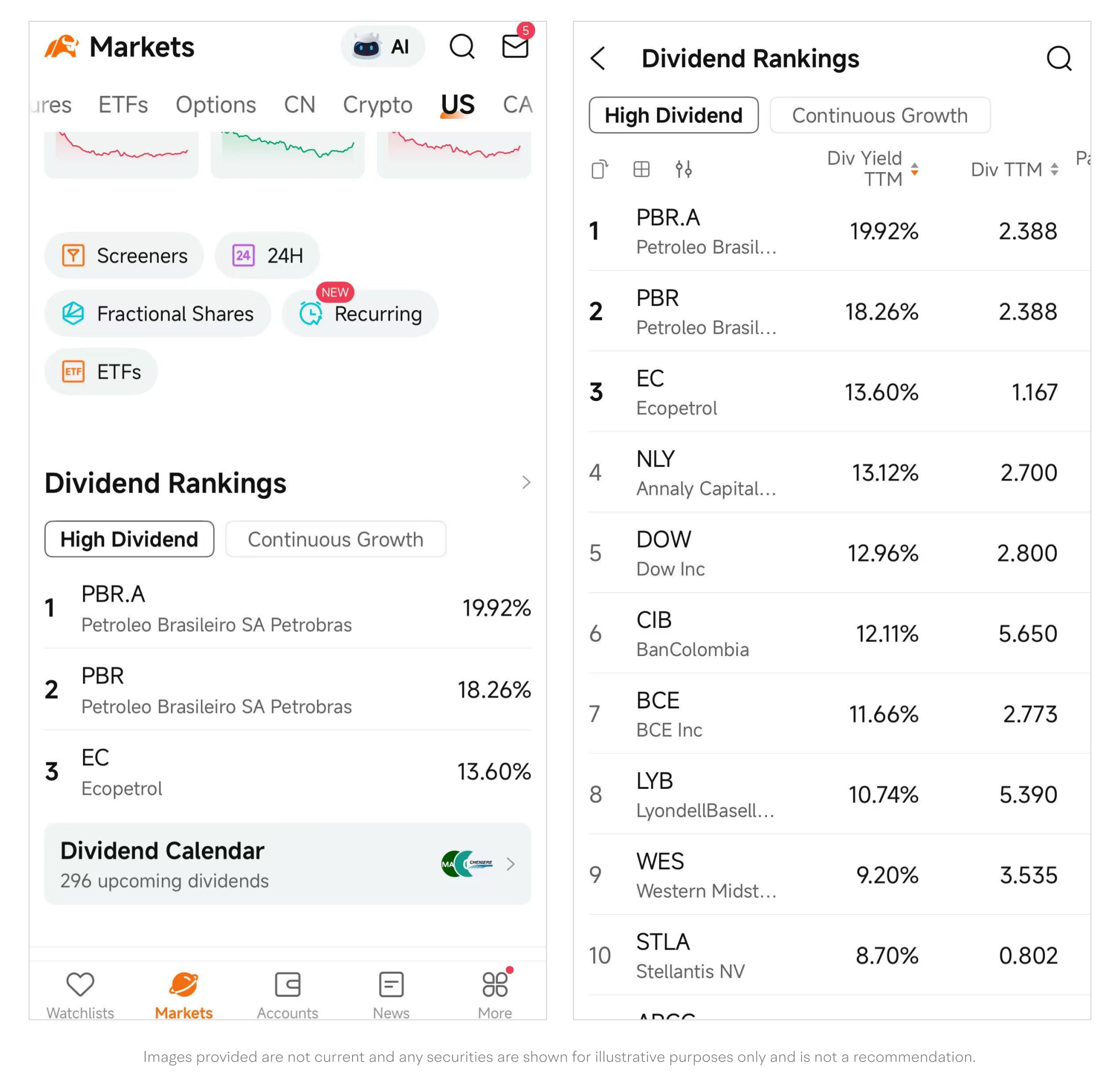
Moomoo's Dividend Rankings help you identify high-dividend stocks in the market. You can also use the filter to adjust different criteria, allowing you to refine your search based on your specific investment preferences and goals.
If you want to explore local Aussie assets, switch to "AU" in the Markets section.
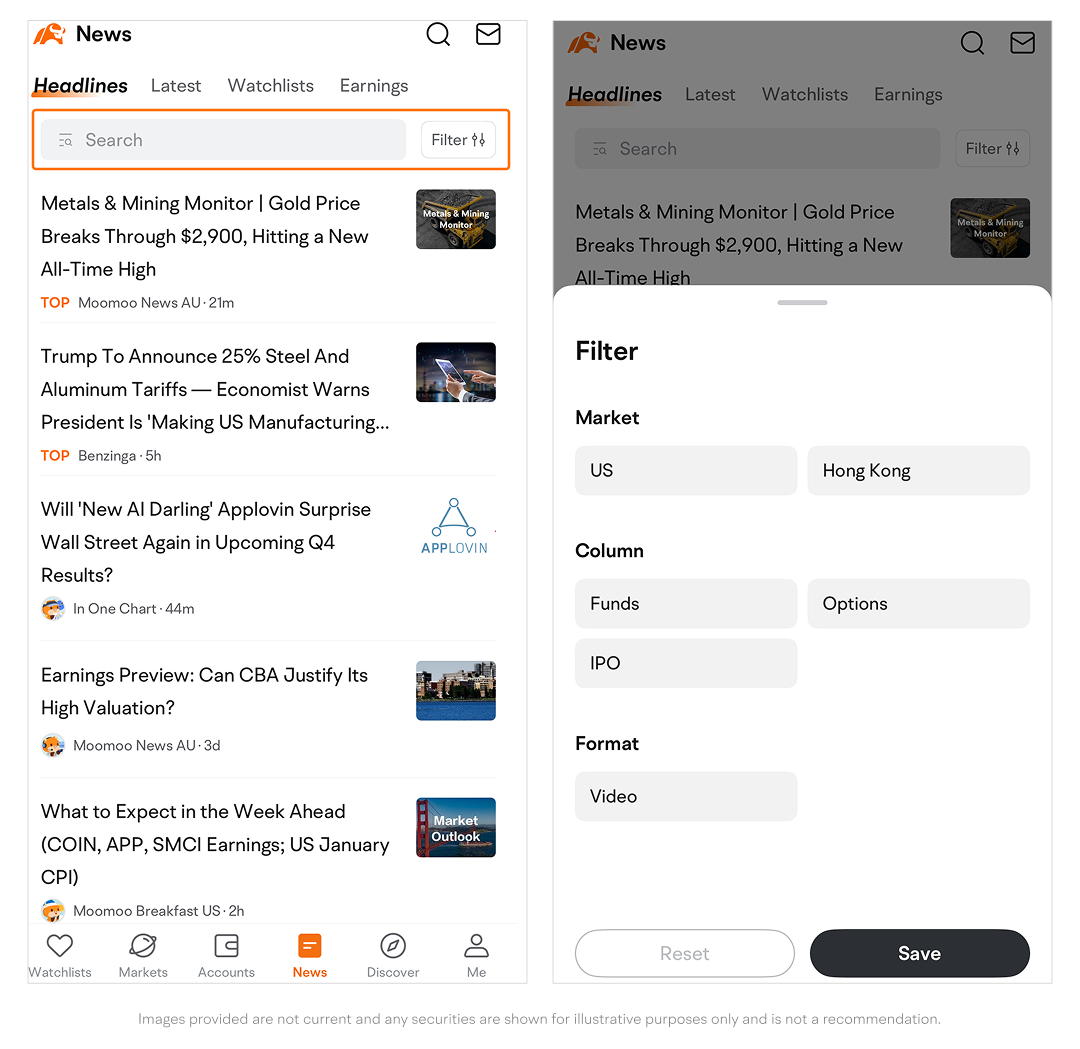
When selecting investments for a recurring investment plan, information is crucial. Moomoo News integrates resources from authoritative global financial media, providing continuous 24/7 updates and in-depth analysis. You can also choose different modules based on themes of interest to obtain more targeted information, helping you make more informed investment decisions.
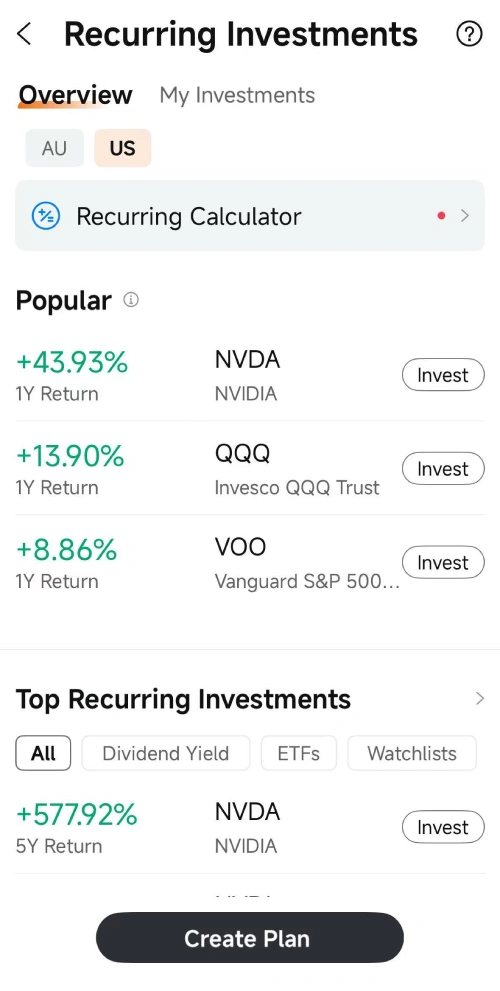
In addition to the tools mentioned, Moomoo also offers a leaderboard specifically designed for recurring investment.
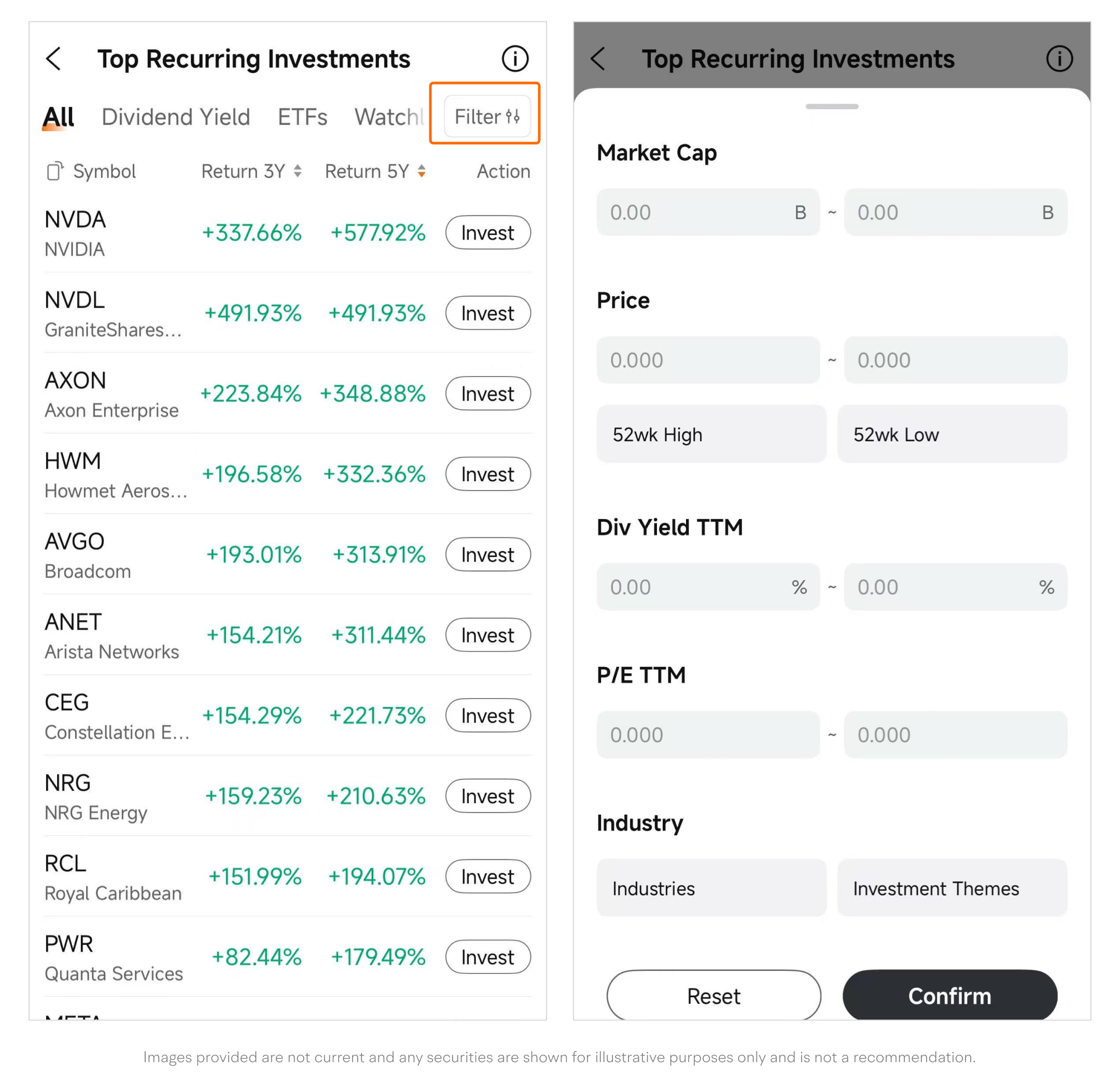
Top Recurring Investments allows you to see which investment targets have recently been popular among investors, as well as their return performance over the past three and five years.
It gives you the scoop on some of the hottest picks for regular investing. You can check out how they’ve performed over the past three and five years. If something catches your eye, just add it to your Watchlist.
You can also use filters to narrow down your options based on criteria such as market capitalization, price, dividend yield (TTM), P/E ratio, and industry. This flexibility helps you to select stocks or ETFs that align with your investment goals and preferences.
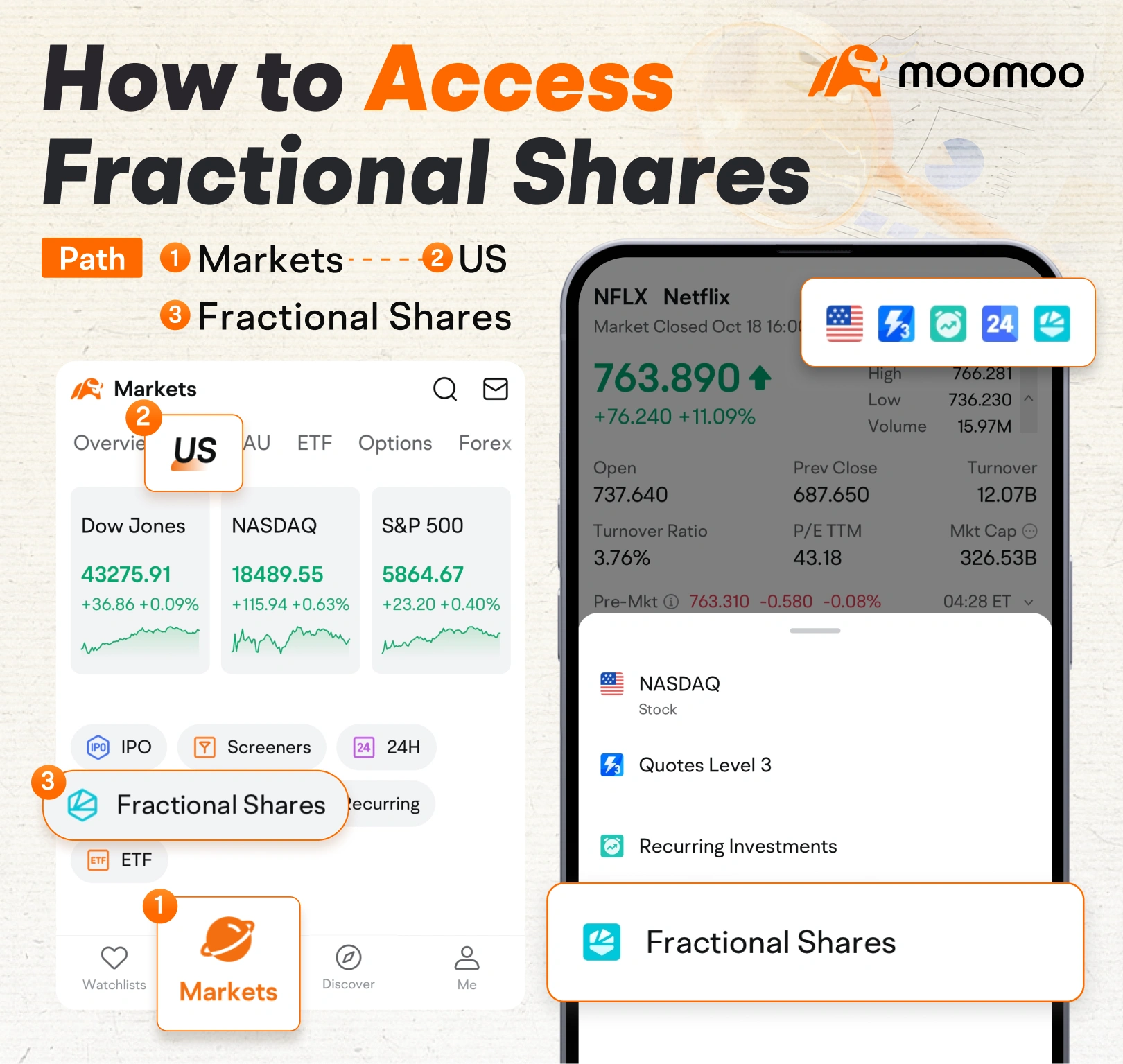
Moreover, if you're interested in purchasing U.S. stocks at high prices but have a tight budget, moomoo supports fractional shares (available for some U.S. assets only). In August 2025, purchasing one share of Microsoft will cost over $500.
Moomoo provides fractional share trading for hundreds of US stocks and ETFs, primarily focusing on blue-chip companies. To view the list of available fractional shares, simply go to Markets > US > Fractional Shares.
If a stock supports fractional trading, the Fractional Shares icon will be visible on the stock’s Detailed Quotes page.
Step 2: Choose a brokerage that supports recurring investment
Many financial institutions and platforms offer low barriers to entry for recurring investments, which allows investors to start with relatively small amounts and increase their contributions over time.
Choosing a brokerage that supports recurring investments is a crucial step in your investment journey. Here are some suggestions to help you make an informed decision:
Range of Products: Ensure the brokerage offers a wide range of investment products, so you can choose according to your investment strategy. Moomoo recurring investment offers a wide variety of options, including U.S. stocks, Australian stocks, and ETFs, among others.
Fee Structure: Understand the brokerage's fee structure, including trading commissions, management fees, and account maintenance fees. A brokerage with low fees can help you save costs over the long term. Moomoo offers highly competitive trading fees, starting from just US$0.99 per order. Other pass-through fees and FX costs still apply.
Security and Reputation: Consider choosing a brokerage with appropriate licensing and regulatory oversight. Ensure the broker you choose holds an Australian Financial Services Licence (AFSL) and is regulated by the Australian Securities and Investments Commission (ASIC). Moomoo Australia is authorised under AFSL No. 224663 and also operates under regulatory oversight in other jurisdictions. Also, moomoo provides CHESS (Clearing House Electronic Subregister System) sponsored trades. With CHESS sponsorship, you (not your broker) are the direct owner of the shares, letting you have greater control over your investments.
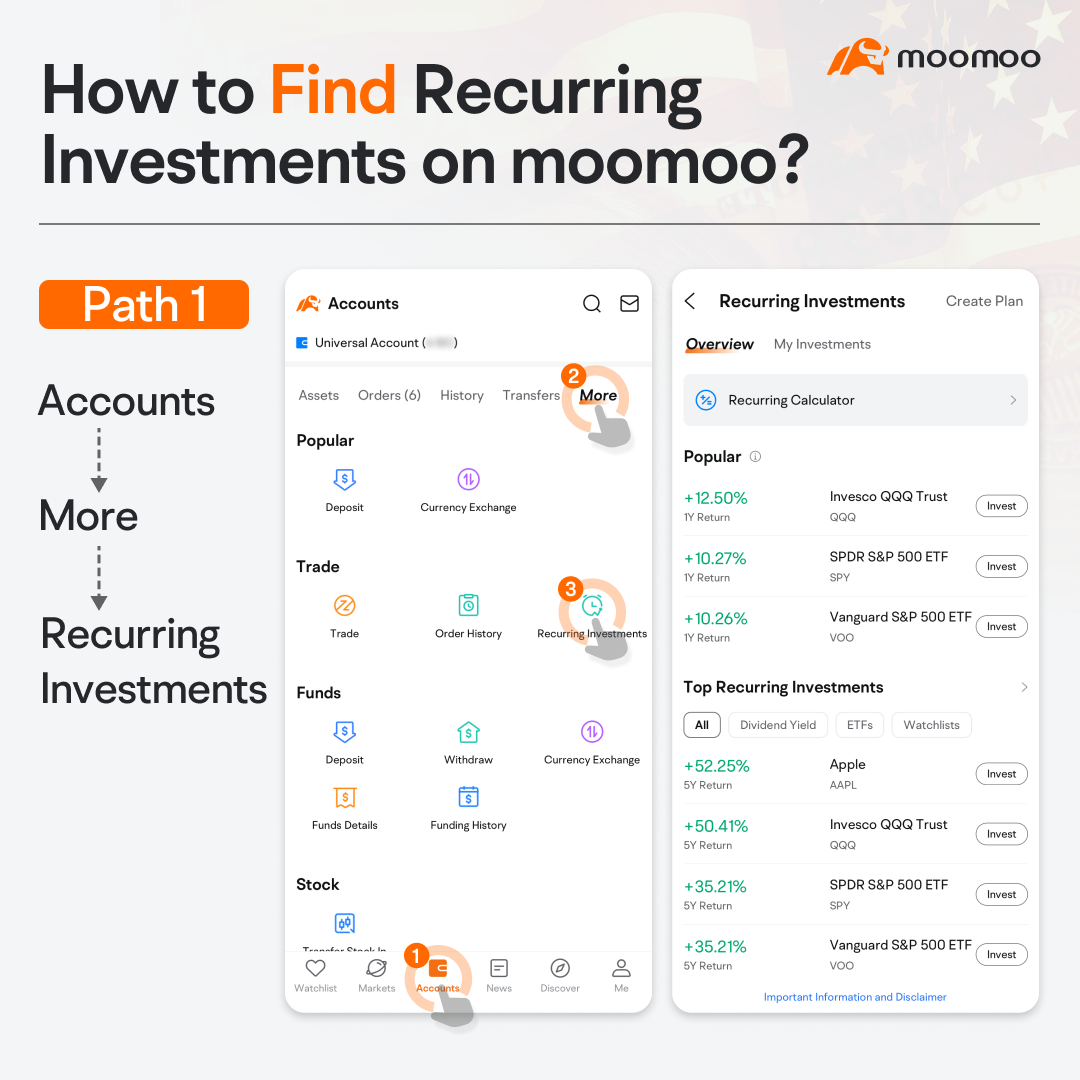
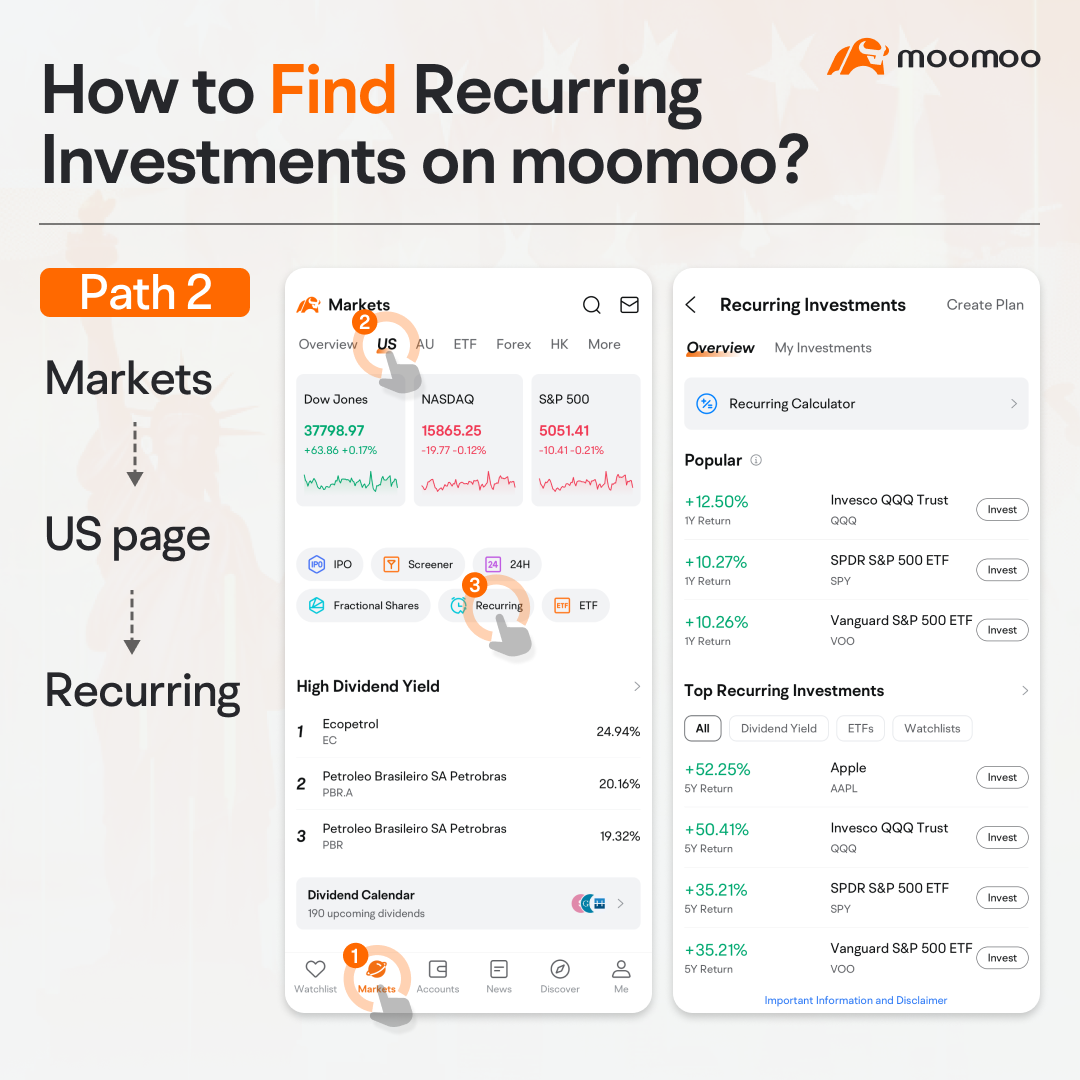
On moomoo, discovering the recurring investment feature is a breeze with three different paths to guide you.
Path 1: Set up through Markets tab
Accounts > More > Recurring Investments
Path 2: Set up through your Accounts tab
Markets > US page > Recurring
Path 3: Set up via your stock of choice
In the lower right corner of an individual stock page > More > Recurring > Create a plan
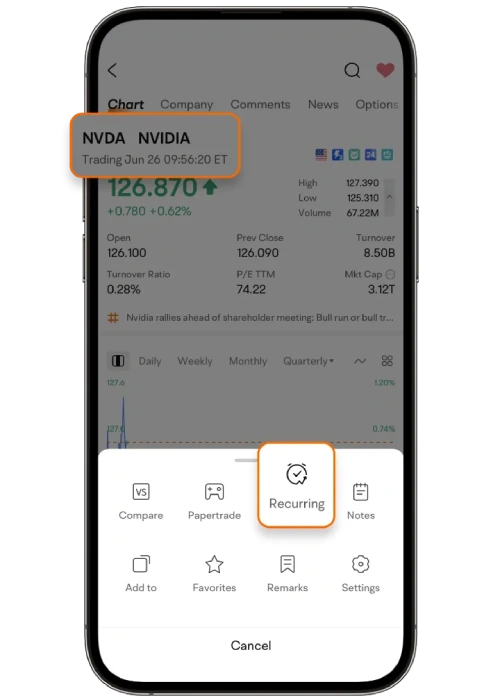
The company mentioned is for illustration purposes only, and any statement involved does not constitute investment advice.
Step 3: Deposit funds into your payment account
To keep your recurring investment plan running smoothly, it's crucial to have enough funds in your Moomoo account before each investment cycle kicks off. This means you should deposit enough money in advance to cover your upcoming investments.
Remember, if there's no cash in your account, you won't be able to pull funds from your bank account automatically.
While standard bank transfers are common, they can take a few business days to process, which might slow down your trading plans. To make things quicker, Moomoo now supports PayID—a fast and convenient system for instant transfers directly from your bank account. If your bank account name matches your Moomoo account name, your funds can arrive in just 5 minutes!
And when your funds do arrive, they’re safe and sound. Moomoo Australia holds client funds in designated client money trust accounts with CBA, HSBC, and MUFG, keeping them completely separate from Moomoo's own funds.
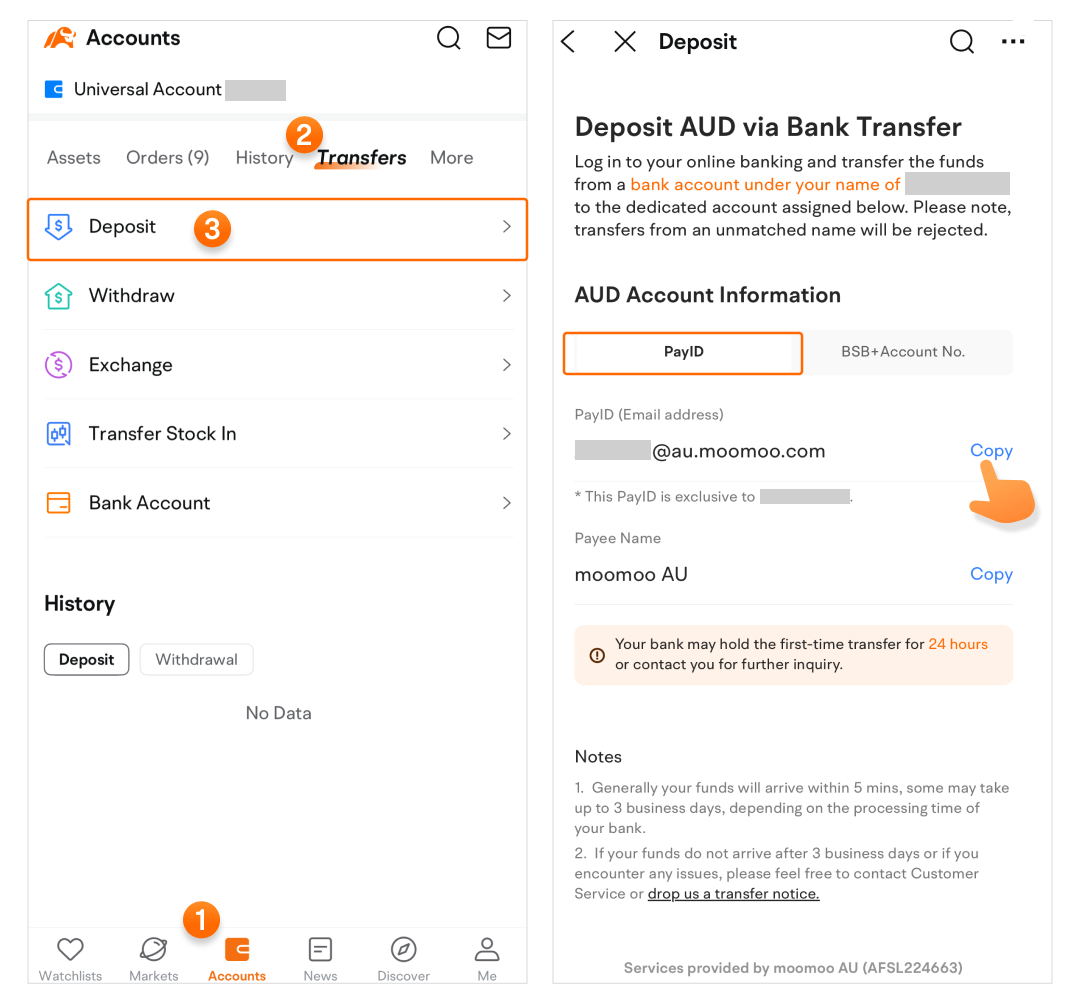
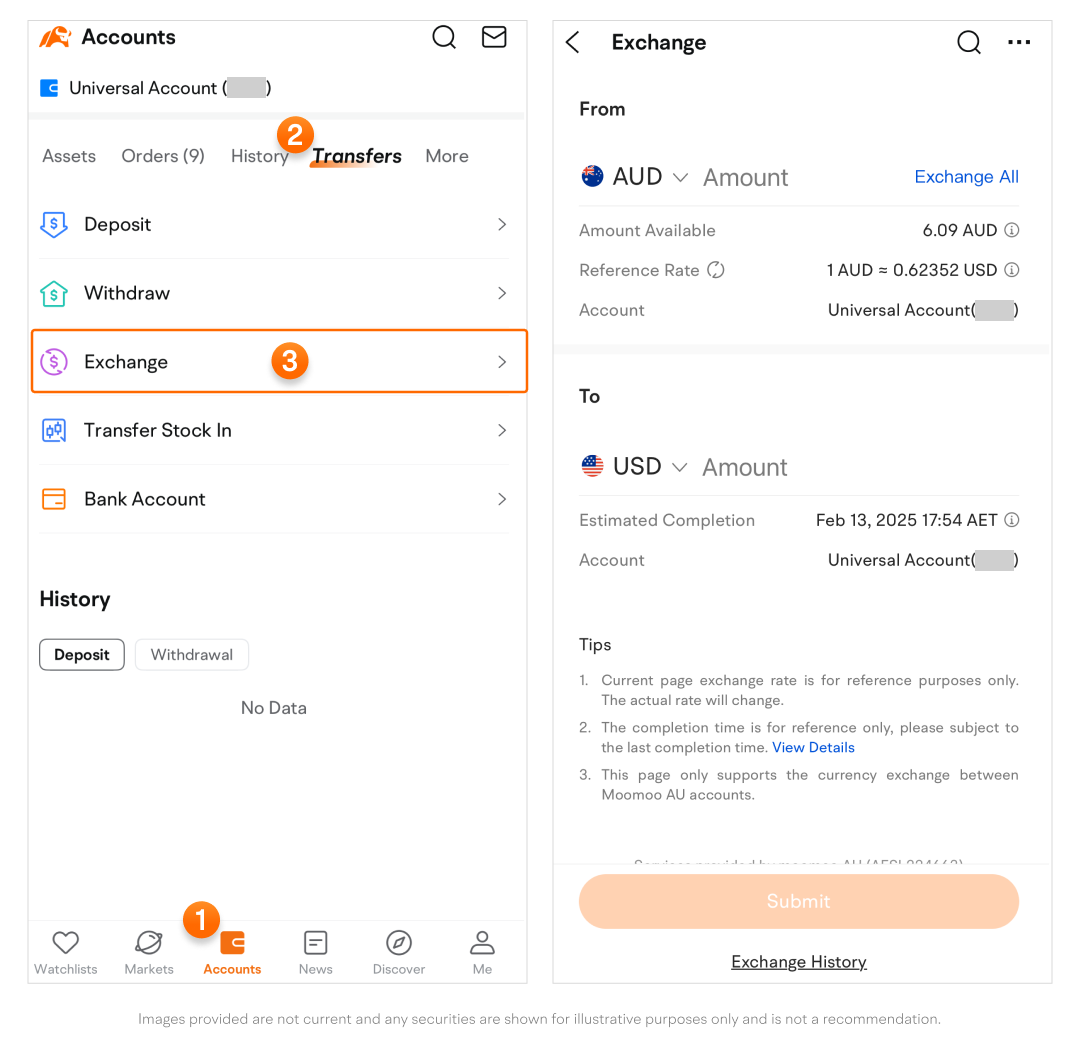
Additionally, moomoo has an in-app currency exchange feature, allowing you to easily convert currencies if you wish to invest in U.S. Assets. There's no need to visit a bank for currency exchange, open additional accounts, or worry about hidden exchange rate costs.
With just a few simple steps, you can convert your Australian dollars to U.S. dollars and immediately use them for U.S. stock trading, saving both time and effort.
Step 4: Select an investment amount
When determining your recurring investment amount, assess your financial situation by calculating your monthly disposable income, which remains after paying fixed expenses like rent, loans, and living costs.
Set clear investment goals
For short-term goals, you may need to invest more due to the shorter timeframe, while long-term goals like retirement can benefit from smaller, consistent contributions. If you prefer a cautious approach, consider investing less or choosing conservative options.
Select an amount you can consistently invest
Ensure your investment fits within this income and that you have an emergency fund covering 3 to 6 months of expenses for unexpected events. Be prepared to adjust the amount if your financial circumstances change, and keep your contributions manageable and aligned with your goals.
On moomoo, you can begin your recurring investment for just US$10 (approximately A$15). And for AU assets, the minimum investment amount is A$50. A lower threshold makes it easier for you to start your regular investment plan!

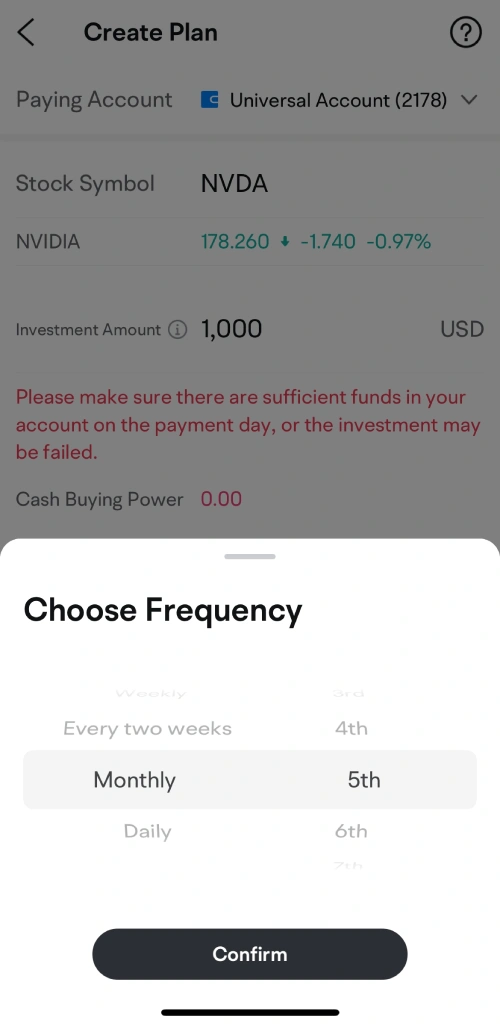
Step 5: Select a contribution frequency
Most investors opt for monthly recurring investments because this cycle aligns well with common financial patterns like receiving paychecks and paying bills. Monthly contributions also help average out investment costs over time, reducing the impact of market volatility.
Other popular investment intervals include weekly or quarterly, and the choice can be tailored to your income flow and personal financial management habits.
On moomoo, you can choose intervals that align with your cash flow, such as weekly, bi-weekly, or monthly.
Consider your income cycle to ensure funds are available when needed, and more frequent contributions can help smooth out market volatility.
Step 6: Order executions
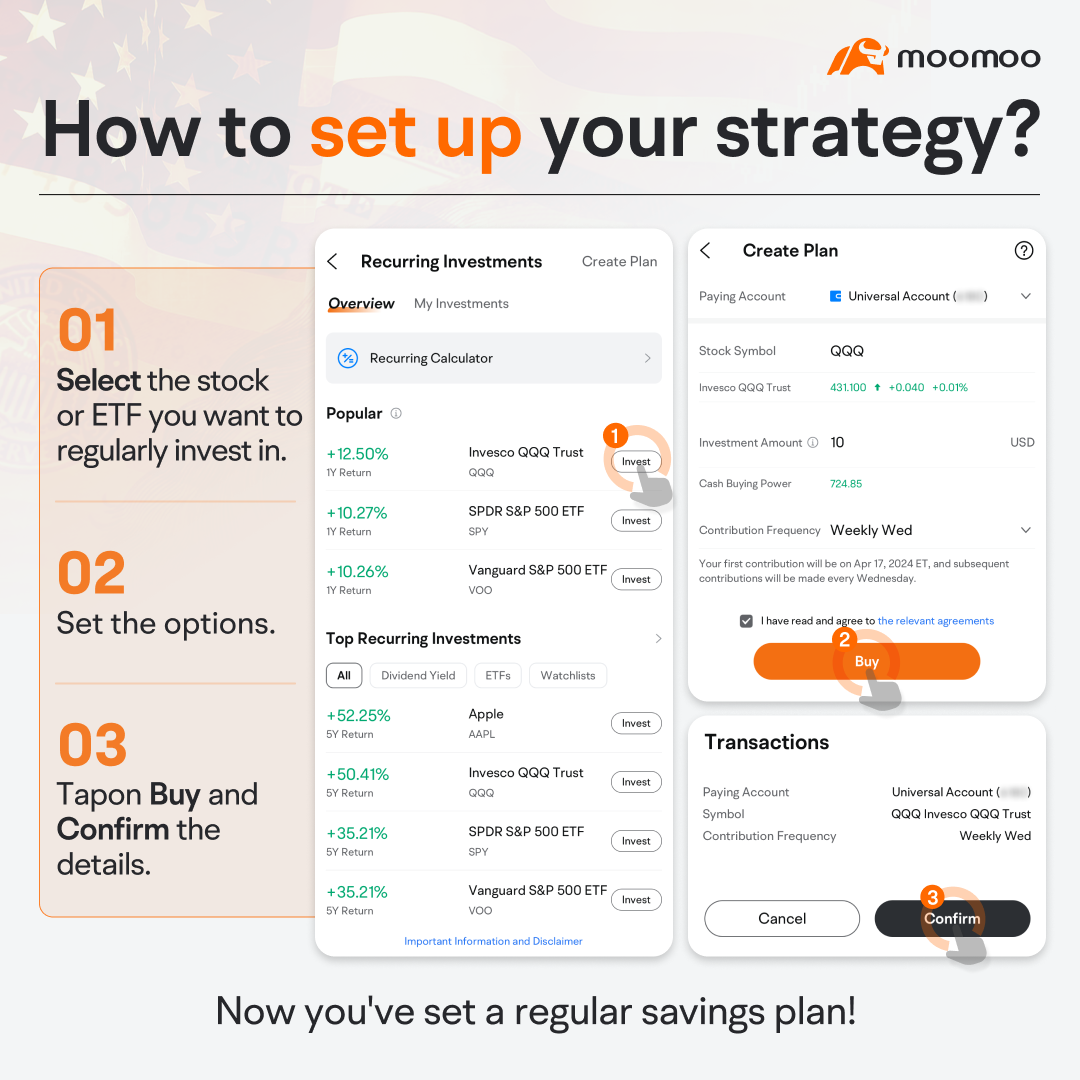
Automating order execution in recurring investments allows investors to maintain a consistent strategy with minimal manual intervention, reducing operational errors. This process ensures investments are made at NAV for mutual funds or market/limit prices for stocks, keeping your plan on track without constant oversight.
On moomoo, once you've set your conditions, you're all set for order execution. Simply click buy and confirm your choice to activate your moomoo recurring investment!
The system will place a market order for the specified assets:
For US assets, it is around 10:30 AM Eastern Time (ET) on the scheduled investment date. If the scheduled date is not a trading day, the order will be placed on the next available trading day around 10:30 AM ET.
For AU assets, the system will place a limit order around 10:30 AM Australian Eastern Standard Time (AEST), following the same protocol during holidays.
We make every effort to ensure, but cannot guarantee, the actual purchase time and the fill price.
Your order may fail for one of the following reasons:
a. Buying 0 shares while funds are sufficient may be due to an illiquid market. Other situations may include technical issues that can't be resolved immediately.
b. Holding a short position for the same stock. If the stock has a short position in your account, the short position will be retained, and the order will not be executed.
c. Insufficient purchasing power: If the maximum purchasing power in your account is insufficient on the scheduled investment day, the order execution will fail.
If you ever run into a "Failed Order" situation, no worries. You can reach out to the 24/7 intelligent customer service for quick assistance, and if you need more personalized support, there's a real human available to help you 24 hours a day, 5 days a week.
>> Learn more: How to Start Recurring Investment

Step 7: Manage your recurring investment
Be prepared to adjust the investment amount, frequency, or choice of securities in response to changes in your financial situation or market conditions. Consider rebalancing your portfolio periodically to maintain your desired asset allocation and risk level.
Regular Review and Assessment: It's advisable to conduct a comprehensive review of your investment portfolio every six months or annually. Pay attention to the return on investments, volatility, and comparisons with market benchmarks. By evaluating these indicators, you can determine whether your investments are on the expected track.
Adjusting Goals and Amounts: As your life stage and income change, adjust your investment amounts to ensure that your investments remain within a manageable range. This helps keep your investment strategy aligned with your current financial situation and goals.
Risk Management and Asset Allocation: Regularly assess your risk tolerance, especially during changes in the market environment. Based on your evaluation, you may need to increase or decrease the proportion of high-risk assets in your portfolio. This ongoing assessment ensures that your asset allocation remains suitable for your risk tolerance and investment objectives.
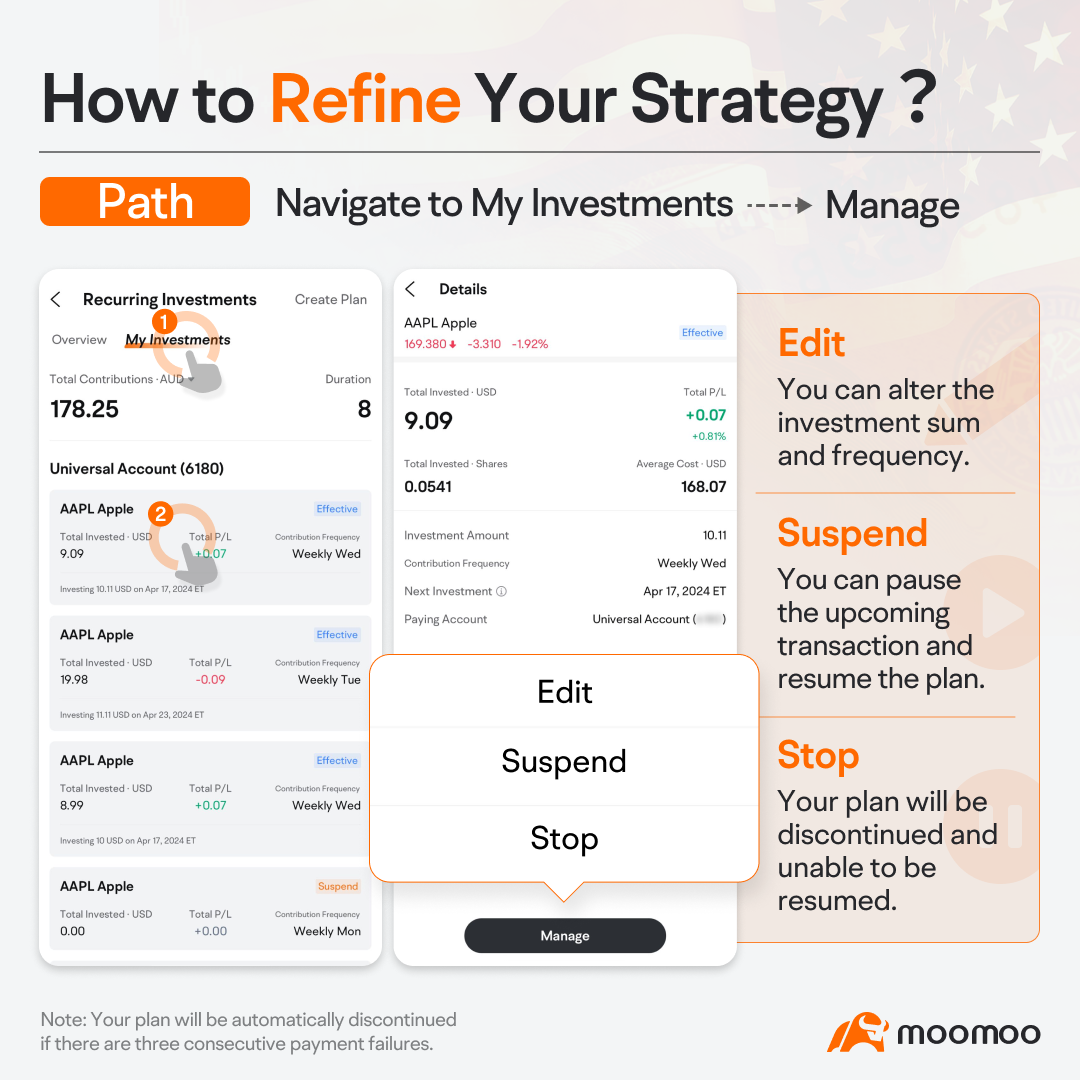
With moomoo, tweaking your recurring investment plan is as easy as pie. You have the flexibility to adjust the investment amount and schedule, suspend the next transaction, or even terminate it altogether.
And please note that your plan will be automatically discontinued if there are three consecutive payment failures.
Recurring investment calculator: help you with your planning!
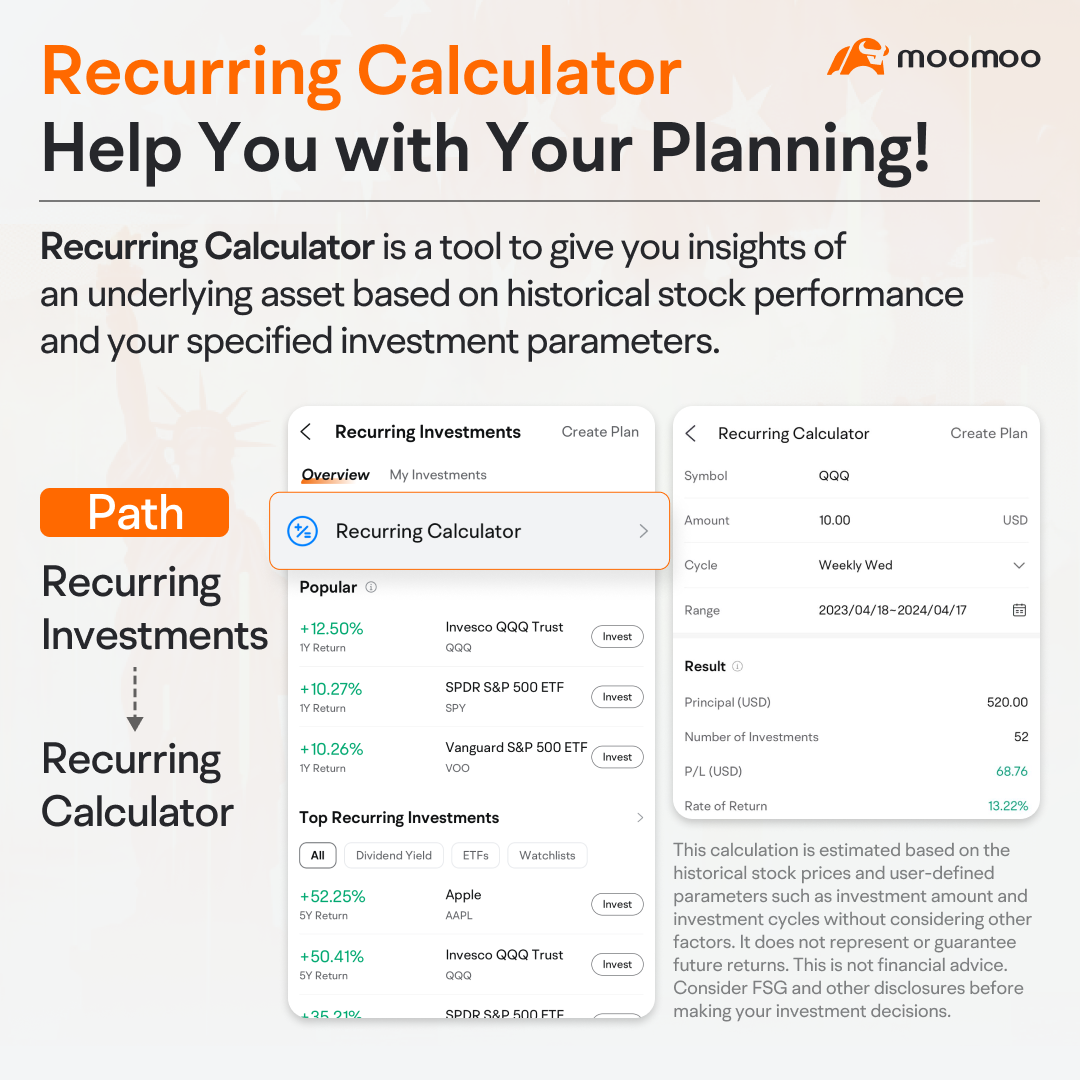
Historical backtesting simulates past performance to validate a recurring investment strategy. It reveals potential returns and risks, including maximum drawdowns during downturns, aiding in adjusting risk tolerance and asset allocation. This data supports decision-making during market volatility.
Moomoo's recurring investment calculator is your ultimate tool for analyzing historical performance. It can give you insights into an underlying asset based on historical stock performance and your specified investment parameters.
You can gain a better understanding of how disciplined, regular investing could potentially build wealth over time, based on historical performance.
However, it's essential to remember that past performance is not indicative of future results, and the tool is best used as a guide rather than a prediction.
What are the benefits and risks of recurring investments?
Just like a coin has two sides, recurring investment isn't perfect either—it comes with its own set of pros and cons.
Let's wrap up what we've discussed:
Benefits:
Dollar-Cost Averaging: By investing a fixed amount at regular intervals, you buy more shares when prices are low and fewer when prices are high, which can lower the average cost per share over time.
Reduced Market Timing Risk: By investing regularly, you mitigate the risk of making poor timing decisions, as you are consistently participating in the market regardless of its conditions.
Consistency and Discipline: Recurring investment encourages discipline, helping you stick to a long-term investment strategy without being swayed by market volatility or emotional decision-making.
Convenience: Once set up, recurring investments require minimal ongoing effort, allowing you to build wealth gradually and systematically.
Compounding Growth: Regular investments can enhance compounding returns, as reinvested earnings generate additional income over time, potentially increasing your wealth exponentially.
Risks:
Market Volatility: While dollar-cost averaging can mitigate some volatility, recurring investments are still subject to market risks, and returns are not guaranteed.
Overlooked Portfolio Management: Recurring investment might lead investors to neglect reviewing and adjusting their portfolios in response to changing financial goals or market conditions.
Inadequate Cash Flow Management: If not carefully planned, the fixed investment amounts could strain your cash flow, especially if unexpected expenses arise.
Final thoughts on recurring investments
Recurring investments can be a powerful tool for building wealth and achieving long-term financial goals. They offer the benefits of dollar-cost averaging, consistency, and compounding growth, making them an attractive option for both novice and experienced investors. By automating contributions, you can maintain discipline and reduce the emotional impact of market fluctuations, helping you to stay the course even during volatile times.
However, it's important to remain engaged with your investment strategy. Regularly reviewing your portfolio, staying informed about market trends, and making adjustments as needed are crucial to ensuring that your investments continue to align with your financial objectives. Additionally, be mindful of fees and ensure that your investment amounts are manageable within your overall financial plan.
In summary, although recurring investments can streamline the investment process and improve long-term outcomes, they should be integrated into a comprehensive financial strategy that considers your risk tolerance, objectives, and the evolving financial environment.
Frequency Asked Questions
What is the best ETF for recurring investment?
Recurring ETF investment depends on several factors, including your financial goals, risk tolerance, investment horizon, and personal interests. However, some ETFs are generally well-regarded for their stability, diversification, and low costs, making them popular choices for long-term investors. For example, ETFs track the performance of the S&P 500 index, representing 500 of the largest U.S. companies.
What are the best stocks for recurring investment?
When you’re doing recurring investments in individual stocks instead of ETFs, there's more homework involved, and the risks are a bit higher. That’s because individual stocks tend to be more volatile compared to broader indices. However, certain characteristics make some stocks generally favored for long-term, recurring investments. These may include established companies with strong financials, a history of stable or growing dividends, and potential for continued growth.
This presentation is for informational and educational use only and is not a recommendation or endorsement of any particular investment or investment strategy. Investment information provided in this content is general in nature, strictly for illustrative purposes, and may not be appropriate for all investors. Read more