What are cryptocurrencies and how do they work?
Cryptocurrency can be confusing for many. Is it just a string of code?
When you search online about how cryptocurrencies work, terms like 'blockchain,' 'consensus mechanism,' and 'hash algorithm' often pop up, which can be overwhelming.
Today, we'll explain cryptocurrency in the simplest terms. While this won't make us technical experts, it will help us understand what we're investing in, rather than just speculating blindly.

First thing first: why invent cryptocurrency?
The currencies we use in our daily lives are called legal tender. People trust these currencies because governments endorse them.
But have you ever wondered if governments are always trustworthy? Today many are printing excessive amounts of money, which some see as a way of depleting society's wealth.
So, is it possible to create a currency system without a central authority, where money isn't endlessly printed and fairness prevails?
That's exactly what Satoshi Nakamoto, the inventor of the first cryptocurrency—bitcoin, thought in 2008.
But how does Bitcoin achieve this?
Let's start with how Bitcoin transactions work and compare them to the bank transfers we're familiar with.
Bank transfers vs. Bitcoin transactions
Let's first look at the similarities, then the differences.
When making a bank transfer, you need:
1. Your account information
2. The recipient's account information
3. A password
For a Bitcoin transaction, you need:
1. Your Bitcoin address
2. The recipient's Bitcoin address
3. A private key
A Bitcoin transaction is similar to a bank transfer but it uses encrypted information for anonymity and security.
(For technical details, see the green box below. Otherwise, you can skip it.)
A Bitcoin address might look like this: 1A1b3CeP5QGeqi2DM
PFfTL6SLmv7EivfNa.
It may look confusing, but as long as it's unique, it works.
A private key might look like this: 1101......0011.
It’s a 256-bit binary number generated by a computer, making it impossible to guess.
Unlike bank accounts and passwords, a Bitcoin address is derived from the private key. This involves elliptic curve multiplication to create a public key, then a hash function to convert it into a Bitcoin address. This one-way process ensures the private key remains secure. This is called asymmetric encryption.
Think of the Bitcoin address like a public bank account, and the private key like a secret password.
PFfTL6SLmv7EivfNa.
It may look confusing, but as long as it's unique, it works.
A private key might look like this: 1101......0011.
It’s a 256-bit binary number generated by a computer, making it impossible to guess.
Unlike bank accounts and passwords, a Bitcoin address is derived from the private key. This involves elliptic curve multiplication to create a public key, then a hash function to convert it into a Bitcoin address. This one-way process ensures the private key remains secure. This is called asymmetric encryption.
Think of the Bitcoin address like a public bank account, and the private key like a secret password.
At first glance, Bitcoin transactions seem similar to bank transfers in terms of user experience. However, the key difference lies in the systems that facilitate these transactions, as shown in the diagram below.
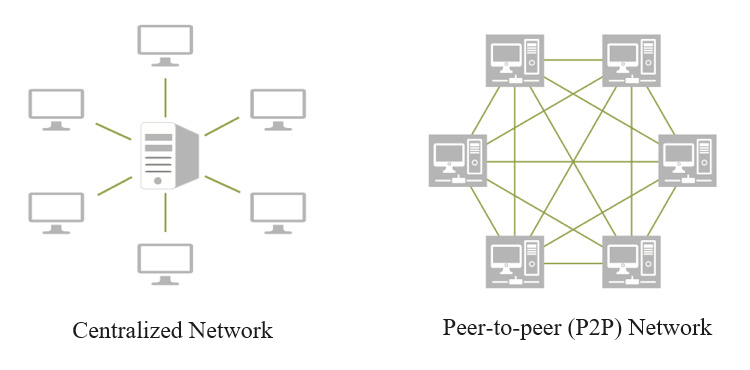
For bank transfers, the bank's centralized system handles the operations. This is known as a centralized network. In contrast, Bitcoin transactions are managed by a peer-to-peer (P2P) network, which is a decentralized network.
Centralized network vs. P2P network
Let's use an example to make this comparison easier. Imagine a classroom where students frequently exchange pencils, but issues often arise, such as someone not receiving a pencil or someone giving away an extra one.
To solve this, the class monitor suggests that before each exchange, students hand their pencils to the monitor, who records the transaction and then passes the pencil to the recipient. This way, the monitor's record book keeps track of all exchanges, resolving any disputes.
This system is like a centralized network, where the monitor acts as the 'central server,' handling all information.
Now, imagine the students start doubting the monitor’s record-keeping. They come up with a new method: whenever someone wants to exchange a pencil, they announce it to the entire class. The exchange is complete only when everyone has recorded it. This way, each student's notebook contains a full record of all transactions. Even if someone loses their notebook, the records are safe, and any tampering would be quickly noticed.
This method resembles a decentralized network. Without a central monitor, each student is a node, collectively maintaining the network’s integrity.
So, the difference is clear: centralized networks rely on a single 'center,' while decentralized networks depend on collective participation. Bitcoin is decentralized because it operates on a network that doesn't rely on banks or any central authority as a 'center'.
On a centralized network, a central server provides services and stores user data. The current internet is a kind of centralized network.
On a decentralized network, network nodes share computing resources and data through specific protocols, each acting like a mini-central server. Bitcoin's peer-to-peer (P2P) network is an example of this.
These nodes, theoretically speaking, can be anyone using a server, mining rig, computer, or even a smartphone.
In a decentralized network, information spreads by each node passing data to a few neighboring nodes. These nodes then relay it to their neighbors, and so on. This process continues until all nodes have received the data, allowing it to spread quickly across the network.
On a decentralized network, network nodes share computing resources and data through specific protocols, each acting like a mini-central server. Bitcoin's peer-to-peer (P2P) network is an example of this.
These nodes, theoretically speaking, can be anyone using a server, mining rig, computer, or even a smartphone.
In a decentralized network, information spreads by each node passing data to a few neighboring nodes. These nodes then relay it to their neighbors, and so on. This process continues until all nodes have received the data, allowing it to spread quickly across the network.
The earlier example helped us understand how the Bitcoin network works, but reality is more complex. How does a P2P network verify Bitcoin transactions and handle thousands of them quickly? This is where blockchain technology comes in.
Quick Explanation of Blockchain
Blockchain is also known as a distributed ledger. Remember how each student had a notebook in the example? Blockchain is like that notebook: every node has an identical copy recording all historical transactions, like a massive, backed-up ledger.
When you send Bitcoin, the transaction is sent to a nearby node for verification. The node checks its ledger to confirm you have enough Bitcoin. If verified, the node broadcasts the transaction across the network.
The transaction isn't complete until it's added to a 'database', which is exactly the so-called blockchain. And the people who participate in validating and processing transactions are called miners.
1. Blocks
A node receives many transactions, which miners bundle into a block. Each block typically contains thousands of transactions.
2. Chain
Once a block is ready, miners broadcast it to the P2P network. Other nodes verify the block against established rules. If verified, the block is linked in chronological order with previous blocks, forming a chain. That's why it's called a 'blockchain.'
When a block is added to the chain, any transactions it contains are confirmed and recognized by all nodes. Future transactions can reference this updated 'ledger.'
A node receives many transactions, which miners bundle into a block. Each block typically contains thousands of transactions.
2. Chain
Once a block is ready, miners broadcast it to the P2P network. Other nodes verify the block against established rules. If verified, the block is linked in chronological order with previous blocks, forming a chain. That's why it's called a 'blockchain.'
When a block is added to the chain, any transactions it contains are confirmed and recognized by all nodes. Future transactions can reference this updated 'ledger.'
Where does Bitcoin come from?
Bitcoin is created through a unique mining mechanism.
As mentioned earlier, miners bundle thousands of transactions into a block. But why do they do this? It's not out of altruism; they are rewarded with Bitcoin. Bitcoin's creator, Satoshi Nakamoto, designed a system where miners compete for the right to record transactions. The only winner gets to add a new block to the blockchain and receives a certain amount of Bitcoin as a reward—this is the only way new Bitcoins are issued.
This ingenious mining design incentivizes nodes to voluntarily record and verify transactions, preventing fraud and double spending.
Mining, technically called the Proof-of-Work (PoW) mechanism, works like this:
Each transaction is broadcast to many nodes, but only one node gets to add it to a new block. Nodes (miners) compete by solving a mathematical puzzle (cryptographic hash function). The first to solve it earns the right to add the block and gets rewarded with Bitcoin. This process is called mining.
Mining requires significant computational power as miners try different numbers until finding a valid hash. It’s like searching for a specific grain of sand in a vast digital ocean, consuming a lot of electricity and using expensive, specialized computers (mining rigs).
However, Bitcoin rewards halve every four years, reducing miners' returns.
Each transaction is broadcast to many nodes, but only one node gets to add it to a new block. Nodes (miners) compete by solving a mathematical puzzle (cryptographic hash function). The first to solve it earns the right to add the block and gets rewarded with Bitcoin. This process is called mining.
Mining requires significant computational power as miners try different numbers until finding a valid hash. It’s like searching for a specific grain of sand in a vast digital ocean, consuming a lot of electricity and using expensive, specialized computers (mining rigs).
However, Bitcoin rewards halve every four years, reducing miners' returns.
Summary
Bitcoin operates on blockchain technology, with mining controlling its supply. It runs independently of governments and banks, relying on a public system—truly ingenious!
Bitcoin gained credibility to become a currency because of its anonymity, security, decentralization, and transparency—attracted tech enthusiasts and later, the general public.
Additionally, Bitcoin’s supply is capped at 21 million, with decreasing issuance rates, ensuring scarcity and inflation resistance.
Let's recap the most important terms about cryptos and blockchain you might encounter.
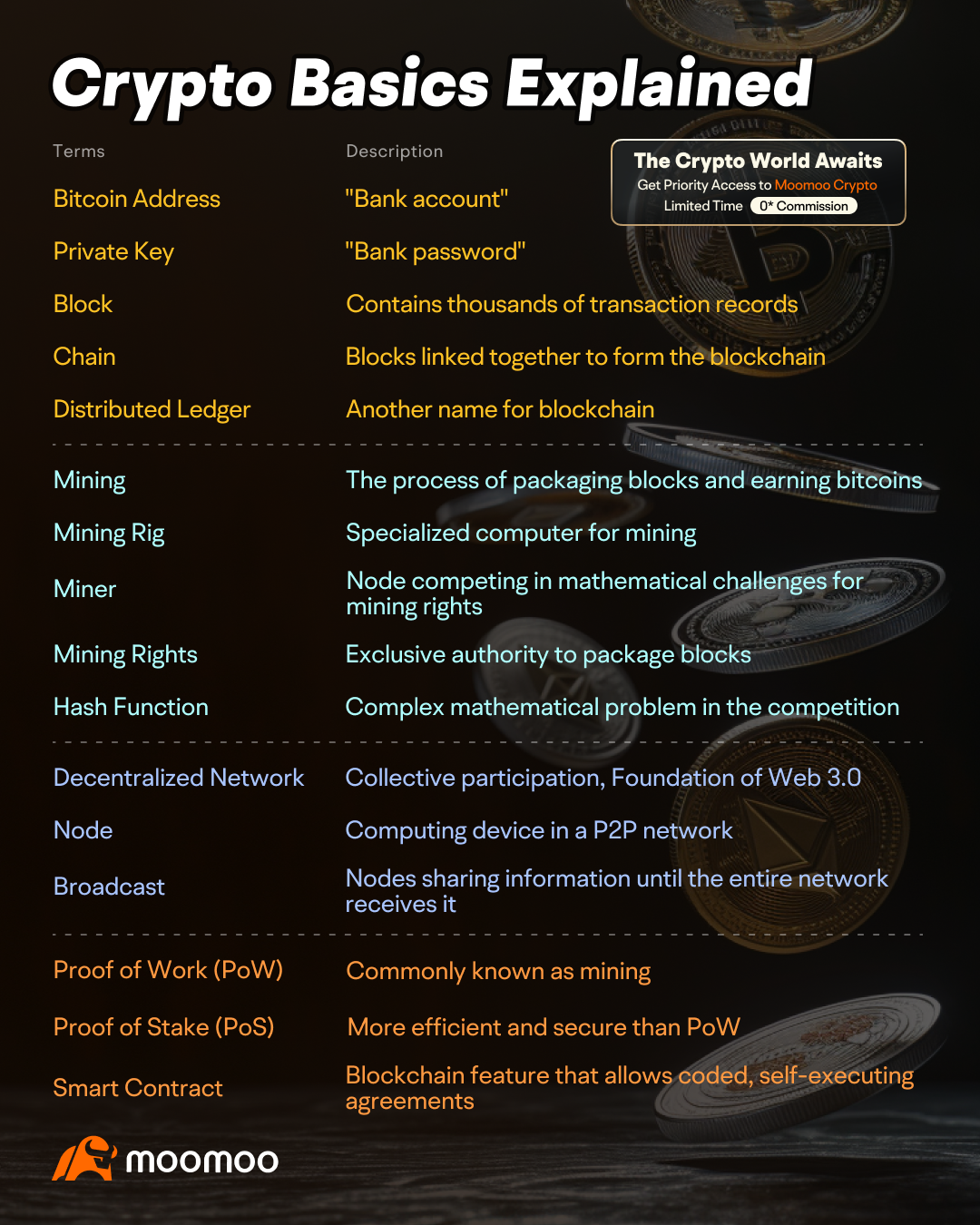
As crypto investors, understanding the basics of Bitcoin is enough, since many other cryptocurrencies are just variations or improvements.
If you're interested in how the field evolves, keep reading to learn about Ethereum. And if you have any questions, leave them in the Comments!
More on crypto: Ethereum
Ethereum, launched in 2015, overcomes the technical limitations of Bitcoin as a second-generation blockchain.
Here's an example of Ethereum's innovation: Suppose Jimmy borrows $10,000 from Michael by pledging 1 Bitcoin. When Jimmy repays the $10,000, Michael should return the Bitcoin. But what if Michael refuses?
Ethereum solves this with Smart Contracts—self-executing agreements on the blockchain. Jimmy can pledge 100 Ether into a smart contract, which then lends him $10,000 worth of USDT (a dollar-pegged token). When Jimmy returns the 10,000 USDT, the contract automatically releases the 100 Ether back to him.
This is why Ethereum is often called the 'world computer.' It enables people to freely write code and use smart contracts to control the flow of value, fostering the growth of decentralized applications (DApps).
Ethereum is one step ahead of Bitcoin as it introduced smart contracts. These allow agreements to be coded directly onto the blockchain and automatically execute when certain conditions are met.
Ether is Ethereum's native currency, used to support the execution of smart contracts and pay transaction fees. Unlike Bitcoin, which is mainly used for transactions, Ether has specific functional uses.
Ether is issued by a proof-of-stake (PoS) mechanism rather than Bitcoin's proof-of-work (PoW) mechanism. PoS is more efficient, significantly reducing mining energy consumption and increasing network security.
Ether is Ethereum's native currency, used to support the execution of smart contracts and pay transaction fees. Unlike Bitcoin, which is mainly used for transactions, Ether has specific functional uses.
Ether is issued by a proof-of-stake (PoS) mechanism rather than Bitcoin's proof-of-work (PoW) mechanism. PoS is more efficient, significantly reducing mining energy consumption and increasing network security.
This presentation is for informational and educational use only and is not a recommendation or endorsement of any particular investment or investment strategy. Investment information provided in this content is general in nature, strictly for illustrative purposes, and may not be appropriate for all investors. Read more