


Moomoo Insights
Jul 16 15:38
TSMC Earnings: AI Demand Is Stronger Than the Chip Selloff Suggests
Moomoo Insights
Sep 30 05:04
Live Take | Anthropic’s $518B Compute Bet: Who Wins From the AI Buildout?
「Possessing the sufficient cash」+「 Sell Put Option」
Note: The cash in account should be sufficient to potentially buy the equivalent amount of the underlying stock.
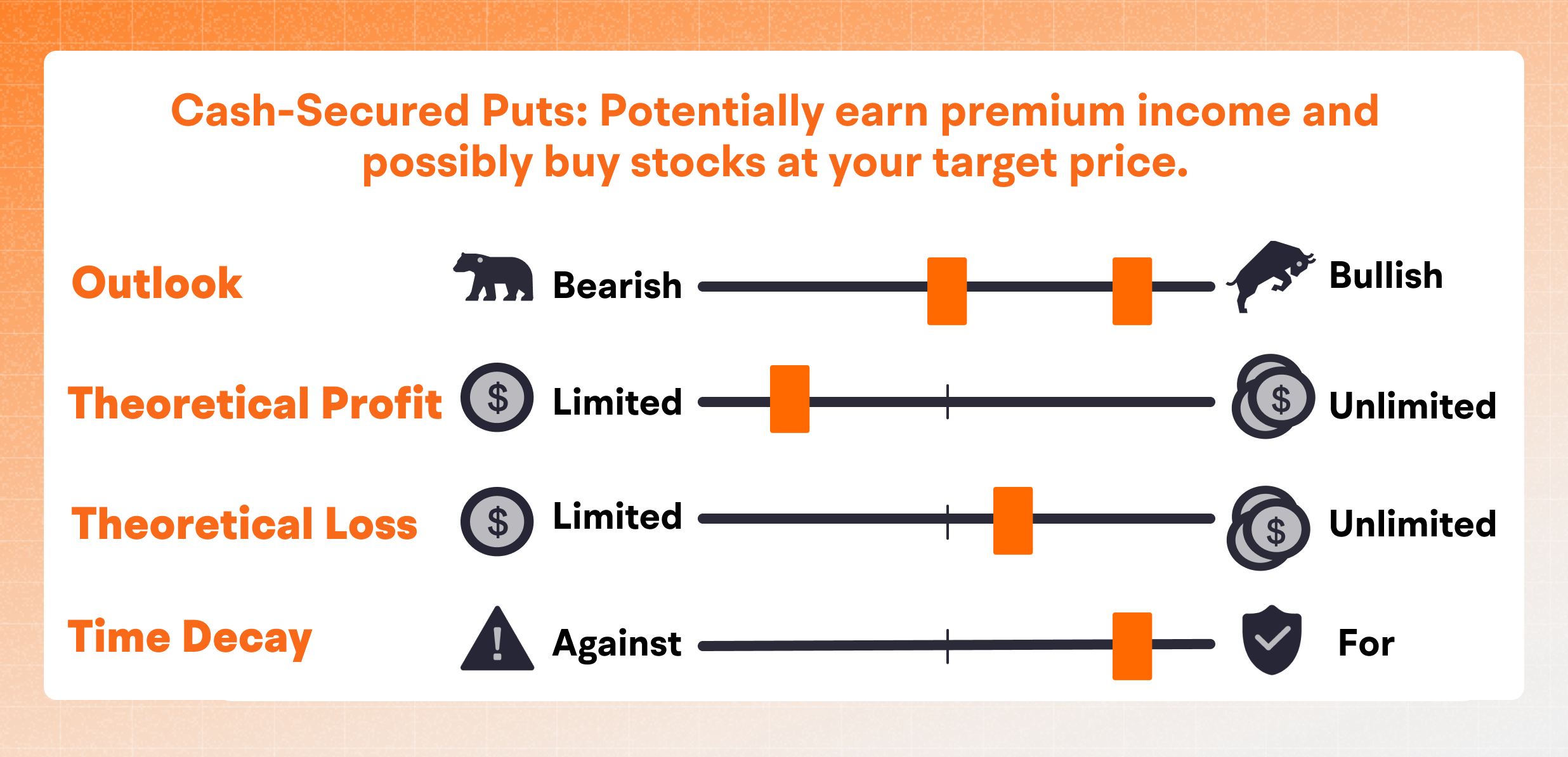
The potential benefit from a cash-secured put theoretically comes from two sources: the premium earned from selling the put option, and the opportunity to buy the stock at a lower price if the option is assigned.
Favorable Conditions: Low to medium volatility, neutral or bullish sentiment on the stock. If you are optimistic about the long-term prospects but expect a short-term pullback in stock prices, you can consider using this strategy to potentially buy stocks at a lower price if you are assigned.
Capped Profit: A cash-secured put has a profit limit. If the stock price exceeds the strike price on the expiration date, you keep the entire premium for maximum profit.
Limited Loss: If the stock price falls to zero and the put option is exercised, you'll use the secured cash to buy worthless stocks, resulting in a maximum loss.
Notes: Although the theoretical loss is limited, it could still be significant if the stock drops precipitously.
Time Decay: As an option seller, time usually works in your favor.
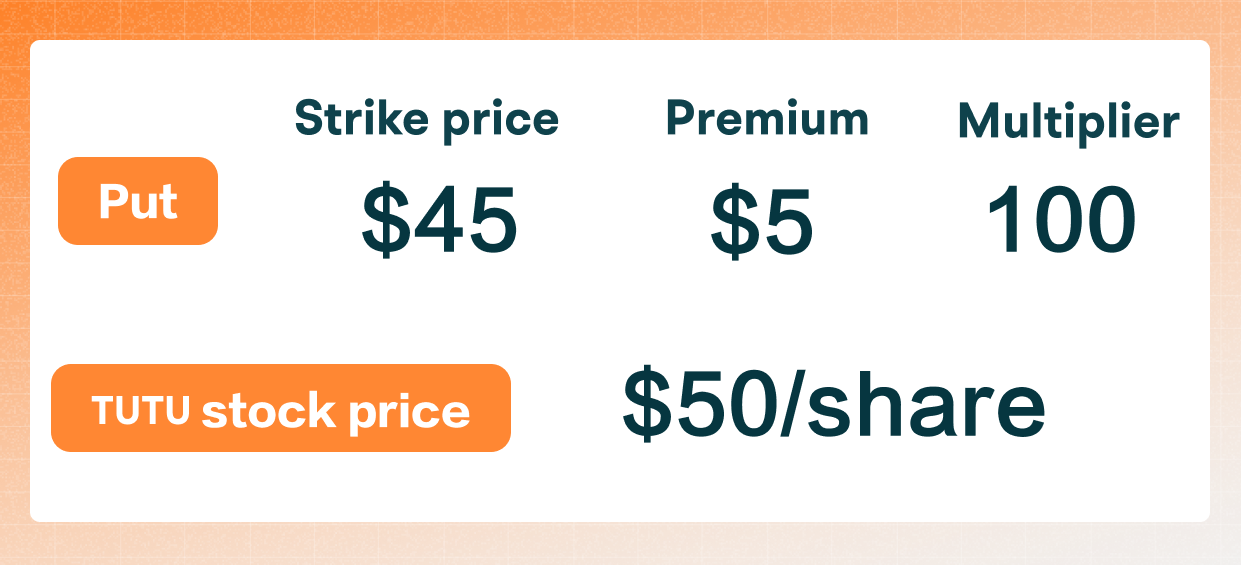
TUTU is a stable, publicly traded company with strong long-term prospects. However, you expect its stock price to fluctuate sideways in the short term due to a lack of positive news.
To try to capitalize on time value and potentially buy TUTU stock at a lower price, you set up a cash-secured put strategy. With TUTU's stock at $50, you sold a put option with a $45 strike price. To cover potential losses if the option is exercised, you must hold $4,500 ($45 * 100 option multiplier) in cash as collateral.
Premium or Potential Income from opening the position:
Put option premium: $500 ($5 per share).
You must maintain $4,500 in cash as collateral, not as a cost but to cover potential purchase of the underlying stock if the option is exercised.
Note: Insufficient cash in the account could lead to a margin call if unexpected events, like significant drops in the asset price, occur.
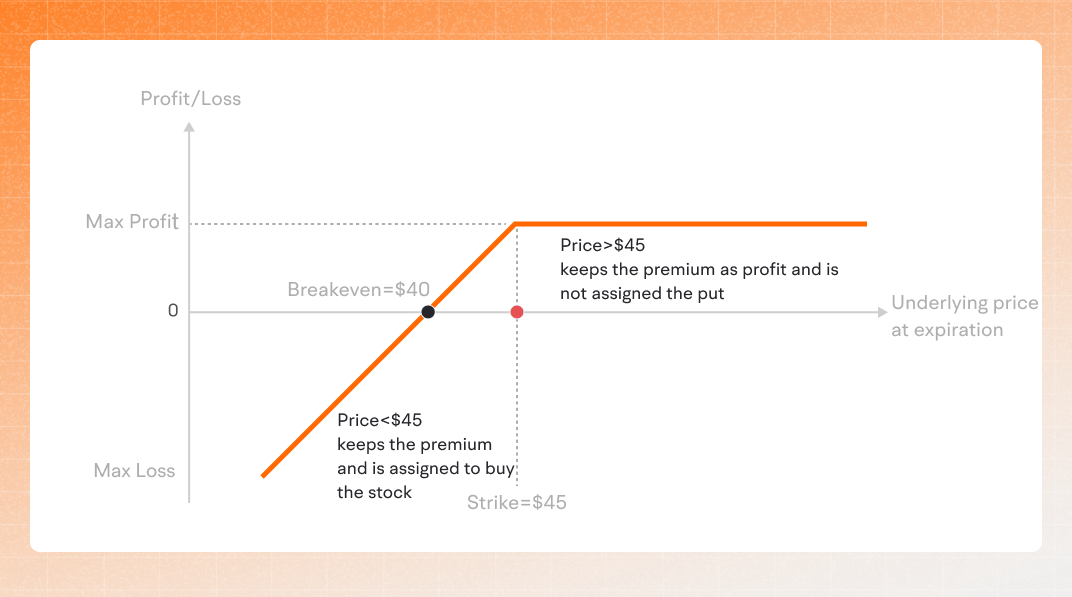
In this case, the option is out-of-the-money, and the buyer is unlikely to exercise it.
Since the option is not exercised, you are not required to purchase TUTU stock, and you earn the entire option premium as profit. Even if the stock's value hasn't increased significantly, you still earn a return from the option premium.
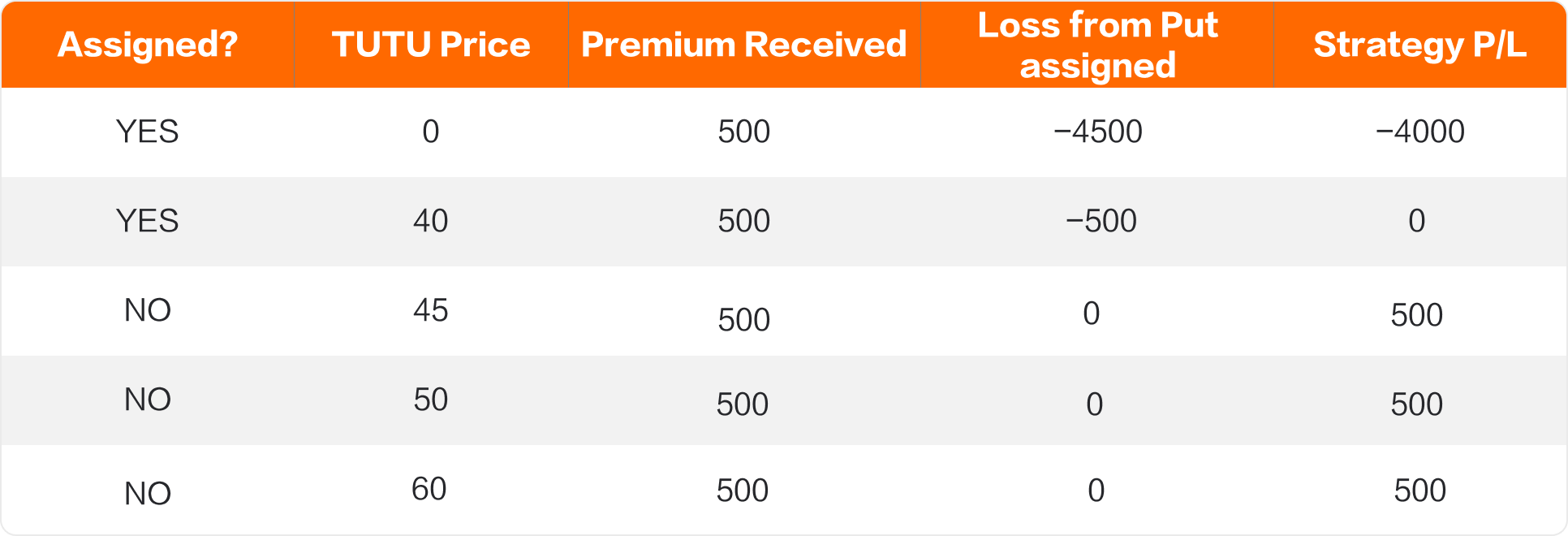
Maximum Profit: Net Premium per Share * Multiplier * Contract Quantity=$500
In this case, the option is in-the-money at expiration, and you're likely to be assigned to buy the stock.
You will need to use the $4,500 held as collateral to purchase 100 shares of TUTU at $45 each, in addition to collecting the option premium.
If the stock price continues to decline, you may end up buying the stock at a higher price than its market value, resulting in a potential loss. If this loss is too significant to be offset by the premium collected, you incur an overall paper loss upon assignment of the underlying shares.
Breakeven: $45 - $5= $40
If TUTU's stock price falls below $40, the strategy incurs a loss. The maximum theoretical loss occurs if the stock price drops to $0, totaling $4,000.
Given your long-term bullish outlook on TUTU, you may choose to hold the stock. Purchasing at $45 through option assignment might still be acceptable, even if it shows as a paper loss, as it aligns with your target purchase price.
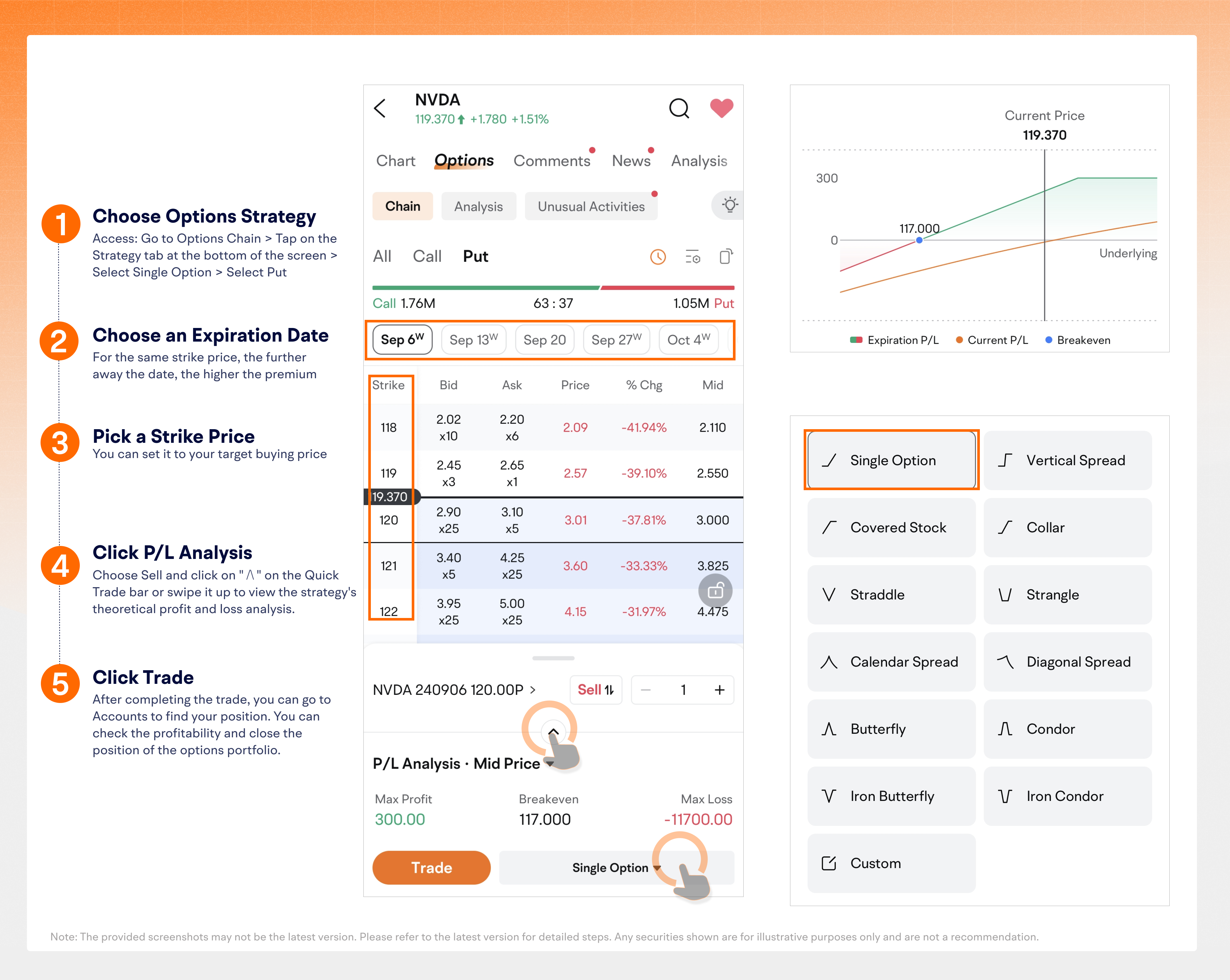
If you have sufficient cash to secure the potential purchase of the underlying shares, you can go to Options Chain > Tap on the Strategy tab at the bottom of the screen > Select Single Option.
By selling a put option with cash collateral, you can construct a cash-secured put strategy.
In the cash-secured put strategy, "selling the put" is the primary position, while holding the cash serves as collateral for the potential option assignment. Option investors typically use cash-secured puts for three main purposes:
Purpose: Long-term bullish on the underlying stock, believing it will not fall, and receiving option premiums by selling puts.
Analysis: Selling puts while holding cash, to keep the option premium as profit if the stock does not fall below the strike price at expiration.
In this scenario puts chosen are generally near-term deep out-of-the-money (OTM):
● Near-term: You hope the put option will expire worthless. The time value of near-term options decays more rapidly.
● Deep OTM: These are less likely to be exercised. However, the deeper the OTM, the lower the premium earned.
If you believe the stock price will move sideways or increase slightly, you can sell near-term slightly in-the-money (ITM) or at-the-money (ATM) puts. However, this increases the probability of assignment.
Purpose: To open a position in a stock but believe the current price is too high, preferring to buy the stock at a lower price if it pulls back.
Analysis:
● If the stock price is below the strike price at expiration, you will likely be assigned the shares of the stock, you open the position at your target price and earn additional option premiums. However, if the decline in stock price is more than the premium received for the sold put option you will be purchasing the shares at (paper) loss.
● If the strike price is not reached, you still keep the option premium received.
Purpose: To open a position in a stock at a certain time without the urgency to buy immediately. By repeatedly selling puts to potentially earn option premiums, you can effectively reduce the cost basis of the stock.
Analysis:
● While setting a limit order can help you buy the stock, selling puts allows you the possibility to earn additional income from the option premium. However, there is no assurance that you will be assigned and assume a stock position in the underlying. If the stock price climbs, you could miss out on potential gains.
● Even if the stock price rises and you didn't achieve your goal of entering the position, collecting the entire option premium means capturing part of the investment return.
 Q: Do I need to have sufficient cash in my account cash before constructing a cash-secured put strategy? (What's the difference between a cash-secured put and a short put?)
A: Yes, you need to have sufficient cash before constructing a cash-secured put strategy. A cash-secured put is essentially a "short put with cash collateral" strategy. You can only sell puts and collect premiums without using margin if your account holds enough cash to cover the potential obligation.
Option sellers face significant risks, so it’s crucial to maintain enough purchasing power in your account. The safest approach is to hold sufficient cash to avoid being forced to close positions, which could lead to significant losses.
For example, in U.S. stocks, one option contract typically represents 100 shares of the underlying stock. Therefore, if you have $5,000 in cash and want to employ the cash-secured put strategy, you should sell a put with a strike price not exceeding $50 to form a cash-secured put strategy (this does not account for commissions or fees).
Q: Which stocks should I choose for a cash-secured put strategy?
A: Since selling a put obligates you to buy the stock if its price falls to the strike price, it's important to choose stocks wisely. If the stock price falls further, holding the position may lead to additional losses.
If you only want to earn option premiums, you should consider choosing relatively stable stocks that you are optimistic about in the long term. If you want to buy stocks at a lower price, you can consider stocks that you are optimistic about in the long term but have experienced a slight decline in the short term.
Q: If the underlying stock plummets and the sold put shows a significant unrealized loss, what can I do?
A: You have several options:
Do nothing and potentially be assigned the stock:
This means you buy the stock at the strike price, which will likely be higher than the market price. You can then decide whether to hold the stock or sell it.
Close the position early by buying back the put:
If you don't want the risk of being assigned the stock, you can buy back the same put option before expiration. While this may result in a loss due to the price difference, it removes your obligation to buy the stock.
Roll the position:
This advanced strategy involves closing the current option (realizing any gains or losses) and opening a new one. You can use a one-click feature to select a new strike price or expiration date, managing your position without buying the stock.
Wheel strategy:
When using the cash-secured put strategy and the put option is exercised, you use the secured cash to buy the stock. At this point, you can choose to hold the stock and sell a call option, forming a covered call strategy.
Additionally, if the covered call is exercised and the stock is sold, you receive cash. You can then decide to sell a put to construct a cash-secured put strategy again if you have sufficient cash in the account.
If the options sold are not exercised, you keep the option premiums. If the options sold are exercised, you can once again transform the cash-secured put strategy into a covered call strategy, or convert a covered call strategy back into a cash-secured put strategy. This cycle of operations is why it is called the "wheel strategy."
Although you may incur losses each time an option is exercised, selecting stocks that have exibited clear resistance levels may allow you to earn premiums more consistently by selling options that are not exercised.
Note: Strategies such as the wheel strategy are more complex and require both knowledge and careful attention to manage effectively. They are not suitable for all traders. Please consider your experience level and your goals and objectives when making investment decisions.
This presentation is for informational and educational use only and is not a recommendation or endorsement of any particular investment or investment strategy. Investment information provided in this content is general in nature, strictly for illustrative purposes, and may not be appropriate for all investors. Read more
Recommend
How Short Put Works: Earning Premiums with Options
How the Options Market Can Signal When Earnings Events Are Too Risky to Trade
Options Earnings Series 1: What's Behind the Rise and Fall of Stock Prices After Earnings?

Options Earnings Series 2: Option Buying and Selling Strategies for Earnings
Options Earnings Series 3: Exploring Common Two-Legged Option Strategies for Earnings Season
Never Be Surprised Again: Understand the Eight Common Market Reactions to Earnings
Why Stocks Drop After Beating Earnings: 6 Key Reasons Behind the Post-Earnings Slump
Earnings unlocked: how options might enhance your trading approach
What should options buyers do if they no longer want to exercise their options?
Why did options buyers' exercise request fail?
A Closer Look at 0DTE Options: Short-Term Trading Explained
Approaching Post-Earnings IV Crush With Options
How to Hedge a Market Downturn with Options:Here's what you need to know
A Guide to the Long Put Strategy: Basics You Need to Know
Understanding Witching Days: What Investors and Traders Need to Know
Understanding Implied Volatility in Options Trading
Discovering Protective Puts: A Beginner's Guide
Why Investors May Consider Cash-Secured Puts in a Downturn
Why Pre-Earnings Volatility Attracts Option Traders
The Wheel Strategy: An Income Generating Options Strategy
What's next for a Short Put?
Long Call Options Strategy: Definition, Potential Benefits, and Risks
Short Put Options Strategy in Options Trading
How to set up a Short Put on moomoo?
What's next for a Long Put?
What is a Short Put?
Who are involved in the option exercise process?
Essential rules to understand about exercising options
When should options buyers exercise?
How can options sellers manage risk?
How does options buyers exercise their option?
What is XSP®
Closing vs. Exercising Options: What's the difference?
What's next for a Short Call?
How to set up a Short Call on moomoo
What is a Short Call?
What's next for a Long Call?
Understanding the Benefits of Index Options
XSP® vs SPY®
XSP® Use Cases
How to set up a Long Call on moomoo?
What is SPX®
Dispelling the Myths of Trading Index Options
What is a Long Call?
Short Put Butterfly
What Are Index Options and How Do They Work
Long Diagonal Bull Call Spread
Short Diagonal Bull Put Spread
Long Diagonal Bear Put Spread
Short Diagonal Bear Call Spread
Long Call Butterfly
Short Iron Butterfly
Short Call Butterfly
Long Put Butterfly
Bear Call Spread
Short Iron Condor
Covered Put
Short Put Condor
Bull Put Spread
Bull Call Spread
Long Collar
Short Strangle
Long Strangle
Long Iron Butterfly
Protective Put
Long Iron Condor
Long Put
Short Straddle
Short Call
Cash-Secured Put
Short Put
Long call
Index Options: An Introduction for Traders
Protective Call
Long Call Condor
Short Call Condor
Long Straddle
Long Put Condor
Short Collar
Bear Put Spread
Covered Call
How Short Put Works: Earning Premiums with Options
How the Options Market Can Signal When Earnings Events Are Too Risky to Trade
Options Earnings Series 1: What's Behind the Rise and Fall of Stock Prices After Earnings?
Options Earnings Series 2: Option Buying and Selling Strategies for Earnings
Options Earnings Series 3: Exploring Common Two-Legged Option Strategies for Earnings Season
Never Be Surprised Again: Understand the Eight Common Market Reactions to Earnings
Why Stocks Drop After Beating Earnings: 6 Key Reasons Behind the Post-Earnings Slump
Earnings unlocked: how options might enhance your trading approach
What should options buyers do if they no longer want to exercise their options?
Why did options buyers' exercise request fail?
A Closer Look at 0DTE Options: Short-Term Trading Explained
Approaching Post-Earnings IV Crush With Options
How to Hedge a Market Downturn with Options:Here's what you need to know
A Guide to the Long Put Strategy: Basics You Need to Know
Understanding Witching Days: What Investors and Traders Need to Know
Understanding Implied Volatility in Options Trading
Discovering Protective Puts: A Beginner's Guide
Why Investors May Consider Cash-Secured Puts in a Downturn
Why Pre-Earnings Volatility Attracts Option Traders
The Wheel Strategy: An Income Generating Options Strategy
What's next for a Short Put?
Long Call Options Strategy: Definition, Potential Benefits, and Risks
Short Put Options Strategy in Options Trading
How to set up a Short Put on moomoo?
What's next for a Long Put?
What is a Short Put?
Who are involved in the option exercise process?
Essential rules to understand about exercising options
When should options buyers exercise?
How can options sellers manage risk?
How does options buyers exercise their option?
What is XSP®
Closing vs. Exercising Options: What's the difference?
What's next for a Short Call?
How to set up a Short Call on moomoo
What is a Short Call?
What's next for a Long Call?
Understanding the Benefits of Index Options
XSP® vs SPY®
XSP® Use Cases
How to set up a Long Call on moomoo?
What is SPX®
Dispelling the Myths of Trading Index Options
What is a Long Call?
Short Put Butterfly
What Are Index Options and How Do They Work
Long Diagonal Bull Call Spread
Short Diagonal Bull Put Spread
Long Diagonal Bear Put Spread
Short Diagonal Bear Call Spread
Long Call Butterfly
Short Iron Butterfly
Short Call Butterfly
Long Put Butterfly
Bear Call Spread
Short Iron Condor
Covered Put
Short Put Condor
Bull Put Spread
Bull Call Spread
Long Collar
Short Strangle
Long Strangle
Long Iron Butterfly
Protective Put
Long Iron Condor
Long Put
Short Straddle
Short Call
Cash-Secured Put
Short Put
Long call
Index Options: An Introduction for Traders
Protective Call
Long Call Condor
Short Call Condor
Long Straddle
Long Put Condor
Short Collar
Bear Put Spread
Covered Call

