

Moomoo Insights
Jul 16 15:38
TSMC Earnings: AI Demand Is Stronger Than the Chip Selloff Suggests
Moomoo Insights
Sep 30 05:04
Live Take | Anthropic’s $518B Compute Bet: Who Wins From the AI Buildout?
What is bear call spread?
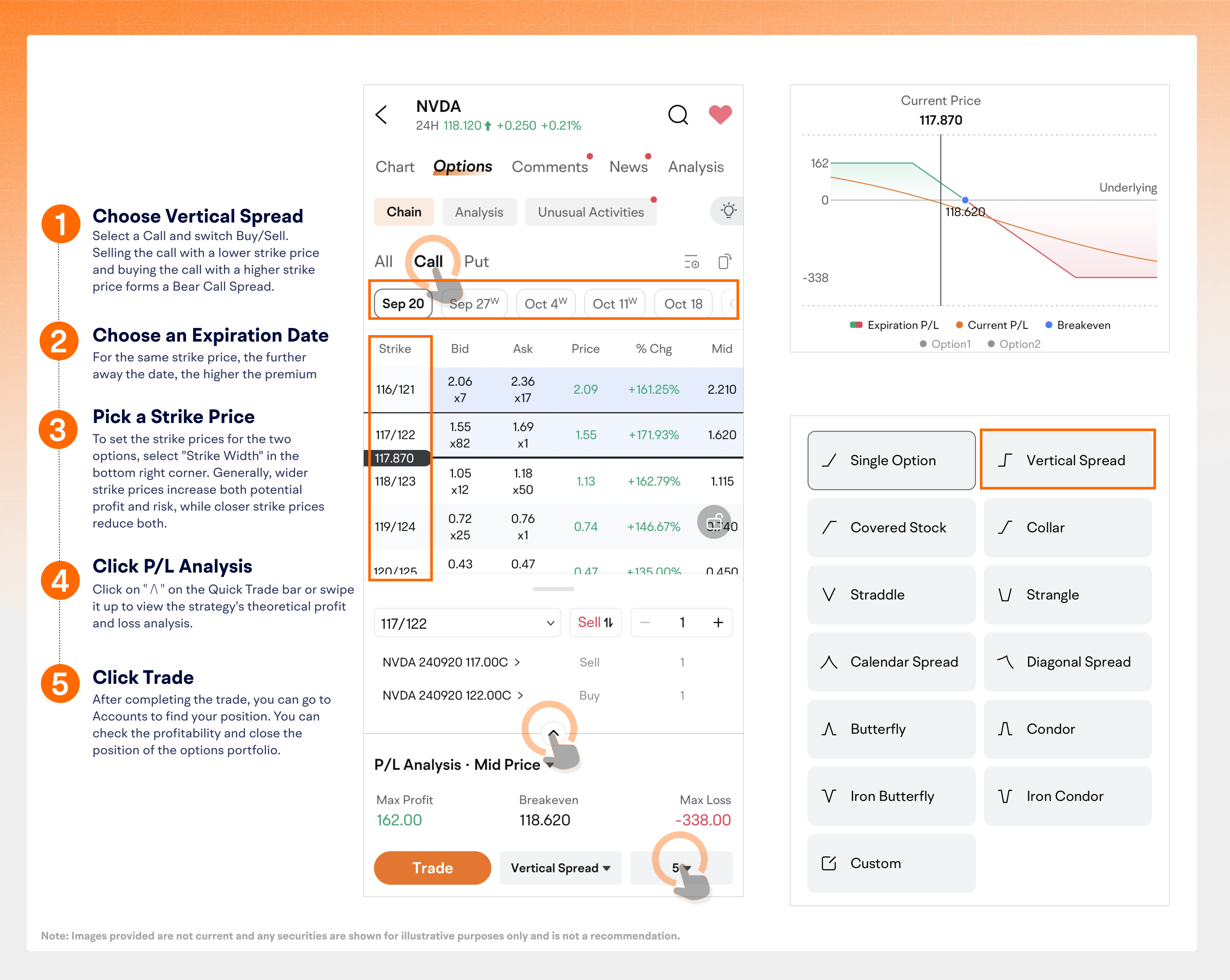
This strategy can be broken down into three parts: bear, call, and spread.
Bear: This indicates a belief that the price of the underlying asset will fall.
Call: This refers to the type of options used in the strategy.
Spread: This involves buying and selling multiple options of the same type (in this case, calls) on the same underlying asset, typically with different strike prices or expiration dates.
Practical Scenarios
● Expect the stock price to drop but not by much.
● Already sold a call option but would like to reduce the risk by buying another out-of-the-money call.
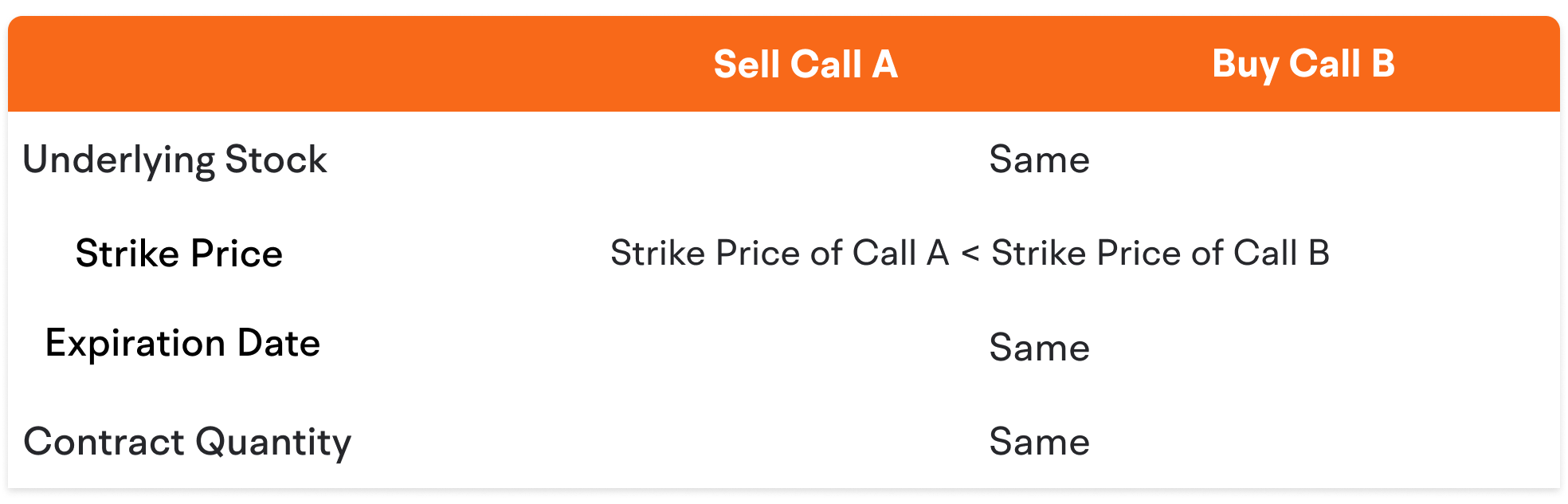
「 Sell Call A」 +「
 Buy Call B」
Strike Price of Call A < Strike Price of Call B
Note: We label the options with uppercase letters for clarity. The strike price of Call A is lower than that of Call B.
The potential profit:
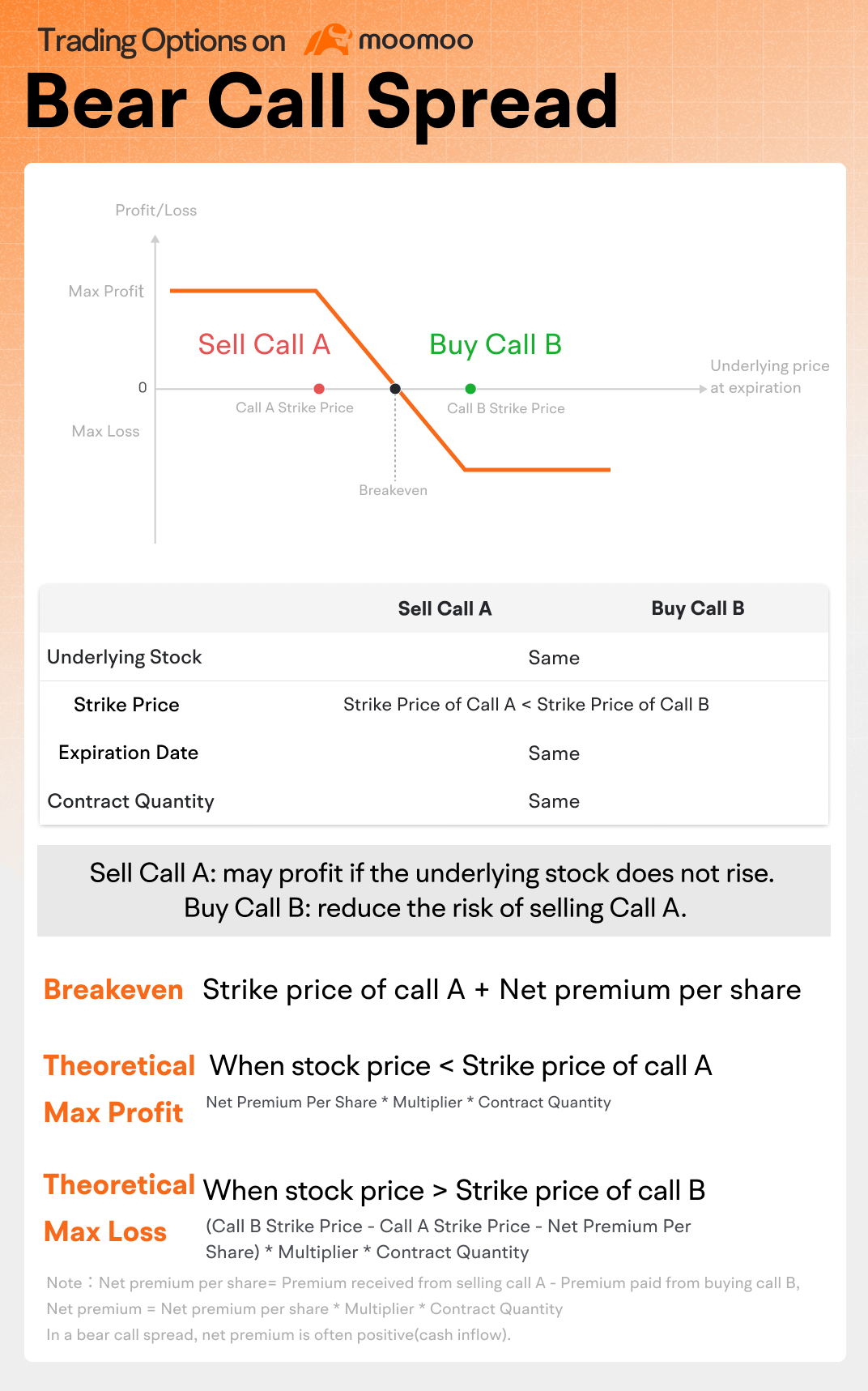
Sell Call A: may profit if the underlying stock does not rise.
Buy Call B: This reduces the risk of selling Call A.
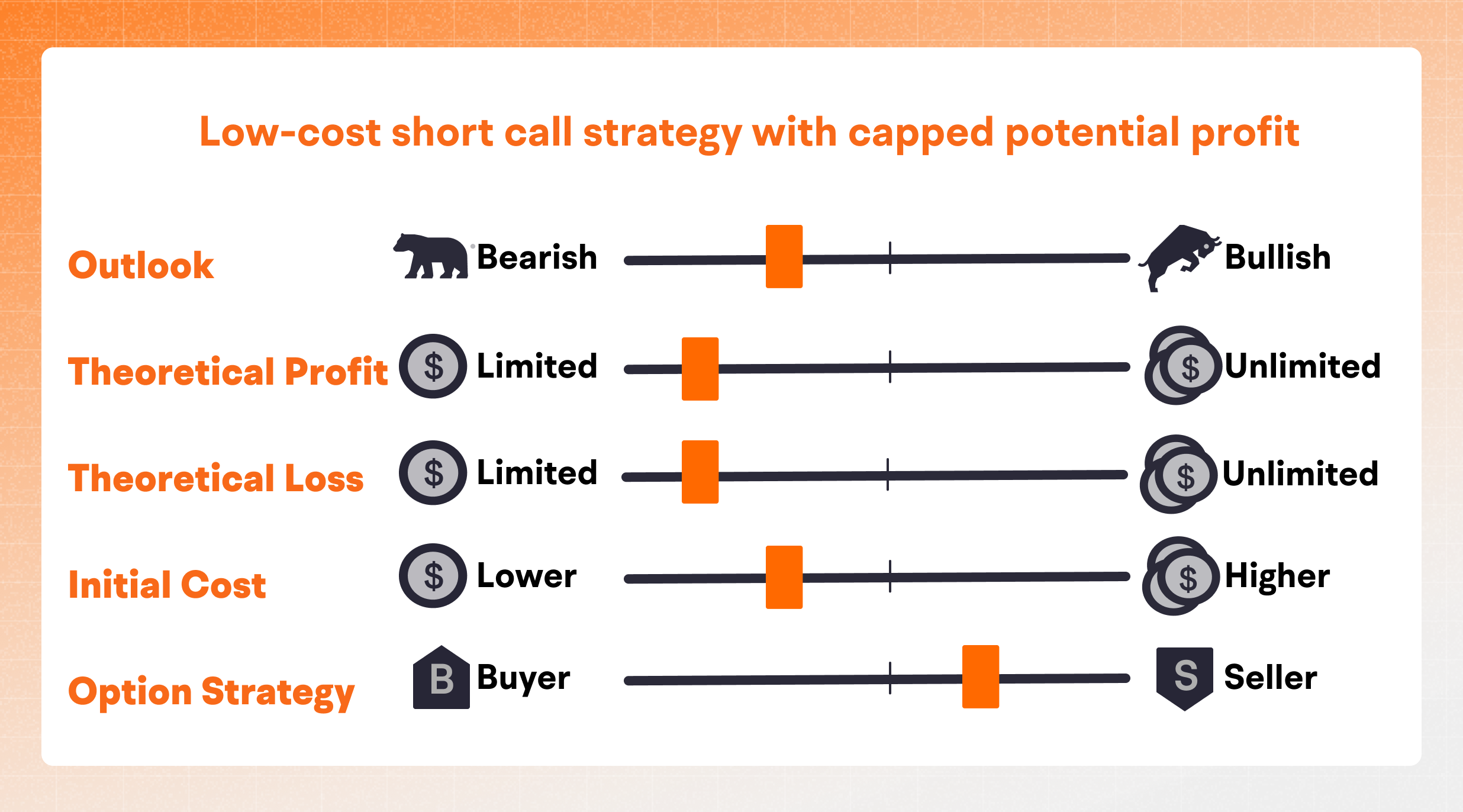
Favorable conditions: Best suited for a mildly bearish outlook where the underlying stock price is expected to stay flat or fall slightly.
Limited Profit: If the stock price falls as expected, selling call A with the lower strike price limits the potential profit.
Theoretical Maximum Profit = Net Premium Per Share * Multiplier * Contract Quantity
Limited Loss: Owning Call B (the purchased call with a higher strike price) may limit your loss.
Theoretical Maximum Loss = (Call B Strike Price - Call A Strike Price - Net Premium Per Share) * Multiplier * Contract Quantity
Note: While the maximum loss is theoretically limited by the bear call spread structure, investors should be aware that assignment risk, early exercise, or volatile price movements can result in losses greater than the theoretical maximum if the position is altered or closed before expiration. Early assignment could result in the need to buy shares at a higher price, potentially exceeding the premium received from selling Call A. Ensure you understand the assignment and margin requirements of your account before implementing this strategy.
Option Selling Strategy: The primary trading position in this strategy is the short call A, which potentially generates profits if the stock falls as expected.
This is a capped-profit bearish option strategy with a limited risk. Ideally, it should be considered when implied volatility is high and may benefit even if the stock price is sideways or oscillating.
Lower Initial Cost: The premium for call A, closer to the stock price, is higher than for call B. So, starting this strategy means you'll receive money upfront due to the net premium inflow.
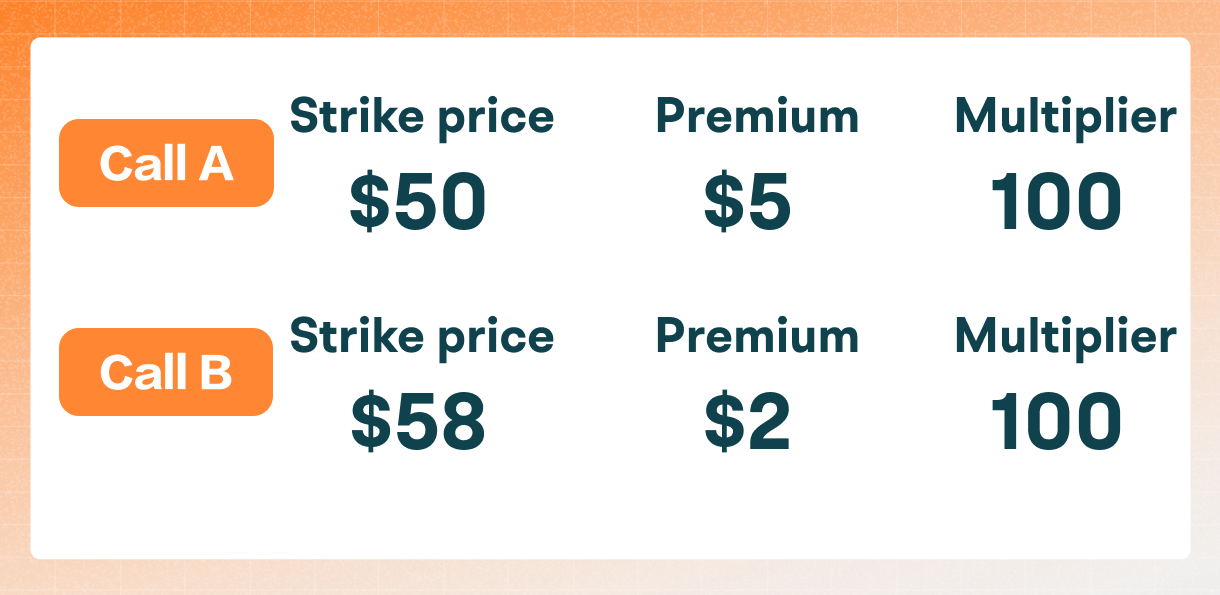
TUTU (a hypothetical stock) is a publicly traded company. After doing some fundamental analysis, you think TUTU's stock is overpriced and won't go above $50 in the near future—in fact, it might even drop. So, you decide to sell a call option with a $50 strike price (Call A).
Because selling naked options carries high risk, you buy a call option with a $58 strike price (Call B) to lower that risk.
If the stock price is below $50 at expiration, you earn the premium from selling Call A.
If the stock price rises, Call B may help protect against some of the potential losses.
Profit from opening the position:
Premium received from call A: $500 ($5 per share).
Premium paid from call B: -$200 (-$2 per share).
Net premium in total: $500 -$200=$300 ($3 per share).
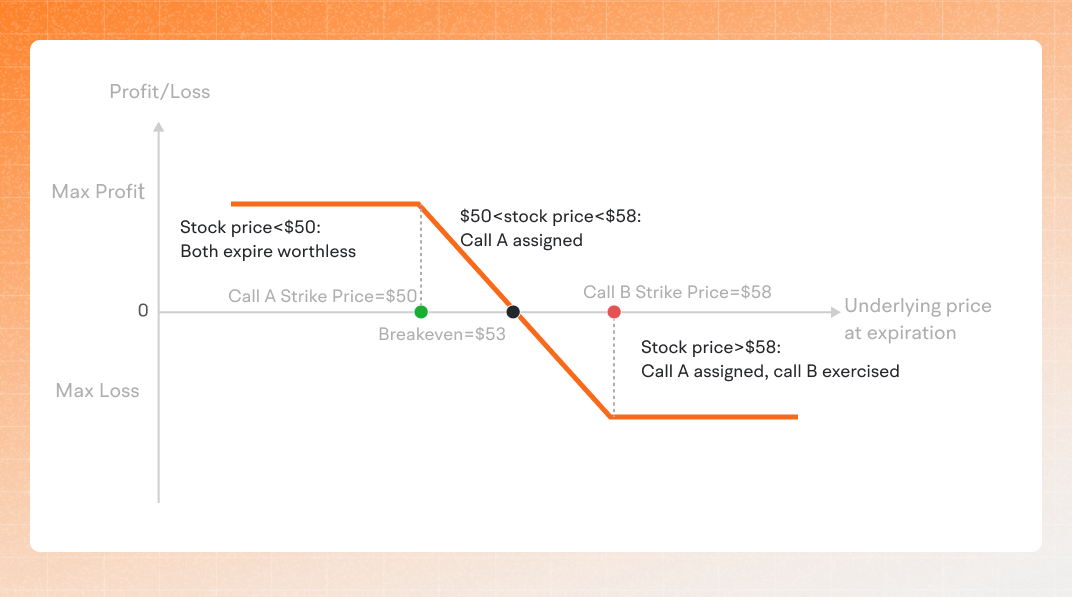
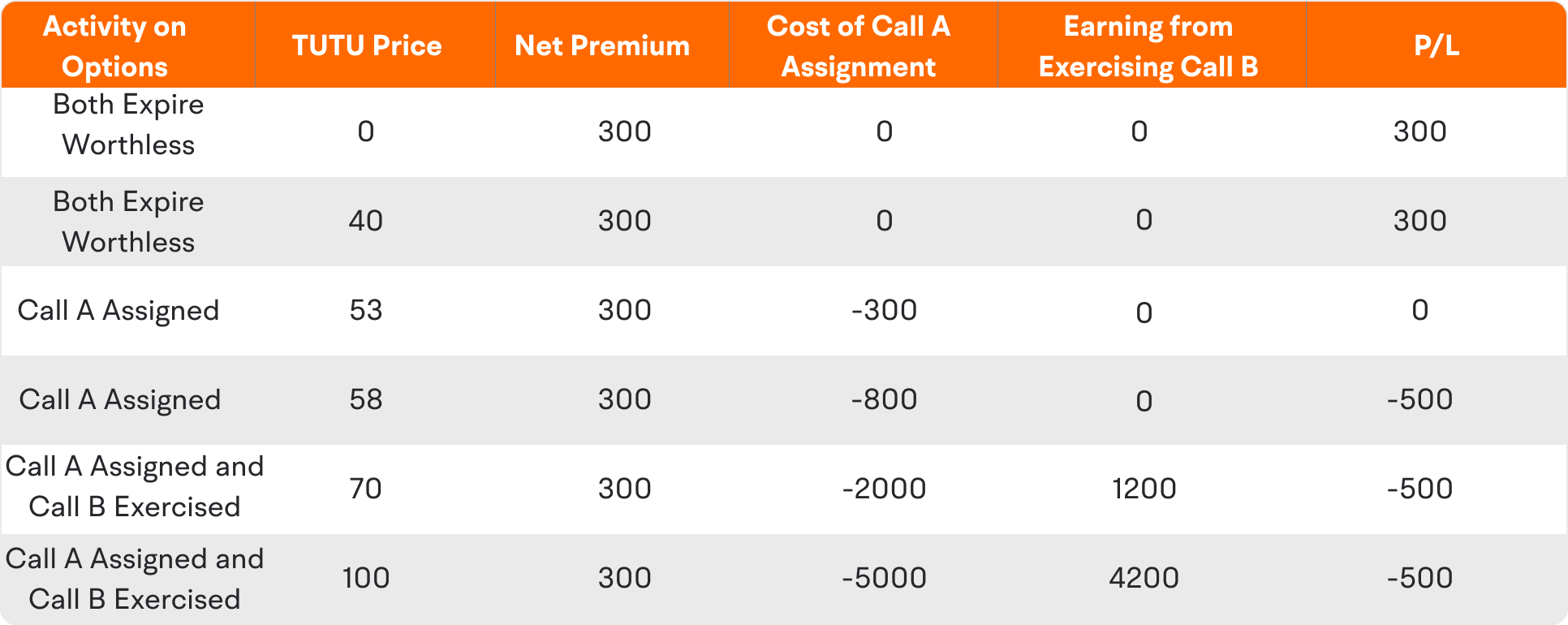
Both call A and call B are out-of-the-money (OTM) and expire worthless.
The maximum profit is achieved, which is the net premium received when opening the position.
Maximum Profit (Theoretical): Net Premium per Share * Multiplier * Contract quantity = ($5-$2)*100*1=$300
Note: The profit for this strategy is limited. Even if TUTU's stock price drops to $0, the profit of the strategy is still $300. However, this is only true if no assignments or early exercises occur.
In this scenario, call A is in-the-money (ITM) and call B is OTM at expiration.
Breakeven = Call A Strike Price + Net Premium Per Share = $50+$3=$53.
If the stock price is below $53, the strategy yields a profit and the profit is limited.
If the stock price is above $53, the strategy suffers a loss, and the theoretical maximum loss is capped.
Both call A and call B are ITM and maximum loss is incurred in this case.
Maximum Loss: (Call B strike price - Call A strike price - Net premium per share) * Multiplier * Contract quantity
Note: In bear call spread, net premium is often positive (cash inflow).
Call A assigned: you need to sell 100 shares of TUTU for $50.
Call B exercised: you can buy 100 shares of TUTU for $58.
As a result, you will suffer a loss of -$8 difference per share.
But don't forget: there was a $3 per share net premium inflow incurred when opening the position.
Since the multiplier is 100, the total loss is ($50-$58+$3) * 100 * 1= -$500.
Note: The potential loss for this strategy is limited by call B. Even if TUTU's stock price rises to $100, the loss of the strategy is still -$500.
Maximum potential loss and profit for options are calculated based on the single leg or an entire multi-leg trade remaining intact until expiration with no option contracts being exercised or assigned. These figures do not account for a portion of a multi-leg strategy being changed or removed or the trader assuming a short or long position in the underlying stock at or before expiration. Therefore, it is possible to lose more than the theoretical max loss of a strategy.
Investors often base their strategies on short-term price trends. If these trends change or fade quickly, the original spread strategy may become ineffective. Therefore, a bear call spread is generally better suited for short-term speculation rather than long-term investment.
If an investor expects the stock price to slightly drop within a certain time frame, they can sell call A and buy call B. This approach allows them to possibly benefit from a stock price decrease while limiting the risk of selling the call if the stock price rises.
An investor may sell at-the-money (ATM) call A if they expect the stock price to fall. To help offset some of the high risk of selling call A, they can buy call B with a higher strike price.
From this perspective: If an investor expects the underlying stock price will decrease or will not rise, they can create a bear call spread by selling an ATM call A and buying an OTM call B at the indicated resistance level. This strategy allows them to potentially profit from the stock's fall while reducing risk as an option seller.
 Q: Choosing the strike price?
A:
Conservative: Relatively conservative investors may buy and sell both out-of-the-money calls. In this way, there is a higher probability the options will expire out-of-the-money, but investors will get a lower premium inflow when opening the position.
Moderate: More moderate investors may sell an at-the-money call and buy an out-of-the-money call, taking on additional level of risk in exchange for potentially moderate returns.
Aggressive: Aggressive investors may buy and sell both in-the-money calls. Such a combination can generate higher returns potentially, but there's a lower probability the options will be out-of-the-money by expiration.
Q: Evaluating the bear call spread position in different scenarios?
A:
Scenario 1: When the stock price is below call A strike price or is above call B strike price
Both options are either in-the-money (ITM) or out-of-the-money (OTM) simultaneously. This indicates that the strategy has reached the boundary of theoretical maximum loss or maximum profit.
In this case, investors can choose to hold the position until expiration. Whether suffering the loss or gaining the profit, moomoo will automatically liquidate the options upon expiration only in cases where the account meets margin requirements, and it is important to verify that this applies to your account. Liquidation is not guaranteed, and investors should monitor their positions closely.
Scenario 2: When call A strike price < stock price < call B strike price
Evaluate the risk of call A being assigned early. If the risk is high, and a short stock position is not wanted, then consider these two methods:
 Method 1: Buy to close the call A position and sell to close the call B position. Exit the bear call spread strategy by closing both options in the strategy and realize the profit or loss.
Method 2: Buy to close the call A position. Although the closing cost may be high in this case, it avoids the risk of being assigned while retaining the profit potential of call B should the underlying stock continue to rise. Remember if you close the call B position only and leave the call A position, you set up a very risky short naked call position.
Scenario 3: Turn a bear call spread into a short call butterfly
If investors have constructed a bear call spread, but the underlying stock does not fall as expected, and they worry that the stock price may face more significant volatility, which may lead to a loss in the strategy.
To help address this, investors may add a bull call spread above the bear call spread position, changing the strategy into a short call butterfly. This adjustment transforms the strategy to be more favorable towards volatility, allowing for profits when there is a significant rise or fall in the stock price.
Scenario 4: Applying short diagonal bear call spread instead of bear call spread
The main difference between a short diagonal bear call spread and a regular bear call spread is the expiration date of the options. In a short diagonal bear call spread, you buy a short-term call option with a higher strike price and sell a long-term call option with a lower strike price, keeping the number of contracts the same.
Investors establish a short diagonal call spread in order to get greater net credit than the bear call spread with the same strike price and same expiration date as the short-term call option. If the stock price rises sharply before the short-term expiration, the short diagonal call spread may suffer the lower maximum loss than the bear call spread.
However, if the stock price is equal to the strike price of long-term call at short-term expiration, the short diagonal call spread will incur a loss, while the bear call spread may realize a profit. The difference mainly comes from the long-term short call in diagonal call spread experienced less time decay than the same strike price, short-term short call in the bear call spread.
Click here to learn more: diagonal spread
Q: What is the difference between a bear call spread and a bear put spread?
A: Both strategies aim to profit from a decline in stock price, but they differ in approach and risk management.
If investors are not bullish on the market outlook, and the current implied volatility is high, they may choose a bear call spread to potentially capture the downside profit while also limiting the potential losses.
If investors are bearish on the market outlook, and the current implied volatility is low, they may choose a bear put spread to potentially capture the downside profit while also reducing the overall premium paid.
This presentation is for informational and educational use only and is not a recommendation or endorsement of any particular investment or investment strategy. Investment information provided in this content is general in nature, strictly for illustrative purposes, and may not be appropriate for all investors. Read more
Recommend
How Short Put Works: Earning Premiums with Options
How the Options Market Can Signal When Earnings Events Are Too Risky to Trade
Options Earnings Series 1: What's Behind the Rise and Fall of Stock Prices After Earnings?

Options Earnings Series 2: Option Buying and Selling Strategies for Earnings
Options Earnings Series 3: Exploring Common Two-Legged Option Strategies for Earnings Season
Never Be Surprised Again: Understand the Eight Common Market Reactions to Earnings
Why Stocks Drop After Beating Earnings: 6 Key Reasons Behind the Post-Earnings Slump
Earnings unlocked: how options might enhance your trading approach
What should options buyers do if they no longer want to exercise their options?
Why did options buyers' exercise request fail?
A Closer Look at 0DTE Options: Short-Term Trading Explained
Approaching Post-Earnings IV Crush With Options
How to Hedge a Market Downturn with Options:Here's what you need to know
A Guide to the Long Put Strategy: Basics You Need to Know
Understanding Witching Days: What Investors and Traders Need to Know
Understanding Implied Volatility in Options Trading
Discovering Protective Puts: A Beginner's Guide
Why Investors May Consider Cash-Secured Puts in a Downturn
Why Pre-Earnings Volatility Attracts Option Traders
The Wheel Strategy: An Income Generating Options Strategy
What's next for a Short Put?
Long Call Options Strategy: Definition, Potential Benefits, and Risks
Short Put Options Strategy in Options Trading
How to set up a Short Put on moomoo?
What's next for a Long Put?
What is a Short Put?
Who are involved in the option exercise process?
Essential rules to understand about exercising options
When should options buyers exercise?
How can options sellers manage risk?
How does options buyers exercise their option?
What is XSP®
Closing vs. Exercising Options: What's the difference?
What's next for a Short Call?
How to set up a Short Call on moomoo
What is a Short Call?
What's next for a Long Call?
Understanding the Benefits of Index Options
XSP® vs SPY®
XSP® Use Cases
How to set up a Long Call on moomoo?
What is SPX®
Dispelling the Myths of Trading Index Options
What is a Long Call?
Short Put Butterfly
What Are Index Options and How Do They Work
Long Diagonal Bull Call Spread
Short Diagonal Bull Put Spread
Long Diagonal Bear Put Spread
Short Diagonal Bear Call Spread
Long Call Butterfly
Short Iron Butterfly
Short Call Butterfly
Long Put Butterfly
Bear Call Spread
Short Iron Condor
Covered Put
Short Put Condor
Bull Put Spread
Bull Call Spread
Long Collar
Short Strangle
Long Strangle
Long Iron Butterfly
Protective Put
Long Iron Condor
Long Put
Short Straddle
Short Call
Cash-Secured Put
Short Put
Long call
Index Options: An Introduction for Traders
Protective Call
Long Call Condor
Short Call Condor
Long Straddle
Long Put Condor
Short Collar
Bear Put Spread
Covered Call
How Short Put Works: Earning Premiums with Options
How the Options Market Can Signal When Earnings Events Are Too Risky to Trade
Options Earnings Series 1: What's Behind the Rise and Fall of Stock Prices After Earnings?
Options Earnings Series 2: Option Buying and Selling Strategies for Earnings
Options Earnings Series 3: Exploring Common Two-Legged Option Strategies for Earnings Season
Never Be Surprised Again: Understand the Eight Common Market Reactions to Earnings
Why Stocks Drop After Beating Earnings: 6 Key Reasons Behind the Post-Earnings Slump
Earnings unlocked: how options might enhance your trading approach
What should options buyers do if they no longer want to exercise their options?
Why did options buyers' exercise request fail?
A Closer Look at 0DTE Options: Short-Term Trading Explained
Approaching Post-Earnings IV Crush With Options
How to Hedge a Market Downturn with Options:Here's what you need to know
A Guide to the Long Put Strategy: Basics You Need to Know
Understanding Witching Days: What Investors and Traders Need to Know
Understanding Implied Volatility in Options Trading
Discovering Protective Puts: A Beginner's Guide
Why Investors May Consider Cash-Secured Puts in a Downturn
Why Pre-Earnings Volatility Attracts Option Traders
The Wheel Strategy: An Income Generating Options Strategy
What's next for a Short Put?
Long Call Options Strategy: Definition, Potential Benefits, and Risks
Short Put Options Strategy in Options Trading
How to set up a Short Put on moomoo?
What's next for a Long Put?
What is a Short Put?
Who are involved in the option exercise process?
Essential rules to understand about exercising options
When should options buyers exercise?
How can options sellers manage risk?
How does options buyers exercise their option?
What is XSP®
Closing vs. Exercising Options: What's the difference?
What's next for a Short Call?
How to set up a Short Call on moomoo
What is a Short Call?
What's next for a Long Call?
Understanding the Benefits of Index Options
XSP® vs SPY®
XSP® Use Cases
How to set up a Long Call on moomoo?
What is SPX®
Dispelling the Myths of Trading Index Options
What is a Long Call?
Short Put Butterfly
What Are Index Options and How Do They Work
Long Diagonal Bull Call Spread
Short Diagonal Bull Put Spread
Long Diagonal Bear Put Spread
Short Diagonal Bear Call Spread
Long Call Butterfly
Short Iron Butterfly
Short Call Butterfly
Long Put Butterfly
Bear Call Spread
Short Iron Condor
Covered Put
Short Put Condor
Bull Put Spread
Bull Call Spread
Long Collar
Short Strangle
Long Strangle
Long Iron Butterfly
Protective Put
Long Iron Condor
Long Put
Short Straddle
Short Call
Cash-Secured Put
Short Put
Long call
Index Options: An Introduction for Traders
Protective Call
Long Call Condor
Short Call Condor
Long Straddle
Long Put Condor
Short Collar
Bear Put Spread
Covered Call