AFRM's Stock Price Surges: Why Do People Like "Buy Now, Pay Later"?
This year's holiday shopping season in the US has been highly popular, with high demand and increased consumer sentiment among residents. As a result, some payment-related companies have experienced a rise in their stock prices.
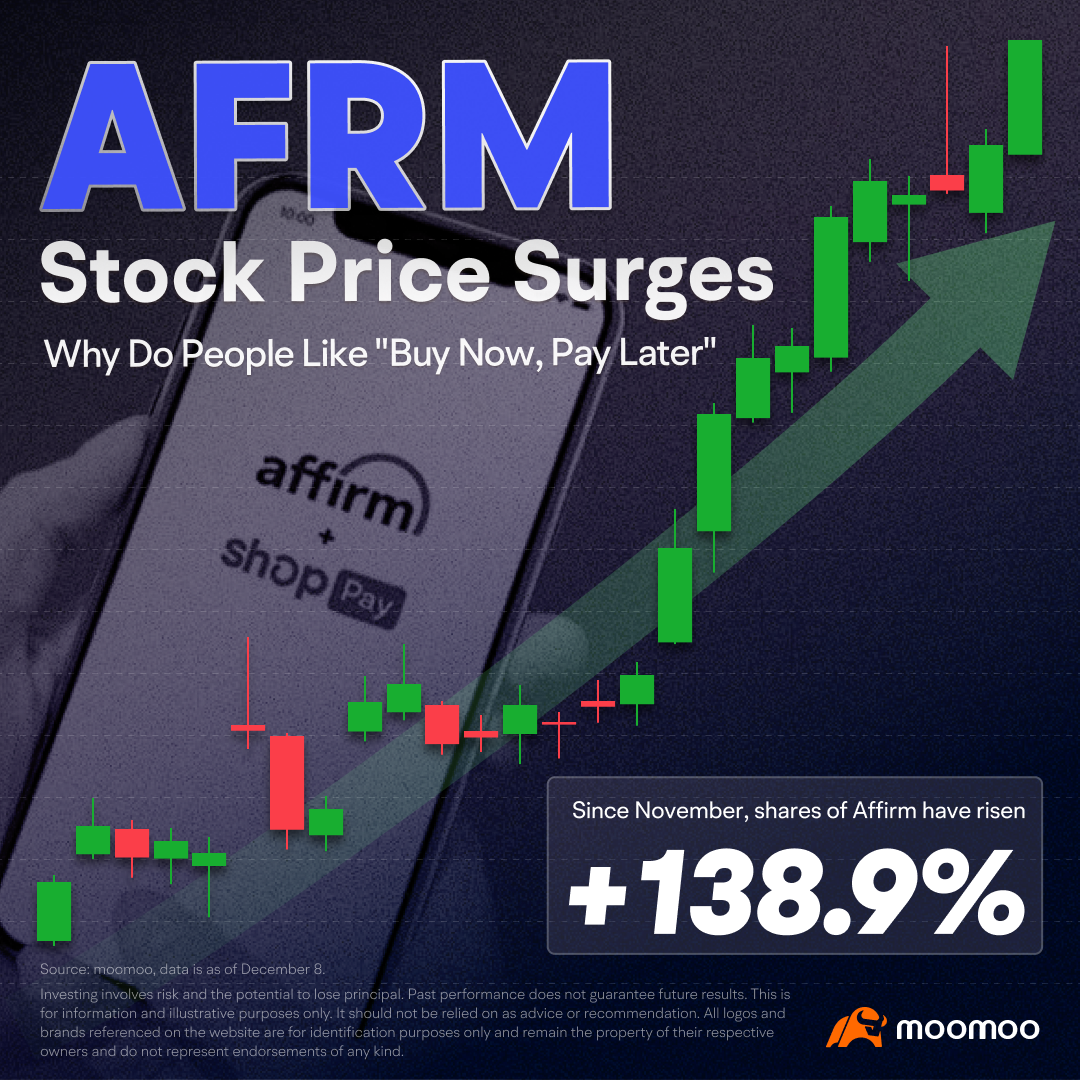
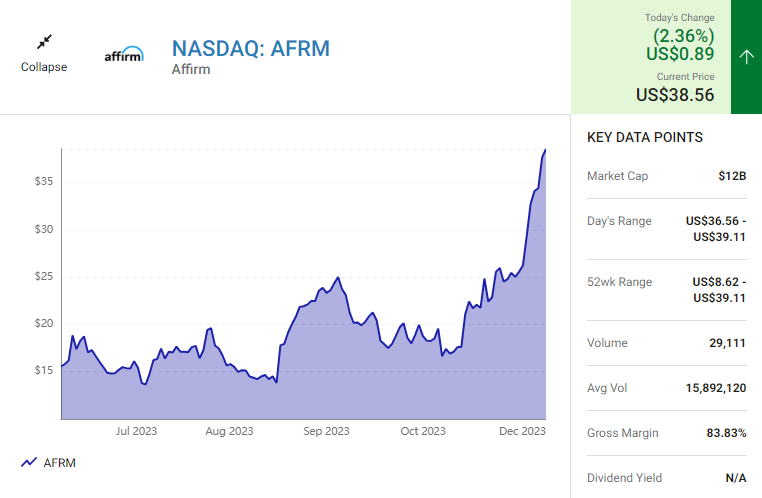
One such company is Affirm (NASDAQ: AFRM), a finance technology firm whose stock price has risen by 138.9% since November (as of December 8) due to the popularity of its "buy now, pay later" business model.
"Buy now, pay later" or BNPL, is a popular payment option that has gained global attention over the past few years. In late October, Apple introduced its BNPL service, "Apple Pay Later," in the U.S. just in time for the holiday shopping season. The market speculates that this new service has already made Apple significant profits.
According to Adobe Analytics, BNPL has contributed $10.1 billion to online spending since early November, showing a 17% increase from last year. During Black Friday, $79 million in sales came from BNPL, showing a 47% increase from last year.
So how does BNPL work? How does it differ from credit cards, and why has its stock price recently soared? Today, let's uncover the mystery of BNPL services.
The influence of BNPL is rising, what is its operating mechanism?
BNPL allows consumers to purchase goods through interest-free financing within a specified period, providing short-term installment loans. It offers flexibility, allowing consumers to buy what they want and pay for it in smaller installments.
Although some physical stores accept BNPL, this payment method is mainly used for online websites. Shoppers will see the option at checkout, dividing the total amount into several payments with due dates for each payment.
For instance, if a consumer's order total is $100, and the payment plan is divided into four periods, they only need to pay $25 on the day they receive the goods, and the remaining three payments are usually automatically deducted every two weeks.
What are the pros and cons of BNPL?
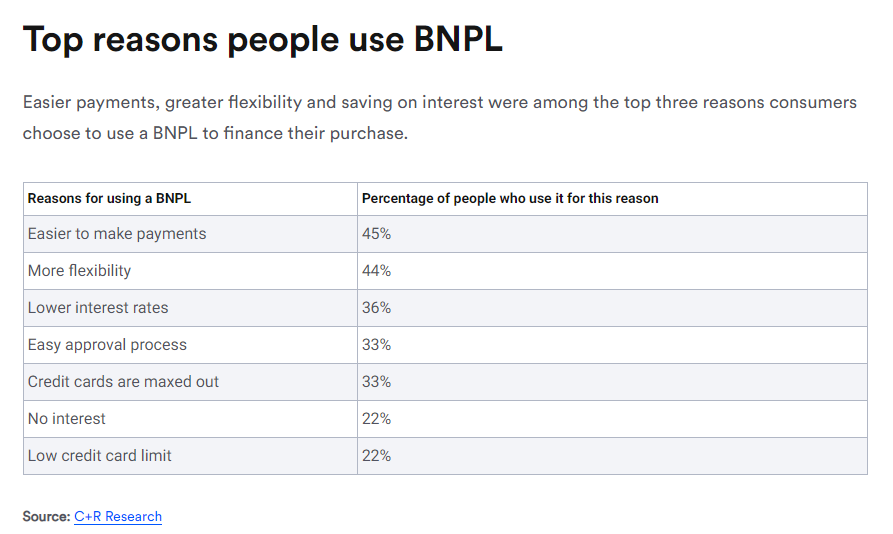
From a customer experience perspective, there are three main advantages of BNPL:
Flexibility in repayment schedule: Consumers can choose installment payments and break down payments into affordable installments, which helps manage credit limits and allows for additional financial buffer room.
Simple application process: Generally, BNPL consumers belong to the Z generation or millennials interested in innovative tech products. Compared to credit cards requiring complex application processes with strict credit score requirements, BNPL is relatively simple and does not require excessive personal information or credit records.
No processing fees: BNPL usually does not have any installment fees, management fees, or even late fees, enabling consumers to shop freely.
As of May 2023, about 16% of U.S. consumers have used BNPL payment methods. Nearly half of the respondents said that if merchants do not offer BNPL options, they would postpone or even cancel their purchases or choose cheaper alternatives. This highlights the importance of offering BNPL options for merchants.
According to Affirm's latest survey last month, 54% of consumers hope that retailers will provide BNPL options during the 2023 holiday shopping season at checkout.
As more consumers use BNPL, most merchants are willing to activate this payment service to keep up with trends and prevent abandoned shopping carts.
What are the disadvantages of using BNPL?
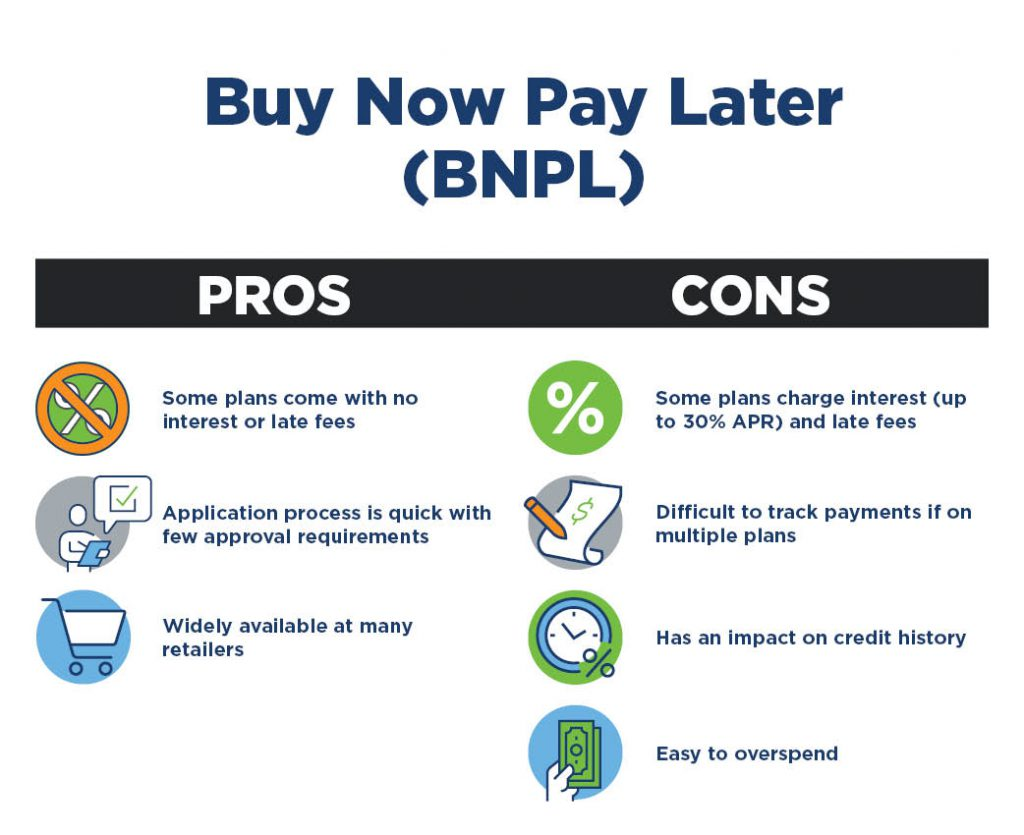
Late fees: Repaying BNPL loans typically do not help consumers build good credit, but forgetting or delaying payments can lead to additional late fees and potentially harm credit scores.
Accumulating debt: A report from the CFPB found that using BNPL services can lead to debt beyond what consumers can afford. This is because consumers are often easily blinded by the initial smaller payment and inadvertently exceed their budgets, while still having installment payments left in the BNPL plan.
Delayed refunds: Because BNPL is a relatively new payment method, the refund process can be more complicated when returning goods. In some cases, consumers may still need to pay for the full purchase amount even if they return the product.
Overall, while BNPL offers many advantages such as flexibility and simplicity, it's important to be aware of the potential downsides, especially the accumulation of debt and additional fees. Before opting for BNPL, consumers should carefully consider their ability to repay the loan on time and read the terms and conditions thoroughly.
Which BNPL companies are currently on the market?
BNPL service providers are typically offered by fintech companies. Here are some of the most popular BNPL companies on the market:
Affirm: With a growing number of active consumers that has increased from 3.6 million to over 16.4 million as of June 2023, Affirm is one of the most influential installment payment platforms with over 250,000 retailers using its services. The platform doesn't charge an annual fee or late fees and offers flexible credit limits for up to four installments depending on the consumer's credit score.
PayPal: PayPal allows consumers to make four interest-free payments every two weeks for purchases up to $1,500. There are no late fees for overdue payments. As of mid-2023, PayPal has issued over 200 million loans to more than 30 million customers across eight markets worldwide, making it one of the leaders in the BNPL industry.
Klarna: Consumers can get four interest-free payments and their buying power is determined by their credit limit. The platform also offers price comparison tools to help consumers save money and earn rewards.
Afterpay: Afterpay offers four interest-free payments that need to be paid within six weeks. It can be used both online and offline, and its app provides access to discounts and perks at various stores. However, Afterpay charges a 25% late fee for missed payments.
Zip: Used by over 94,000 merchants worldwide, Zip offers four interest-free payments that need to be paid within six weeks. Rewards and discounts are available when using Zip at specific retailers, but the platform charges a $6 installment payment fee and a $5 late fee.
According to a report from Adobe Analytics, BNPL transactions accounted for around $7.3 billion of online spending from November 1st to 26th, up 14% from the previous year. This trend seems to be accelerating after Black Friday. During the holiday season, demand for BNPL services surged, resulting in a rise in the stock prices of BNPL companies. Affirm's stock price nearly doubled from $17.61 on October 31st to $34.41 on November 30th, increasing by 95.4%.
Affirm's stock price is riding the wave of the industry's momentum. On November 8th, the company released its Q1 FY 2024 results, exceeding analysts' expectations in all indicators, while also raising its fiscal year outlook. The Motley Fool stated that Affirm's robust performance has consistently exceeded analysts' expectations for several quarters, and the management's optimistic forecast has attracted investors to buy the stock.
Affirm's performance is riding the wave of the industry, as it guided for growth in Q1 of fiscal year 2024 on November 8, 2023. All indicators exceeded analysts' expectations, and the company also raised its outlook for the fiscal year. The Motley Fool noted that Affirm has consistently surpassed analysts' expectations for several quarters, and the management's optimistic forecasts have attracted investors to buy the stock.
What are the potential opportunities and risks in the BNPL industry?
1. In the short term, consumer resilience may decrease.
Due to high inflation in the past two years, the cost of living has become very high, causing many consumers to turn to BNPL loans to cope with rising prices and dwindling savings. Compared to credit cards, BNPL is a more affordable option even during periods of rising interest rates, making it an attractive choice for young users and merchants alike.
However, providing BNPL loans is not risk-free. During economic downturns, default risk increases as more people become unemployed and unable to make payments. Currently, consumers in the United States face significant economic pressures, and strong personal spending over the next few months may weaken. The BNPL market may be affected as US consumption slows down.
2. Record household debt poses a risk
A study conducted in 2023 found that consumers spend 20% more on BNPL than other forms of payment. In addition, a survey by the CFPB revealed that 88% of BNPL users also have open credit cards. This indicates that on average, BNPL borrowers are more likely to be heavily indebted and use high-interest financial services.
Furthermore, due to increased consumer spending in recent years, the United States has seen record levels of household debt. As of the second quarter of 2023, total household debt reached $17.06 trillion, with credit card debt exceeding $1 trillion for the first time. The third quarter saw another all-time high at $17.29 trillion, with credit card debt increasing by 16.7% from the previous year. This poses a high risk of default for BNPL companies.
3. Interest-bearing installment payments may become a trend
Many BNPL companies have been moving away from zero-interest payment models to interest-bearing installment loans in recent months. Data released by Affirm indicates that 74% of its merchandise volume in the most recent quarter came from interest-bearing loans, with over 90% of loans having a maximum annual interest rate of 36%.
4. In the long term, the future of the BNPL industry looks bright
According to Allied Market Research, as developing countries increasingly adopt online payment methods, the BNPL market is expected to reach $3.98 trillion by 2030, with significant growth expected in the Asia-Pacific region.
Overall, while BNPL offers consumers flexibility and simplicity when it comes to managing payments, it's important to read the terms and conditions and understand the potential downsides before opting for these services, such as additional fees and accumulation of debt beyond what you can afford.
This presentation is for informational and educational use only and is not a recommendation or endorsement of any particular investment or investment strategy. Investment information provided in this content is general in nature, strictly for illustrative purposes, and may not be appropriate for all investors. Read more