A complete guide to the "Dividend Aristocrats"
Dividend investing is a popular strategy among investors looking for stable income streams and long-term wealth accumulation.
Especially during the volatile market, dividend stocks sometimes can act as a safe harbor.
However, with a wide variety of stocks in the US market, how can investors choose stocks that consistently pay dividends?
In this article, we will introduce a concept called 'Dividend Aristocrats', which helps you find high-quality dividend stocks easier.
What is the "Dividend Aristocrats"
The Dividend Aristocrats, also known as the S&P 500 Dividend Aristocrat, is an index designed to measure the performance of S&P 500 companies that have increased dividend payments every year for the last 25 consecutive years.
The index was launched in 2005 and there is a total of 68 stocks included in this index in 2023.
In general, The Dividend Aristocrats are considered some reliable dividend stocks because of their track records in providing steady and predictable returns.
"Dividend Aristocrats" criteria
It's not easy to become a dividend aristocrat, and there are strict screening criteria:
The company must be a member of the S&P 500 Index.
Constituents must have increased dividend payments every year for at least 25 consecutive years.
Market capitalization must exceed USD$3 billion.
The average daily trading volume over the past 3 months should be at least USD$5 million.
It is relatively rare to see a company that not only pays dividends consistently but continuously increases the size of its payouts to shareholders.
It requires the companies' business operations to be exceptionally stable, and their products or services typically remain resilient to economic downturns to continue increasing dividend payouts.
As a result, Dividend Aristocrats are usually considered blue-chip stocks with well-established leadership positions in their respective markets.
These companies usually have mature business models that can generate stable profits and cash flow. Moreover, they are generally willing to reward shareholders by distributing profits in the form of dividends.
Perhaps you're familiar with household names such as Coca-Cola, McDonald's, and Walmart, which are all well-known examples of Dividend Aristocrats.
Who are the "Dividend Aristocrats" in 2023?
In 2023, the Dividend Aristocrats index consists of 68 component stocks, and these companies come from various industries.
Investors can also filter out some noteworthy Dividend Aristocrats based on various indicators, with one of them being the dividend yield.
Since companies' stock prices fluctuate continuously while dividend payments from companies are relatively stable, the dividend yields of stocks in the Dividend Aristocrats can vary at different times.
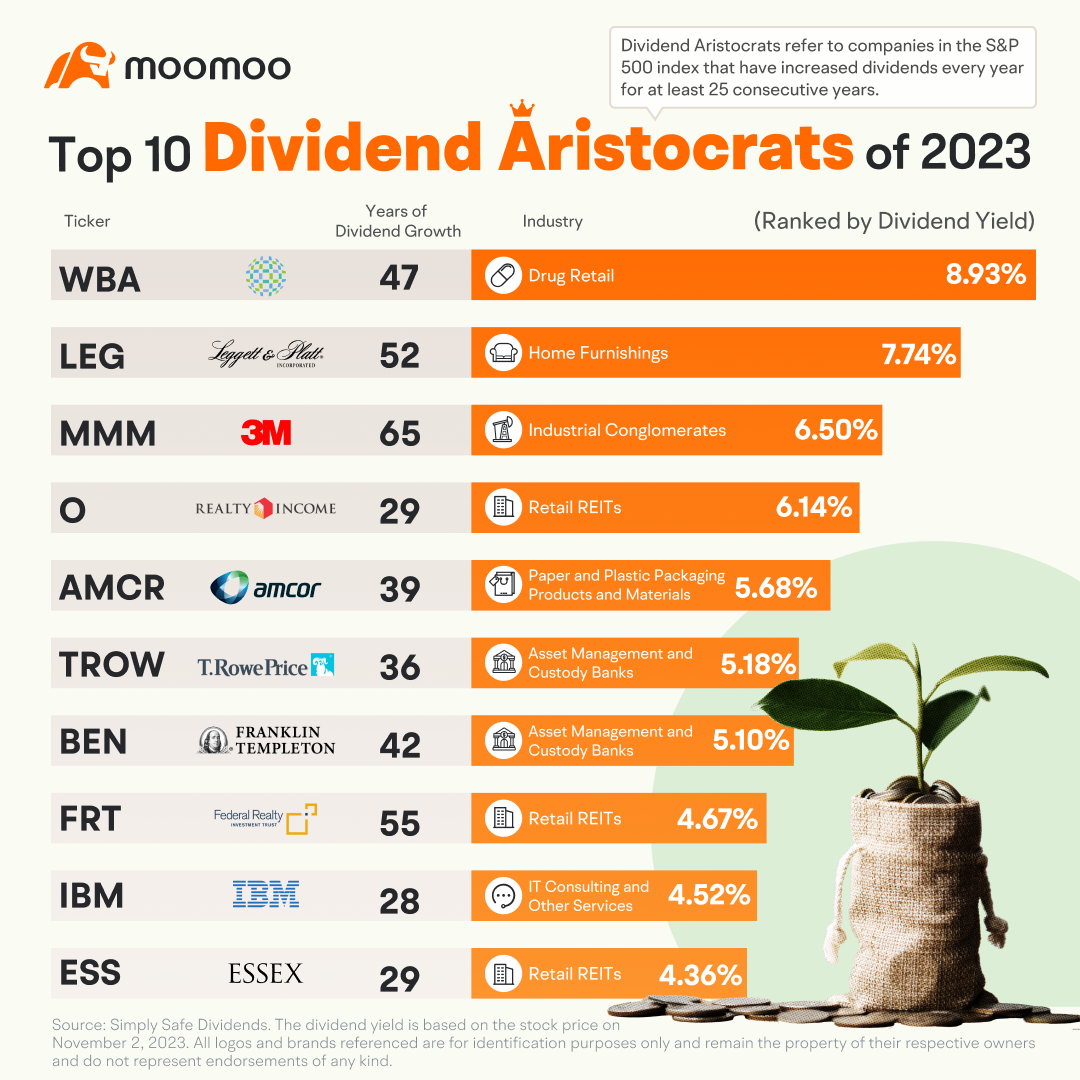
As of November 2, 2023, based on the latest dividend yield rankings, investors can discover the top 10 Dividend Aristocrats by dividend yield. They are:
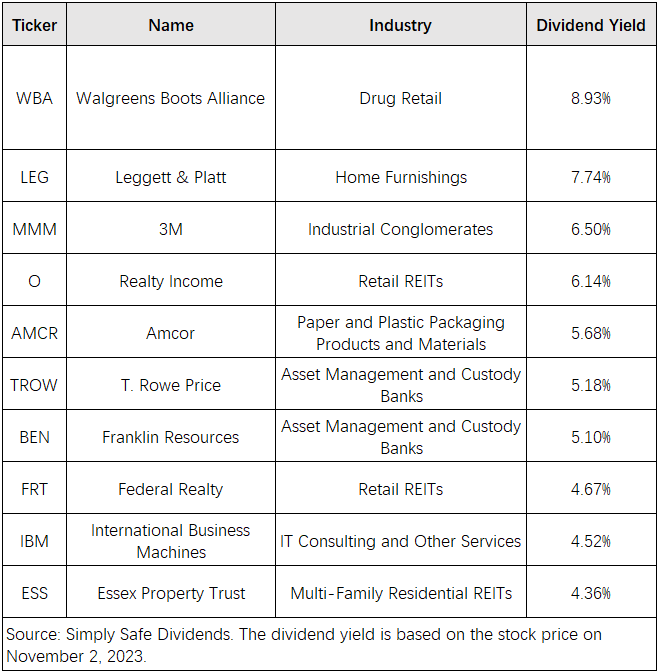
From the chart above, we can see that the retail pharmacy company Walgreens Boots Alliance (WBA) has the highest dividend yield at 8.93%, followed by Leggett & Platt (LEG) and 3M Company (MMM) in the 2nd and 3rd positions, with dividend yields of 7.74% and 6.50%, respectively.
However, it's important to keep in mind that high dividend-yielding stocks may not always be a wise investment choice. While a soaring dividend yield can seem attractive, it's often related to a significant drop in the stock price. A declining stock price may suggest deteriorating company performance and declining profits, which could pose a risk of reduced dividends.
Therefore, when making investment decisions, investors should consider fundamental analysis, market analysis, and other factors in a comprehensive assessment, rather than solely relying on high dividend yields as the primary criterion.
How to invest in "Dividend Aristocrats"?
For investors seeking a stable cash flow, Dividend Aristocrats may be a good choice.
However, with over 60 stocks in the Dividend Aristocrats, how do you choose the right ones?
Although companies in the Dividend Aristocrats are generally stable blue-chip stocks with relatively low risk, it doesn't mean there's no risk involved.
Therefore, investors can further spread their risk by diversifying their investments, rather than putting all their money into one or two stocks.
Dividend Aristocrat ETFs
Investing in Dividend Aristocrat ETFs may be a good way to diversify risk.
These ETFs track the performance of the Dividend Aristocrats index, providing a way for investors to gain exposure to a diversified basket of these dividend-paying companies.
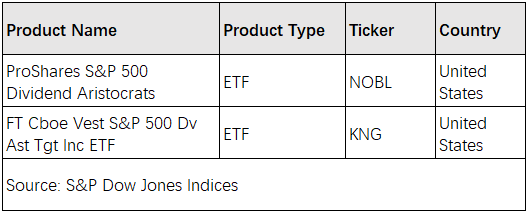
According to the website of S&P Dow Jones Indices, there are currently two ETFs in the U.S. market that track Dividend Aristocrats' performance: the ProShares S&P 500 Dividend Aristocrats ETF (NOBL) and the FT Cboe Vest S&P 500 Dividend Aristocrats Target Income ETF (KNG).
It's worth noting that based on the index's past performance, the Dividend Aristocrats have not outperformed the S&P 500 index over the past 10 years. However, analysts at Morningstar suggest that in some bad years for the stock market, the performance of Dividend Aristocrat ETFs might be more stable, as seen in 2022.
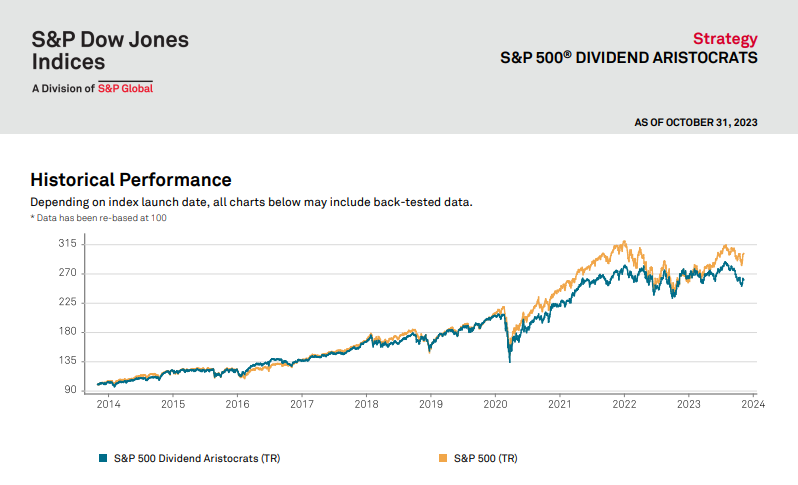
Source: S&P 500 Dividend Aristocrats Index Factsheet
But remember that all investments come with risks, and investing in Dividend Aristocrat ETFs is no exception.
When the market is not doing well, the prices of Dividend Aristocrat ETFs can be volatile too, potentially leading to losses. Additionally, Dividend Aristocrat ETFs may also underperform the broader market, so investors should tailor their investment strategy to their own needs.
Pros and cons of dividend aristocrats
Pros:
Reliable income: The Dividend Aristocrats offer a stable source of income, even in the face of stock market downturns or economic recessions.
Strong financials: The Dividend Aristocrats have consistently increased dividends over the last 25 years, demonstrating their financial stability, even during challenging economic conditions.
Cons:
Low growth: Dividend aristocrats are typically mature companies with restricted opportunities for revenue growth.
Limited capital gains: Investing in dividend stocks usually doesn't yield substantial capital gains compared to other types of investments.
Dividends are taxable: Annual dividend payments are subject to taxation, even if you hold your stock investments for the long term, which can affect your overall returns.
In conclusion, Dividend Aristocrats offer an appealing option for investors seeking reliable income, but they also come with certain limitations. Investors need to balance these pros and cons to ensure they align with their specific financial goals and risk tolerance.
This presentation is for informational and educational use only and is not a recommendation or endorsement of any particular investment or investment strategy. Investment information provided in this content is general in nature, strictly for illustrative purposes, and may not be appropriate for all investors. Read more