Will there be a Window Dressing in the stock market at the end of the year?
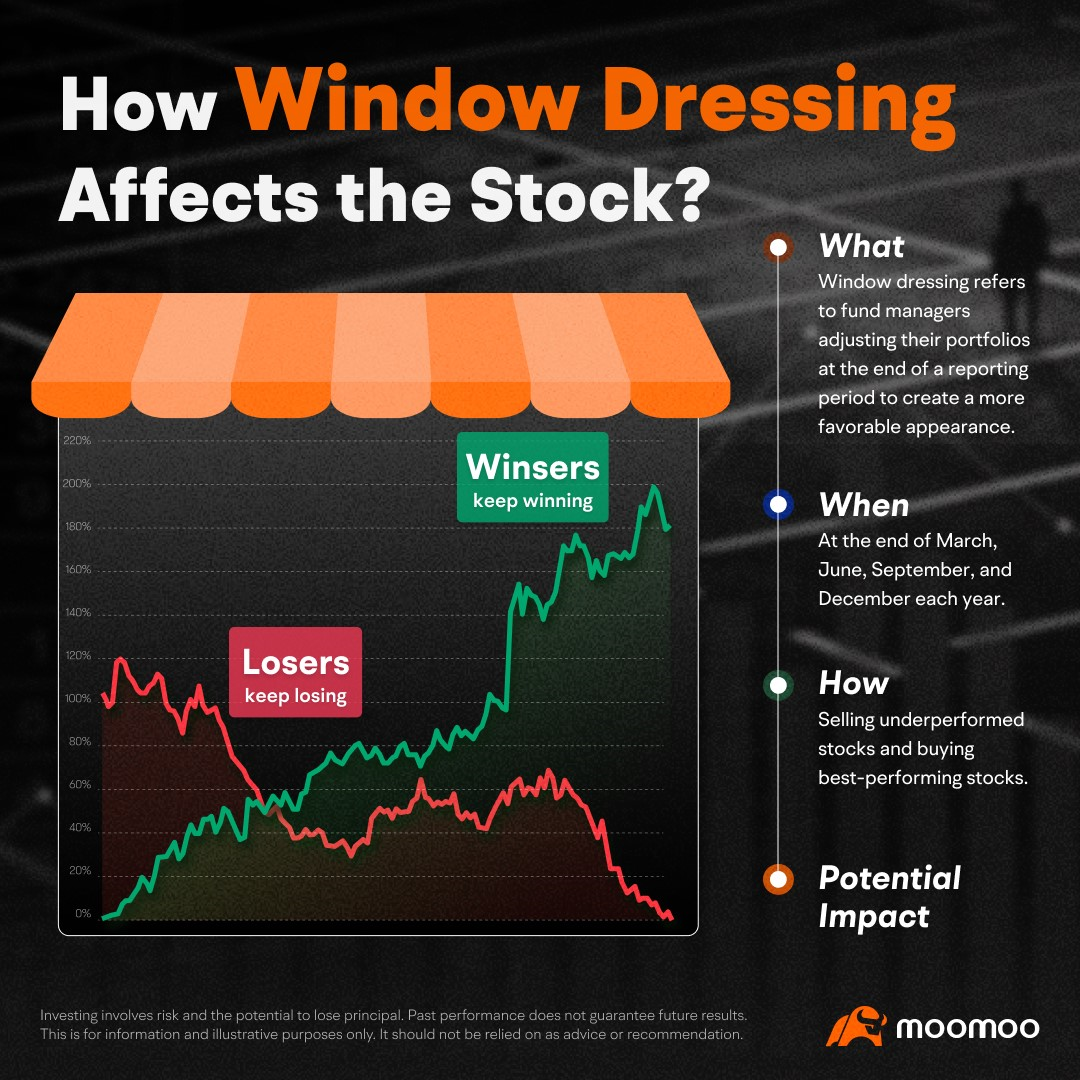
The term "Window Dressing" was originally used in the retail industry to describe a strategy that retailers use to attract customers. They display their merchandise with selling points in the storefront windows to grab the attention of potential consumers.

While it makes sense for retailers to do this, you may wonder why the financial industry has "Window Dressing" as well.
In fact, just like retailers, some mutual fund managers also hope that their products perform well enough. Therefore, they may use certain tactics to make their investment portfolios look better whenever a company's quarterly report is released. This not only satisfies existing investors but can also attract new ones, making it a win-win situation.
As a result, when many institutional investors are trying to spruce up their products, it often leads to a "Window Dressing Effect" in the market.
How do these fund managers "dress up their windows"?
As mentioned earlier, fund managers tend to practice window dressing at the end of a quarter, when they have limited time left before submitting performance reports. Their primary goal is to achieve maximum profits for their investment portfolios within a short span of time. To accomplish this, the quickest method involves two simple steps: selling off stocks that have significantly underperformed and buying ones with robust performances.
After making these adjustments, the new stocks replace the original holdings and feature in the fund's physical periodic reports or marketing materials. Many investors assume that these are the same stocks that the institution held all along.
This strategy conceals any weak performance and creates an illusion of substantial returns, leading to the fund appearing to have performed better in the short term.
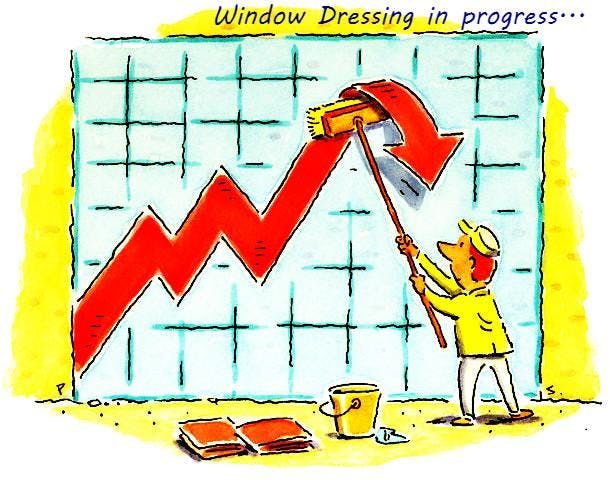
To give an example, let's say a fund has been performing poorly for the past few months. From the fund manager's perspective, they wouldn't want to reveal that they have significant positions in companies with poor performance. To make their portfolio look better, the manager may sell off these underperforming stocks and buy recent market darlings like companies A, B, and C. When investors see A, B, and C listed on the disclosure report and think they made the right choice, only the fund manager knows the actual situation is not as it appears.
However, some style-based funds require a "restoration" after window dressing. Therefore, fund managers may choose to repurchase the stocks they sold off during the next quarter. This practice actually harms the entire portfolio's return since buying and selling these stocks incurs high transaction costs.
Regardless of which industry this tactic is used in or what purpose it serves, it can be considered a deceptive practice. Investors should closely monitor fund strategies for anomalies at the end of each quarter. If investors find that the underlying assets of their funds do not match the original targets and strategies, the performance may have been "window dressed".
How does Window Dressing impact the stock market?
As the year comes to a close, fund managers dressing up their windows can affect individual stocks that have either performed very well or very poorly throughout the year.
For successful stocks, these buying and selling activities can drive stock prices even higher. However, underperforming stocks that are sold off will experience further downward pressure on their prices. Once institutional investors stop selling, these previously poorly performing stocks may potentially rebound significantly next month.
According to Financial Analysts Journal's article in 2007, with January excluded, the average monthly return to a momentum strategy for U.S. stocks was found to be 59 bps for non-quarter-ending months but 310 bps for quarter-ending months. The pattern was stronger for stocks with high levels of institutional trading and was particularly strong in December. The results suggest that window dressing by institutional investors and tax-loss selling contribute to stock return momentum.
According to Benzinga's analysis, from a technical perspective, analysts predict that the S&P 500 index pulled back to its resistance level by the end of June 2023 due to two different mechanisms working simultaneously: window dressing and end-of-quarter rebalancing.
According to Zacks Investment Ideas' report on December 12th, 2023, analysts predict that the trend of the Window Dressing Effect is expected to continue, as the Nasdaq 100 ETF has risen nearly 50% since the beginning of 2023.
Other countries' stock markets may also be subject to window dressing. For example, in Germany's DAX index, analysts predict Zalando, Bayer, and Siemens Energy will likely experience further declines, while HeidelbergCement, Rheinmetall, and Adidas are competing for the role of biggest winner of the year. Additionally, Malaysian stock market analysts state that window dressing did not seem to visit the Malaysian market this year, as the stock market has had poor performance by the end of the year.
Can individual investors make use of Window Dressing as a trading strategy?
Some investors may be curious if they could earn profits from window dressing created by institutional investors, since it seems to exist in the market.
Enlightened Stock Trading analysts have developed a trading strategy to test this theory.
The trading strategy rules are as follows:
Identify the five strongest and weakest stocks in the S&P 500 index based on "relative strength".
Buy the top-performing five stocks and short-sell the five weakest-performing stocks five days before the end of each month.
Hold these stocks for five days, then close the positions.
Allocate 20% weight to each stock.
In back-testing, consider a 0.25% slippage and commission for each trade.
If this trading strategy generates significantly more excess returns than the S&P 500, it would be an attractive portfolio. However, the results are not satisfactory.
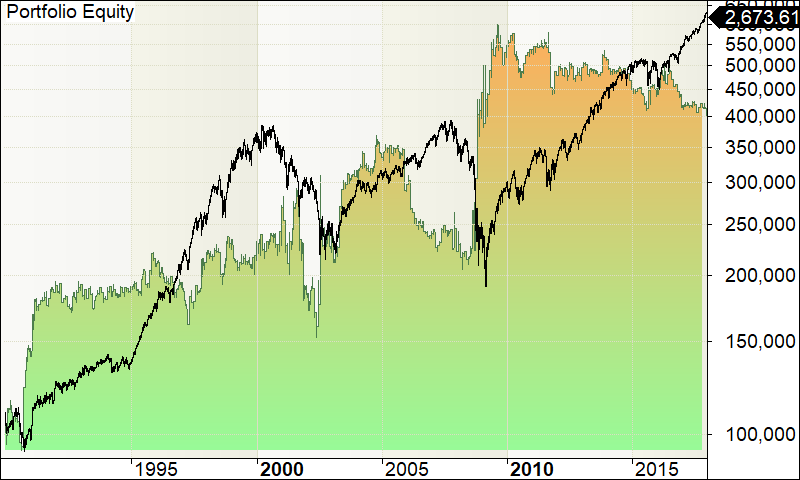
Source: Enlightened Stock Trading | Note: Amibroker was used to back-test the data from 1990 to 201
In fact, the total return of this portfolio was less than the return of the S&P 500. The reason is that there is no evidence that window dressing causes the prices of the worst-performing five stocks to fall further at the end of the month. Changing the rule to quarterly trades without short-selling also does not produce good results. Therefore, Enlightened Stock Trading's analysts believe that using window dressing for trading may require additional conditions.
Currently, relying on window dressing to generate substantial income at the end of each quarter still carries significant risks for individual investors.
In general, window dressing is not a specific strategy but rather a phenomenon that may exist in the market. Investors should analyze and evaluate any unusual movements or extreme overbought or oversold situations sensibly and cautiously for individual stocks.
This presentation is for informational and educational use only and is not a recommendation or endorsement of any particular investment or investment strategy. Investment information provided in this content is general in nature, strictly for illustrative purposes, and may not be appropriate for all investors. Read more