Understanding capital gains tax in Canada: How much and how to reduce it
If you've recently made money from selling a stock, you may have to pay capital gains tax.
In Canada, when you sell an investment, 50% or more of your profit is taxable. This means it will be taxed at your marginal tax rate, which depends on your total income.
This article will explain capital gains tax, show you how to calculate it, and offer tips on how to reduce it.
What are capital gains and capital losses?
Before diving into the capital gains tax, let's try to understand the concept of capital gains and losses.
Capital gains: Capital gains occur when you sell an asset for more than its adjusted cost base (ACB), which includes the purchase price plus any acquisition costs (e.g., commissions, legal fees). For example, if you buy a stock for $1,000, sell it for $1,100, and pay $10 in commissions for buying and selling, your capital gain is $90.
Capital losses: On the other hand, capital losses occur when you sell an asset for less than its ACB. These losses can be used to offset capital gains, which can help reduce your taxable income. Additionally, you can carry back capital losses for up to three years or carry them forward indefinitely to offset future gains.
How much is capital gains tax in Canada?
In Canada, capital gains tax is included as part of your overall income tax.
Previously, 50% of your capital gains were taxable. However, starting June 25, 2024, the taxation will change: you will be taxed on 50% of your annual capital gains up to $250,000, and for any gains exceeding that amount, the taxable portion will increase to two-thirds, or about 66.67%.
This taxable amount is added to your annual income and taxed according to your marginal tax rate, which can vary based on your total income and the province. Therefore, the actual tax on capital gains can differ among individuals. For example, if your marginal tax rate is 26%, it is likely that your capital gains tax rate will also be 26% on half or more of your capital gains.
How to calculate tax on a capital gain in Canada?
Let's say you purchase 100 shares of Apple stock at $150 per share, with a buying commission of $10. Later, you sell those shares at $200 each, incurring another $10 commission. If your marginal tax rate is 26%, how much capital gains tax do you need to pay? Here is the calculation:
Calculate the capital gain:
You buy 100 shares of Apple at $150 each.
Total cost: $15,000 + $10 commission for buying = $15,010
You sell all 100 shares at $200 each.
Total revenue: $20,000 - $10 commission for selling = $19,990
Capital gain: $19,990 (revenue) - $15,010 (cost) = $4,980
Determine the taxable portion of the capital gain:
Capital gain is under $250,000, 50% of capital gain is taxable.
Taxable amount: 50% of $4,980 = $2,490
Calculate the capital gains tax:
Marginal tax rate: 26%
Capital gains tax: $2,490 * 26% = $647.40
From this example, you can see that you earned $4,980 from the Apple trade (after commissions) and need to pay $647.40 in taxes.
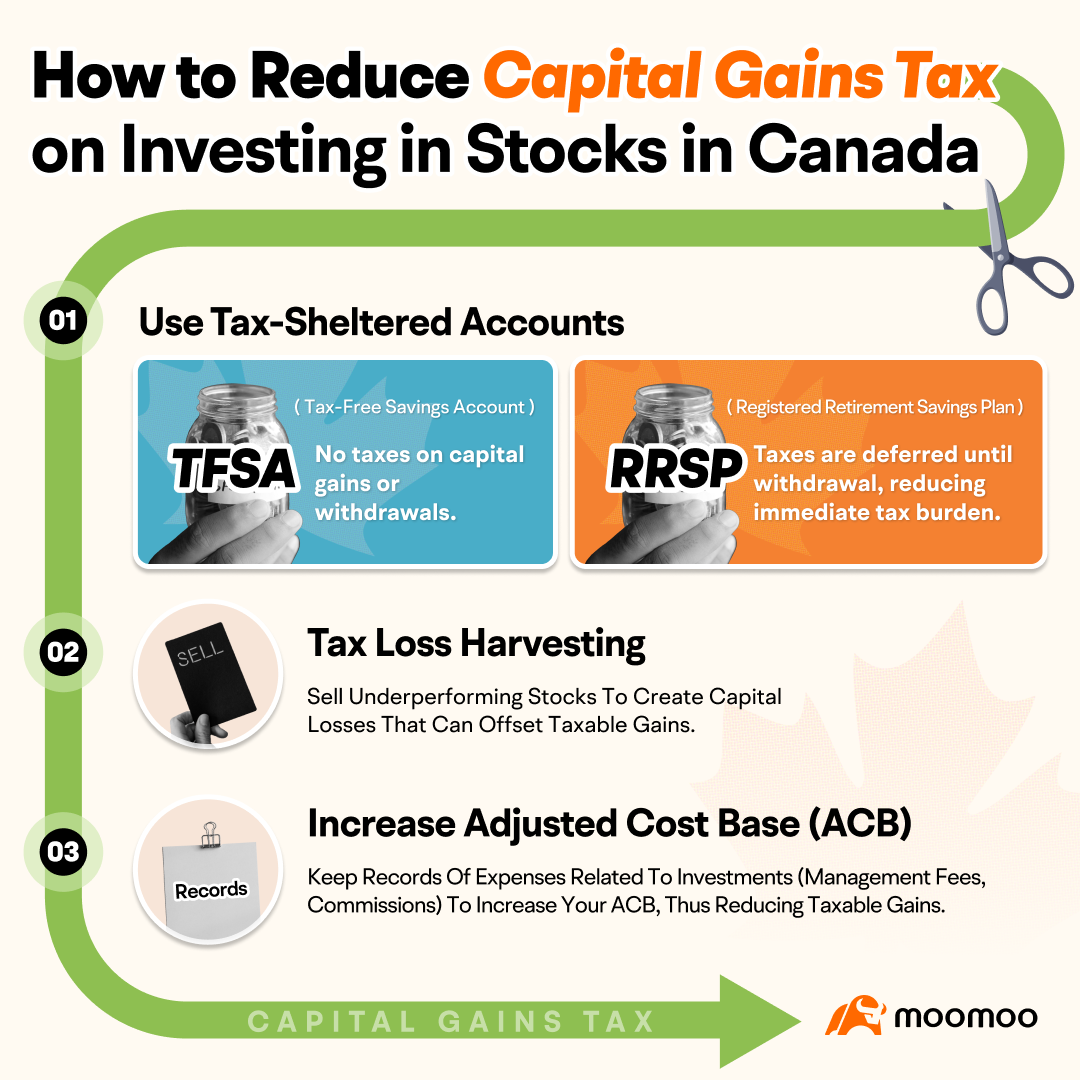
How to reduce your capital gains tax in Canada
Here are a few ways to reduce your capital gains tax:
Option 1: Invest within tax-sheltered accounts, including TFSA or RRSP
TFSA: Income earned in a Tax-Free Savings Account (TFSA) is not taxable, even when gains are realized. Withdrawals are also tax-free. Note that U.S. dividend income is subject to U.S. withholding tax. Be mindful of annual contribution limits to avoid penalties.
RRSP: Capital gains in a Registered Retirement Savings Plan (RRSP) are tax-deferred until withdrawal, at which point they are taxed as ordinary income. Contributions also provide immediate tax deductions.
Option 2: Try tax loss harvesting
Sometimes, you can reduce your capital gains tax by using a strategy called tax loss harvesting. This involves selling investments that have lost value to create a capital loss. You can then use this loss to offset the gains from other investments.
For example, if you made $10,000 from selling some assets but also lost $10,000 from selling others, the gains and losses would cancel each other out, resulting in no capital gains tax.
Option 3: Keep track of your expenses
Track expenses related to managing your investments, like management fees, legal fees, and trading costs. These expenses can increase the adjusted cost base (ACB) of your investments, which in turn can reduce your capital gains tax when you sell the assets.
This presentation is for informational and educational use only and is not a recommendation or endorsement of any particular investment or investment strategy. Investment information provided in this content is general in nature, strictly for illustrative purposes, and may not be appropriate for all investors. Read more