High-Yield vs. High-Return: A 2024 Canadian ETF Strategy Comparison
Learn how to build different ETF portfolios with different risk tolerances in high-yield or high-return strategies. — 6 minutes
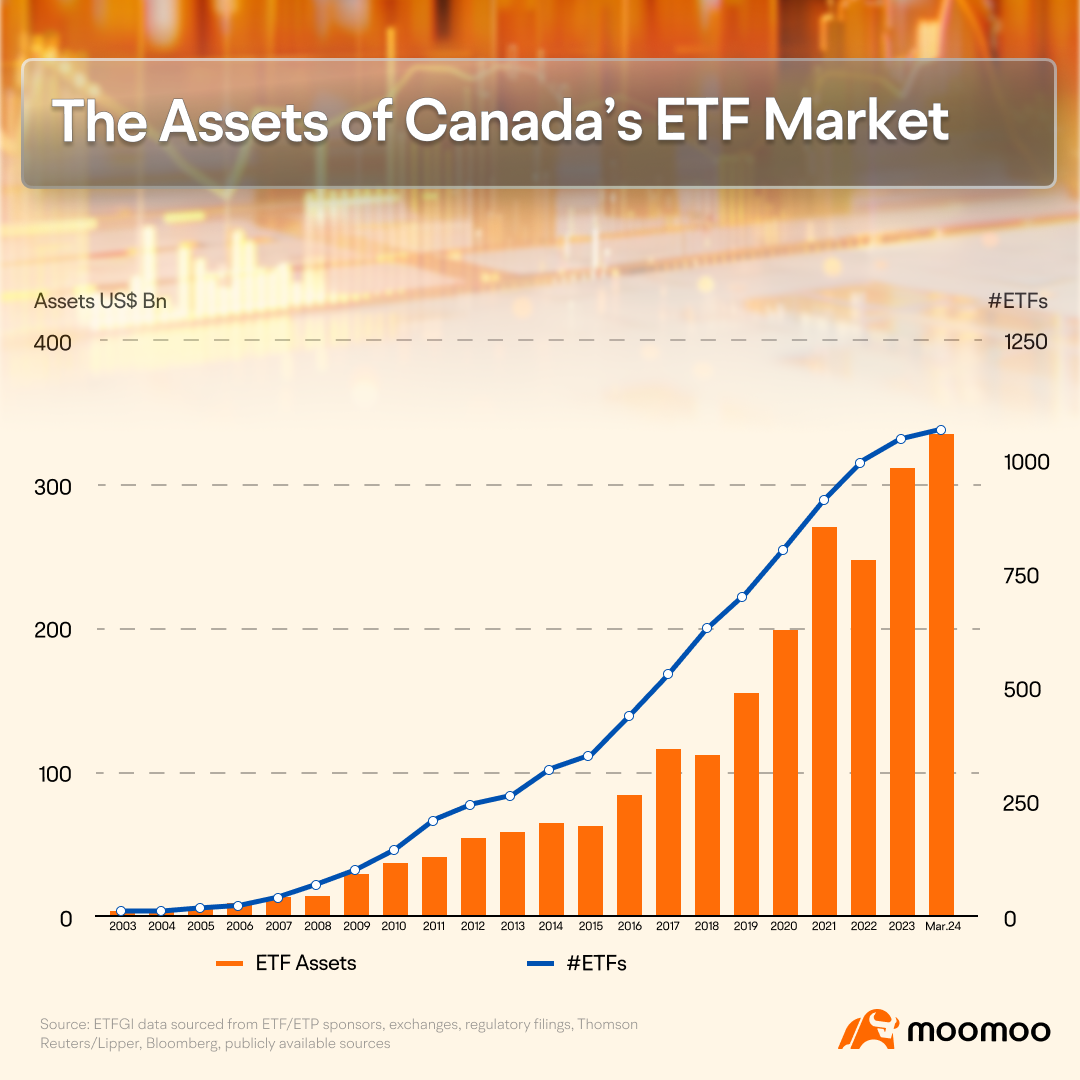
Exchange Traded Funds (ETFs) have been growing steadily in the Canadian market. The market share has jumped from 6% to 16% over the past decade, marking a 267% growth, according to the Canadian ETF Association. At the end of February 2024, the assets of the Canadian ETF market reached a record high of $409 billion, with 1,121 funds now available, a 57% increase.
For Canadian investors, there is more choice in ETFs today than ever before. You can tailor your own ETF investment strategy around your investment goals and risk tolerance. In this article, we will explore answers to these questions:
What is a high-yield ETF strategy?
What is the core and explore strategy?
What is a high-risk leveraged ETF?
If you are still getting started with ETFs, we recommend reading High-Yield vs. High-Return: A 2024 Canadian ETF Strategy Comparison, to learn the basics of ETFs available in Canada.
Low Risk: Canadian dividend ETFs
Canadian investors seeking both dividend income and capital appreciation from high-yield stocks often grapple with the challenge of choosing the right stocks. You start with analyzing financial data, fundamentals, analyst ratings, and then decide how much of your portfolio to invest in a single dividend stock.
A well-diversified portfolio should have at least 20 stocks, so selecting each individual stock can be rather time consuming and far from the 'invest it and forget it' strategy preferred by many busy Canadians.
An easier alternative is investing in dividend ETFs which offer a diversified portfolio of dividend stocks with minimal effort. Here's why they can be a smart choice:
Dividend ETFs in Canada have a track record of performing well, reflecting the strength of Canadian dividend stocks.
Earning dividends is a great complement to the low-cost ETF investing approach that focuses on growth.
Dividend ETFs mitigate the risk of any individual company suffering a loss, as they are already diversified by holding many stocks.
Get started by buying as little as one share of the ETF. You can add to your position steadily over time.
In essence, dividend ETFs provide a cost-effective, diversified, and dependable income stream for investors.
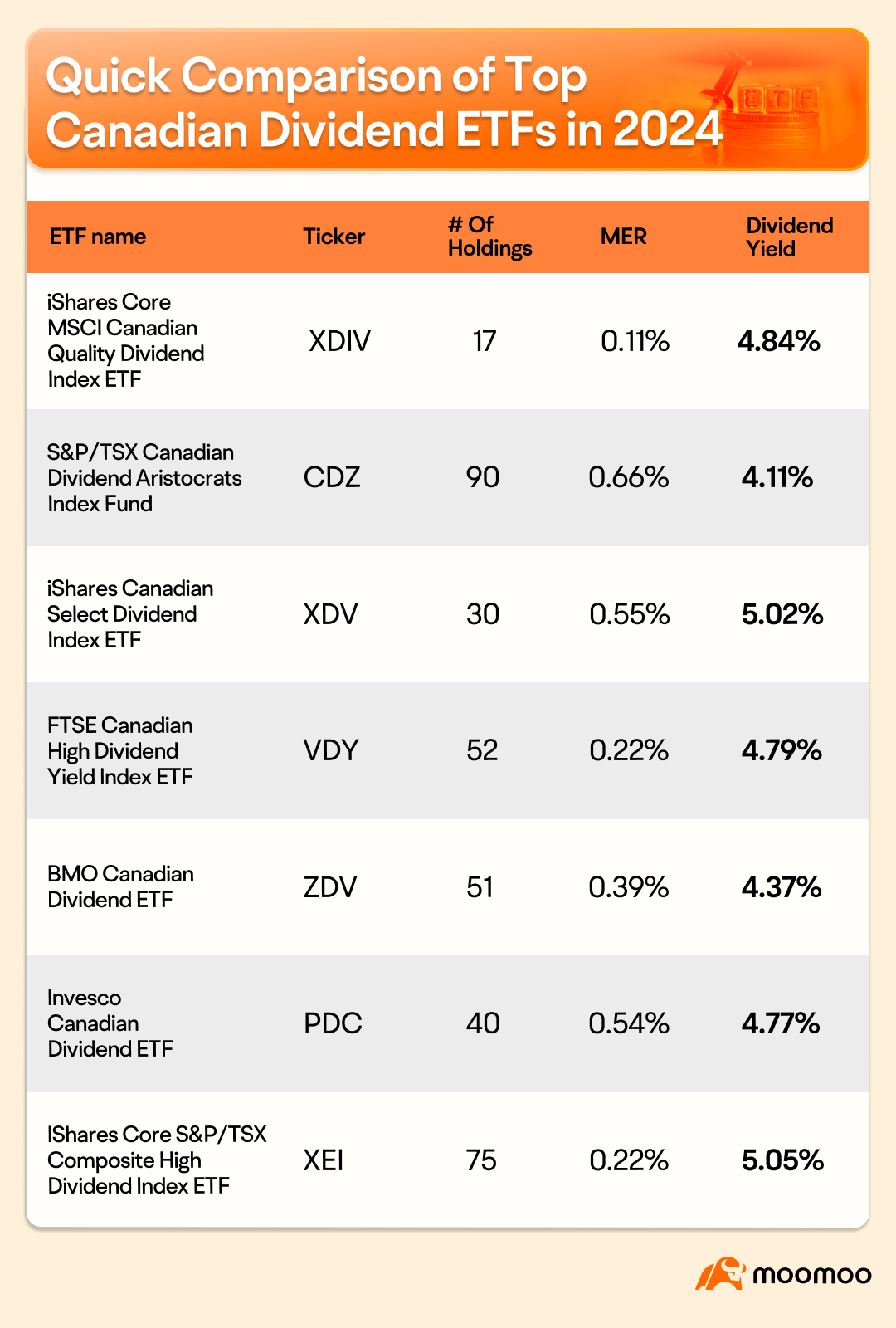
We've chosen to feature the iShares Core MSCI Canadian Quality Dividend Index ETF (XDIV), known for its exceptional performance, for an in-depth introduction.
iShares Core MSCI Canadian Quality Dividend Index ETF (XDIV)
Investment Style: This iShares ETF was launched in June 2017. It offers a low-cost portfolio of Canadian stocks with above-average dividend yields, steady or increasing dividends, and strong overall financials.
Despite its fairly concentrated portfolio of only 17 positions, the XDIV ETF has a management expense ratio (MER) of approximately 0.11%. This makes it a very cost-effective option for a dividend ETF. Due to its lower cost and similar exposure, this iShares ETF may continue to outperform XDV and other Canadian dividend ETFs in the future.
Top 5 Holdings:
Royal Bank of Canada (RY)
Manulife Financial Corp. (MFC)
Pembina Pipeline (PPL)
Toronto-Dominion Bank (TD)
Sun Life Financial (SLF)
Key Facts:
MER: 0.11%
Number of stocks: 17
Dividend yield: 4.84%
Distribution frequency: Monthly
AUM: $930 million
2023 Performance: 11.61%
Note: This is intended for educational purposes only and should not be construed as investment advice.
Low Risk: Diversified all-in-one ETFs
Many investors turn to equity ETFs to boost their retirement portfolios, but not everyone is comfortable putting all their eggs in the stock market basket. Additionally, some lack the time or confidence to manage their asset allocation. ETFs that include stocks, bonds and other investments such as real estate also offer you some passive built-in expertise. You choose the ETF, and the ETF managers choose how to allocate the funds based on their professional experience.
All-in-one ETFs offer a simple and effective solution for diversified asset allocation.
What is the "Core and Explore" strategy?
Investing shouldn't be an all-or-nothing proposition, where investors are forced to choose products that only correspond to their risk tolerance and offer little flexibility. That's why some people adopt a "Core and Explore" strategy when building their portfolio.
Core holdings aim for consistent results and typically include a mix of equities and fixed income, weighted according to the investor's risk tolerance.
Explore holdings aim for surprise results, or use unconventional investments. A range of Explore investments can include anything from initial public offerings (IPOs), special-purpose acquisition companies (SPACs), thematic funds, venture capital funds, to cryptocurrencies.
Core and Explore strategy adopters might allocate a large part, 80%-90% of their assets to the Core, investing in broad-market index funds or similar diverse holdings. The remaining 10%-20% is dedicated to Explore-ing opportunities which can lead to growth in emerging sectors or through high-risk, high-return ventures.
How to implement the core and explore ETF strategy
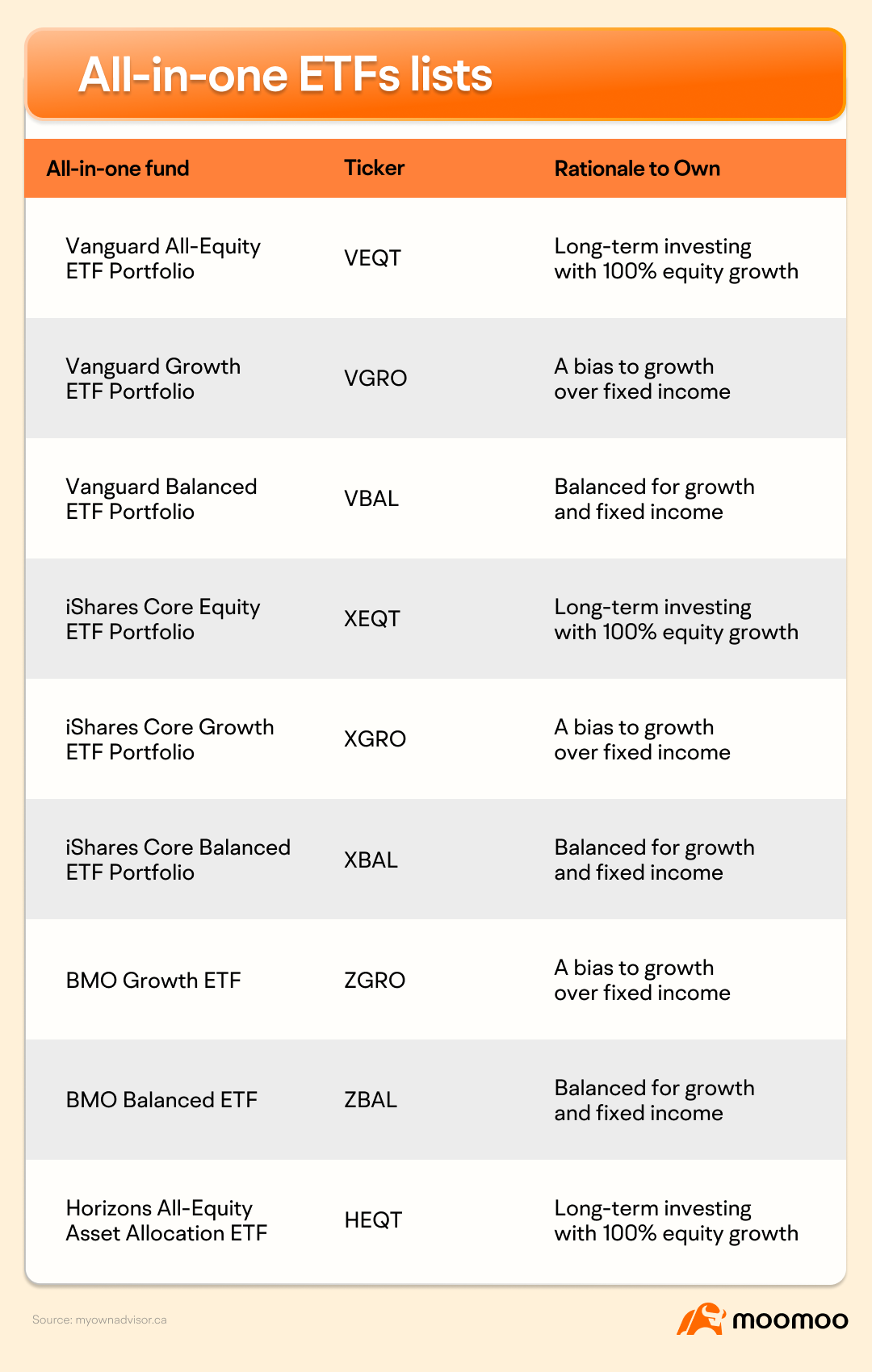
When using the Core and Explore strategy with ETFs, investors can simplify their Core investments with all-in-one ETFs. These convenient 'one-ticket' solutions can encompass a variety of stocks and bonds, often automatically rebalanced within the fund's mandate.
All-in-one advantages
These ETFs eliminate the hassle of manual rebalancing, offering a predetermined blend of assets.
They cater to varying risk preferences and ensure global diversification.
The global diversification extends to a mix of U.S. and international equities and bonds, with some also incorporating Canadian assets.
With an all-in-one ETF as the Core, investors can afford to be bolder with their Explore choices.
For example, let's compare two different all-in-one ETFs:
ETF #1 Balanced
The Fidelity All-in-One Balanced ETF (FBAL) is a low to medium risk ETF with:
59% global equity
39% global fixed income
2% cryptocurrencies
As of Oct. 31, 2023.
ETF #2 High Equity Growth
The Fidelity All-in-One Growth ETF (FGRO) has a higher equity weighting with:
82% global equity
15% global fixed income
3% cryptocurrencies
As of Oct. 31, 2023.
The first all-in-one ETF has a focus on creating a balanced investment portfolio with a relatively low-risk portion in global fixed income such as bonds and treasury bills from different countries and corporations. The second all-in-one ETF is a growth focused ETF with a relatively large portion of global equities.
You can further diversify your holdings by adding multiple all-in-one ETFs to your portfolio.
Mid Risk: A mix of ETFs and dividend stocks
Investors often debate whether high-yield ETFs or individual stocks will bring in greater returns.
A high-yield ETF such as a high-dividend ETF is intended to reduce risk by offering a diversified mix of income-focused stocks. However, you may find it difficult to pass up an investment in a steadily growing high-dividend stock with excellent financials. The good news is that you can have both by creating a strategy that mixes both ETFs and individual stocks, at portfolio weights that feel right for your investment goals.
Hybrid advantages
Owning individual stocks can offer the advantage of minimal or no money management fees, which can increase overall returns for investors.
This approach can be tax-efficient, as investors can hold Canadian dividend-paying stocks in taxable accounts and low-cost US-listed ETFs inside RRSP accounts, potentially reducing their tax burden.
Stocks can protect against inflation by potentially increasing earnings and dividends as the prices of goods and services rise over time.
To learn more about tax-efficiency, check out Everything you need to know about your RRSP.
High Risk: Leveraged ETFs
Leveraged ETFs offer a way to increase your exposure to indices or assets without needing a margin account. With a margin account, you borrow funds to invest in an ETF. However, a leveraged ETF already has loans included in the fund's holdings. Using margin or leverage increases both losses and gains.
For example, a 3x leveraged ETF on the Nasdaq 100 index would rise by 3% if the index closes up by 1% for the day, while a 3x short ETF on the same index would drop by 3%.
Leveraged ETFs come with significant risks. They use daily rebalancing to maintain a constant level of leverage, which can lead to compounding effects that may not reflect long-term trends of the underlying index.
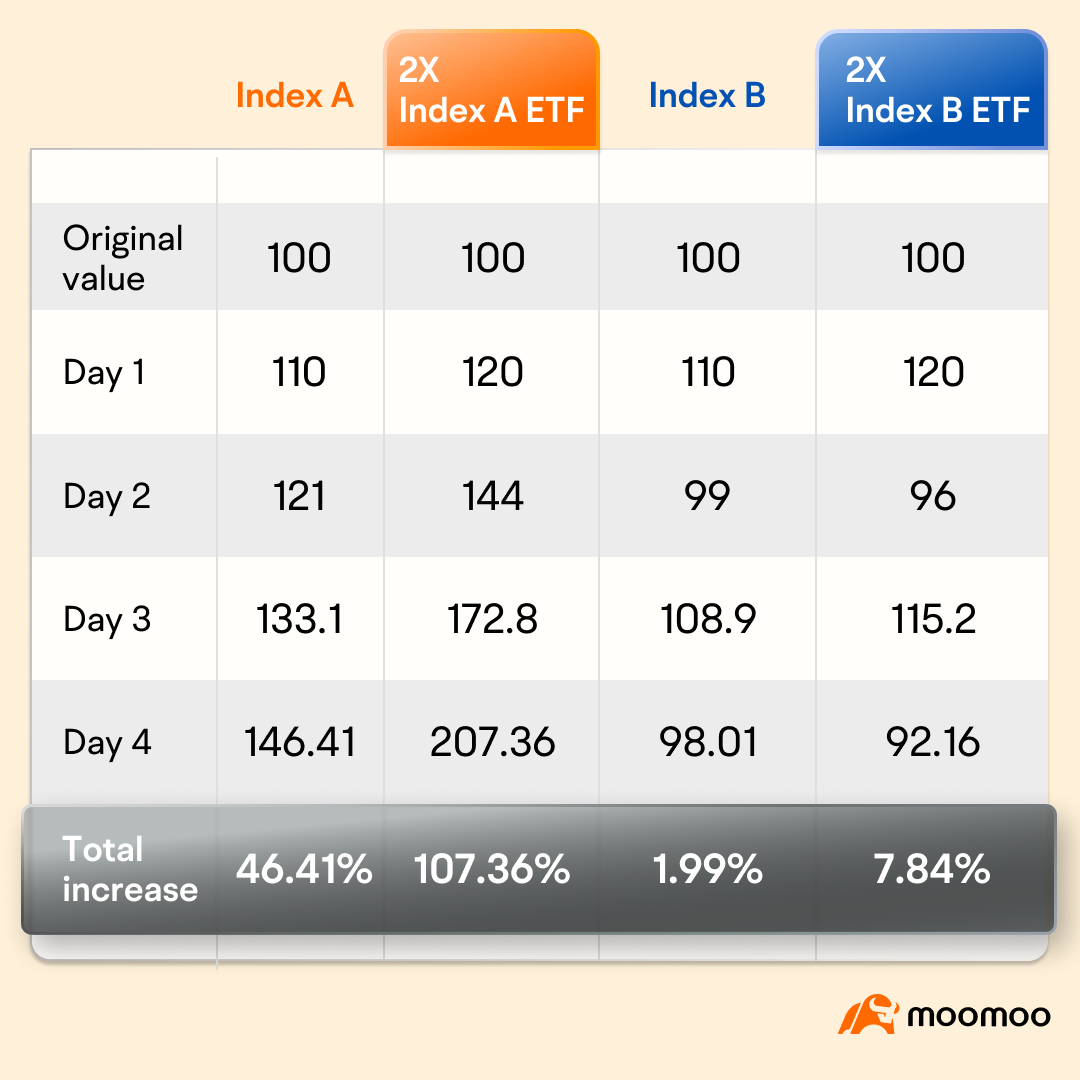
To show the outsized effect of leverage, let's look at an example:
Standard ETF: If Index A starts at 100 and grows 10% daily for four days, it ends up at 146.41.
Leveraged ETF: A 2x leveraged ETF on Index A, also starting at 100, would ideally rise 20% daily with rebalancing. After four days, the ETF could end at 207.36, showing a larger percentage increase due to the leverage and compounding effects.
While leveraged ETFs can help amplify returns during periods of extreme market strength, this compounding can also magnify losses, making leveraged ETFs a volatile and potentially risky investment.
Leveraged ETFs with unconventional investments
Leveraged ETFs may also include futures or swap contracts in their portfolios. These unconventional investments can carry additional risk, and may require frequent trading and active management by fund managers to avoid significant deviations from their underlying benchmarks.
This additional effort may result in additional fees that are deducted from the ETF's net assets. Read the fine print in the ETF prospectus to see what investments may be included in the ETFs.
For investors seeking passive investments to save time and effort, leveraged ETFs may not be suitable for long-term holding.
Now that you have a snapshot of how to use ETFs for different investment strategies, you can get started with your own investments. If you are still hesitating, consider opening a paper trade account to test out a strategy before investing with your actual funds.
Join moomoo now to discover ETFs firsthand.
This presentation is for informational and educational use only and is not a recommendation or endorsement of any particular investment or investment strategy. Investment information provided in this content is general in nature, strictly for illustrative purposes, and may not be appropriate for all investors. Read more