Best Oil ETFs to Buy in 2026: Middle East Tensions Drive Oil
Key Takeaway
Oil ETFs remain a strategic investment for Canadian portfolios in 2026, balancing current demand with the energy transition.
Equity-based ETFs like XLE and VDE offer diversified, long-term exposure to leading energy companies.
Commodity-based ETFs like USO provide direct access to crude oil price movements, ideal for short-term trading.
Consider expense ratios, liquidity, and risk factors when selecting the best oil ETF to buy for your goals.
As geopolitical instability escalates in the Middle East, the global energy market is witnessing one of its most significant breakouts in decades. For Canadian investors, this surge presents a critical strategic moment: while broader markets have struggled with volatility, the energy sector has emerged as a powerhouse, with some funds soaring over 20% year-to-date. With institutional giants like J.P. Morgan and Goldman Sachs closely monitoring supply-side risks in the Strait of Hormuz, the "oil clock" is ticking for those looking to hedge their portfolios against rising inflation.
In this guide, we’ll break down the 10 best oil ETFs to buy in 2026, covering both Canadian oil ETFs and international options and show you how to use moomoo’s professional-grade tools to execute your trades with precision before the next price spike.
The 2026 Oil Surge: Why Investors are Pivoting to Energy
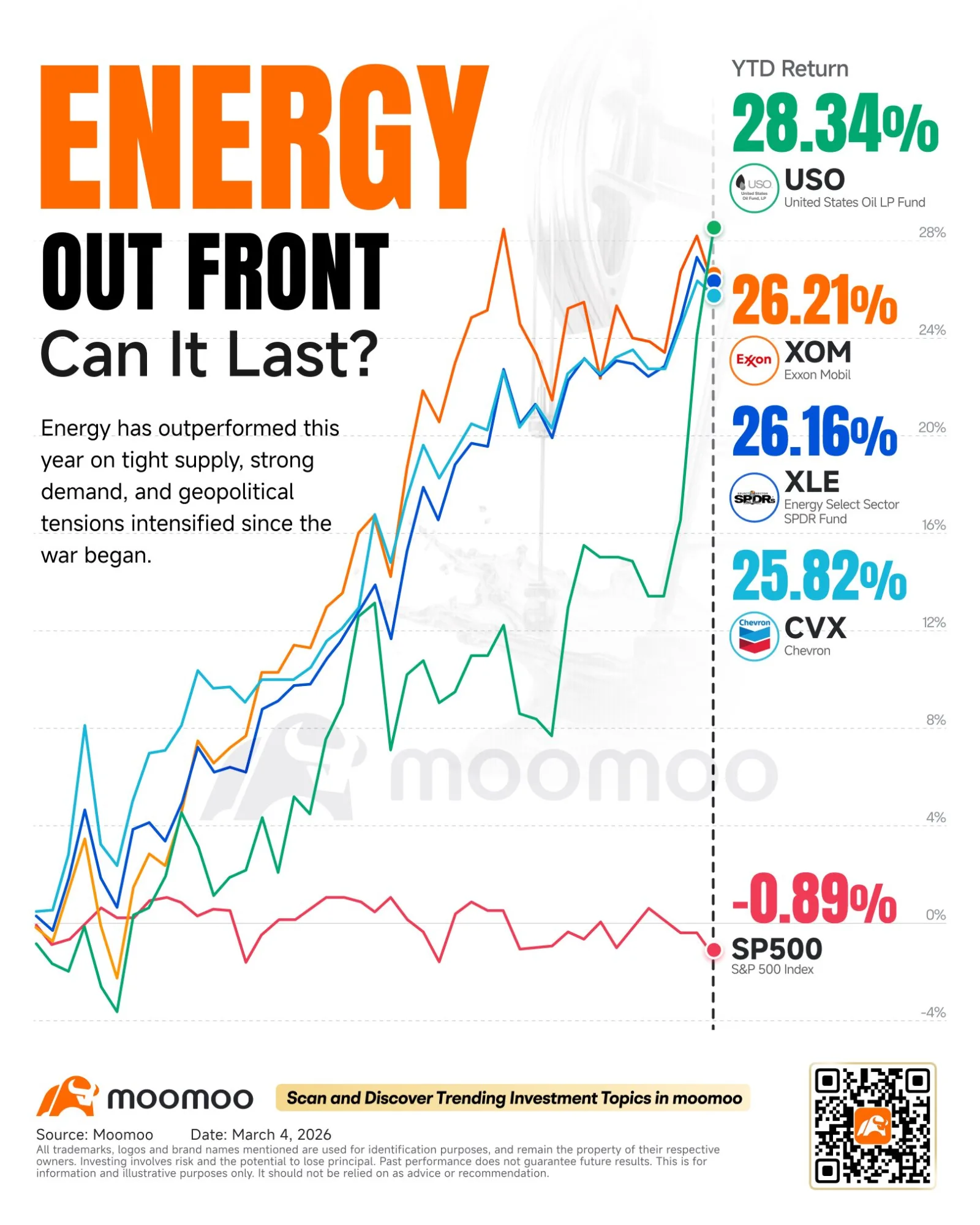
The energy sector has dramatically outperformed the broader market in 2026, with major indices struggling while energy-related assets have surged over 20% year-to-date. This massive rotation is driven by a "perfect storm" of geopolitical and fundamental factors that make choosing the right oil ETFs a top priority for strategic investors.
Geopolitical Risk Premium: Following military actions in the Middle East, Brent crude prices spiked by more than 8% in a single day, as the market began pricing in the uncertainty of a prolonged conflict.
The "Hormuz Factor": Institutional analysts from J.P. Morgan and Goldman Sachs are closely watching the Strait of Hormuz; any significant disruption there could send oil prices toward $100 per barrel, fueling further momentum for every major oil etf.
Institutional Rotation: Capital is rapidly exiting former market leaders and flowing into defensive energy plays, as high-for-longer oil price forecasts make the sector the only one showing both positive returns and strong inflows.
Supply-Side Constraints: With global inventories potentially facing depletion within weeks during a full closure scenario, investors are pivoting to energy to hedge their portfolios against supply-chain shocks.
For investors trying to navigate fast-moving geopolitical events, timely information is just as important as the investment itself. With moomoo’s News & Market Insights, users can access real-time financial news, institutional analysis, and market commentary directly within the app.
>> Download moomoo to stay ahead of latest news!
>> Download moomoo to stay ahead of latest news!
What Are Oil ETFs and How Do They Work?
At its core, an oil ETF is an investment fund that is traded on a stock exchange, much like a regular stock. However, instead of representing ownership in a single company, it holds a basket of assets related to the oil industry. This structure allows investors to buy or sell shares of the ETF throughout the trading day, providing a simple and liquid way to gain exposure to the oil market's performance. The primary goal of an oil ETF is to track the price of oil or the performance of companies within the energy sector.
Equity-Based Oil ETFs vs. Futures-Based Oil ETFs
When looking for the best oil ETF to buy, you'll encounter two primary types. Understanding their fundamental differences is crucial for aligning your investment with your objectives.
Equity-Based Oil ETFs: These funds do not hold oil itself. Instead, they invest in the stocks of companies involved in the oil and gas industry. This can include massive integrated "supermajors" (like ExxonMobil and Chevron), exploration and production (E&P) firms, refiners, and equipment and service providers. Their performance is correlated with oil prices but is also influenced by company-specific factors like management effectiveness, operational efficiency, and dividend policies.
Futures-Based Oil ETFs: These ETFs aim to provide more direct exposure to the price of oil. They do this by investing in oil futures contracts, which are agreements to buy or sell oil at a predetermined price on a future date. The ETF's value moves in close correlation with the spot price of oil. These are often used for more tactical, short-term trading strategies due to complexities like "contango," which we will discuss later.
Here is a simple breakdown of their pros and cons:
Feature | Equity-Based Oil ETFs | Futures-Based Oil ETFs |
Exposure | Indirect; tracks oil company stocks. | Direct; tracks oil price via futures contracts. |
Pros | - Potential for dividend income. | - High correlation to the spot price of oil. |
Cons | - Performance affected by market sentiment and company management. | - Subject to "contango" and "backwardation," which can erode returns. |
Top 5 International Oil and Gas ETFs to Watch
In the current 2026 market climate, identifying the best oil ETF to buy requires a focus on liquidity, institutional flow, and direct exposure to price breakouts. The following oil and gas ETF selections represent the most prominent international vehicles for capturing the ongoing energy surge.
Oil ETF | Tracker | AUM (Approx.) | Expense Ratio | ETF Description |
XLE | S&P Energy Select Sector Index | $39.04B | 0.08% | Broad exposure to US energy giants. |
USO | Light Sweet Crude Oil (WTI) | $1.28B | 0.70% | Direct tracking of crude oil futures. |
XOP | S&P Oil & Gas Exploration Index | $2.55B | 0.35% | Focus on upstream production companies. |
OIH | MVIS US Listed Oil Services Index | $2.48B | 0.35% | Exposure to oil equipment and services. |
IXC | S&P Global Energy Sector Index | $2.24B | 0.40% | Global exposure including non-US majors. |
The data is current as of March 5, 2026. For the latest data, please visit the moomoo quote page. | ||||
Energy Select Sector SPDR Fund (XLE)
As the definitive oil sector ETF for many institutional investors, XLE has dominated 2026 with a YTD return exceeding 20%. It provides concentrated exposure to the largest US energy companies, such as ExxonMobil and Chevron, which have remained resilient even as other market sectors have struggled. For those looking to anchor an RRSP with stable, dividend-paying energy titans, XLE is frequently cited as a top contender.
United States Oil Fund LP (USO)
For investors who want to trade the price of crude oil as directly as possible, the United States Oil Fund (USO) is the most well-known option. As a futures-based ETF, its primary objective is to track the daily price movements of West Texas Intermediate (WTI) light, sweet crude oil.
Strategy: USO invests in near-month WTI futures contracts. It is designed for short-to-medium-term tactical positions rather than long-term buy-and-hold strategies due to the potential for return erosion from contango.
Outlook: In a volatile 2026 market driven by geopolitical headlines, USO offers a liquid tool to speculate on or hedge against sharp oil price swings. Its direct exposure makes it a pure play on the commodity itself.
Why let high currency conversion fees eat into your oil trading profits? For Canadian investors looking to capture opportunities in the US market, moomoo offers a game-changing advantage: $0 Currency Exchange Fees when converting CAD to USD.

SPDR S&P Oil & Gas Exploration & Production ETF (XOP)
Investors with a higher risk tolerance seeking amplified exposure to oil price movements should look at the SPDR S&P Oil & Gas Exploration & Production ETF (XOP). This fund focuses on E&P companies, whose revenues and profits are highly sensitive to commodity prices.
Strategy: Unlike market-cap-weighted funds, XOP uses a modified equal-weighting strategy. This gives more influence to smaller and mid-sized E&P companies, providing a different risk/reward profile than ETFs dominated by supermajors.
Outlook: When oil prices are rising, E&P companies often outperform the broader energy sector, making XOP a powerful tool for bullish investors. However, the reverse is also true, and this ETF can be more volatile during downturns. It's a high-beta play for those confident in the direction of oil prices.
VanEck Oil Services ETF (OIH)
This oil sector ETF targets the companies that provide the essential hardware and services for oil extraction. As oil prices hold "higher-for-longer," the demand for drilling and completion services typically rises, positioning OIH to benefit from increased capital expenditure across the industry. It is a tactical choice for those who believe the energy breakout will lead to a sustained increase in global drilling activity.
iShares Global Energy ETF (IXC)
If you prefer a more stable, long-term approach, the iShares Global Energy ETF (IXC) is an excellent choice. This fund provides diversified exposure to the world's largest and most influential energy companies, including those in oil, gas, and consumable fuels.
Strategy: IXC holds stocks of global energy giants like ExxonMobil, Chevron, Shell, and TotalEnergies. This global diversification reduces single-country risk and provides exposure to different regulatory environments and consumer markets.
Outlook: With its blue-chip holdings and dividend potential, IXC is a solid core holding for long-term investors bullish on the energy sector. It offers a blend of potential capital appreciation and income, making it a strong candidate for the best oil ETF to buy for a balanced portfolio.

5 Best Canadian Oil ETFs to Watch
For investors focusing on domestic energy exposure, selecting a Canadian oil ETF can be a strategic way to benefit from Canada’s vast oil and gas industry while trading in local markets. These ETFs provide diversified access to major Canadian energy producers, making them an attractive option for those seeking an oil ETF in Canada without the need to pick individual stocks.
The following picks highlight several oil ETF Canada options that investors often consider when looking to gain targeted exposure to the country’s energy sector.
Top Canadian Oil ETF Comparison
Oil ETF | Tracker | AUM (Approx.) | ETF Description |
XEG | S&P/TSX Capped Energy Index | $1.95B | Broad exposure to Canadian energy blue-chips. |
ZEO | BMO Equal Weight Oil & Gas Index | $288.65M | Balanced exposure across Canada's energy sector. |
HUC | Horizons NYMEX Crude Oil Index | $43.65M | Tracks crude oil prices via futures (CAD-hedged). |
NNRG | Active Management (Nutrient/Energy) | $1.48B | An actively managed fund focused on energy growth. |
VCE | FTSE Canada Capped Energy Index | $3.24B | Low-cost exposure to top-tier Canadian energy firms. |
The data is current as of March 5, 2026. For the latest data, please visit the moomoo quote page. | |||
iShares S&P/TSX Capped Energy Index ETF (XEG)
Widely regarded as the benchmark Canadian oil ETF, XEG provides heavy exposure to the "Big Oil" players in Canada, such as Canadian Natural Resources and Suncor. As capital rotates from losers to winners in 2026, XEG’s concentrated portfolio of liquid, large-cap energy stocks makes it a primary target for institutional inflows.
BMO Equal Weight Oil & Gas Index ETF (ZEO)
Unlike market-cap weighted funds, ZEO offers an ETF Canadian oil investors use to avoid over-concentration in just one or two companies. By equally weighting its holdings, ZEO captures the growth of mid-sized producers that may benefit more acutely from the 2026 oil price surge than their larger counterparts. This makes it a tactical choice for those who believe the energy breakout will lift the entire industry, not just the giants.
Horizons NYMEX Crude Oil ETF (HUC)
If you are looking for an oil ETF in Canada that tracks the commodity price directly rather than equity performance, HUC is a unique CAD-hedged solution. It uses futures contracts to provide exposure to the light sweet crude oil market, allowing Canadians to speculate on the $100/bbl forecasts mentioned by Goldman Sachs without needing to open a USD account. It is particularly effective during sharp spikes in Brent and WTI prices.
Ninepoint Energy Fund (NNRG)
NNRG is an actively managed Canadian oil ETF designed for investors who prefer professional portfolio management in navigating the volatile energy market. By actively adjusting holdings in response to factors such as supply disruptions and shifting geopolitical risks, the fund aims to outperform traditional passive energy indices. For investors seeking an expert-led approach to identifying high-potential energy opportunities before they gain widespread attention, NNRG offers a compelling active management advantage.
Vanguard FTSE Canadian Capped Energy Index ETF (VCE)
VCE is a low-cost Canadian oil ETF designed for long-term investors who prioritize fee efficiency and broad sector exposure. It tracks some of the largest Canadian energy companies, offering diversified access to the country’s leading oil and gas producers along with a consistent dividend stream. As the energy sector continues to attract strong investor inflows in 2026, VCE provides a reliable, broad-market vehicle for those seeking stable exposure to Canada’s energy industry.
How to Buy Oil ETFs in Canada?
Investing in the energy sector has become a primary strategy for Canadians looking to hedge against inflation and capitalize on global market shifts. Whether you are looking for a Canadian oil ETF or an international powerhouse, moomoo provides a seamless, professional-grade platform to execute your trades in minutes.
In this section, we will guide you on how to buy oil ETFs in Canada.
Step 1: Open and Fund Your Account

Start by opening a dedicated investment account, such as an RRSP or TFSA, to maximize your tax efficiency. With moomoo’s Instant Deposit via INTERAC e-Transfer®, your funds can arrive in just 1-3 minutes, allowing you to react instantly to sudden oil price spikes.

Step 2: Navigate to the ETF Hub and Research oil ETF
When researching oil ETFs, investors often face dozens of options on the market. The real challenge isn’t just finding ETFs—it’s quickly identifying which ones stand out based on key metrics.
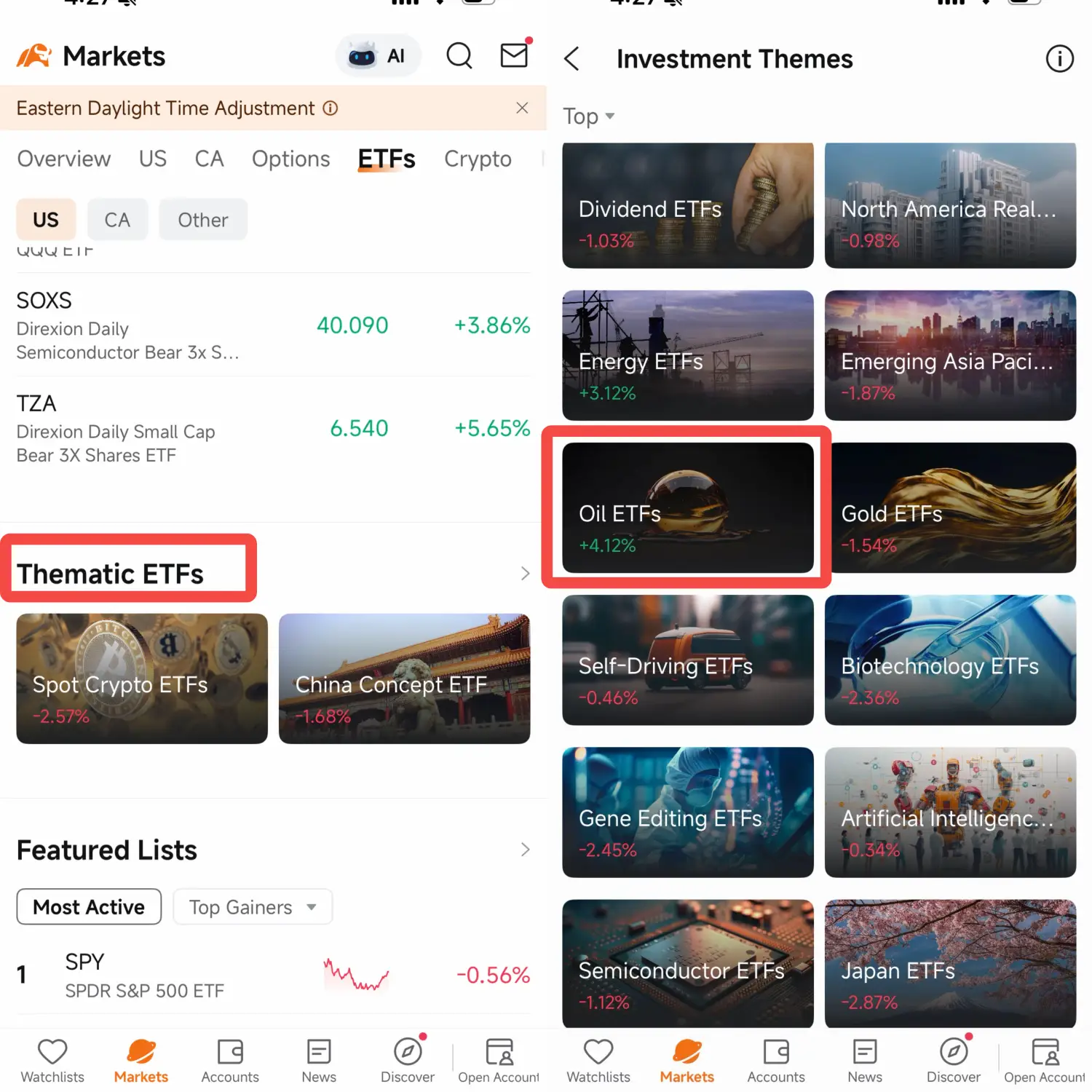
In the moomoo app, you can easily access this feature by opening the app, tapping Markets → ETF, and scrolling down to Thematic ETFs. After selecting a theme such as Energy, the platform displays a list of related ETFs in one place.
From there, investors can sort and rank ETFs by metrics like Price, YTD Change, Turnover, AUM, and Expense Ratio, this ensures you find the most cost-effective oil etf in Canada or US-listed fund for your portfolio. Instead of manually searching and comparing multiple ETFs across different pages, this tool allows you to quickly evaluate and shortlist potential gold ETFs directly within the app.
Step 3: Compare ETF
Once you’ve shortlisted several oil ETFs, the next question is which ones truly fit your portfolio. This is where moomoo’s ETF Compare tool becomes invaluable.
Instead of flipping through multiple fact sheets or building spreadsheets, you can compare multiple ETFs side by side and evaluate key metrics such as historical performance, AUM, expense ratio and management fees, dividend yield, and volatility. For example, while several ETFs may look similar at first glance, a deeper comparison might reveal differences in cost efficiency, liquidity, or dividend payouts that could significantly impact your long-term returns.
With all the critical data displayed clearly in a single view, ETF Compare removes guesswork and helps you make confident, informed investment decisions, even if you’re only testing one position or weighing multiple options.
Step 4: Execute with Precision
Once you’ve selected the right oil ETF, it’s time to execute your trades with confidence. Moomoo’s Advanced Orders give you full control over how and when your trades are placed, so market fluctuations no longer dictate your schedule.
For example, a Stop-Limit Order allows you to automatically sell your position at a specific price if the market drops, protecting your investment without constant monitoring. Meanwhile, a Trailing Stop-Limit Order can follow the market upward, locking in gains while still letting your position grow.
With 8 Order Types, including 6 advanced options beyond basic market and limit orders, you can set precise entry points, automate exits, and manage risk efficiently, all tools designed to help you trade oil ETFs with accuracy, even in volatile or unpredictable market conditions.

Step 5: Monior Your Portfolio and Follow Real-time News
Stay ahead of the "Oil Clock" by using moomoo’s integrated newsfeed. Receive real-time push notifications from top-tier sources like Bloomberg and Dow Jones, ensuring you are the first to know about geopolitical developments in the Middle East that could impact your holdings.
Conclusion: Are Oil ETFs a Good Buy in 2026?
In 2026, oil ETFs remain a compelling option for investors looking to capitalize on energy sector momentum and hedge against geopolitical uncertainty. With rising oil prices, supply-side constraints, and strong institutional interest, finding the best oil ETF to buy can offer both growth potential and portfolio diversification.
Tools like moomoo’s ETF Compare and Advanced Orders make it easier to select the right ETFs, monitor performance, and execute trades with precision—helping investors manage risk while maximizing opportunities. Whether you’re targeting Canadian oil ETFs or broader global options, the key is using professional tools to make informed, strategic decisions in a volatile market.
This presentation is for informational and educational use only and is not a recommendation or endorsement of any particular investment or investment strategy. Investment information provided in this content is general in nature, strictly for illustrative purposes, and may not be appropriate for all investors. Read more