Top 4 Performing Canadian Equity ETFs to Watch 2024

This year, the Canadian Securities market has been performing well, with the S&P/TSX Composite Index continuously rising due to the strong performance of various industry sectors and the optimistic expectations for a global economic recovery. With sectors such as resources, finance, and biotechnology leading the charge, the Canadian Securities market has become a focal point for investors. For those looking to gain exposure to the overall Canadian Securities market, investing in Canadian equity ETFs (Exchange Traded Funds) is a good choice.
In light of this, this article will explore why Canadian equity ETFs are worth investors' close attention and focus on the four good-performing Canadian equity ETFs in 2024.
What are equity ETFs?
Equity ETFs, which are a part of Exchange Traded Funds (ETFs) that focus on stocks, are financial products that track a specific basket of stocks, often from a particular stock index, and are traded on stock exchanges like regular stocks. These ETFs can track indices such as the S&P/TSX Composite Index, the S&P 500, or other indices, sectors, themes, or even strategic portfolios.
The core concept of ETFs is to provide a low-cost way for investors to gain diversified exposure to a broad array of stocks. Here are several key points explaining why equity ETFs are an important tool for modern investors:
Diversified investing
By holding shares of an ETF, investors can easily gain exposure to a diversified portfolio consisting of dozens to hundreds of stocks. This diversification helps spread risk, as poor performance from a single stock will not significantly affect the overall performance of the ETF. This is an ideal choice for investors who wish to reduce the risk associated with individual stocks without spending a lot of time and effort researching each one.
High liquidity
Unlike traditional mutual funds, ETFs offer more flexibility in trading. Investors can buy and sell ETF shares at any time during the trading day, which means they can quickly adjust their positions in response to market changes. This immediacy and flexibility make ETFs an ideal choice for many investors seeking to rapidly respond to market dynamics.
High transparency
ETFs are required to report their holdings regularly, and this transparency allows investors to understand the specific companies and assets they are investing in. This level of information transparency helps investors make more informed investment decisions and more easily monitor their portfolios.
Cost-efficiency
Since most ETFs are passively managed—that is, they aim to replicate the performance of a selected index rather than trying to outperform it—they typically have lower management fees and operating costs. Compared to actively managed funds, this low-cost structure allows investors to keep more of their returns.
Benefits of investing in Canadian equity ETFs
Having understood the benefits of investing in equity ETFs, we now know that there are additional benefits to investing in Canadian equity ETFs, based on the characteristics of the Canadian economic market.
Rich exposure to industries
Investing in Canadian equity ETFs provides investors with the opportunity to access a diversified Canadian market. The cornerstone of the Canadian economy is its abundant natural resources, such as oil, gas, metals, and minerals, which are important components of global demand. However, Canada's economy is not limited to natural resources. It also includes a strong financial services industry and a growing technology sector. By investing in Canadian equity ETFs, investors can gain direct exposure to these resources and the financial industry, and indirectly participate in other areas that support the development of these industries, such as logistics, manufacturing, and technical services. This diversification helps to mitigate the potential impact of poor performance in a particular industry or company.
Economic stability and safety
Canada's economic system is known for its stability and transparency. As one of the G7 countries, Canada has a robust legal framework and supportive government policies that create an environment conducive to business growth and investment returns. In addition, Canada's banking system performed exceptionally well during the global financial crisis and is recognized as one of the most robust banking systems in the world. This economic stability provides investors with a safer investment environment, reducing investment risks due to macroeconomic instability.
Top 4 Canadian equity ETFs to watch 2024
When considering investing in equity ETFs, it's not just about looking at historical performance. Other key factors such as the fund's size, expense ratio, and holdings are also crucial to evaluate. Here are four Canadian equity ETFs that have shown good performance this year and are worth paying attention to:
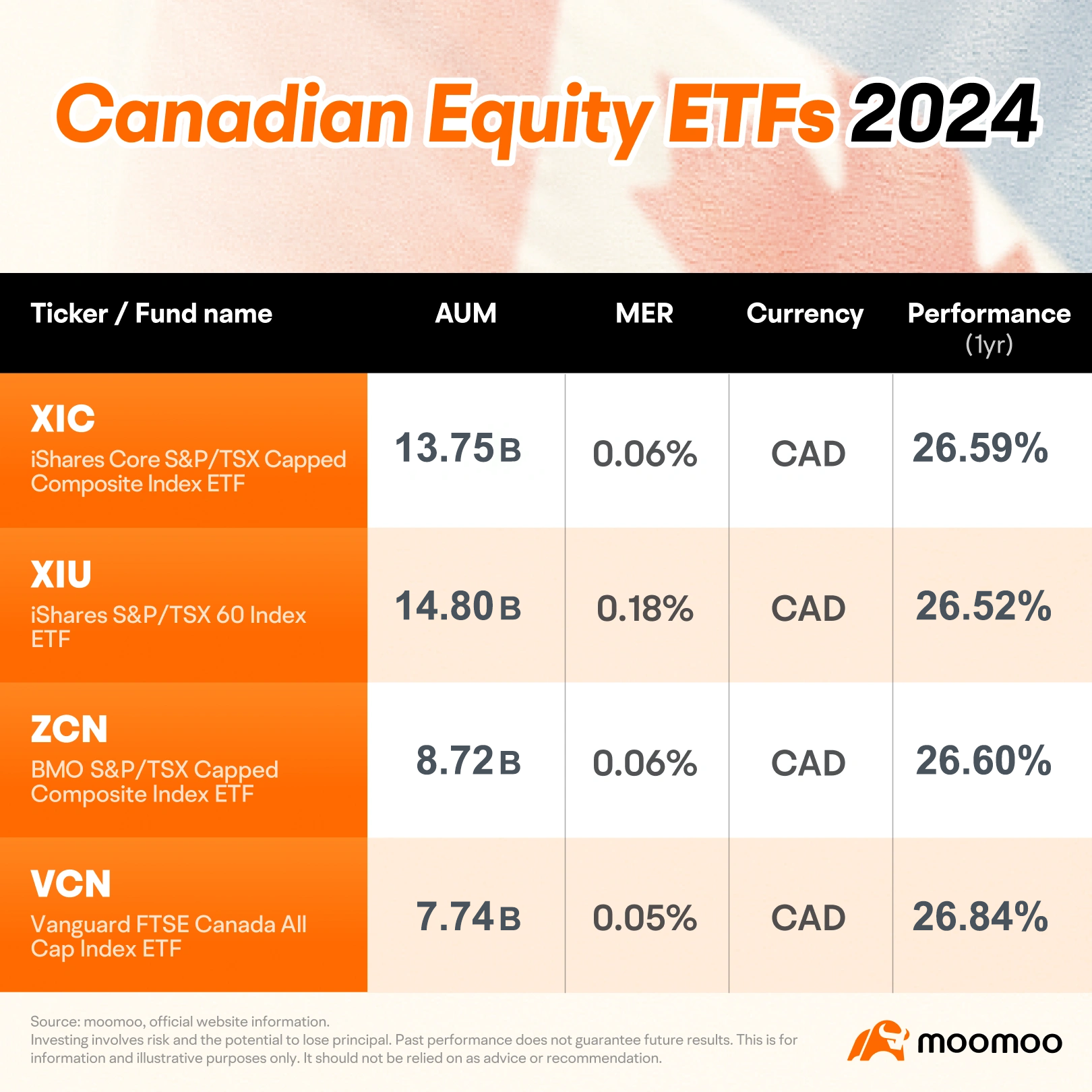
(XIC , XIU , ZCN : AUM date as of Oct 21, 2024 ; Performance date as of Sep 30, 2024)
(VCN : All date as of Sep 30, 2024)
iShares Core S&P/TSX Capped Composite Index ETF (XIC)
This ETF tracks the S&P/TSX Capped Composite Index. As of October 21st of this year, the ETF holds 224 stocks, primarily covering the financial, energy, materials, and industrial sectors, but also maintains exposure to other industry sectors such as information technology. Here is the detailed data.
Top 10 Holdings | Sector Exposure | ||
Name | Weight (%) | Sector | Weight (%) |
Royal Bank of Canada | 6.90 | Financials | 31.78 |
Shopify | 3.90 | Energy | 17.42 |
Toronto Dominion | 3.86 | Materials | 12.83 |
Enbridge Inc | 3.53 | Industrials | 12.63 |
Brookfield Corp | 3.11 | Information Technology | 8.51 |
Canadian Natural Resources Ltd | 2.96 | Consumer Staples | 3.94 |
Canadian Pacific Kansas City Ltd | 2.87 | Utilities | 3.92 |
Bank of Montreal | 2.64 | Consumer Discretionary | 3.34 |
Bank of Nova Scotia | 2.54 | Communication | 2.92 |
Constellation Software Inc | 2.43 | Real Estate | 2.11 |
Health Care | 0.31 | ||
Cash and/or Derivatives | 0.30 | ||
Date as of Oct 21, 2024 | |||
iShares S&P/TSX 60 Index ETF (XIU)
This ETF's Benchmark Index is the S&P/TSX 60 Index. Although it holds only 61 stocks, these high-quality shares still maintain exposure to a majority of industries.
Top 10 Holdings | Sector Exposure | ||
Name | Weight(%) | Sector | Weight(%) |
Royal Bank of Canada | 8.59 | Financials | 35.75 |
Shopify | 4.85 | Energy | 17.74 |
Toronto Dominion | 4.81 | Industrials | 11.35 |
Enbridge Inc | 4.39 | Materials | 10.33 |
Brookfield Corp | 3.87 | Information Technology | 9.44 |
Canadian Natural Resources Ltd | 3.69 | Consumer Staples | 4.17 |
Canadian Pacific Kansas City Ltd | 3.57 | Consumer Discretionary | 3.72 |
Bank of Montreal | 3.29 | Communication | 3.37 |
Bank of Nova Scotia | 3.16 | Utilities | 3.13 |
Canadian National Railway | 3.02 | Real Estate | 0.66 |
Cash and/or Derivatives | 0.33 | ||
Date as of Oct 21, 2024 | |||
BMO S&P/TSX Capped Composite Index ETF (ZCN)
Similar to the iShares Core S&P/TSX Capped Composite Index ETF, both of these ETFs aim to reflect the returns of the same index. Therefore, the data on historical performance, holdings, and sector exposure for these two exchange-traded funds are very close. However, there are subtle differences between them.
Top 10 Holdings | Sector Exposure | ||
Name | Weight(%) | Sector | Weight(%) |
Royal Bank of Canada | 6.91 | Financials | 32.27 |
Shopify | 3.90 | Energy | 16.64 |
Toronto Dominion | 3.86 | Industrials | 12.91 |
Enbridge Inc | 3.53 | Materials | 12.62 |
Brookfield Corp | 3.11 | Information Technology | 8.40 |
Canadian Natural Resources Ltd | 2.96 | Consumer Staples | 4.12 |
Canadian Pacific Kansas City Ltd | 2.87 | Utilities | 4.03 |
Bank of Montreal | 2.64 | Consumer Discretionary | 3.40 |
Bank of Nova Scotia | 2.54 | Communication Services | 3.05 |
Constellation Software Inc | 2.43 | Real Estate | 2.25 |
Date as of Oct 21, 2024 | |||
Vanguard FTSE Canada All Cap Index ETF (VCN)
This ETF's Benchmark Index is the FTSE Canada All Cap Domestic Index. As of September 30th of this year, the number of holdings is 164. Due to the characteristics of the tracked index, the ETF's holdings cover large, mid, and small-cap companies, and also provide a rich sector exposure, aiming to offer investors a representation of the overall Canadian domestic market performance.
Top 10 Holdings | Sector Exposure | ||
Name | Weight(%) | Sector | Weight(%) |
Royal Bank of Canada | 7.17 | Financials | 33.65 |
Toronto Dominion | 4.55 | Energy | 17.1 |
Shopify | 3.94 | Basic Materials | 11.66 |
Enbridge Inc | 3.51 | Industrials | 9.82 |
Canadian Pacific Kansas City Ltd | 3.25 | Technology | 8.72 |
Brookfield Corp | 3.22 | Consumer Discretionary | 6.22 |
Canadian Natural Resources Ltd | 2.84 | Utilities | 5.83 |
Bank of Nova Scotia | 2.72 | Telecommunications | 2.55 |
Canadian National Railway | 2.68 | Consumer Staples | 2.26 |
Bank of Montreal | 2.67 | Real Estate | 2.08 |
Health Care | 0.09 | ||
Date as of Sep 30, 2024 | Date as of Aug 31, 2024 | ||
Final words on Canadian equity ETFs
For Canadian investors, purchasing equity ETFs allows them to easily hold multiple stocks, achieving diversification and gaining exposure to various industries in the Canadian market. However, it is important to note that investors ultimately hold stocks, so investing in equity ETFs is a medium to high risk investment, and investors should be aware of the potential risks brought by market volatility and macroeconomic changes. Additionally, when choosing investment targets, the data of equity ETFs often changes with market fluctuations, so investors need to obtain the latest data from the corresponding fund's official website or broker before making investment decisions. The content of this article is for reference only and does not constitute any investment advice.

This presentation is for informational and educational use only and is not a recommendation or endorsement of any particular investment or investment strategy. Investment information provided in this content is general in nature, strictly for illustrative purposes, and may not be appropriate for all investors. Read more