What Is a Crypto ETF and How to Invest in Crypto ETFs in Canada?

With the rapid development of blockchain technology and the acceleration of global digital transformation, cryptocurrencies have grown from a marginalized concept into a huge market. According to CoinMarketCap data, at the beginning of 2024, the total market value of global cryptocurrencies reached over $2.7 trillion at its peak, with Bitcoin and Ethereum dominating.
Faced with such a vast and dynamic market, an increasing number of traditional investors are looking for ways to enter this field, and Crypto Exchange-Traded Funds (Crypto ETFs) have become the bridge connecting traditional financial markets with the crypto world. In Canada, financial regulatory authorities have a relatively open attitude towards the cryptocurrency industry, which provides a favorable environment for the development of crypto ETFs.
This article will start with the basic information of cryptocurrencies to introduce to Canadian investors what crypto ETFs are, discuss their operational mechanisms, potential advantages, and risks, and how to invest in crypto ETFs in Canada.
What are Crypto ETFs?
Cryptocurrency
Cryptocurrency is a digital or virtual currency based on blockchain technology, which uses cryptographic techniques to ensure the security of transactions and the privacy of users. Unlike traditional fiat currencies (such as the US dollar, euro, etc.), cryptocurrencies do not rely on central banks or government institutions for issuance and management, but instead record and verify transactions through distributed ledger technology, namely blockchain.
Perhaps for investors unfamiliar with cryptocurrencies, it is not easy to fully understand them in a short period of time. However, as a tradable asset, investors can first understand their trading characteristics.
Round-the-Clock Trading
Unlike traditional stock markets, the cryptocurrency market is open almost all year round, 24 hours a day. This means that investors can buy and sell cryptocurrencies at any time, unrestricted by time. This round-the-clock market characteristic provides investors with greater flexibility but also requires investors to remain vigilant, as the market may undergo significant changes at any time.
Price Volatility
The cryptocurrency market has frequent and large price fluctuations. This high volatility provides rich trading opportunities for short-term traders but also increases the difficulty and risk of trading. Investors need to closely monitor market dynamics and adjust their trading strategies in a timely manner.
Market Sentiment Influence
The cryptocurrency market is greatly influenced by market sentiment. Social media, news reports, celebrity remarks, and more can all trigger sharp market fluctuations. Investors need to learn to filter information, avoid blindly following trends, and maintain rational judgment.
Various Trading Methods
Cryptocurrency trading is not limited to spot trading; it also includes futures, options, and other derivative trades. These complex financial instruments provide investors with a more diversified range of trading strategies and risk management tools.
Technical Analysis
Due to the high volatility and complexity of the cryptocurrency market, technical analysis plays an important role in trading. Tools such as chart, indicators, and algorithms can help investors identify trends, support levels, and resistance levels, thereby making wiser trading decisions.
Global Market Interconnection
The cryptocurrency market is a global market, influenced by global economic events, policy changes, and technological advancements. Investors need to pay attention to macroeconomic dynamics worldwide to better predict market trends.
Crypto ETFs
Given the characteristics mentioned above, trading cryptocurrencies might be a high-risk and energy-consuming endeavor for many investors. Purchasing crypto ETFs could be a way for investors to easily gain exposure to cryptocurrencies.
As a type of ETF, crypto ETFs are investment funds listed on stock exchanges that track the performance of specific cryptocurrencies or a basket of cryptocurrencies. They have the following characteristics:
Avoid direct holding: There is no need to understand complex blockchain technology and management rules; the ETF takes care of the management of the underlying assets.
Diversified investment: You can choose ETFs that focus on a single cryptocurrency (such as Bitcoin ETF) or track multiple cryptocurrencies, diversifying investment risks and reducing the impact of high volatility associated with a single cryptocurrency.
Convenience: It can be bought and sold through a stock brokerage account, with simple operations, without the need to open a dedicated cryptocurrency exchange account.
Trading Hours: Trading hours are typically during the market opening times on weekdays.
Regulation: Subject to strict regulation by regulatory authorities, providing higher transparency and security.
Asset Management: Managed by professional fund managers who are responsible for asset management and compliance matters, ensuring the safety and compliant operation of assets.

Types of Crypto ETFs
Based on the different attributes of the underlying assets, crypto ETFs can be divided into Crypto Spot ETFs and Crypto Futures ETFs.
Crypto Spot ETFs
Crypto Spot ETFs hold one or more cryptocurrencies directly to track the price of their underlying assets in the market, aiming to replicate the performance of the underlying assets.
Investors who purchase these ETFs can directly gain exposure to cryptocurrencies, and the structure of these ETFs is simple, making it easy for ordinary investors to understand.
Crypto Futures ETFs
Crypto Futures ETFs do not hold cryptocurrencies directly; instead, they hold futures contracts based on cryptocurrencies as the underlying assets. Futures contracts are agreements that stipulate the purchase or sale of an asset at a set price on a specified future date.
Purchasing these ETFs symbolizes investors' optimism about the future price of cryptocurrencies, representing an investment in their future. Investors gain exposure to the cryptocurrency market through futures contracts without holding the actual assets.
Futures contracts can offer leverage, allowing investors to acquire larger positions with relatively less capital when purchasing these ETFs. However, this also implies greater risk.
You may also like: What are Bitcoin ETFs worth investors' attention in the Canadian market?
Crypto Spot ETFs vs Crypto Futures ETFs
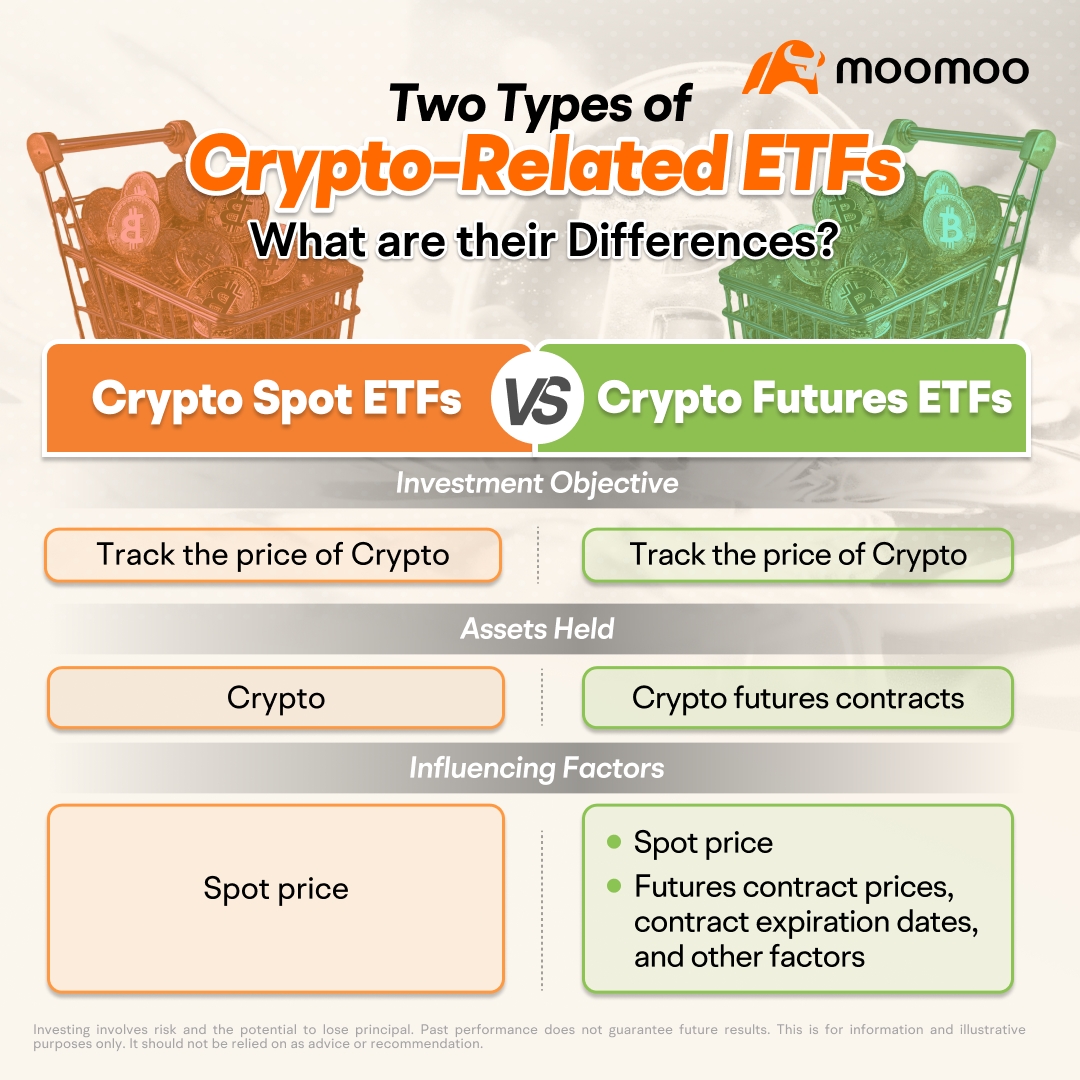
Comparing Crypto Spot ETFs and Crypto Futures ETFs, Crypto Futures ETFs have a relatively more complex structure, and therefore their performance is influenced by more factors. It is important to note that futures contracts have an expiration date, so when futures contracts approach expiration, the managers of Crypto Futures ETFs need to "roll" the expiring contracts into new, longer-dated contracts. This process incurs transaction costs, including fees for buying and selling futures contracts. These costs undoubtedly affect the performance of the ETF.
Benefits and risks of investing in Crypto ETFs in Canada
All investments carry risks. Overall, based on the nature and characteristics of crypto ETFs, the following benefits and risks can be summarized.
Benefits
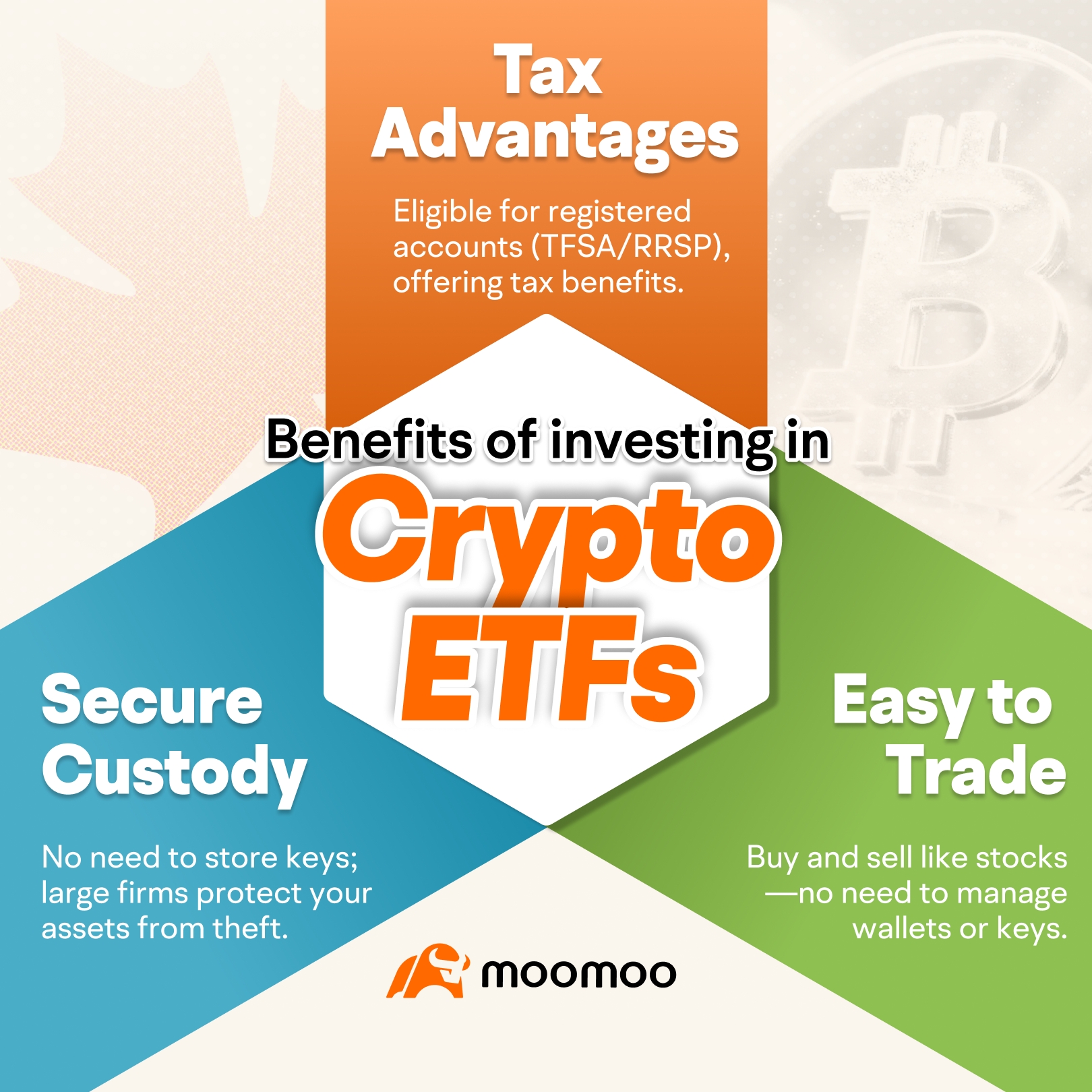
Tax Advantages: As an investor in Canada, you can invest in crypto ETFs using tax-advantaged accounts, such as purchasing ETFs through brokers with a Tax-Free Savings Account (TFSA) and a Registered Retirement Savings Plan (RRSP), thereby obtaining tax relief. This differs from investing directly in cryptocurrencies, as tax-advantaged accounts do not support holding cryptocurrencies.
Secure Custody: If you hold cryptocurrencies directly, investors need to be mindful of safeguarding their private keys, which are the core mechanism ensuring users have control over their digital assets. Managing private keys can be troublesome and poses the risk of loss and leakage for investors. However, if you invest in crypto ETFs, the preservation of private keys will be the responsibility of the fund manager, ensuring the security of your assets.
Easy to Trade: As an ETF, investors can trade like stocks, making transactions easily while avoiding the management of cryptocurrency assets.
Risks
Market Volatility: Cryptocurrencies are highly volatile, and their value is influenced by multiple factors such as regulatory changes, technological developments, and market sentiment, making their value uncertain. These factors, of course, also affect crypto ETFs, exposing them to the risk of high volatility.
Fees: Crypto ETFs have management fees that can impact returns. Additionally, there may be brokerage commissions when buying and selling ETFs, which are costs that investors need to consider.
Other Risks: Cryptocurrencies may face specific risks such as hacking attacks, which can affect the performance of ETFs and ultimately impact investors' returns.
How to invest in crypto ETFs in Canada?
To invest in crypto ETFs in Canada, one must first choose a broker, and moomoo is a broker that supports the trading of crypto ETFs in Canada. Investors can trade using moomoo through the following steps.
Step 1: Visit the moomoo Canada or download the moomoo app from the App Store or Google Play Store to create an account.
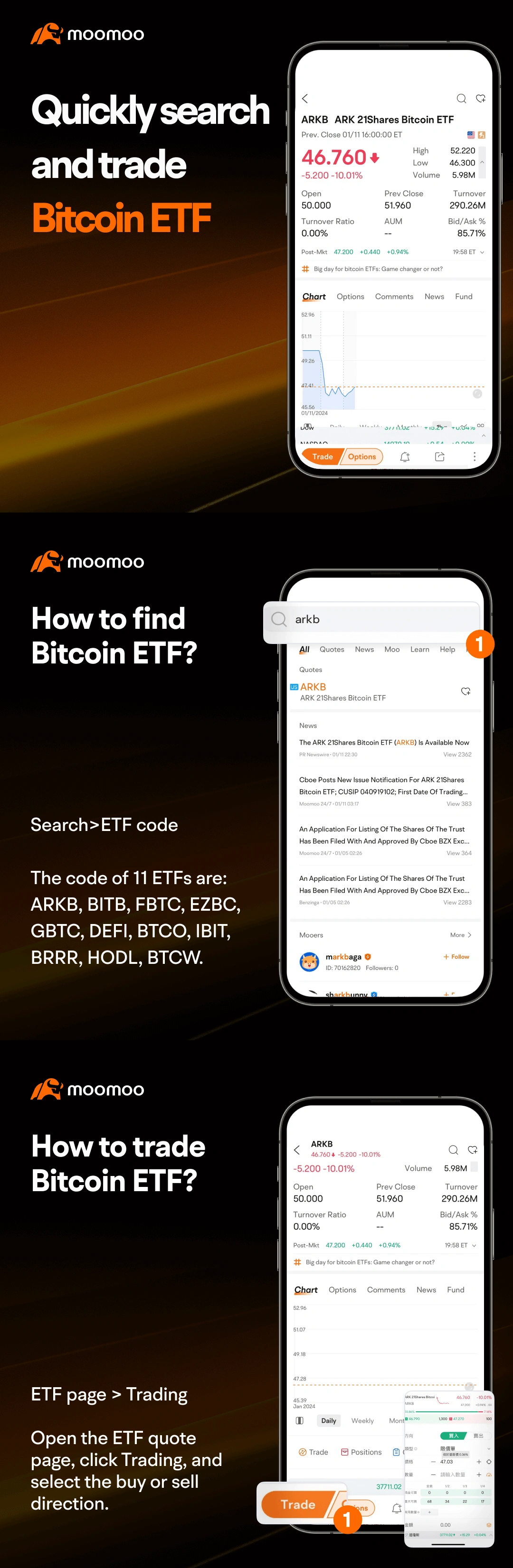
Step 2: Search for and select crypto ETFs to trade. For trading Bitcoin ETFs as an example, you can follow the process below.
This presentation is for informational and educational use only and is not a recommendation or endorsement of any particular investment or investment strategy. Investment information provided in this content is general in nature, strictly for illustrative purposes, and may not be appropriate for all investors. Read more