How to Buy BYD Stock in Canada?
Key takeaways
 Learn how to invest in BYD in Canada with easy steps. The 1:6 BYD stock split will take effect on July 30, 2025 (U.S. Eastern Time), increasing share quantity and lowering the price per share. The BYD stock split makes shares more affordable and improves liquidity for Canadian retail investors. BYD’s strong growth in electric vehicle sales and global expansion offers promising long-term investment potential.
BYD has emerged as a global leader in electric vehicles and batteries. Canadian investors looking to tap into this momentum may wonder how to invest in BYD in Canada. A key event is the upcoming 1-for-6 stock split for the BYD ADR (ticker BYDDY), effective July 30, 2025 (U.S. Eastern Time). This adjustment means each existing share will be split into six, making the stock more affordable and accessible for retail investors in Canada.
If you are considering investing in BYD, now is a great time to learn about the stock split and how it could benefit your investment strategy. Let’s get started!
How to buy BYD stock in Canada? Step-by-step guide
The main way to invest in BYD shares in Canada is through an online trading platform that offers access to the U.S. over-the-counter (OTC) market. Follow our step-by-step guide below to get started.
Step 1: Selecting a broker and opening an account
To buy BYD stock in Canada, your first step is to choose a reliable online broker that offers U.S. OTC access.
Each broker has its own fee structure, trading tools, and account types, so it’s important to compare features based on your needs.
After selecting your preferred brokerage platform, you need to do the following:
Create your account – Start by signing up on your chosen broker’s platform. You’ll need to provide basic details such as your full name, email address, mobile number, and create a secure password.
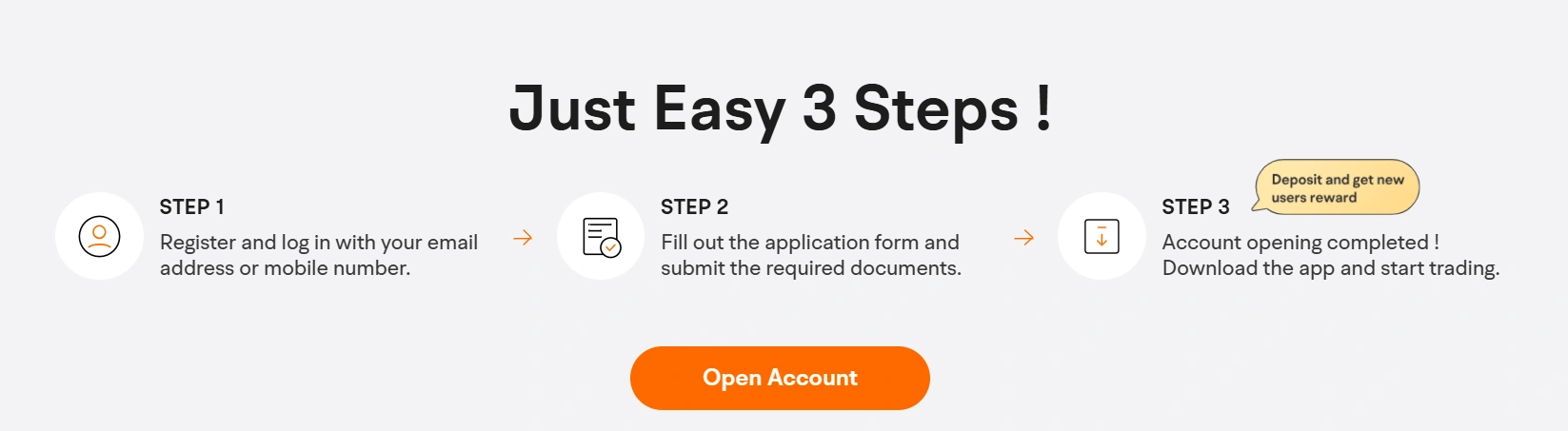
Enter your personal information – Canadian brokers will ask for additional details like your date of birth, residential address, employment status, and Social Insurance Number (SIN) for tax reporting purposes.
Verify your identity – To comply with Canadian regulations, you’ll need to upload a government-issued photo ID (like a driver’s licence or passport) and a proof of address document, such as a recent utility bill, bank statement, or government correspondence.
Step 2: Fund your account
Once your brokerage account is open, the next step is to deposit funds so you can start investing. Canadian investors have several convenient options to fund their accounts, including online bill payment, Electronic Funds Transfer (EFT), and wire transfer.
Online bill payment is usually the fastest and most recommended method, taking about 1–3 business days for the funds to appear in your account. EFT can take up to 5 business days, while wire transfers are typically processed within 4 business days but may incur fees from your bank.
Step 3: Research BYD stock
Before buying BYD shares through OTC tickers like BYDDY or BYDDF, do your homework on this company. Ask yourself key questions to get a clear picture:
What does BYD do, and what is its core model?
How has it performed historically?
What are its risks or weaknesses?
How does it stack up against competitors?
What are its plans for future growth?
Step 4: Decide how many shares you want to buy
When deciding how many BYD shares to purchase, start by checking the current price. As of mid-June 2025, BYDDY is trading around US $100–$105 per share. To understand the cost in Canadian dollars, use today's USD-to-CAD rate, about 1 USD = 1.37 CAD, so one BYD share costs roughly C$137–C$144.
Next, figure out how much you're comfortable investing. For example, investing C$1,000 would let you buy around 7 shares (7 × C$140 ≈ C$980), leaving a small buffer for fees or currency shifts. Think about:
Your budget – How much are you prepared to invest in one stock?
Diversification – How will BYD fit with other holdings in your portfolio?
Stock split effect – After the 1-for-6 split on July 30, 2025, you'll receive six times more shares at one-sixth the price, so if you buy now, your share count will be multiplied post-split, and per-share cost adjusted accordingly.
Step 5: Place your order
Once you’ve settled on how much to invest in BYD, the next step is to place your order using your chosen brokerage platform.
You’ll typically choose between two main order types:
Market Order – This type of order is executed right away at the best available price. It’s ideal if you want to complete your trade quickly and are okay with minor price fluctuations at the time of purchase.
Limit Order – A limit order allows you to specify the exact price at which you want to buy BYD stock. For example, if you set a limit price of $16.36 per share, your order will only go through if the stock drops to that price or lower. This method gives you more control over the cost but may take longer to execute—or might not go through at all if the price doesn’t hit your target.
The choice between a market and limit order comes down to your investment approach. If timing and execution speed matter most, a market order may be better. If price certainty is your priority, consider using a limit order.
Step 6: Monitor your investment
After purchasing BYD shares, it’s important to regularly monitor your investment to stay informed about the company’s performance and market trends. BYD is a fast-growing player in the electric vehicle industry, and its stock price can be influenced by quarterly earnings reports, new product launches, and global EV market developments. Canadian investors should keep an eye on key financial updates and news that could impact BYD’s stock value.
Using tools available on platforms like moomoo Canada can make monitoring easier. Moomoo offers real-time quotes, detailed charts, and news feeds that help you track BYD’s stock price movements and technical indicators. You can also set alerts for price changes or news events to react quickly if needed.
Additionally, reviewing BYD’s quarterly results and industry trends will help you decide whether to hold, buy more, or sell your shares based on your investment goals and risk tolerance.
Moomoo Canada: One-stop Solution for Global Stocks!
>> Click to open an account and claim your welcome rewards!
>> Click to open an account and claim your welcome rewards!
BYDDY vs BYDDF, what's the difference?
BYDDY and BYDDF are two different ways to invest in BYD stock, but they represent different share classes and trading venues.
BYDDY is the American Depositary Receipt (ADR) of BYD Company Limited, traded on the U.S. OTC market. It represents BYD’s H-shares, which are shares of Chinese companies listed in Hong Kong. BYDDY tends to be more liquid and is often preferred by international investors, including Canadians, because it provides easier access to BYD shares in U.S. dollars.
On the other hand, BYDDF also trades OTC in the U.S. but is considered a less liquid version of BYD’s stock, often referred to as the H-shares themselves. BYDDF usually trades at a lower volume and can have wider bid-ask spreads. In terms of dividends, BYDDF typically offers a higher yield compared to BYDDY, reflecting its different risk and income profiles.

BYD business overview
Company background
BYD was founded in 1995 and is headquartered in Shenzhen, China. It is a global enterprise spanning four major industries: automobiles, electronics, new energy, and rail transit. As of 2025, the company employs over 968,900 people and has established production bases in more than 30 countries. In 2024, BYD’s total assets reached RMB 783.356 billion.
The company’s core business segments include:
New Energy Vehicles: In 2024, revenue from the automotive business reached RMB 617.38 billion, accounting for 79.45% of total revenue.
Mobile Components and Assembly: In the first half of 2024, this segment generated RMB 72.778 billion, making up 24.17% of total revenue.
Rechargeable Batteries and Photovoltaics: In 2024, BYD ranked among the top three globally in terms of installed capacity for new energy batteries.
Industry status
BYD is a global leader in the new energy vehicle (NEV) industry.
In 2024, the company sold 4.27 million NEVs worldwide, securing a 33.2% global market share and maintaining its position as the top-selling NEV brand for the third consecutive year.
In May 2025 alone, BYD delivered 382,500 vehicles, marking a 15.27% year-over-year increase. In the battery sector, its proprietary “Blade Battery” has set new safety standards and holds around 20% of the global market share for power batteries.
The company continues to expand its global footprint.
As of the first half of 2024, overseas revenue accounted for 29.87% of total sales, with products reaching over 100 countries.
BYD has launched manufacturing operations in countries like Thailand and Uzbekistan, driving its overseas vehicle sales share to 29.5%.
Recent financial performance (Q1 2025)
Financial Metric | Q1 2025 Result | Year-over-Year Change | Notes |
Revenue | RMB 170.36 billion (~$24B) | 36.35% | Driven by new energy vehicle (NEV) sales |
Net Income (Net Profit) | RMB 9.16 billion (~$1.26B) | 100.38% | Net income doubled compared to Q1 2024 |
Gross Margin | 20.07% | -0.64 percentage points YoY | Slight decrease from 20.71% in Q1 2024 |
Earnings Per Share (Basic & Diluted) | 3.12 RMB | 98.73% | Significant growth in EPS |
Net Cash Flow from Operating Activities | RMB 8.58 billion | -16.10% | Declined compared to previous year |
Total Assets | RMB 840 billion | 7.30% | Reflects company growth and asset expansion |
BYD’s Q1 2025 results highlight a doubling of net profit year-on-year, driven by strong sales growth in its electric vehicle segment. Revenue rose 36.35% compared to the same period last year, reaching approximately $24 billion USD.
Despite a slight decline in gross margin and net cash flow from operations, BYD continues to invest heavily in technology and international expansion, maintaining its leadership in the global NEV market.
BYD stock performance
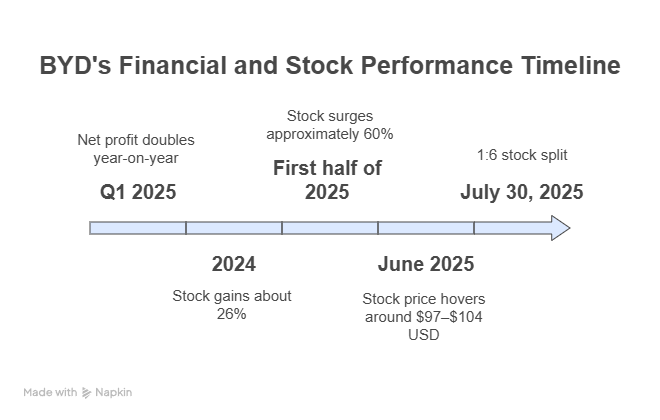
BYD’s American Depositary Receipt (ADR), traded under the ticker BYDDY on the U.S. OTC market, has experienced notable growth and volatility from 2023 through mid-2025. The stock gained about 26% in 2024 and surged approximately 60% in the first half of 2025, reflecting strong investor confidence driven by BYD’s expanding electric vehicle sales and solid financial results.
As of June 2025, BYDDY’s price hovers around $97–$104 USD, with a 52-week high near $120 USD. Despite some short-term fluctuations, the stock has delivered a year-to-date return of over 50%, outperforming many peers in the EV sector.
Analysts project mixed short-term forecasts, with some expecting a price correction around $48 USD to $55 USD by the end of 2025, while long-term outlooks remain very bullish, predicting BYDDY could reach over $200 USD by 2030 and continue rising significantly through 2050.
BYDDY trades at a forward price-to-earnings ratio of about 23.3x, which is considerably lower than Tesla’s ratio, making it attractive for value-conscious investors. Its price-to-sales ratio is also much lower, indicating potential undervaluation given BYD’s rapid growth and innovation in battery technology and vehicle production.
Canadian investors should watch the upcoming 1:6 stock split on July 30, 2025, which will increase share liquidity and lower the per-share price, potentially making BYDDY more accessible to retail investors.
How does the BYD stock split affect existing shareholders?
The upcoming 1:6 stock split for BYD Company ADR (BYDDY) will significantly affect existing shareholders by increasing the number of shares they own while proportionally lowering the price of each share. This split is set to take effect on July 30, 2025, U.S. Eastern Time.
For every one share of BYDDY an investor currently holds, they will receive an additional five shares, resulting in a total of six shares. While the number of shares outstanding will increase, the total value of an investor's holding will remain the same immediately after the split, as the share price will be divided by six.
For example, if you owned one share worth $120, after the 1:6 split, you would own six shares, each valued at approximately $20. This move is primarily intended to boost the stock's liquidity and make it more accessible and affordable for a broader range of investors, including Canadian retail investors.
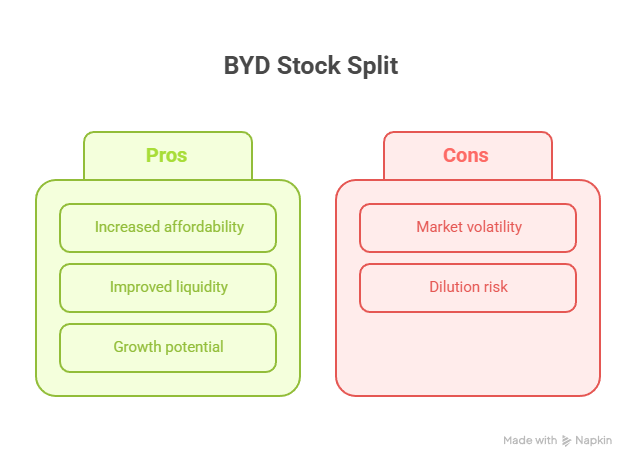
However, shareholders should be aware of a few implications. While the fundamental value of the company does not change, per-share metrics such as Earnings Per Share (EPS) will be proportionally lower (e.g., one-sixth of the pre-split EPS).
There might also be a temporary period where brokerage accounts reflect a lower share price but have not yet allocated the additional shares, which can lead to an apparent "paper loss" until the distribution is completed around the effective date. Despite this, a stock split does not fundamentally alter the company's underlying value or performance; it is primarily an accounting adjustment aimed at improving market accessibility.
Final advice: is BYD a good stock to buy?
For Canadian investors seeking exposure to the global EV and battery revolution, BYD presents a compelling case. The company has consistently delivered strong results—double-digit revenue and profit growth, record vehicle deliveries, and innovations like its Blade Battery and fast-charging tech. Its valuation remains reasonable (~22–24× forward P/E), trading at a discount compared to Western EV leaders. Support from stalwart investor Warren Buffett and robust global expansion efforts further bolster its appeal.
However, BYD also faces challenges. Fierce price competition in China has squeezed margins, and the firm carried a significant working-capital deficit—RMB 125 billion at the end of 2024. Rising global tariffs and regulatory hurdles abroad could also dampen growth. These macro and operational risks are important considerations.
So, if you're looking for long-term growth and are comfortable with exposure to China risk, EV industry competition, and macroeconomic variables, then BYD stands out as a high-conviction pick among EV and cleantech stocks. If you prefer stability, fewer geopolitical or currency risks, you might opt for a more diversified or Western-focused EV fund.
Frequency Asked Questions
Is BYD better than Tesla for long-term growth?
BYD currently shows stronger momentum than Tesla for long-term growth, especially in 2025. BYD sold over 1 million electric vehicles in Q1 2025—more than three times Tesla’s sales—and continues to expand aggressively into global markets with a diverse product lineup and strong vertical integration. This strategy helps BYD reduce costs and improve supply chain stability, giving it an edge in affordability and production scale. Tesla remains a leader in innovation, particularly in autonomous driving and software, but faces challenges including an aging product lineup, delivery declines, and public controversies that have affected investor confidence. Tesla’s financial results in early 2025 showed declining revenue and profit, while BYD reported doubling net income and strong revenue growth. For Canadian investors considering long-term growth, BYD’s current market position and expansion strategy make it a very competitive choice compared to Tesla, though Tesla’s innovation potential still holds upside if it can overcome its operational hurdles.
Should I buy BYD shares before or after the stock split?
It is generally better to buy BYD shares before the 1:6 stock split takes effect on July 30, 2025, because the split will lower the price per share proportionally while increasing the number of shares you own. Buying before the split means you get more shares after the split at a lower price per share, which can improve liquidity and make your investment more flexible. However, the total value of your investment immediately after the split remains the same, so the split itself does not create additional value.
This presentation is for informational and educational use only and is not a recommendation or endorsement of any particular investment or investment strategy. Investment information provided in this content is general in nature, strictly for illustrative purposes, and may not be appropriate for all investors. Read more