Top 10 Communication Services Stocks to Watch after Fed Rate Cuts in 2024

In an effort to stimulate economic growth by reducing the cost of borrowing, the Federal Reserve announced a 50 basis point interest rate cut on September 18, 2024. This policy shift has presented opportunities and challenges across various industries, and for the communications services sector, it could signify a chance for growth.
Over the past year, XLC (The Communication Services Select Sector SPDR Fund) has shown strong performance, increasing by 37%, outpacing the S&P 500 index. The development prospects brought to the communications services sector by the interest rate cut may further propel the rise of related stocks.

This article aims to help investors understand the impact of the interest rate cut on the communications services sector and to assist in their decision-making by introducing some noteworthy stocks in the communications services sector.
Effects of Fed rate cuts on communications services sector
The communications services sector is a capital-intensive sector that heavily relies on technological innovation. On one hand, these companies need to invest substantial capital upfront to build and maintain their infrastructure. On the other hand, with the development of new technologies such as 5G and artificial intelligence, these companies also need to allocate funds for technological upgrades. Given this industry context, the impact of the Federal Reserve's interest rate cut on the communications services sector is mainly reflected in the following aspects.
Reduced financing costs
Lower interest rates mean that communications services companies can obtain loans or other forms of financing at a lower cost. This is crucial for businesses that require substantial capital investment to maintain and expand their network infrastructure. Lower capital costs can help businesses save on expenses and allocate more funds to technological innovation and business development.
Increased capital expenditure
With the reduction in borrowing costs, communications services companies have more financial flexibility to make capital expenditures. This includes investments in next-generation communication technologies such as 5G networks, as well as expansions into emerging areas like data centers and cloud computing. These investments help to enhance the competitiveness of businesses and lay a solid foundation for future technological development.
Boosted stock prices
Interest rate cuts often increase liquidity in the market and raise investors' risk appetite, thereby driving up stock prices. For the communications services sector, due to its technology-driven nature, the stock prices of such companies are typically more sensitive to market sentiment. Therefore, interest rate cuts may lead to increased investor interest in communications services stocks, driving up their prices.
Promoted M&A activities
In an environment of lower interest rates, reduced borrowing costs may stimulate mergers and acquisitions within the communications services sector. Companies can take advantage of low borrowing costs to complete strategic acquisitions, integrate resources, and expand market share.
Increased R&D investment
Lower capital costs provide communications services companies with more funds for research and development, which helps to drive technological innovation within the industry. Whether it's improving existing services or developing entirely new products, increased R&D investment helps businesses maintain a leading position in a highly competitive market.
Potential risks
Although the Federal Reserve's interest rate cuts may bring opportunities such as reduced financing costs for the communication services industry, they also come with a series of potential risks. If companies become overly reliant on debt expansion due to easy borrowing, it can lead to increased long-term financial fragility; moreover, the low-cost financing environment may attract new competitors into the market, intensifying competitive pressure.
Investors should also be aware that if the interest rate cut cycle lasts for a long time, it may create a prolonged low-interest-rate environment, potentially leading to an excess of funds flowing into the communication technology sector and causing asset bubbles. Additionally, sustained low interest rates could be accompanied by currency devaluation and inflation, increasing costs for companies that rely on imported equipment. Finally, if future monetary policy suddenly shifts, it could also lead to market volatility and disrupt corporate strategic planning. Therefore, while enjoying the short-term benefits brought by the interest rate cuts, investors should also remain sensitive to changes in the macroeconomy.
Top 10 communications services stocks to watch after Fed rate cuts
Here, based on market capitalization and past performance over a period of time, ten noteworthy stocks in the communications services sector have been selected.
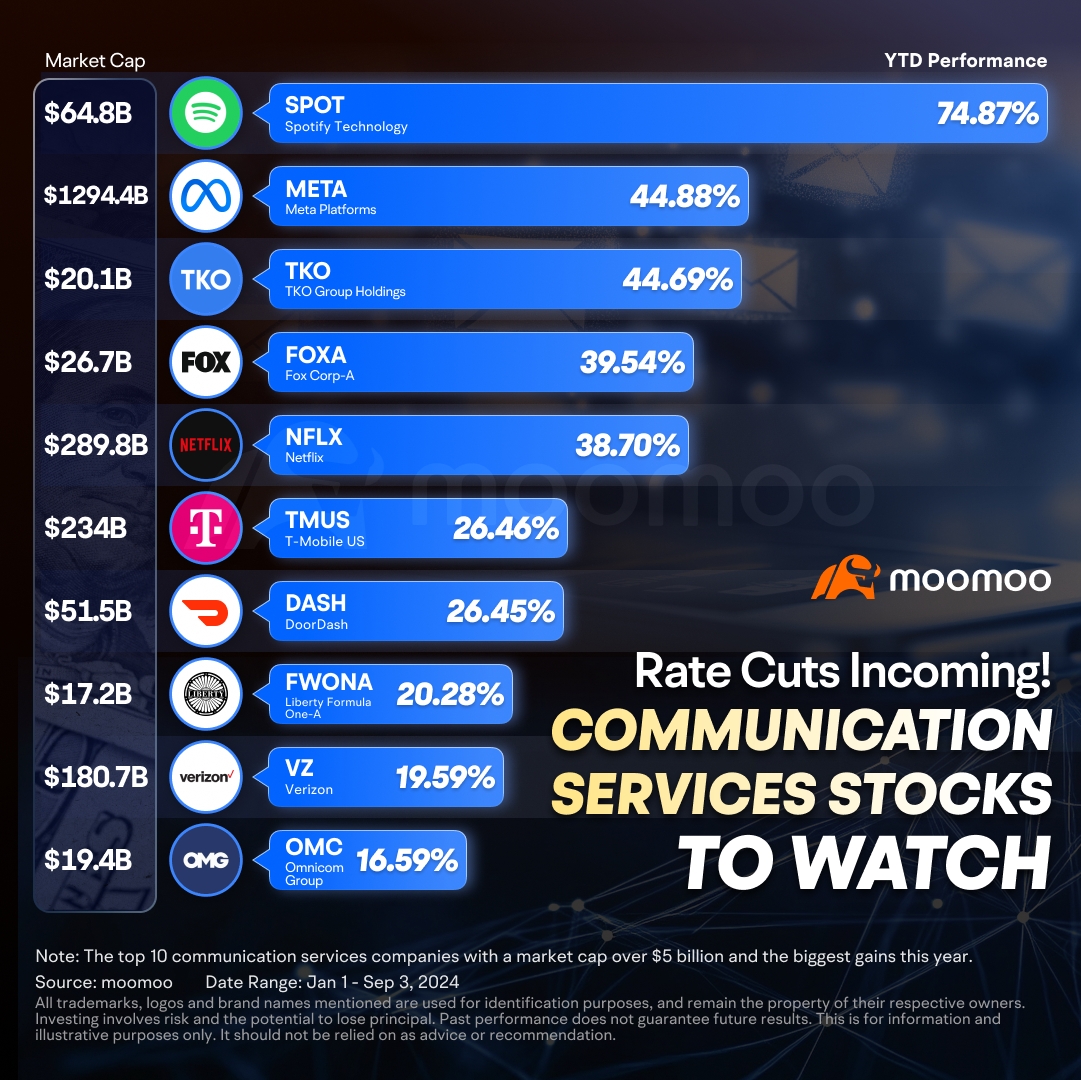
Spotify Technology (SPOT)
Spotify, as the world's leading music streaming servicer, is closely connected to the communications services sector. By providing music, podcasts, and other audio content to users over the internet, Spotify relies on high-speed and stable network connections, making it an integral part of digital communication services.
Financial Focus: According to the Q2 2024 financial report of Spotify, earnings per share (EPS) were $1.33, a year-on-year increase of 185.81%; operating revenue was $3.807 billion, a year-on-year increase of 19.83%; net profit was $274 million, a year-on-year increase of 190.73%. This demonstrates Spotify's strong short-term profitability and investment value.
Prospective Outlook: In early October, Spotify's free option officially entered the South Korean market. It is anticipated that as the service expands its operational regions globally, the number of users will continue to grow, and this potential is also highly regarded by financial institutions such as Goldman Sachs.
Meta Platforms (META)
As a social networking giant, Meta (formerly Facebook) plays a significant role in the communications services sector. Through its platforms like Facebook, Instagram, and WhatsApp, Meta provides instant messaging services to billions of users worldwide, facilitating information exchange and interaction between individuals and businesses.
Financial Focus: In the second quarter of 2024, Meta achieved an operating income of $39.071 billion and a net profit of $13.465 billion, with year-on-year growth of 22.10% and 72.89%, respectively. Its potential for growth in profitability cannot be ignored, and its earnings per share (EPS) of $5.16 also achieved a year-on-year increase of 73.15%.
Prospective Outlook: As a company involved in both the AI and communications services sector, Meta has always been favored by the market. With the continued heating up of data centers and the AI boom, Meta is expected to continue growing.
TKO Group Holdings (TKO)
TKO Group Holdings, established in 2023, is an American media group formed by the merger of UFC from Endeavor and WWE. It includes the world's leading mixed martial arts organization, UFC, and the globally recognized leader in sports entertainment, WWE.
Financial Focus: According to the latest financial report, TKO Group Holdings performed well in the second quarter of 2024, with operating income of $851 million, a year-on-year increase of 178.9%; net profit was $150.664 million, turning around from a negative net profit in the first quarter. This indicates that it still has strong sustainable profitability in the future.
Fox Corp-A (FOXA)
Fox Corporation is an American mass media company, created from the remaining assets after The Walt Disney Company's acquisition of 21st Century Fox. Its business includes news reporting, live sports broadcasting, and entertainment program production. Fox disseminates information to the public through various platforms, including the internet and traditional television, reflecting the diversity of modern communication services.
Financial Focus: In the second quarter of this year, Fox achieved an operating income of $3.992 billion, a year-on-year increase of 1.98%. However, its net profit and earnings per share have declined on both a year-over-year and quarter-over-quarter basis. Although Fox has maintained profitability in the long term, its ability to sustain profitability is also facing challenges.
Prospective Outlook: It is worth noting that as a media company, Fox has growth elements in the future for a period of time, such as the broadcast of the Super Bowl.
Netflix (NFLX)
Netflix, as the world's leading streaming service provider, has changed the way people watch movies and TV shows. By offering video-on-demand services over the internet, Netflix has set higher standards for the quality and speed of communication networks and has also promoted the development of broadband communication services.
Financial Focus: As of the second quarter of 2024, Netflix has maintained a robust growth in operating revenue for several consecutive quarters, with a revenue of $9.559 billion in the second quarter, a year-on-year increase of 16.76%; net profit was $2.147 billion, a year-on-year increase of 44.35%. This demonstrates Netflix's solid profitability and potential for continued growth in the future. Benefiting from this, Netflix's earnings per share also achieved a year-on-year increase of 48.33%, reaching $4.88.
Prospective Outlook: Some analysts have indicated that in the near future, Netflix may increase the prices of its advertising and standard plans to increase free cash flow. Most financial institutions also maintain an optimistic attitude towards the future trend of Netflix's stock price.
T-Mobile US (TMUS)
T-Mobile is one of the major mobile communication service providers in the United States, offering mobile phone services, data services, and home internet solutions. T-Mobile's work in network construction and maintenance is directly related to the quality of communication services.
Financial Focus: In the second quarter of 2024, T-Mobile's financial performance was strong, with operating revenue of $19.772 billion, a year-on-year increase of 3%; net profit was $2.925 billion, a year-on-year increase of 31.70%; earnings per share were $2.49, a year-on-year increase of 33.87%.
Prospective Outlook: According to the latest news, T-Mobile has won the championship in 5G availability for two consecutive terms. With the popularization and increased coverage of 5G technology in the future, this could become a significant growth potential for T-Mobile.
DoorDash (DASH)
DoorDash is one of several technology companies that use logistics services to provide food from restaurants on-demand. After covering all 50 states and Puerto Rico in the United States, it has expanded its operations to Canada and Australia. DoorDash has now become a company with an absolute leading position in the U.S. food delivery market.
Financial Focus: According to the latest data, DoorDash achieved a revenue of $2.63 billion in the second quarter of 2024, maintaining stable growth for several consecutive quarters. Although the net profit performance was not optimistic, it failed to turn a profit. However, it can be seen that DoorDash has the potential for continuous growth.
Prospective Outlook: Recently, DoorDash's grocery delivery service has been launched in Maryland, and it is expected that the scope of operations will continue to expand in the future.
Liberty Formula One-A (FWONA)
Liberty Formula One Group is the company responsible for promoting the FIA Formula One World Championship and exercising the commercial rights of the sport. It is a subsidiary of Liberty Media Corporation.
Financial Focus: In the second quarter of 2024, Liberty Formula One Group's financial performance was not particularly impressive, with operating revenue of $988 million, a year-on-year increase of 36.46%. However, the net profit has seen a significant decline compared to the previous quarters, and it decreased by 79.13% year-on-year. This weakening of profitability has also led to a decrease in earnings per share for Liberty Formula One Group in this quarter, which was $0.10, a year-on-year decrease of 75.61%.
Prospective Outlook: In early October, Mattel and F1 reached a cooperation, which may help Liberty Formula One Group achieve growth.
Verizon (VZ)
Verizon is also one of the major mobile communication operators in the United States, providing mobile communication, fixed broadband internet, and telephone services. Verizon's investment and development in 5G technology are significant in driving the next generation of communication services.
Financial Focus: The financial performance of Verizon this year is stable, with operating revenue of $32.796 billion in the second quarter. It increased by 0.61% year-on-year; net profit was $4.702 billion, a decrease of 1.34% year-on-year; earnings per share were $1.09, a decrease of 0.91% year-on-year.
Omnicom Group (OMC)
As a global leader in advertising and marketing services, Omnicom helps businesses formulate and implement advertising strategies through its extensive service network. Omnicom's brand networks and professional companies offer services in four areas: advertising, customer relationship management (CRM), public relations, and specialized services. With digital transformation, Omnicom is increasingly using digital communication channels to convey information to clients.
Financial Focus: In the second quarter, Omnicom's operating revenue was $2.854 billion, a year-on-year increase of 6.76%. However, due to the increase in operating costs and the decrease in other income, net profit decreased by 9.13% year-on-year, to $348 million. This also resulted in a 9.34% year-on-year decrease in earnings per share.
Final thoughts on communications services stocks after Fed rate cuts
For the communications services sector, the low-cost financing environment brought about by interest rate cuts provides companies with more room to engage in technological innovation and business expansion. The ten noteworthy stocks in the communications services sector that we have listed cover various sectors of the industry, including not only telecommunications service companies but also online platform services, media, and entertainment content companies. They demonstrate leadership in their respective fields and reflect the importance of the communications services sector in today's digital age. Investors considering these stocks should pay attention to the company's long-term growth potential, technological innovation capabilities, and adaptability to market changes. Although short-term market fluctuations may affect stock performance, in the long run, with continuous technological advancements and sustained demand growth, the communications services sector is expected to continue to be a key area of interest for investors.
Following the Federal Reserve's announcement of an interest rate cut, if investors are still looking for more investment opportunities, they can pay attention to: Biotech stocks and Utilities stocks
The content of this article is for reference only and does not constitute any investment advice.

This presentation is for informational and educational use only and is not a recommendation or endorsement of any particular investment or investment strategy. Investment information provided in this content is general in nature, strictly for illustrative purposes, and may not be appropriate for all investors. Read more