Who Will Claim the Title of a $4 Trillion Market Cap First: Apple, Nvidia, or Microsoft?
In the fierce competition among global tech giants, Apple, Nvidia, and Microsoft are undoubtedly the most dazzling stars. These three companies not only lead innovation in their respective fields but also demonstrate astonishing growth potential in the capital market.
Apple, as a giant in the consumer electronics sector, maintains its market-leading position with strong brand loyalty and a continuous stream of new products. Nvidia stands out in the fields of artificial intelligence and high-performance computing, with its graphics processing unit (GPU) technology becoming an industry standard, driving a wide range of applications from autonomous driving to data centers. Microsoft, with its extensive product line and cloud services, continues to solidify its dominance in the enterprise market. As the tech industry continues to evolve, these three companies are all aiming for a market capitalization of $4 trillion.
This article will review the development history of Apple, Nvidia, and Microsoft, and analyze the main reasons for their current market cap, providing investors with a direction for thought to serve as a reference for investment decisions.
The development history of Apple, NVIDIA, and Microsoft.
Apple
Looking back at the history of Apple's development, it can be divided into four stages:
Stage One: The Rise of the Personal Computer Era
1976: Apple was co-founded by Steve Jobs, Steve Wozniak, and Ron Wayne, launching the first personal computer, the Apple I. During this period, which was the early days of the personal computer era, Apple quickly stood out with its innovative design and user-friendly interface.
1984: Apple introduced the Macintosh, pioneering the graphical user interface. At a time when IBM PCs and their clones dominated the market, the Macintosh stood out with its unique design and ease of use, establishing Apple's position in the personal computer market.
Stage Two: The Arrival of the Internet Era
1997: Jobs returned to Apple and launched the iMac the following year, marking the resurgence of Apple. During this period, as the internet began to spread, consumer demand for multimedia and personal computing grew. The iMac's colorful casing and all-in-one design attracted a large number of young users.
2001: Apple launched the iPod, revolutionizing the music industry. With the popularity of the MP3 format, the iPod quickly captured the market with its large storage capacity and convenient operation, becoming synonymous with portable music players.
Stage Three: The Era of Mobile Internet and Smart Devices
2007: Apple unveiled the first-generation iPhone, ushering in the era of smartphones. During this period, mobile internet developed rapidly, and smartphones became a necessity in people's daily lives. The iPhone's touch screen and App Store created a new mobile ecosystem.
2010: Apple introduced the iPad, leading the tablet market. With the growth of mobile computing demands, the iPad quickly became a hot-selling product with its large screen and long battery life.
2011: Jobs passed away, and Tim Cook became CEO, continuing to drive the company's innovation and development. During this period, Apple continued to expand in the wearable device sector, including smartwatches (Apple Watch) and wireless earbuds (AirPods), further consolidating its leadership in the consumer electronics market.
Stage Four: Layout in the AI Field
2020: Apple launched the M1 chip, which, along with its successors, integrates a powerful neural engine specifically designed to accelerate AI computing. This allows Apple devices to efficiently run complex AI models locally, reducing reliance on the cloud, and improving data privacy and security.
2022: Apple's market value exceeded $3 trillion, becoming the first company in the world to reach this milestone.
2024: Apple launched Vision Pro and Apple Intelligence, marking Apple's dual development in hardware and software in the AI field. Vision Pro, leading the development of virtual reality (VR) and augmented reality (AR), will be a significant application direction for AI technology in the future. Apple Intelligence is a significant AI feature launched by Apple in 2024, aimed at enhancing the daily experience of users through a series of AI-based technologies. Additionally, Apple Intelligence demonstrates Apple's latest developments in the field of AI.

Nvidia
Nvidia's development history can be divided into three stages:
Stage One: The Rise of Graphics Processing and the Gaming Industry
1993: Nvidia was founded, focusing on the design and manufacturing of computer graphics cards and graphics processing units (GPUs). During this period, the PC gaming market experienced rapid growth, leading to an increasing demand for high-performance graphics cards. Nvidia quickly rose to prominence with its advanced GPU technology.
2000: Nvidia launched its first GPU based on transformation and lighting technology, significantly enhancing graphics processing speed. This period saw the rapid growth of the GPU market driven by the development of 3D gaming and graphics processing technologies.
Stage Two: Initial Exploration of Scientific Computing and AI
2006: Nvidia introduced its first GPU product line, the GTS, aimed at scientific computing, rapidly gaining recognition in the scientific research community. During this time, the demand for high-performance computing and scientific calculations grew, making Nvidia's GPUs the preferred hardware in these fields.
2012: With the rise of deep learning and artificial intelligence, Nvidia's GPUs became the hardware of choice in this domain. The advancements in AI and machine learning technologies further propelled the growth of the GPU market.
Stage Three: The Era of AI and High-Performance Computing
2023: Following the release of ChatGPT at the end of 2022, which sparked an AI wave, major technology companies in 2023 increased their R&D investment in the field of AI, creating a substantial demand for Nvidia. Even now, Nvidia's products remain the top choice for the computational support needed to develop AI. This has led to a strong upward trend in Nvidia's stock price since the beginning of 2023.
2024: Nvidia's market capitalization surpassed $3 trillion, making it one of the highest market cap companies globally.
Microsoft
The development of Microsoft can be divided into three stages:
Stage One: Leader in the Personal Computer and Operating System Era
1975: Microsoft was co-founded by Bill Gates and Paul Allen, focusing primarily on developing and selling operating systems. During this period, the personal computer market grew rapidly, and Microsoft's MS-DOS operating system became the industry standard.
1985: Microsoft launched the Windows operating system, which quickly became the standard in the personal computer market. The proliferation of graphical user interfaces during this period propelled the widespread adoption of Windows, making Microsoft the leader in the personal computer operating system market.
Stage Two: Expansion into the Internet and Enterprise Markets
2000s: Microsoft introduced the Office suite of office software, becoming the leader in the enterprise market. During this period, the demand for information technology and automation in enterprises continued to increase, making Microsoft's Office products a standard for businesses.
2001: Microsoft launched the Xbox gaming console, entering the gaming market. The development of the internet and multimedia technology during this period provided new market opportunities for Microsoft.
Stage Three: Layout and Development of New Businesses
Layout in the Gaming and Entertainment Market
2021: Microsoft announced the completion of its acquisition of Activision Blizzard, further expanding its influence in the gaming and entertainment sectors. During this period, the gaming market continued to grow, and Microsoft consolidated its position in the gaming market through acquisitions and self-developed products.
Development in Cloud Computing and AI
2014: Satya Nadella took over as CEO, driving the company's transformation with a focus on cloud computing and AI. During this period, the rapid development of cloud computing and big data provided new growth opportunities for Microsoft, with Azure cloud services becoming an important source of revenue for the company.
2023: Microsoft invested an additional $10 billion in OpenAI, becoming its largest investor. This investment further solidified the partnership between the two companies. The business connection between them is profound, Microsoft's Azure cloud platform is the exclusive cloud provider for OpenAI, powering all of OpenAI's research, products, and API services; Microsoft uses OpenAI's artificial intelligence models to improve its own products and services, such as integrating OpenAI's models into Office 365, Windows, and other products.
2024: Microsoft's market value exceeded $3 trillion, making it one of the most valuable companies in the world.
Apple vs Nvidia vs Microsoft in a $4 Trillion Showdown
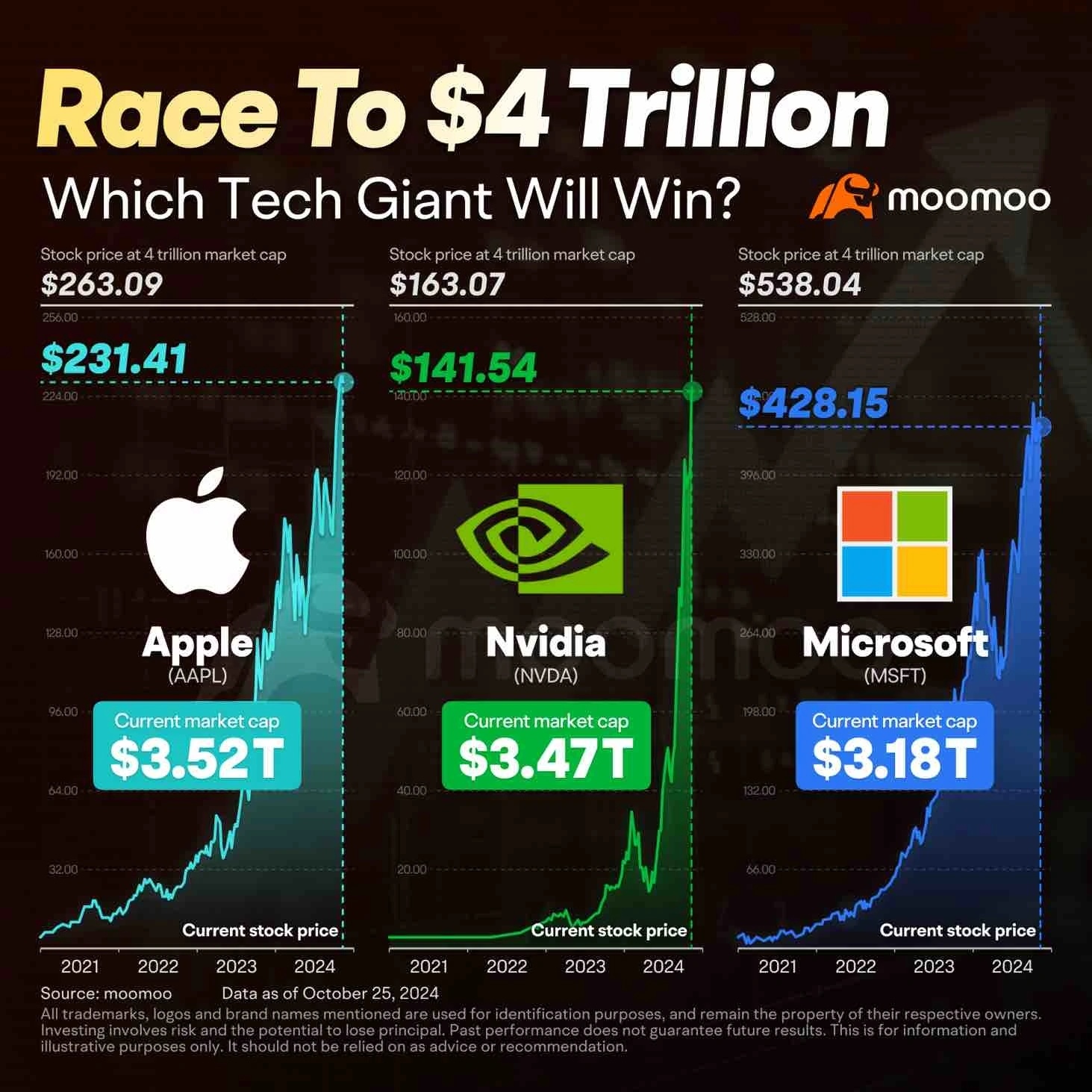
Apple's Race to $4 Trillion Market Cap
It can be seen that in the consumer electronics field, Apple has always maintained a high level of innovation and excellent user experience, which has allowed Apple to establish a strong brand image and customer loyalty. This foundation makes consumers willing to pay a premium for Apple, leading to Apple's excellent product margins. With the combined effect of these factors, Apple has proven its value in the capital market, ultimately leading to its current massive market value.
In the future, Apple's advantages lie in:
On the one hand, Apple has a strong product ecosystem, which is not only reflected in Apple's comprehensive product line in personal consumer electronics but also in Apple's excellent software services (such as Apple Music, Apple TV+, Apple Arcade). This is the main advantage and driving force for Apple's future growth, and leveraging and expanding this advantage can keep Apple's foundation for future growth.
On the other hand, with the development of AI technology, Apple's continuous layout in the AI field and the introduction of software services and hardware devices with higher levels of AI technology will become an additional growth potential for the company. Indeed, the potential of Apple Intelligence may trigger a "super cycle" of record iPhone sales. Wedbush Securities analyst Dan Ives forecasts that Apple may achieve sales of 240 million iPhones during the fiscal year 2025.
Nvidia's Race to $4 Trillion Market Cap
It can be said that Nvidia has always maintained a leading position in the development of hardware computing power, which has enabled it to become the most benefited company in the AI wave of the past two years. This is both accidental and inevitable. As technology continues to evolve, the market's expanding demand for computing power is an inevitability.
In the future, Nvidia's advantage in chip computing power may continue to be amplified, as the demand for its high-performance chips from major technology companies shows no signs of weakening. Nvidia's Chief Executive Officer, Jensen Huang, characterizes the market demand for the company's forthcoming Blackwell processors as "crazy". Moreover, Nvidia occupies an unparalleled position in the AI industry chain, with tech giants such as Meta, Amazon, Alphabet, and Microsoft being sources of its revenue. It can be said that Nvidia's products are strategically important to the development of AI technology. At the same time, with the rapid development of cloud computing and big data, the demand for high-performance computing continues to increase, from which Nvidia will benefit, and this will become an important source of revenue for the company.
Microsoft's Race to $4 Trillion Market Cap
In the past, Microsoft's leadership in the personal computer system sector established its position as a tech giant. Now, Microsoft has achieved success in the enterprise market. Microsoft's Azure cloud service is one of the company's fastest-growing businesses, with Azure's revenue growing by 29% year-on-year in the fourth quarter of the company's fiscal year 24, surpassing all other public cloud providers. As enterprises' demand for cloud computing increases, Azure's market share will continue to rise, becoming an important source of revenue for the company. At the same time, Xbox holds a significant position in the gaming hardware sector, and it can be said that the growth from multiple business lines is an important reason for Microsoft's current market value.
Looking ahead, with continued deep cultivation in the enterprise market, Azure's revenue growth may further accelerate, which will be the driving force for Microsoft's growth. As Microsoft continues to develop in the field of AI, integrating AI capabilities to enhance its leading enterprise software and launching smarter products and services, while expanding its footprint in the entertainment gaming sector, this will be the potential driving force for Microsoft's growth.
The Bottom Line
In the fierce competition among global tech giants for a market capitalization of $4 trillion, Apple, Nvidia, and Microsoft are undoubtedly the most formidable contenders. These three companies not only demonstrate unparalleled innovation and market leadership in their respective core business areas but also continuously expand their boundaries in emerging technology fields such as artificial intelligence and cloud computing. All three companies possess strong development potential, and it is worth watching to see which one will be the first to break through this milestone. For investors, a deep understanding of the development strategies and competitive advantages of these three companies will help make wiser investment decisions.
This presentation is for informational and educational use only and is not a recommendation or endorsement of any particular investment or investment strategy. Investment information provided in this content is general in nature, strictly for illustrative purposes, and may not be appropriate for all investors. Read more