Top 10 Utilities Stocks to Watch after Fed Rate Cuts in 2024
In recent months, the shift in the Federal Reserve's monetary policy has attracted widespread attention in the global market. With the official implementation of the Federal Reserve's interest rate cuts, the market has had varied reactions to stocks in different industries.
Looking back over the past period, the utility sector has performed particularly well, outperforming the broader market trend in the U.S. stock market. Notably, the Utilities Select Sector SPDR Fund (XLU) has seen a year-to-date increase of 22%, demonstrating investors' preference for such stocks.
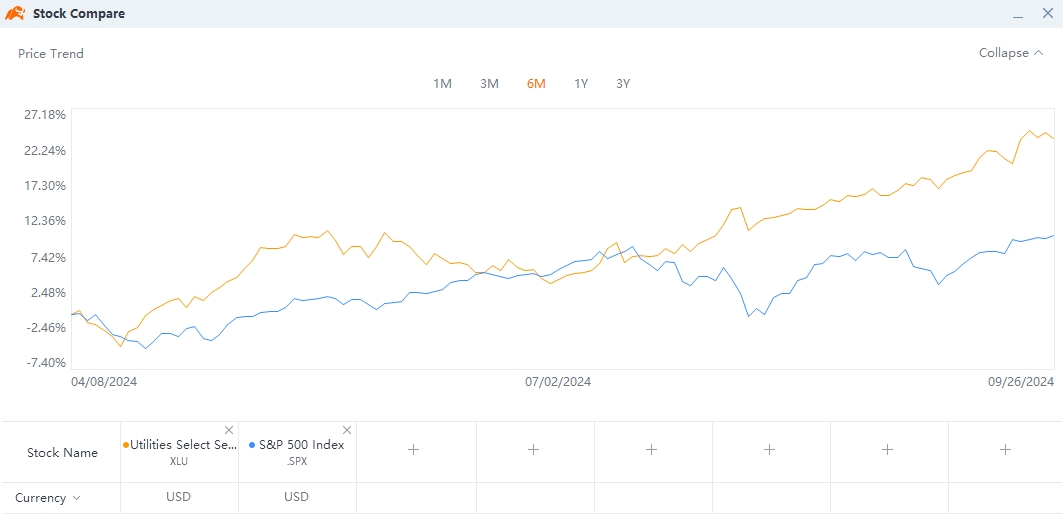
Based on this, let's explore the impacts of the Federal Reserve's interest rate cuts on utilities stocks and identify which related stocks are worth paying attention to in this context.
Overview of utilities stocks
Utilities stocks refer to the stocks of companies that focus on providing essential life services such as electricity, natural gas, and water. Due to the uniqueness of their business models, these stocks exhibit several notable characteristics:
Stability and continuity
The services provided by public utility companies are an indispensable part of daily life, which ensures the stability of their demand. Even during economic downturns, these companies' revenues remain relatively stable. Moreover, these companies usually have a monopoly or oligopoly status in their operating regions, ensuring the continuity of their business and long-term profitability.
Dividends and income
Thanks to the stable cash flow and moderate growth rate of public utility companies, they tend to offer higher dividend yields, which are highly attractive to investors seeking a stable source of income. Additionally, these companies can adjust their charge rates to maintain profit levels in the face of inflation, enhancing their ability to hedge against inflation.
Regulation and policy influence
Public utility companies are subject to strict government regulation due to the public interest nature of the services they provide, including pricing mechanisms and service quality. Changes in policy can impact the company's operations, which is one of the factors investors need to consider when evaluating utilities stocks.
Return on investment and long-term value
These stocks typically require a significant initial capital investment, but once the facilities are constructed and operational, they can generate returns for an extended period. Their price-earnings ratios are usually maintained within a reasonable range, reflecting the stability and predictability of their earnings. For investors seeking long-term, steady returns, utilities stocks are an ideal choice, not only for the dividend income they provide but also for the potential capital appreciation over time.
Effects of Fed rate cuts on utilities sector
The impact of the Federal Reserve's interest rate cut on the utilities sector can be viewed from several aspects:
Macroeconomic environment
As the Federal Reserve cuts interest rates, the yield on the 10-year U.S. Treasury bonds may decreases, making the dividend returns of utilities stocks more attractive relative to other investments. This provides investors with an alternative investment option in a low-interest-rate environment. Utilities stocks typically perform well in environments of declining interest rates and economic downturns.
Dividend yield
Due to the stable nature of their businesses, utility companies often provide a high and steady dividend yield. During periods of declining interest rates, the returns on fixed-income securities, such as bonds, also decrease, making utilities stocks with stable cash flows and higher dividend yields more attractive to investors seeking stable returns and long-term income.
Cost of capital
The utilities industry is capital-intensive and often requires raising capital to finance its infrastructure investments. In an environment of declining interest rates, borrowing costs decrease, and stock valuations typically rise, making it easier for utility companies to finance their operations and expansion projects. Lower capital costs not only improve their profit margins but also enable them to invest in more growth opportunities.
Electricity demand in the AI boom
With the development of artificial intelligence technology, the demand for electricity has surged, providing additional growth momentum for utilities. Compared to high-priced tech giants, investors can participate in the AI technology revolution at a lower cost by investing in the utility sector, offering new opportunities for value investors.
Potential risks
The Federal Reserve's interest rate cut is expected to have a positive impact on utilities stocks, but it also comes with certain risks and uncertainties. Rate cuts often occur against the backdrop of slowing economic growth as a means to stimulate the economy, which may mean that at the beginning of the rate cut phase, utility companies may already be facing a situation where demand decreases and profitability is challenged. In addition, it is necessary to be vigilant that if the economy enters a rate-cutting cycle and maintains it for a long period, a long-term low-interest-rate economic environment may emerge, it may trigger inflationary pressures. If the inflation rate rises beyond expectations, the real interest rate (that is, the nominal interest rate minus the inflation rate) may decrease, which is not good news for utility companies that rely on stable cash flows. At the same time, investors also need to pay attention to potential risks that other factors such as changes in market sentiment may bring.
Top 10 utilities stocks to watch after Fed rate cuts
Here are ten utilities stocks with large market capitalizations that have performed well this year.
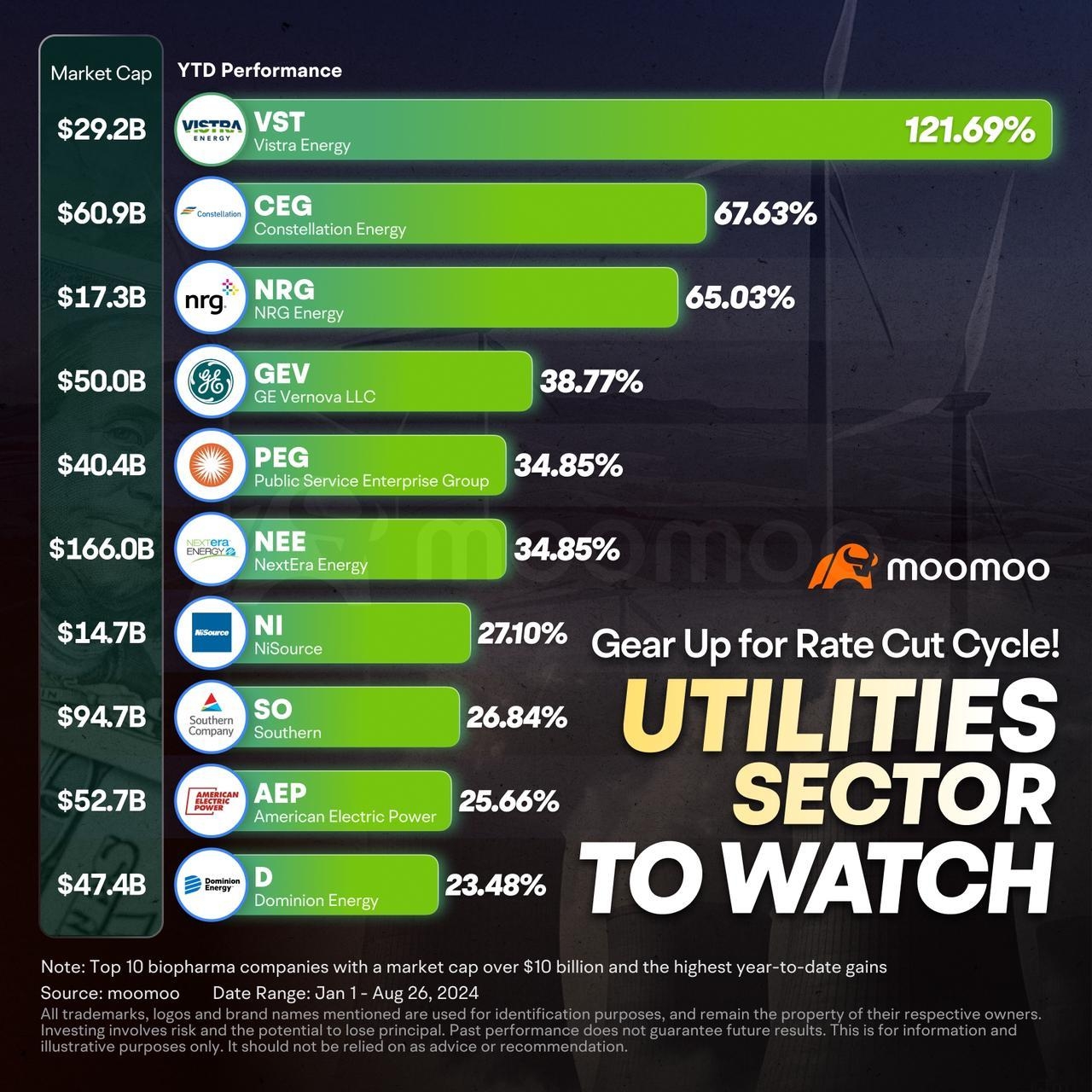
Vistra Energy (VST)
Company Overview: Vistra Energy is a leading electricity and natural gas company that provides electricity and natural gas services across multiple states in the United States. The company is committed to offering its customers reliable, sustainable, and economical energy solutions through its diversified power generation portfolio and retail electricity platform.
Business Scope: Vistra Energy's business scope includes electricity production and supply, natural gas sales and trading, as well as the development of renewable energy projects.
Market Position: As a significant player in the U.S. energy market, Vistra Energy holds a substantial market share in both electricity and natural gas sectors.
Constellation Energy (CEG)
Company Overview: Constellation Energy is one of the largest clean, carbon-free energy producer in the United States and a leading supplier of energy products and services. The company offers a range of energy solutions and services to various clients, including commercial entities, residential properties, local communities, and government agencies throughout the contiguous United States.
Business Scope: Constellation Energy sells natural gas, renewable energy, and other energy-related products and services. The company has a generation capacity of 33,094 megawatts, including nuclear, wind, solar, natural gas, and hydroelectric assets.
Market Position: Constellation Energy holds a leading position in the clean energy sector, with a customer base that includes numerous Fortune 100 companies.
NRG Energy (NRG)
Company Overview: NRG Energy is a diversified energy company headquartered in Texas.
Business Scope: NRG Energy is engaged in energy production and retail electricity business. Their portfolio includes natural gas power generation, coal power generation, oil power generation, nuclear power generation, wind power generation, and distributed solar generation.
Market Position: NRG Energy has power generation facilities in multiple regions and serves 6 million retail customers across 8 provinces in Canada and 24 states in the United States. It can be said to have a foothold in the North American retail electricity market.
GE Vernova LLC (GEV)
Company Overview: GE Vernova stands at the forefront of the global energy sector, specializing in a comprehensive suite of offerings that encompass the generation, conveyance, synchronization, transformation, and preservation of electrical power. The company is a result of the 2024 spin-off of General Electric's energy business and focuses on the new energy transition.
Business Scope: GE Vernova covers three major business segments in the energy sector, including power generation (gas, steam, nuclear, hydro), wind power (offshore wind, onshore wind, Elm wind energy), and electrification (digitalization, grid solutions, power conversion, solar and energy storage solutions), and accelerates business development through cutting-edge research, consulting services, and financial services.
Market Position: GE Vernova holds an important position in the power industry, with solutions aimed at accelerating energy transition and enhancing profitability.
Public Service Enterprise Group (PEG)
Company Overview: Public Service Enterprise Group is a utility company that provides electricity and natural gas services, operating in multiple states in the United States.
Business Scope: Public Service Enterprise Group's business scope includes electricity production and supply, natural gas sales and transmission, etc.
Market Position: Public Service Enterprise Group has a stable customer base and market share in the utility sector, committed to providing reliable energy services to its customers.
NextEra Energy (NEE)
Company Overview: NextEra Energy is one of the largest electric and energy infrastructure companies in North America and one of the largest renewable energy power generation company globally.
Business Scope: NextEra Energy operates in various power generation businesses, including wind, solar, hydro, nuclear, and natural gas power generation.
Market Position: NextEra Energy holds a leading position in the renewable energy sector and is an important energy supplier across the United States.
NiSource (NI)
Company Overview: NiSource is an energy utility company that provides natural gas and electricity services in the United States.
Business Scope: NiSource is engaged in the production, transmission, and distribution of electricity, as well as the natural gas distribution business.
Market Position: NiSource has a certain market share and customer base in the energy utility sector.
Southern (SO)
Company Overview: Southern Company, established in 1945 and headquartered in Atlanta, Georgia, is a public electric company.
Business Scope: Engaged in the business of generating, transmitting, and distributing electricity from coal, nuclear, oil, natural gas, and hydropower. Also builds, acquires, owns, and manages power generation assets, including renewable energy projects.
Market Position: Southern Company is one of the largest electric power producers in the United States.
American Electric Power (AEP)
Company Overview: American Electric Power is an electric utility company headquartered in Ohio.
Business Scope: American Electric Power provides electricity production and sales services and has operations in multiple states in the United States.
Market Position: American Electric Power holds an important position in the U.S. electricity market, providing power services to a wide range of customers and is a major electricity supplier in the states where it operates.
Dominion Resources (D)
Company Overview: Dominion is an electric and natural gas utility company headquartered in Virginia.
Business Scope: Dominion operates in the business of electricity production and sales, and provides natural gas services.
Market Position: Dominion is one of the major electricity and natural gas suppliers in the states where it operates.
Final thoughts on utilities stocks after Fed rate cuts
With the macroeconomic changes brought about by the Federal Reserve's interest rate cuts, utilities stocks may become a focus for investors due to their good performance and higher dividend yields. However, while seeing the potential benefits of these companies and stocks, one should not overlook the corresponding risks. Although utilities stocks are considered a safe haven choice due to their stable cash flow and higher dividend yields, their stock prices may also fluctuate in times of increased market volatility or increased economic uncertainty.
Therefore, before considering allocating funds to utilities stocks, investors should carefully assess their personal risk tolerance and investment objectives, while closely monitoring market dynamics and changes in relevant policies to make more rational and scientific investment decisions. Overall, in the current market environment, utilities stocks remain a robust investment option, but appropriate allocation should be made based on individual circumstances.
The content of this article is for reference only and does not constitute any investment advice.

This presentation is for informational and educational use only and is not a recommendation or endorsement of any particular investment or investment strategy. Investment information provided in this content is general in nature, strictly for illustrative purposes, and may not be appropriate for all investors. Read more