How Are ETFs Taxed in Canada?

In the process of building an investment portfolio, understanding and managing tax implications is one of the key factors in achieving long-term financial goals. Especially in Canada, tax policies have a significant impact on investment returns. With exchange-traded funds (ETFs) increasingly becoming a preferred choice for investors, understanding the tax treatment of these financial instruments has become key to improving investment efficiency.
This article focuses on the tax treatment related to ETFs, hoping to help investors develop more effective tax planning strategies, reduce tax burdens, and achieve the goal of wealth appreciation.
ETF tax impact on Canadian investor returns
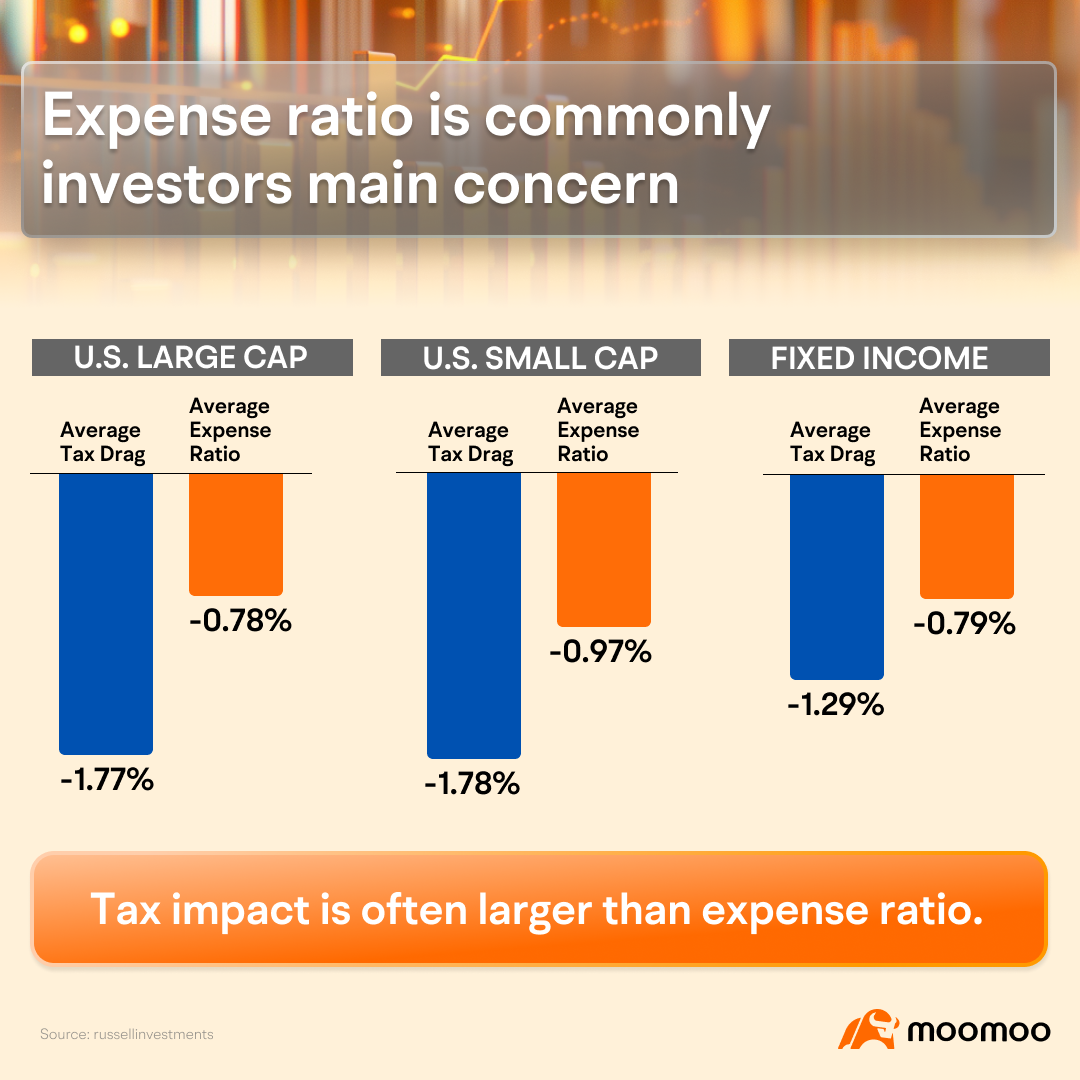
Most investors are aware that expense ratios can impact returns on their ETFs. In reality, taxes can have a significant impact on these investor returns, sometimes even greater than the impact of expense ratios.
According to research and reports by Morningstar, the impact of taxes on returns is greater than that of expense ratios, whether in US large-cap stocks, US small-cap stocks, or fixed income. Although this study targets the US market, it serves as an important reference for Canadian investors as well.
How are ETFs taxed in Canada?
Earnings from ETFs (Exchange-Traded Funds) can be categorized into two types and both these two types of earnings fall within the scope of personal income tax. And after the corresponding deductions and credits, taxes are paid at the individual marginal tax rate (the income tax rate applicable to the individual's taxable income for the year).
Below are two types of earnings generated by ETFs.
Capital gains
Realized gains: When investors sell their held ETFs at a price higher than their cost basis, a capital gain is realized.
Distributed gains: When an ETF sells its holdings at a price higher than the purchase price, it generates capital gains. The ETF may distribute a portion of these capital gains to investors. This distribution typically occurs at year-end when the ETF liquidates its capital gains and distributes the net capital gains (i.e., the excess over any capital losses) to the holders.
Distribution income
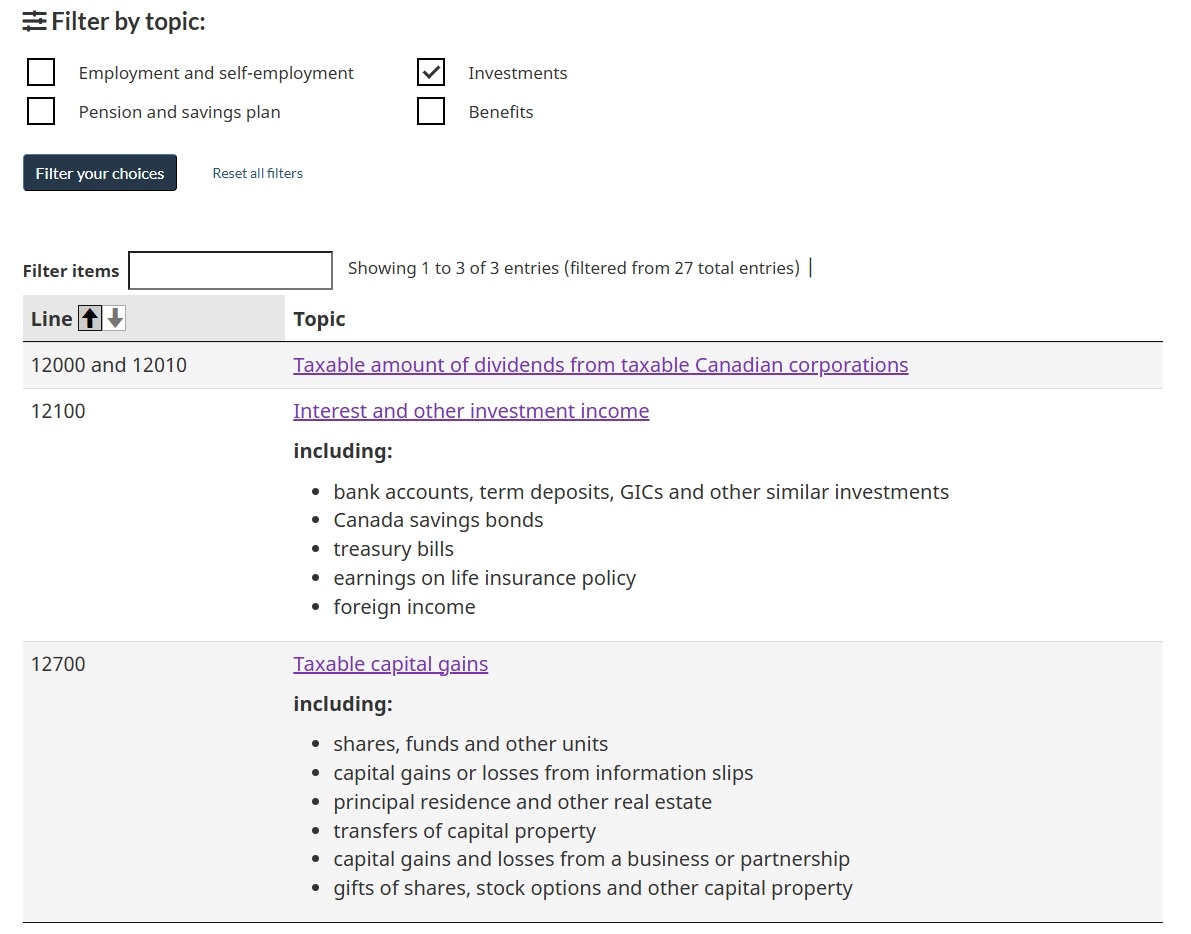
Dividend income: For equity ETFs, if the ETF's distributions come from the dividends paid by the stocks it holds, then this income will be reported as "Interest and other investment income". In Canada, dividend income is typically eligible for certain tax benefits, known as the "Dividend Tax Credit," which helps to reduce the taxes payable on dividend income.
Interest income:For ETFs that hold bonds or other fixed-income instruments, the ETF's distributions come from the interest paid by the bonds or other fixed-income instruments they hold. This income will also be reported as "Interest and other investment income." Generally, interest income is fully taxed at the individual's applicable income tax rate. However, the interest distributed by certain bond ETFs is tax-exempt, such as that from municipal bond ETFs.
Refer to the CRA's regulations on the scope of personal income for investments--Personal income tax - All types of income
Some points need to be noted
First, the portion taxed as capital gains is not fully included in taxable income, and capital losses are allowed to offset against them fairly.
For more details, please refer to "How to Avoid Capital Gains Tax in Canada"
Second, if an ETF holds foreign stocks, the dividends distributed by these foreign stocks may be subject to foreign withholding tax (FWT).
What is the best account to hold US-listed ETFs in Canada?
In Canada, investors can hold ETFs through certain tax-advantaged accounts to avoid or reduce tax pressure.
Tax-Free Savings Account (TFSA)
Registered Retirement Savings Plan (RRSP)
Registered Retirement Income Fund (RRIF)
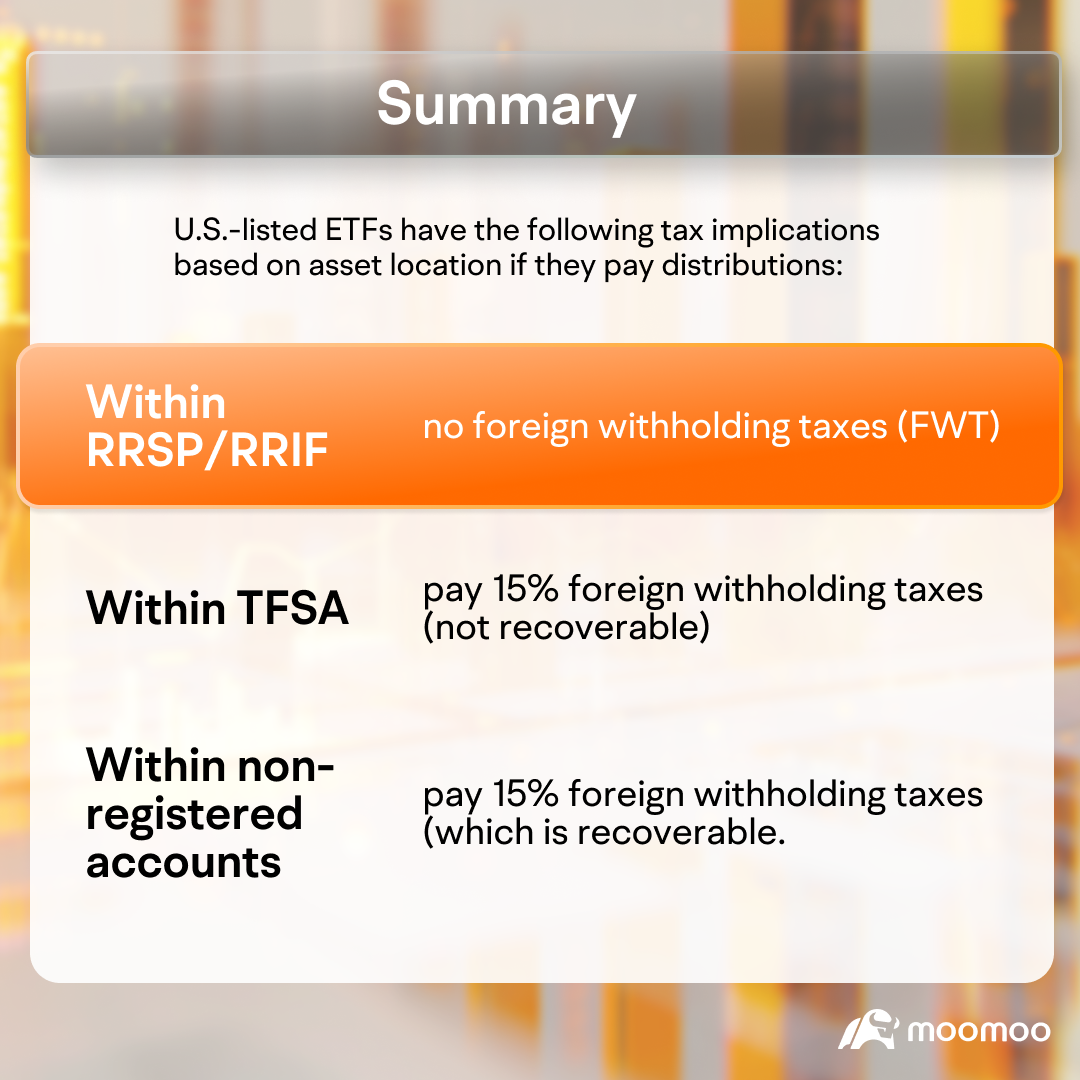
If investors hold US-listed ETFs through these accounts, the primary difference lies in how US dividend withholding tax is handled. Using a TFSA to hold US-listed ETFs does not avoid foreign dividend withholding tax. However, under the bilateral agreement between the US and Canada, holding US-listed ETFs or US stocks in an RRSP or RRIF allows investors to avoid the 15% US dividend withholding tax.
It's important to note that using any account (including RRSP or RRIF) to hold Canadian-listed ETFs that invest in US securities will still incur foreign dividend withholding tax, as this tax is applied before dividends are distributed to your account.
Professional investors likely know that the management expense ratio (MER) of US-listed ETFs are generally lower than those of comparable ETFs listed in Canada. If the foreign dividend withholding tax is considered part of the MER, holding US-listed ETFs in an RRSP/RRIF for exposure to the corresponding types of ETFs may be the most cost-effective option.
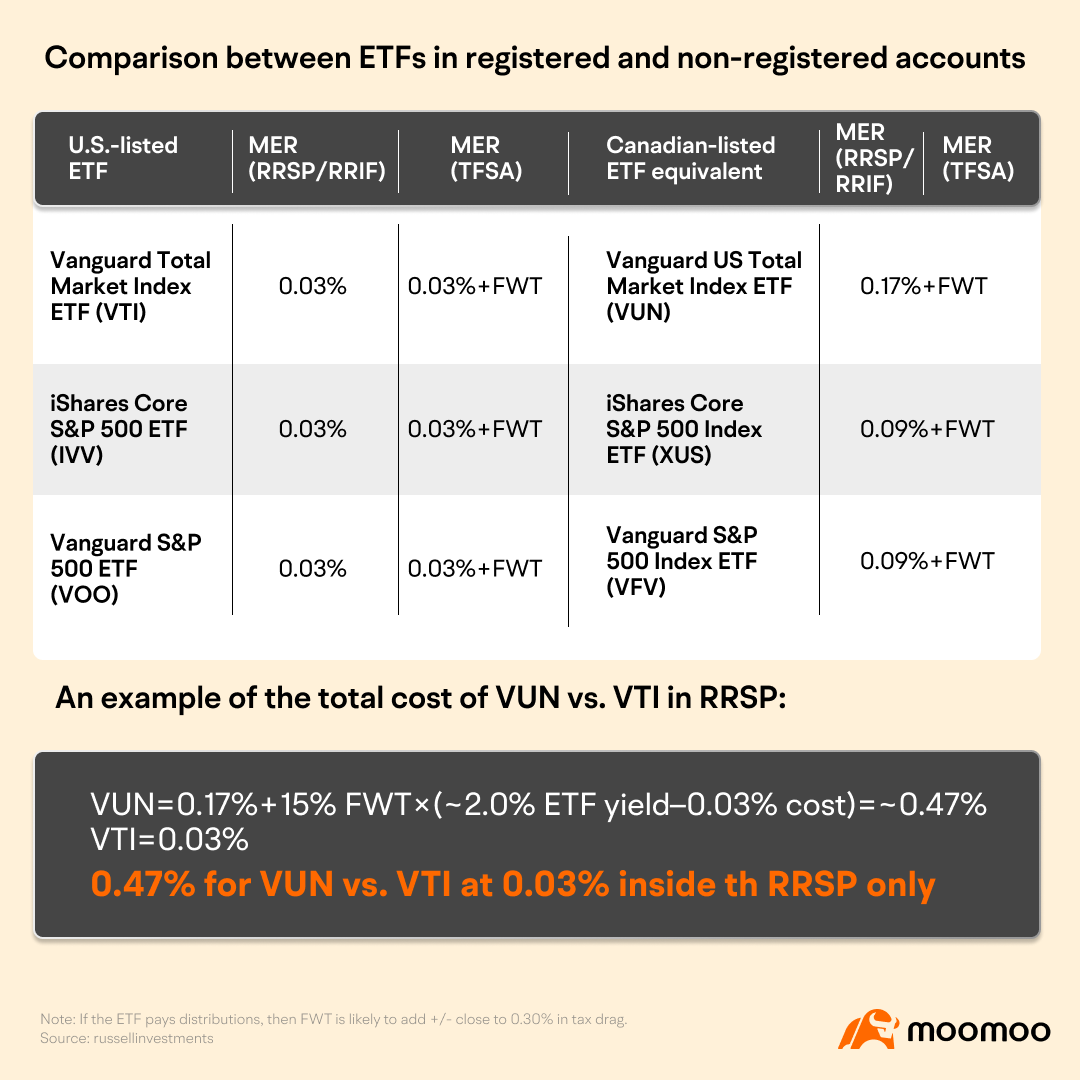
Of course, investors can also choose to use a TFSA to hold US-listed ETFs. While they will incur US dividend withholding tax, any capital gains generated are tax-free. In contrast, with an RRSP, taxes must be paid upon withdrawal during retirement, meaning that both the principal and the appreciation are subject to taxation. However, unlike a TFSA, contributions to an RRSP can be deducted from taxable income, making it difficult to determine which option is more tax-efficient. If investors are allocating funds to stocks with high growth potential, considering the contribution limits of a TFSA, it may be more efficient to hold high-dividend US-listed ETFs or US stocks in an RRSP, thereby reserving more of the TFSA contribution room for capital appreciation.
If only consider foreign withholding taxes, the following summary can be made:
How are ETFs taxed in non-registered accounts in Canada?
In Canada, a non-registered account refers to an investment account that is not registered with the government and does not enjoy tax incentives. This means that any investment income within the account, such as interest, dividends, and capital gains, is subject to taxation according to general tax rules. Unlike registered accounts like RRSPs or TFSAs, investments in a non-registered account are taxed at a higher rate, but there are no restrictions on withdrawals or contributions.
Non-registered accounts can be divided into Cash Accounts and Margin Accounts.
Cash Account
A Cash Account is the most basic type of investment account, where investors can only use the funds they have deposited into the account to make investments. The risk level is relatively low.
Margin Account
A Margin Account allows investors to increase their purchasing power through borrowing. With this type of account, investors can not only use their own funds but also borrow from brokers to increase their investment amount. Since borrowed funds are used, investments may bring greater returns, but they also increase the potential risk.
Tax Efficiency
Holding ETFs in a non-registered account is subject to general tax rules. The tax treatment for the two types of returns generated by ETFs is as follows:
Capital Gains: For the portion of annual net capital gains that do not exceed $250,000, half of the amount is included in taxable income; for the portion exceeding that, two-thirds are included. Capital losses from previous years can be used as offsets.
Distribution Income: Interest income is taxed as ordinary income, but dividends that meet the criteria may be eligible for dividend tax credits.
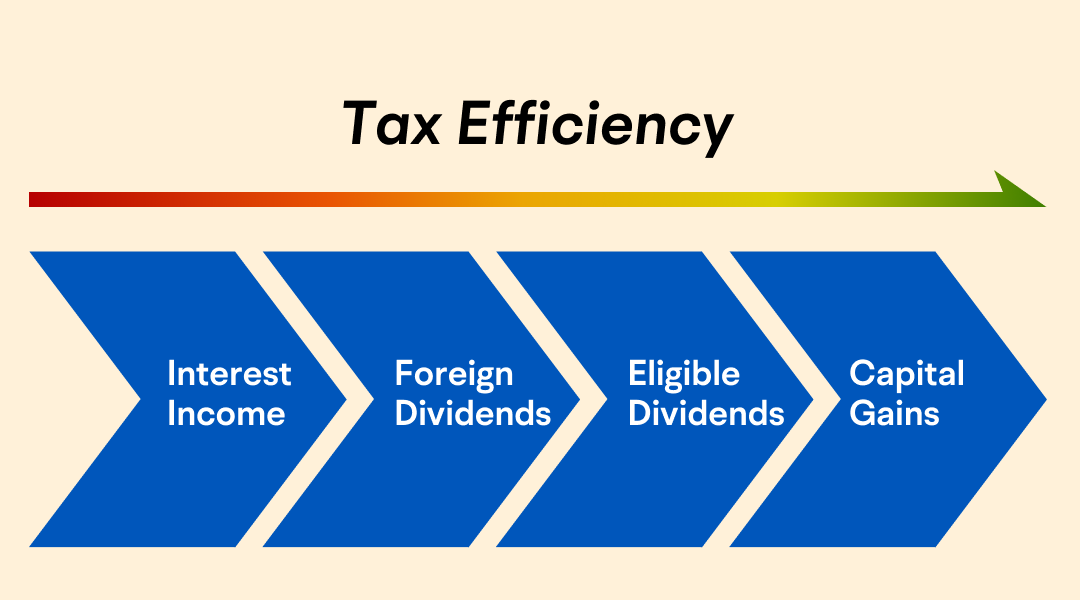
Overall, holding ETFs in a non-registered account is tax-efficient for capital gains and eligible dividends, but not for foreign dividends and interest income (earned from fixed-income instruments).
Final words
For Canadian investors who hold different types of ETFs and have diverse investment objectives, using different accounts to hold various ETFs and investment instruments may achieve the greatest tax efficiency. For instance, holding ETFs aimed at capital appreciation and those targeting fixed interest, such as bond ETFs, within a TFSA; holding US high-yield stocks or similar type ETFs within an RRSP; and holding ETFs targeting eligible dividends from Canadian high-yield stocks in a non-registered account. Of course, the specific investment goals that each investor may face require a case-by-case analysis, and this article aims to provide investors with reference information and suggestions.
This presentation is for informational and educational use only and is not a recommendation or endorsement of any particular investment or investment strategy. Investment information provided in this content is general in nature, strictly for illustrative purposes, and may not be appropriate for all investors. Read more