2 Great Canadian Bond ETFs to Watch 2024

Are you a cautious investor with a preference for steady returns? Do you find yourself hesitant about the risks associated with purchasing individual bonds directly? If so, a bond fund might just be the solution you've been seeking. Within the Canadian fund market, bond funds hold a significant share, demonstrating the trust and confidence investors place in them. This popularity underscores the appeal of bond funds for many Canadians who seek a balanced approach to wealth management.
When contemplating an investment in bond funds, Exchange-Traded Funds (ETFs) stand out as particularly attractive options. Bond ETFs combine the diversification benefits of mutual funds with the trading flexibility of stocks, making them an excellent choice for those who want the stability of fixed income with the added advantage of market liquidity.
What is a bond ETF?
A bond ETF (Exchange-Traded Fund) is a special type of fund that trades on the market like individual stocks, but its portfolio contains a variety of bonds instead of company shares. For investors, they can easily trade bond ETFs in the market to gain exposure to these bond portfolios.
What to consider when choosing a bond ETF for Canadian investors?
For fixed-income investment tools like bond ETFs, we should focus on their fees and income distribution, as these affect your actual returns. Additionally, it's important to pay attention to the fund's size and holdings, which can indicate the level of risk to some extent. Let's look at each aspect in detail.
Fees
Regarding the fund's fees, you can focus on two figures: “Management Fee” and “Management Expense Ratio (MER)”. The Management Fee is a charge that investment management companies collect from investors to manage and operate the fund. It covers the costs of the fund's daily operations, such as the salaries of fund managers, research costs, and other expenses related to the management and operation of the fund. The Management Expense Ratio (MER) is a more comprehensive concept, as it includes not only the management fee but also other various costs incurred during the fund's operation, such as audit fees, legal fees, marketing expenses, and administrative management fees. Therefore, the MER is higher than the simple management fee.
Distribution
Bond ETFs typically distribute interest income to investors on a regular basis, such as monthly or quarterly. Understanding the distribution pattern and historical record of bond ETFs is very important for investors because it directly affects whether they can obtain a stable cash flow. This is especially important for retirees who rely on investment income to maintain their livelihood.
Size
The size of a fund, or Assets Under Management (AUM), reflects its popularity and market recognition. A larger fund size generally indicates that more investors trust and have chosen this fund, which also means that the fund has higher liquidity in the market. In addition, large-scale funds are often better able to diversify risks because they typically hold a more diversified range of assets.
Holdings
Understanding the specific holdings of a bond ETF can help investors assess the credit quality and maturity distribution of their investment portfolio. Holding information reveals what types of bonds the ETF invests in (such as government bonds, corporate bonds, etc.), as well as the credit ratings and maturity dates of these bonds. This helps investors judge the risk level of the ETF and whether it aligns with their investment objectives.
Benefits and risks of investing in bond ETFs in Canada
After gaining a certain understanding of bond ETFs, it can be summarized that they have the following advantages and disadvantages.
Benefits
Diversification and flexibility:
Bond ETFs offer a way to access a variety of bond portfolios through a single investment tool, helping investors achieve risk diversification. Thanks to the characteristics of ETFs, bond ETFs can be bought and sold at any time during the trading day, similar to stock trading. This provides investors with the ability to quickly respond to market changes.
Cost-effectiveness and transparency:
Compared to actively managed funds, bond ETFs typically have lower management fees because most bond ETFs use a passive management strategy, tracking specific bond indices. Additionally, bond ETFs usually update their holdings regularly, increasing investment transparency and helping investors better monitor the performance of their portfolios.
High liquidity and easy market access:
Since bond ETFs are traded on exchanges, they generally have high liquidity, which means that investors can easily buy and sell these ETFs without worrying about a lack of trading counterparts. Furthermore, for small investors, bond ETFs provide a way to enter the fixed-income market, reducing the barrier to entry.
Risks
Despite the many advantages of bond ETFs, they are not without risks. The most prominent of these are interest rate risk and credit risk.
Interest rate risk:
Bond prices are sensitive to changes in interest rates. When interest rates rise, the market value of existing bonds typically decreases, which can negatively impact the value of the ETF. This is because the fixed interest payments of the bonds become less attractive compared to new bonds offering higher returns. The longer the maturity of the bonds in the bond ETF, the more sensitive their value will be to interest rate fluctuations. Investors can use the duration of a bond as a measure to estimate the potential capital gains or losses in response to a 1% change in interest rates.
Credit risk:
Although bond ETFs achieve diversification by holding a variety of bonds, they cannot completely eliminate credit risk. If some of the bonds held by the ETF default, the performance of the entire fund may be affected. Therefore, investors need to pay attention to the credit quality of the bonds in the ETF's portfolio, choosing with higher credit quality and lower risks.
Generally, credit quality ratings range from good to poor as follows: AAA, AA, A, BBB.
2 great Canadian bond ETFs
Below are informations on two Canadian bond ETFs available for trading on the Toronto Stock Exchange, both denominated in Canadian dollars, designed to assist with investment choices and decision-making processes.
BMO Aggregate Bond Index ETF (ZAG)
iShares Core Canadian Universe Bond Index ETF (XBB)
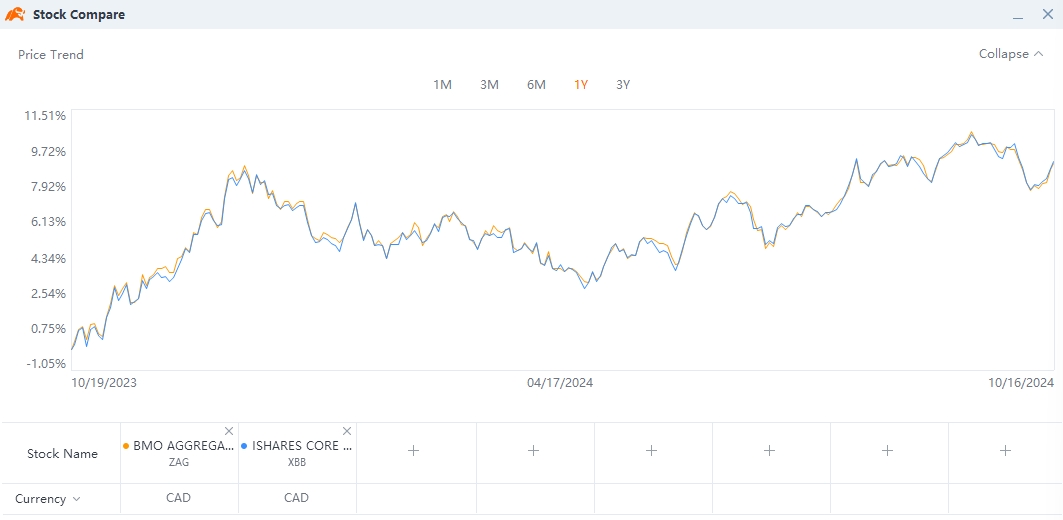
BMO Aggregate Bond Index ETF (ZAG)
This ETF is designed to track and emulate the performance of the FTSE Canada Universe Bond Index, which provides a comprehensive view of the Canadian investment-grade bond market. The ETF allocates its investments across a diverse range of bonds with maturities exceeding one year. It includes a wide array of bond types, such as federal bonds, provincial bonds, and corporate bonds, ensuring extensive representation of the Canadian fixed-income landscape.
According to the official data from BMO on August 7th of this year, the relevant data indicators for this ETF are as follows:
Assets Under Management (AUM):$9.5 Billion
Management Expense Ratio(MER): 0.09%
Annualized distribution Yield: 3.48%
Distribution Frequency: Monthly
10-year Cumulative Performance: 22.62%
Holdings:
Credit Quality Rating | Weight |
AAA | 41.06% |
AA | 32.83% |
A | 15.91% |
BBB | 10.20% |
iShares Core Canadian Bond Universe Index ETF (XBB)
The iShares Core Canadian Bond Universe Index ETF also tracks the FTSE Canada Universe Bond Index. Its portfolio distribution is diverse, with major investments in Canadian government bonds, as well as holdings in provincial and corporate bonds. It covers a range of sectors including finance, energy, infrastructure, communications, real estate, and industrials.
According to the official data from BlackRock on August 7th of this year, the relevant data indicators for this ETF are as follows:
Assets Under Management (AUM):$7.5 Billion
Management Expense Ratio(MER): 0.1%
Annualized distribution Yield: 3.31%
Distribution Frequency: Monthly
10-year Cumulative Performance: 20.78%
Holdings:
Credit Quality Rating | Weight |
AAA | 41.16% |
AA | 32.11% |
A | 14.60% |
BBB | 10.46% |
Comparing ZAG and XBB
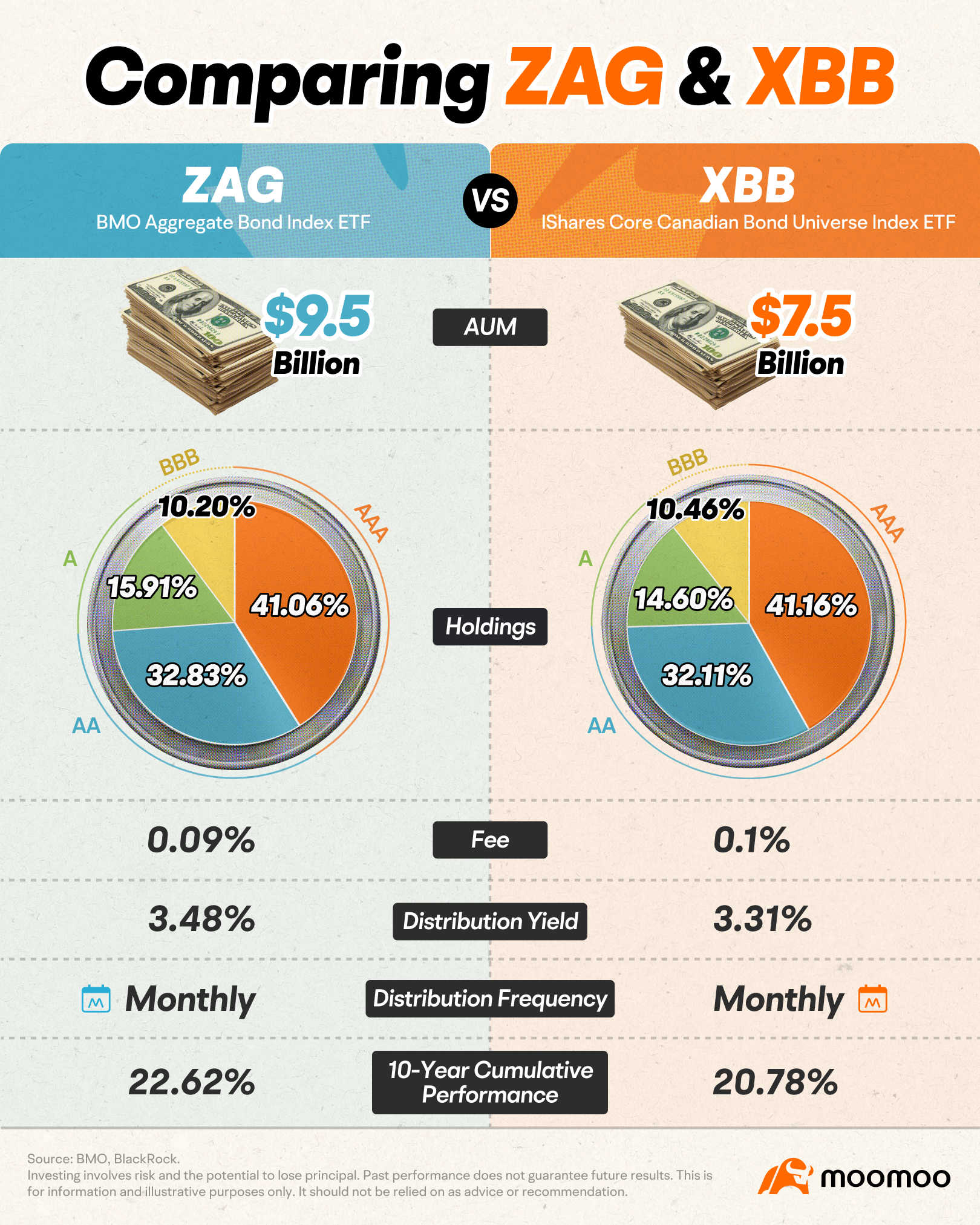
Since both ETFs track the FTSE Canada Universe Bond Index, they have similar holdings and performance data. However, based on the data provided, the BMO Aggregate Bond Index ETF, which has a lower expense ratio and a higher yield, might be slightly better. But the data is constantly changing, and the information gathered here is for reference only. Investors still need to collect the latest data through official websites and other means for comparison before making decisions.
Final thoughts: Are bond ETFs right for you?
Bond ETFs serve as an investment tool in the fixed-income market, providing an ideal solution for investors seeking stable returns while avoiding the risks associated with purchasing individual bonds directly. Particularly for Canadian investors, bond ETF products such as the BMO Aggregate Bond Index ETF (ZAG) and the iShares Core Canadian Bond Universe Index ETF (XBB) offer a diversified investment portfolio while demonstrating good liquidity and transparency. However, while enjoying the convenience and potential returns brought by bond ETFs, investors should not overlook the existence of interest rate risk and credit risk. Therefore, wise investors should continuously monitor market dynamics, reasonably assess their own risk tolerance, and make timely investment decisions based on the latest market information.

This presentation is for informational and educational use only and is not a recommendation or endorsement of any particular investment or investment strategy. Investment information provided in this content is general in nature, strictly for illustrative purposes, and may not be appropriate for all investors. Read more