How to Avoid Capital Gains Tax in Canada?

As an investor in Canada, you might be accustomed to paying income tax on 50% of your capital gains. However, please note that this year the Canadian government has made significant adjustments to this policy, making the Canadian tax system more fair and reasonable. This could also affect your tax liability.
If you are confused about this, please read this article for a deeper understanding of how capital gains tax work. You might be able to avoid paying some taxes as a result.
What are capital gains and capital losses ?
For investors, every investment you make will result in either capital gains or capital losses upon its conclusion, and these two capital changes are the basis for calculating capital gains tax. Therefore, it is important to understand what capital gains and capital losses are.
Capital Gains: Refers to the situation where an individual or business sells an asset (such as stocks, bonds, real estate, etc.) at a price higher than the purchase price or original cost. The difference is capital gains.
Capital Losses: Refers to the situation where an asset is sold at a price lower than the purchase price or original cost. In this case, the investor will incur capital losses. Capital losses can reduce net capital gains used for tax calculations.
It is also important to note that when you initially purchase an asset, your acquisition costs (such as commissions and other fees) are also considered part of the asset's original cost. For example, if you bought a stock for $10,000 and held it, then sold it for $11,000, with a commission of $10 during the process, your final capital gain would be $990.
Additionally, according to the Canada Revenue Agency (CRA), if you incur a net capital losses in the current year—which is calculated by subtracting any capital gains realized during the year from your capital losses—you can use these losses to offset capital gains from any of the previous three years. If your net capital loss exceeds the capital gains of those years, you can also carry forward the unused portion of the loss indefinitely into the future to offset capital gains in subsequent years. This can be a strategic move to minimize your tax liability over time.
What are taxable capital gains and allowable capital losses ?
Now we know that if you have multiple investments in a year with both gains and losses, and ultimately you end up with a profit or loss for that year, we can refer to it as net capital gains or net capital losses. Net capital gains are subject to taxes, but not the entirety of them. Similarly, net capital losses can be used to offset taxable net capital gains, but again, not the entirety of them. Therefore, an inclusion rate (IR) is used to determine "taxable capital gains" and "allowable capital losses".
According to the new rules, the inclusion rate (IR) used to determine taxable capital gains is no longer a fixed 50%. Instead, an IR of 50% applies to annual net capital gains not exceeding $250,000, and an IR of two-thirds applies to the portion exceeding $250,000.
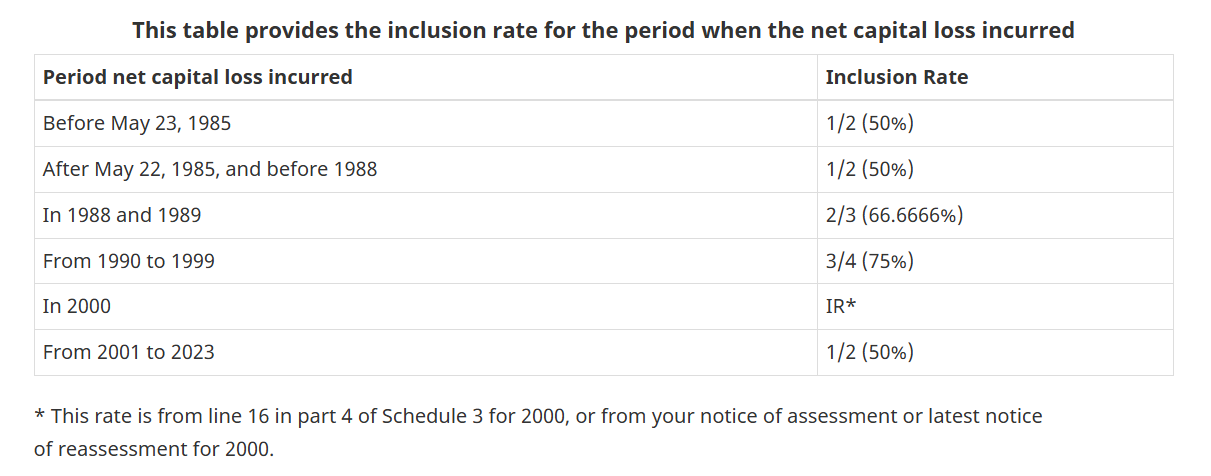
The inclusion rate (IR) used to determine allowable capital losses is 50%, but this rate has been adjusted several times in the past. For specific details, you can refer to:“How do you use a capital loss?”
How to calculate capital gains tax in Canada ?
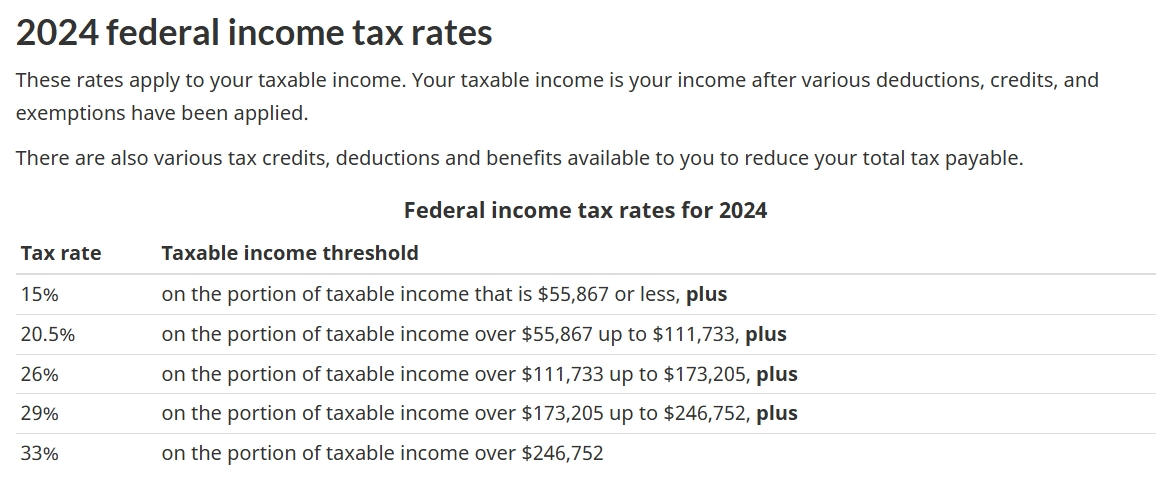
It's important to know that capital gains are also part of personal income, so they are subject to individual income tax rates. Therefore, the capital gains tax equals the taxable income (capital gains portion) multiplied by the personal income tax rate. Your taxable income (capital gains portion) is obtained by subtracting various deductions and credits (such as allowable capital losses) from the taxable capital gains.
Once you know the taxable income (capital gains portion), you can calculate the capital gains tax you need to pay based on your individual income tax rate. (You can confirm your individual income tax rate by using "Income tax rates for individuals".)
Example
Assuming you are an investor who started investing last year, your net capital losses for last year were $300,000. This year, your capital gains amount to $450,000, and your capital losses are $50,000.
In this example, all of your investments over the past two years have totally generated a profit of $100,000( gains:$450,000 Minus losses:$300,000 and $50,000 ), which does not exceed $250,000. If the inclusion rate applies, You only need to pay the income tax corresponding to the taxable capital gains of $100,000 × 1/2 = $50,000. (That is, all your losses have been used to offset all gains.)
Indeed, in the process of calculating taxable income (capital gains portion), the Canadian government makes a series of adjustments to allowable capital losses to fairly offset taxable capital gains.
Below is the calculation process for this example, and the final result for taxable income is also $50,000. Although the calculation process is somewhat complex, it ensures fairness.
Your net capital gain for this year is $400,000 ($450,000 - $50,000).
taxable capital gains=250,000×1/2+(400,000-250,000)×2/3=$225,000
allowable capital losses=300,000×1/2=150,000
It's important to note that for tax advantages, allowable capital losses can be used first to offset the portion of taxable capital gains subject to the 2/3 inclusion rate, which is calculated as ($400,000 - $250,000) × 2/3 = $100,000. However, since the inclusion rates applied to both are different, adjustments need to be made to the allowable capital losses.The adjustment factor is:
Inclusion Rate for net capital losses | Inclusion Rate for net capital gains | |
1/2(≤250,000) | 2/3(>250,000) | |
1/2 | 1 | 4/3 |
2/3(≤250,000): allowable capital losses=$100,000 (Allowable capital losses are sufficient to fully offset this portion of taxable capital gains, while the corresponding allowable capital losses before adjustment are 100,000÷4/3=$75,000)
1/2(>250,000): allowable capital losses=(150,000-75,000)×1=$75,000
allowable capital losses(after adjustment)=100,000+75,000=$175,000
taxable income (capital gains portion)=225,000-175,000=$50,000
If your applicable individual income tax rate is 26%, then the capital gains tax is calculated as $50,000 × 26% = $13,000.
How to avoid or reduce capital gains tax in Canada ?
Now that we have a certain understanding of the process and calculation of capital gains tax, we can discover some methods for legitimate tax avoidance through this process.
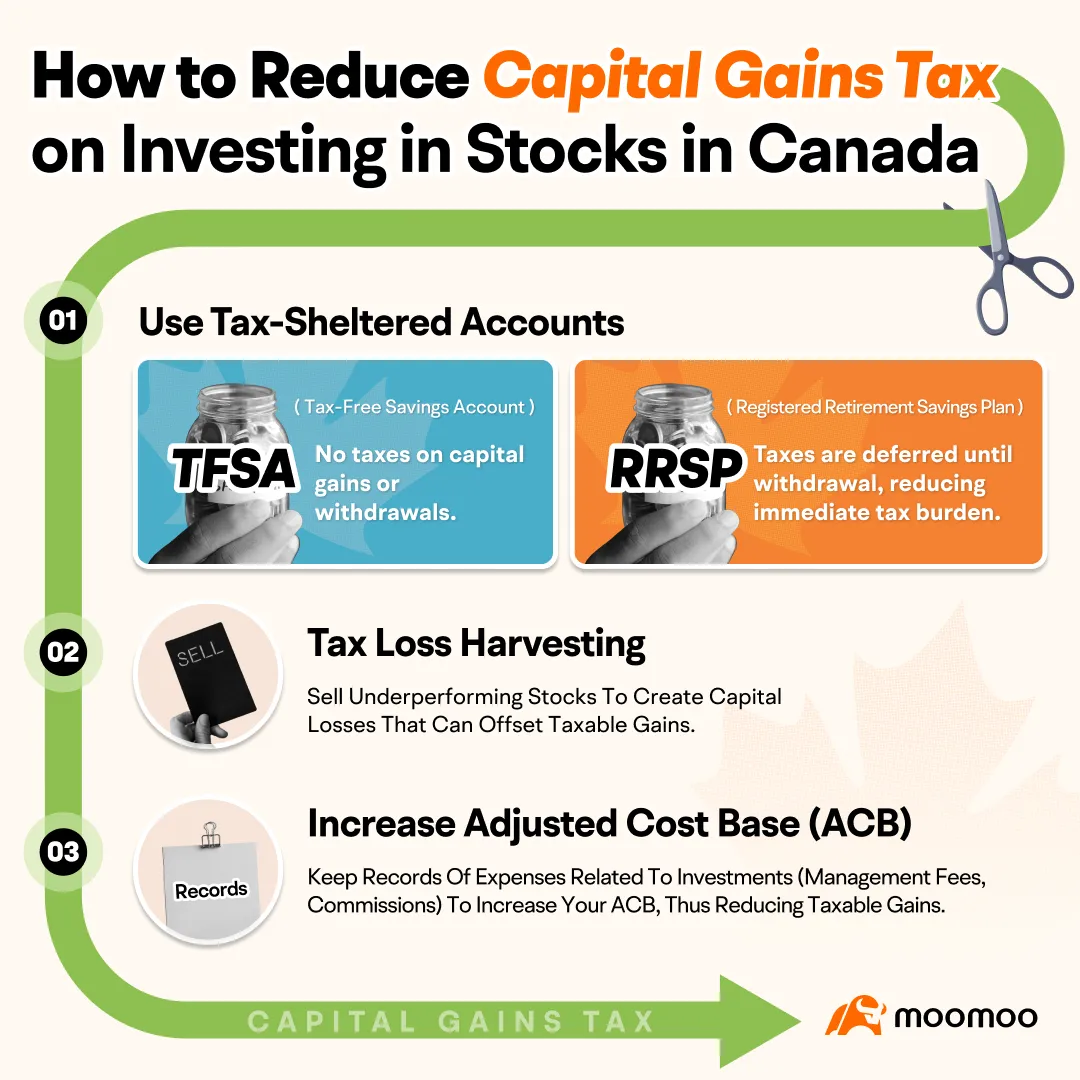
Use Tax-Sheltered Accounts
TFSA: Investing through a Tax-Free Savings Account (TFSA) is the best method because the returns realized from investments made within a TFSA are completely tax-free. Aside from issues related to the use of the TFSA, you don't need to consider anything else.
You can learn about the issues related to the use of the TFSA through TFSA rules and penalties, or a more specific guide about TFSA Over Contribution Penalty.
RRSP:Using a Registered Retirement Savings Plan (RRSP) can alleviate current tax pressure because taxes on the RRSP contributions are only paid upon withdrawal during retirement. Additionally, contributing to an RRSP account now can also reduce your taxable income.
Tax Loss Harvesting
If you have multiple investments, selling some poorly performing assets that have unrealized losses can create capital losses to reduce capital gains tax. This method is called tax loss harvesting.
Increase Adjusted Cost Base (ACB)
Keep a record of expenses associated with managing your investments, such as management fees, legal fees, and trading costs. These costs can raise the adjusted cost base (ACB) of your investments, ultimately lowering your capital gains tax when you sell the assets.
Final thoughts on how to avoid capital gains tax in Canada
Of course, in addition to the three methods mentioned above, there are other ways to reduce or avoid capital gains tax. But generally, these methods aim to decrease the taxable income. Therefore, understanding the entire process of capital gains tax payment and calculation is important.

This presentation is for informational and educational use only and is not a recommendation or endorsement of any particular investment or investment strategy. Investment information provided in this content is general in nature, strictly for illustrative purposes, and may not be appropriate for all investors. Read more