What is a stock split?

What is a stock split?
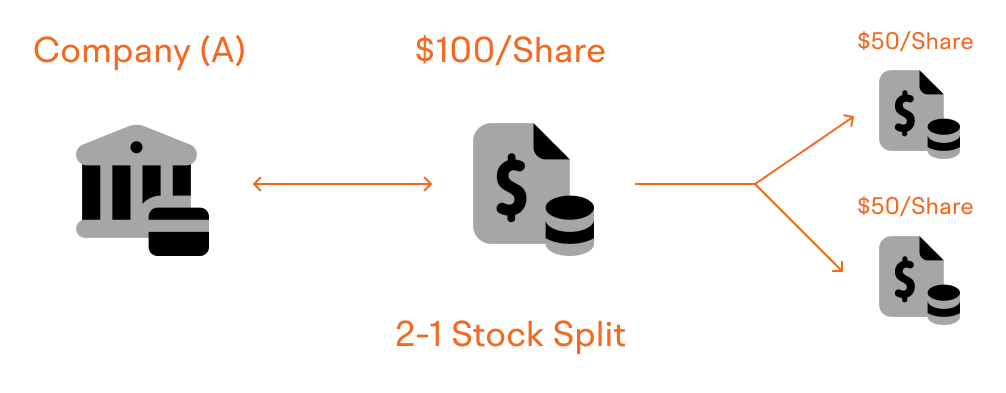
A stock split is an action taken by a company to divide its existing shares into multiple new shares. While this has no direct impact on a company's market cap, the increase of available shares tends to allow for a cheaper entry price for investors.
Example: If a company announces a 2-for-1 stock split, each share held by an investor will be split into two shares. If the stock was trading at $100 before the split, it will trade at $50 after the split, and the investor will now own two shares instead of one.
How does a stock split work?
When a company decides to split its stock, it multiplies the number of shares outstanding by a specific ratio (e.g., 2-for-1, 3-for-1). The price per share is then increased or decreased proportionally depending on the split. However, the company’s market capitalisation remains unchanged because the change of shares is offset by the change in price.
Example calculation:
Before split: 1,000 shares outstanding at $100 per share = $100,000 market capitalisation.
After a 2-for-1 split: 2,000 shares outstanding at $50 per share = $100,000 market capitalisation.
Types of Stock Splits
Forward Stock Split
A forward stock split, also known simply as a stock split or forward split, is a corporate action in which a company increases the number of its outstanding shares by issuing additional shares to existing shareholders. In a forward stock split, the total value of the company remains the same, but the number of shares outstanding increases and the price per share decreases proportionally.
For example, in a 2-for-1 forward stock split, if an investor already owns 100 shares, they would receive an additional 100 shares post split, resulting in a total of 200 shares. However, the price of each share would be halved to maintain the same overall market capitalisation.
It's important to note that while a forward stock split affects the number of shares outstanding and the price per share, it does not change the total market value of an investor's holdings or the company's market capitalization.
NVIDIA's forward stock splits
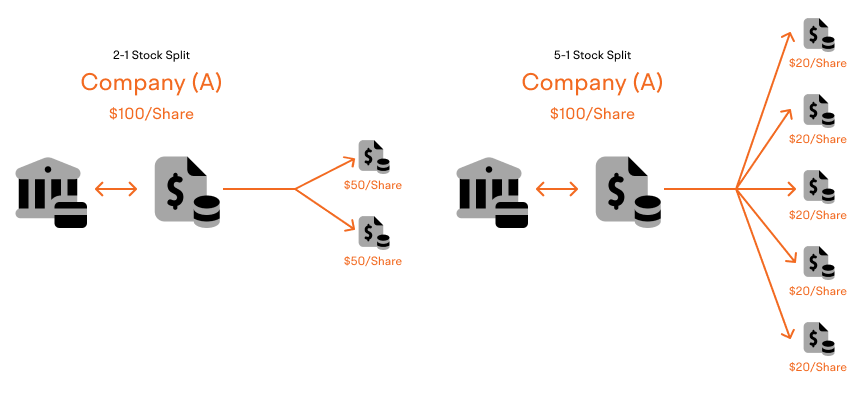
Historically, NVIDIA has issued four forward stock splits, with the fifth coming up early June 2024.
June 27, 2000: NVIDIA announced a 2-for-1 stock split. For every share owned before the split, investors received one additional share, effectively doubling the number of shares they held.
September 17, 2001: NVIDIA declared another 2-for-1 split. As with the previous split, shareholders received one additional share for each share they held.
April 6, 2006: NVIDIA executed a 2-for-1 stock split, continuing its trend of making shares more accessible to a broader range of investors.
July 20, 2021: NVIDIA announced a 4-for-1 stock split. This meant that each share an investor owned was split into four shares, and the share price was adjusted downward proportionally.
June 7, 2024: NVIDIA announced a 10-for-1 stock split. This will mean that each share will be split into ten shares, and the share price will be reduced proportionally.
Reverse stock split
A reverse stock split, also known as a stock consolidation or reverse split, is a corporate action in which a company reduces the number of its outstanding shares by merging multiple shares into a single share.
In a reverse stock split, the total value of the company remains the same, but the number of shares outstanding decreases and the price per share increases proportionally.
For example, in a 1-for-10 reverse stock split, if an investor owns 100 shares before the reverse split, they would end up with 10 shares after the split. However, the price per share would be ten times higher to maintain the same overall market capitalisation.
While a reverse stock split affects the number of shares outstanding and the price per share, it does not change the total market value of an investor's holdings or the company's market capitalization.
Common Ratios: 1-for-2, 1-for-3, 1-for-10
Example: In a 1-for-5 reverse split, every five shares are consolidated into one share. If you owned 5 shares priced at $20 each, you would own 1 shares priced at $100 after the split.

Reverse stock splits are typically implemented by companies whose share price has fallen to a very low level, often trading below certain thresholds, such as $1 per share. A reverse split can help a company meet minimum listing requirements for stock exchanges and regain compliance with regulatory standards. It can also be used as a strategic measure to enhance the perceived value of the company's stock and attract institutional investors without impacting their market cap.
Why do companies split their stock?
Improving liquidity
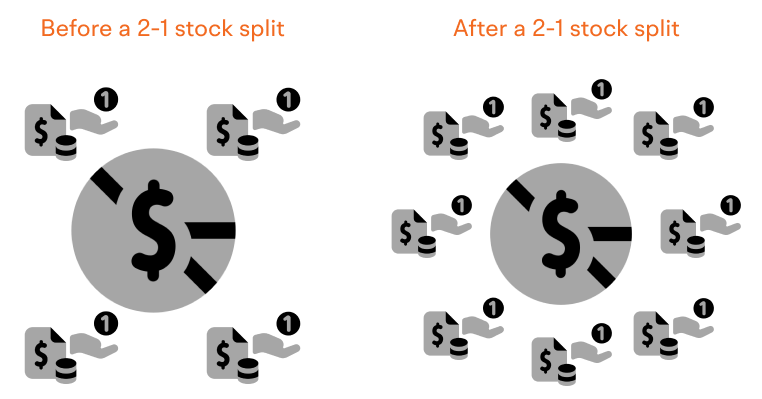
Lowering the price per share can make the stock more accessible to a broader range of investors, including retail investors, thereby increasing trading volume and liquidity. Higher liquidity can lead to tighter bid-ask spreads, making it easier and less costly to buy and sell shares.
Attract more investors
A lower share price can make the stock seem more affordable and attractive to small investors, potentially broadening the shareholder base. This can be particularly important for companies looking to increase their visibility and attract a more diverse group of investors.
Positive market perception
A stock split can be perceived as a positive signal, indicating that the company is confident in its future prospects. It often occurs when the stock has seen significant appreciation. Investors may interpret a stock split as a sign that the company expects continued growth and strong performance.
Index inclusion
Certain stock indexes have criteria for stock prices. Splitting the stock can help a company meet this criteria and gain a spot on an index, which can attract more institutional investors.
Maintain an optimal price range
Companies often aim to keep their stock prices within a certain range that is perceived as 'normal' or 'optimal' for attracting investors. A very high stock price might deter new investors, while a split can bring the price back to a more manageable level.
How does a stock split impact shareholders?
Impact on Shareholders
Change of shares, not value: Immediately after a stock split, the total value of an investor's holdings remains the same. Although the number of shares increases, the price per share decreases proportionally. For example, if an investor owned 100 shares valued at $50 each before a 2-for-1 split, they would own 200 shares valued at $25 each after the split.
Psychological effects: Investors may perceive a lower-priced stock as more accessible and potentially more attractive. This psychological impact can lead to increased demand for the stock, potentially driving up its price in the short term. However, it's essential to note that the fundamental value of the company does not change due to the split.
This presentation is for informational and educational use only and is not a recommendation or endorsement of any particular investment or investment strategy. Investment information provided in this content is general in nature, strictly for illustrative purposes, and may not be appropriate for all investors. Read more