More complicated, more divergent: it’s time to reassess AI investing
Artificial intelligence is a revolutionary force changing how consumers, business and government source information and carry out tasks. The power of that change also swept up investors, who have lifted the sharemarket to highs with their enthusiasm for all things AI.
No more. The way investors are trading AI is rapidly changing. And that initial phase of simply buying the biggest technology names is now over.
Investors may be just as excited about the potential gains of artificial intelligence, but they are now nuanced, judicious and exacting in their trading behaviour.
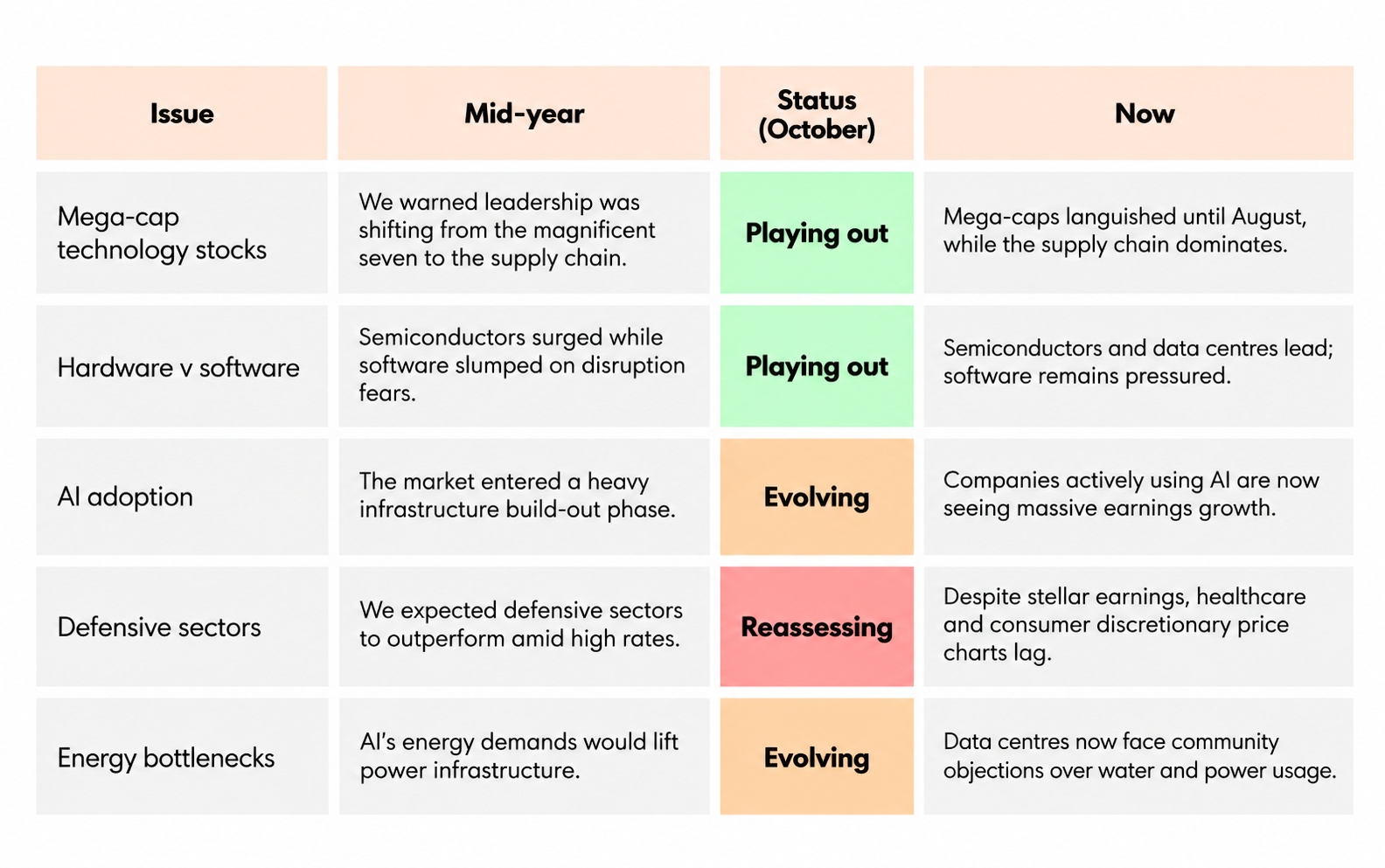
In our mid-year outlook we warned that market leadership was shifting away from the traditional mega-cap technology stocks – the so-called ‘magnificent seven’ – toward more specialised segments of the supply chain.
A major reason for this was investor wariness over lofty valuations and the massive capital required to build global infrastructure that left high-growth technology stocks vulnerable.
That caution proved timely. The ‘magnificent seven’ stocks, such as Meta and Microsoft, largely languished as we entered the third quarter, only regaining their footing when August earnings reports confirmed growth was accelerating rather than slowing. But that wasn’t the only surprise of the most recent US reporting season.
While technology earnings growth was impressive at 56%, sectors such as consumer discretionary, communications and healthcare completely outstripped those results. Amazon's spectacular earnings, for example, anchored the consumer-discretionary sector's massive 200% growth, beating analyst forecasts by more than 100%. These standout sectors were largely driven by companies enthusiastically using artificial intelligence to cut costs and drive margins. This represents an impressive expansion of the AI trade.
And it’s occuring as headwinds intensify against the global AI infrastructure build out: hardware manufacturers are hitting semiconductor bottlenecks, data centres are facing community backlash over power and water usage, and software companies are battling fears of obsolescence as cheaper models flood the market.
Cutting through the noise
Navigating these ever-accelerating swings in investor sentiment is challenging. One of the most effective ways to strip out the noise is to look at groups of stocks, rather than individual companies. This thematic approach helps investors and traders detect the underlying trends driving capital flows by reducing the impact of single-stock volatility.
On the moomoo platform, users can track these shifts using the investment themes feature. Looking at the artificial intelligence theme – a basket of 50 stocks directly exposed to commercial activity in the sector – we can see the group is up around 21% for the year to date.
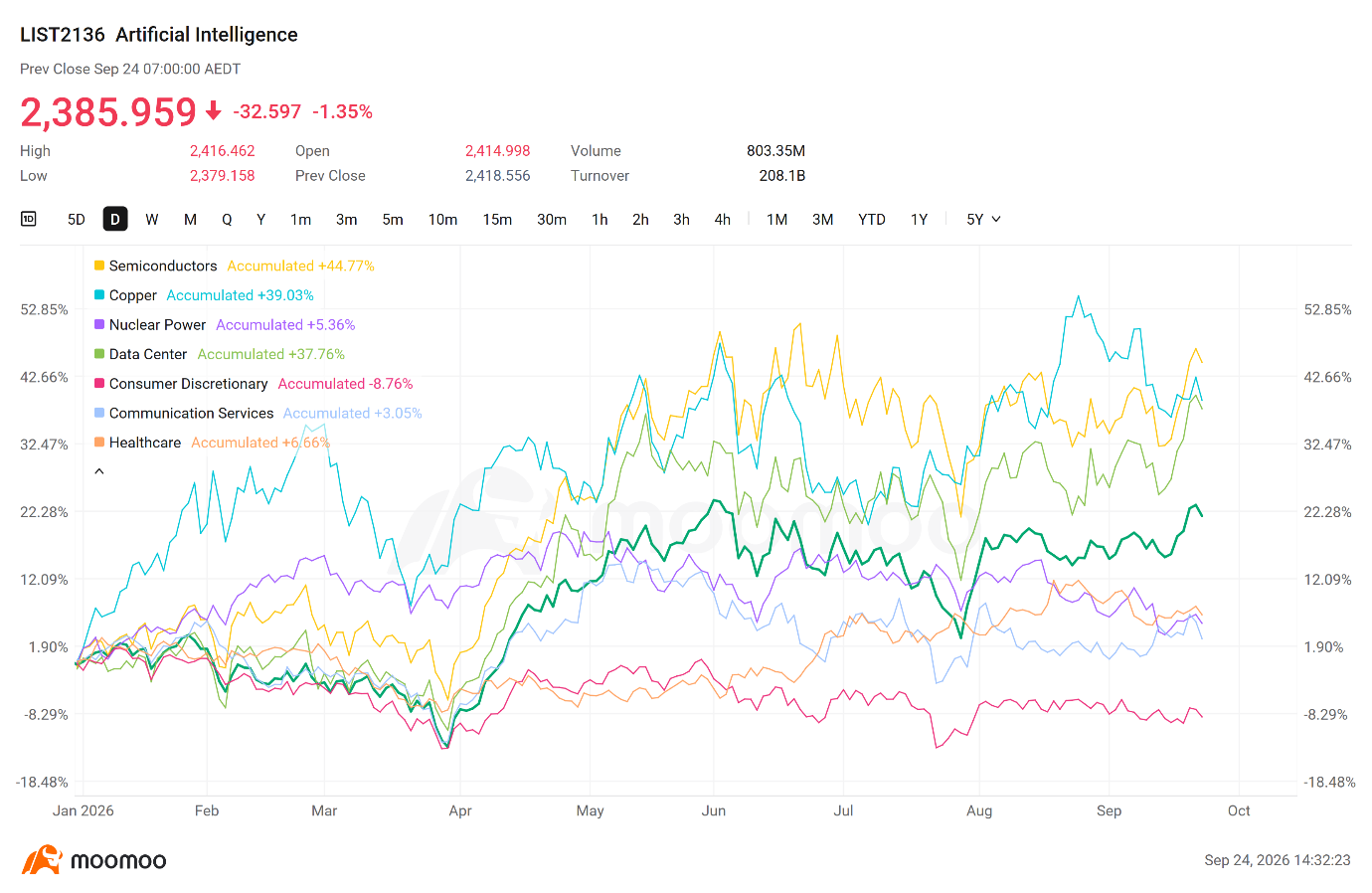
Breaking this down further reveals the clear winners and losers. Over 2026, the semiconductors, copper, and data centre themes have significantly outperformed the benchmark. Conversely, the healthcare, nuclear power, communications, and consumer discretionary themes have underperformed.
Finding your strategy
Understanding this divergence allows you to position your portfolio based on your individual strategy.
Value investors searching the market for bargains might examine the subsectors that have underperformed, looking for companies that will ultimately benefit from adopting the technology. These investors typically avoid the high-flying themes that are currently leading the market.
Momentum investors may take the opposite approach, identifying the top-performing physical infrastructure themes as the winners of the current race and buying the dips.
Active traders can use these changes in relative value to build strategies, buying the laggards and shorting the most popular sectors.
However you approach the market, stepping back to examine shifting investment trends provides a valuable shortcut in the search for your next trade. The focus on the potential of AI and sentiment around its possible impacts is likely to remain an important driver of market action for years to come, but it may get more selective.
Michael McCarthy is market strategist and chief executive officer at Moomoo Australia and New Zealand
This presentation is for informational and educational use only and is not a recommendation or endorsement of any particular investment or investment strategy. Investment information provided in this content is general in nature, strictly for illustrative purposes, and may not be appropriate for all investors. Read more