How to Buy Australian Stocks? The Ultimate Guide to Investing in the ASX
Enhanced international capital mobility has attracted growing investor interest in Australia, the most economically developed nation in the Southern Hemisphere. With its abundant natural resources and advanced service sector, Australian equities can constitute a significant component of asset allocation for both novice and experienced investors.
However, investing in Australian stocks may prove challenging for those unfamiliar with the local market. This guide introduces the fundamentals of investing on the Australian Securities Exchange (ASX) and highlights key considerations throughout the process.
This article provides a step-by-step introduction to investing on the ASX, along with essential foundational knowledge.

Analysis of ASX Indices
Familiarity with ASX indices is essential for investors in the Australian securities market. These indices not only reflect overall market conditions but also help investors evaluate portfolio performance, serving as indispensable tools for understanding the Australian stock market.
The ASX indices are a series compiled by S&P Dow Jones Indices to track share price movements of companies listed on the ASX. Among these, the S&P/ASX 200 Index is particularly significant, covering the 200 largest and most liquid companies in the Australian market. As a barometer of the Australian stock market, this index reflects market confidence and economic growth potential.
The S&P/ASX 200 Index (abbreviated as ASX 200), the primary equity index of the Australian Securities Exchange (ASX), comprises the 200 largest listed companies by market capitalization. Its constituents are reviewed and adjusted quarterly to ensure the index accurately reflects the latest market developments.S&P/ASX 200 IndexConstituents span multiple sectors, including financial services, materials (such as mining), energy, healthcare, and technology. Key components include the "Big Four" banks (Commonwealth Bank, Westpac, National Australia Bank, and ANZ Group), mining giants such as BHP and Rio Tinto, as well as other industry leaders.
Investors can use the ASX index to gauge overall market sentiment as a basis for investment decisions. A sustained rise in the ASX index serves as a buy signal, indicating bullish market conditions; a sustained decline acts as a sell signal, reflecting bearish sentiment; while volatile fluctuations suggest simultaneous buy and sell signals, indicating a state of market indecision.
In addition to the broader index, investors may also monitor sector-specific indices, such asthe S&P/ASX 200 Banking Index,、the S&P/ASX 200 Materials Index,and others. These sector-specific indices help investors analyze the performance of specific industries in greater detail, thereby enabling more targeted investment decisions.
Advantages of Investing in Australian Equities
1. Stable Financial System
Australia boasts a mature financial system and stringent regulatory oversight, allowing investors to operate within a secure investment environment. Furthermore, its robust legal framework provides strong protection for investor rights, offering greater peace of mind during periods of market volatility. Consequently, Australia is regarded as an attractive destination for investment.
2. Abundant Resources Sector
Australia is known as "the country riding on the sheep's back" (note: commonly referred to as "riding on the mine cart" in modern context regarding minerals), endowed with rich mineral resources such as iron ore and coal.Gold, as well as important agricultural resources such as wool and wheat, provide a solid foundation for the development of related industries. Therefore, companies investing in these sectors are expected to benefit from rising global commodity prices.
3. High Dividend Yield
Australian listed companies generally maintain high dividend payout ratios, making their dividend yields highly attractive to investors seeking stable income. Many companies distribute substantial cash dividends at the end of the fiscal year, which is one of the key reasons why investors focus on strategies for investing in Australian equities.
Which Australian stocks are available for trading?
Investors can access a diverse range of financial products and asset classes through the ASX (Australian Securities Exchange). The following are some of the major tradable instruments on the ASX market:
1. Equities
The Australian Securities Exchange (ASX) lists numerous companies across various industry sectors, including but not limited to banking, mining, telecommunications, and healthcare. Shares of these companies serve as fundamental investment tools that allow investors to participate in corporate growth and earnings, potentially generating returns through both capital appreciation and dividend distributions.
2. ETFs
ETFs are funds that track specific indices, industries, or asset classes, and they are listed and traded on the ASX similar to stocks. ETFs offer investors a simple and cost-effective way to diversify their portfolios and gain exposure to broader markets.

Review of Australian stock market trends
Year to date, despite global uncertainties including geopolitical tensions and a sluggish pace of global economic recovery, the Australian stock market has maintained relatively robust growth, demonstrating strong performance.
Sustained momentum in the resources sector: As a major resource-rich nation, Australia's resources industry continues to be a primary driver of the market in 2024. In particular, rising prices for commodities such as iron ore, coal, and liquefied natural gas (LNG), along with significant investment in the renewable energy sector, reflect growing global energy demand.
Resilience in financial services: Although changes in the interest rate environment have impacted the financial sector, Australia's financial services segment remains resilient, with stable profit growth reported by the four major banks (Commonwealth Bank, Westpac, ANZ, NAB) and other financial institutions.
Rise of the healthcare and technology sectors: With an accelerating aging population, demand in the healthcare industry continues to grow. Meanwhile, technological innovation and digital transformation have boosted the performance of technology stocks. Companies in fields such as biotechnology, internet technology, and wearable devices have performed particularly well, attracting substantial capital inflows.
Performance of stock market indicesAs a key benchmark for the Australian stock market, the ASX 200 Index reflected broader market trends in 2024, demonstrating overall resilience despite experiencing some volatility. The index has risen by 6.71% year-to-date.
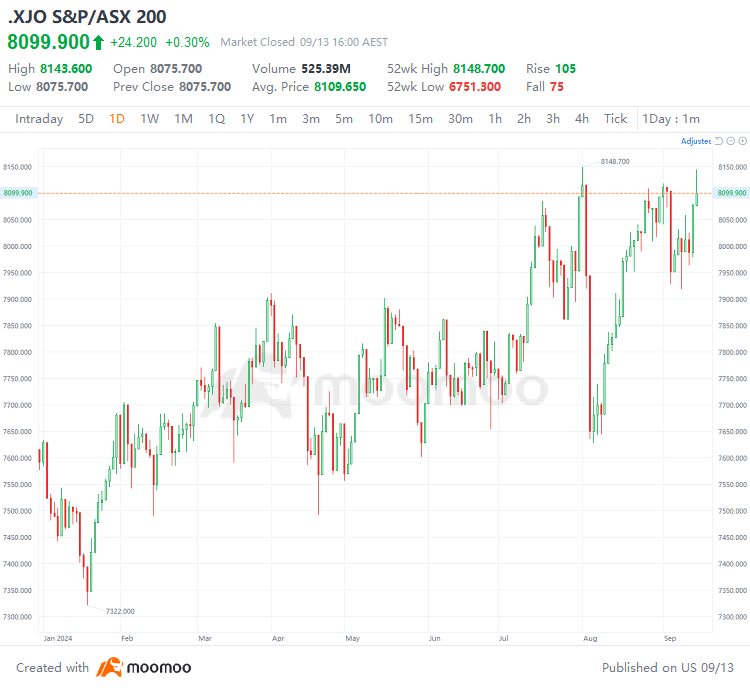
Currently, the Australian economy faces a series of challenges, accompanied by some positive signals. As a major resource exporter, Australia's economic performance is closely tied to global market demand, particularly in the energy and mining sectors. With economic growth slowing in several resource-importing countries, demand for raw materials has declined, leading to lower prices for commodities such as ore and energy. This has had some negative impacts on Australia's mining and energy industries. However, against the backdrop of global expectations for Federal Reserve rate cuts, positive anticipations of increased liquidity may inject new vitality into the economy. Furthermore, although the Reserve Bank of Australia remains cautious about cutting interest rates in order to curb inflation and stabilize wage levels, the economy is expected to gradually improve as stimulus measures are progressively implemented. The labor market remains a key determinant of economic prospects; while the unemployment rate has risen slightly, it remains at a relatively low level, providing support for economic stability. Overall, despite current challenges, the Australian economy demonstrates strong resilience and development potential.
Forecast for Australian Stock Market Trends
To formulate an effective investment strategy, it is crucial to understand the potential future direction of any market before investing. Below is a forecast for the Australian stock market. Please note that all market forecasts involve uncertainties; therefore, investors should make prudent decisions with a primary focus on risk management.
Short-Term Trends
In the short term, the global economic environment and domestic economic policies will continue to influence the trajectory of the Australian stock market. The uneven pace of global economic recovery, coupled with geopolitical factors and supply chain disruptions, may trigger market volatility. However, given the still-solid fundamentals of the Australian economy and supportive government and central bank policies, the market is expected to maintain a relatively stable stance in the near term.
Macroeconomic Indicators: Key indicators for short-term market trends include economic data such as the unemployment rate, GDP growth rate, and inflation rate. If these data indicate healthy economic growth, the stock market may receive a positive boost.
Corporate Performance: Financial results released by listed companies will directly affect market sentiment. Companies that exceed earnings expectations will be favored by investors, whereas those that miss expectations may face selling pressure.
Long-Term Trends
Over the long term, the Australian stock market retains significant growth potential. Although it faces numerous global uncertainties, the diversification and resilience of the Australian economy provide robust support.
Economic Growth Outlook: We maintain an optimistic view on the sustained growth prospects of the Australian economy. Within the resources sector, technology and healthcare are viewed most favorably for their growth potential. The development of these related industries is expected to drive long-term growth in the stock market, yielding positive effects.
Population Aging: As population aging intensifies in the future, market demand for healthcare and services will continue to grow steadily. This provides important support for the development of related industries.
Technological Innovation: Rapid technological advancements will continuously give rise to new business models and drivers of economic growth. Companies that proactively adapt to technological changes and pursue innovation are more likely to gain recognition and attract investment.
In summary, while the Australian economy currently faces challenges such as high interest rates and high inflation, it still holds substantial potential for recovery. Supported by strong growth forecasts and favorable market conditions, the ASX 200 Index is projected to rise next year. Additionally, anticipated tax cuts and improved consumer behavior are expected to further boost economic growth in 2025. Consequently, the overall economic outlook for 2025 appears increasingly positive.
How to Trade Australian Stocks: A Guide Using moomoo
To enter the Australian securities market and engage in investment activities, understanding how to trade Australian stocks is an essential first step. Below, usingmoomooas an example, we introduce how to begin your journey into investing in Australian stocks.
Step 1: Register and Open an Account
Choose a Suitable BrokerFirst, select an online trading platform or broker with a strong reputation and comprehensive services. Compare factors such as fee structures, trading tools, customer service, and security across different platforms. moomoo provides investors with full-service support and tools to facilitate easy access to the Australian stock market.
Register and Open an Account:Open a Trading Account with moomooThis process generally involves providing personal information, proof of identity, and tax documentation. The account opening process with moomoo is simple and fast; it can be completed via its official website or by downloading the moomoo app.

Step 2: Understand the Market
Market ResearchConducting in-depth research on the Australian stock market is essential before executing any trades. Gain a thorough understanding of major indices (such as the ASX 200) and their constituent stocks, as well as the fundamental conditions of various industries and companies.
Financial AnalysisMastering basic financial analysis skills, such as reading financial statements and calculating financial ratios, is crucial for assessing a company's true value.
Step 3: Capital Preparation
Fund Deposit: Once the account is opened and approved, funds can be transferred to the trading account. moomoo supports various transfer methods, including bank transfers and e-wallets.
Understand Fees: Before trading, clearly understand all platform fees, including transaction fees and custody fees, to avoid unnecessary expenses in the future. moomoo typically offers competitive fee structures, but specific costs may vary depending on the market and trading volume.
Step 4: Order Placement
Select Investment Targets: Select stocks that align with your investment strategy based on your research and analysis. Comprehensively consider the company's fundamentals, industry positioning, and growth prospects.
Place Orders: On the moomoo platform, you can easily place buy and sell orders via the website or mobile app. Select the specific stock you wish to trade. Choose the appropriate order type based on your trading strategy, such as market orders or limit orders. Carefully verify all details, including the security code, quantity, and price, before submitting the order.
Step 5: Portfolio Management
Market Monitoring: Regularly monitor the performance of your individual holdings and broader market trends to make timely adjustments to your investment strategy.
Risk Management: Set appropriate stop-loss and take-profit levels to avoid excessive losses due to market volatility.
Summary of Investing in Australia
In exploring how to invest in Australian shares, we have examined the characteristics of the Australian stock market, available trading instruments, the use of trading platforms, and market trend analysis. Through this article, we aim to equip investors with the necessary knowledge and tools to enter the Australian stock market with greater confidence and professionalism. Whether you are a long-term investor seeking steady growth or a short-term trader pursuing market dynamics, the Australian stock market offers abundant opportunities. The key lies in selecting an appropriate investment strategy, leveraging reliable trading platforms such as moomoo, implementing effective risk management, and continuously monitoring market developments. Remember, investing is a process of continuous learning and adaptation; by continually optimizing your portfolio, you can achieve your financial goals in the Australian stock market.
This presentation is for informational and educational use only and is not a recommendation or endorsement of any particular investment or investment strategy. Investment information provided in this content is general in nature, strictly for illustrative purposes, and may not be appropriate for all investors. Read more